

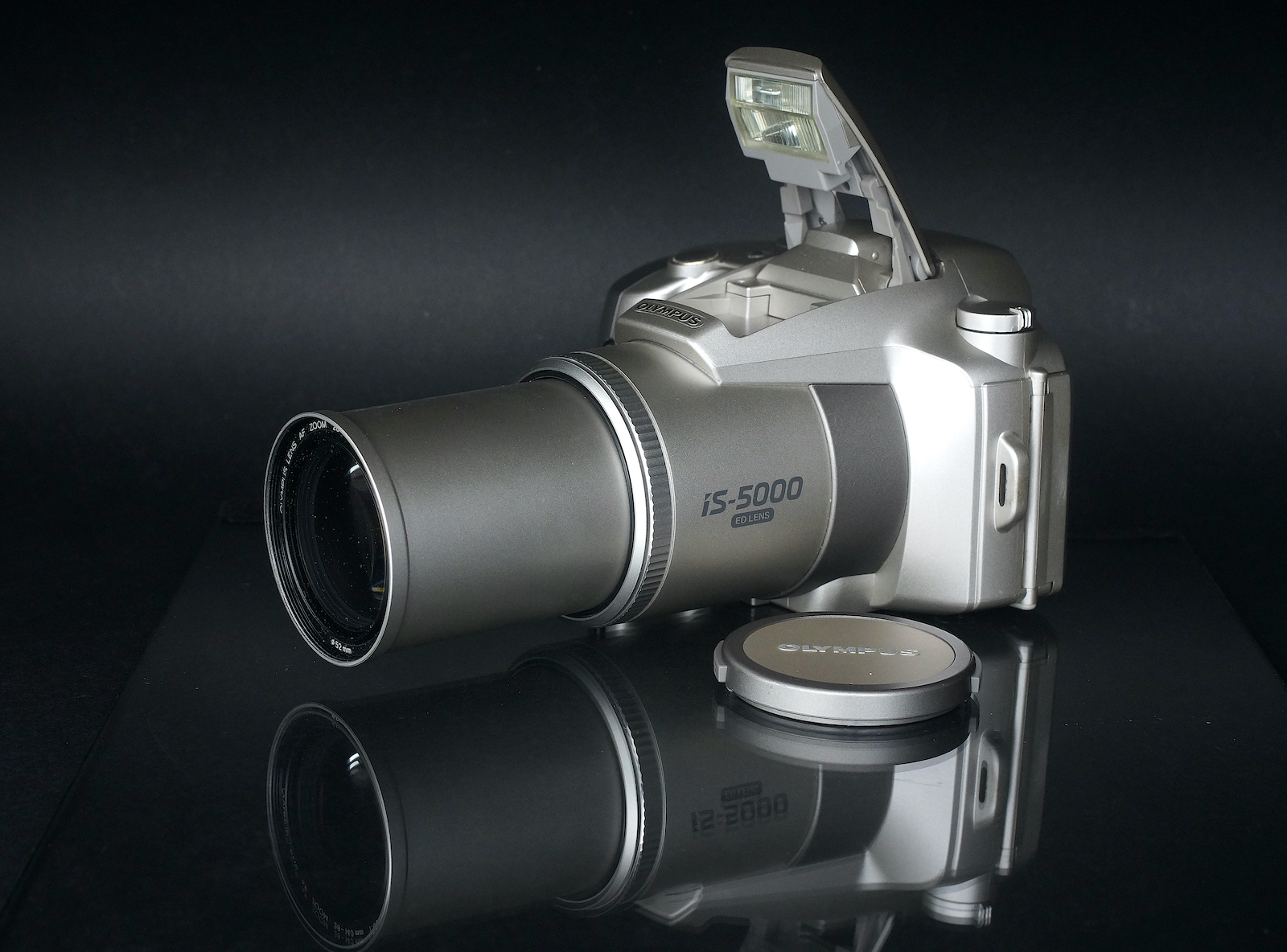
Camera development in second half of the 20th century has been occupying me for a while. In particular it saw camera manufacturers seeking to automate more and more of the technical aspects of making a photograph, fulfilling Kodak’s 1888 claim that “…we do the rest”, but mainly to encourage a wider user base for their products. Kodak’s original box camera had introduced the concept of a “consumer camera” to the world while the millennium saw its near ultimate refinement and digital’s coming of age. Today’s cameras and the mobile phone in particular have all but completed the process. I thought that I had sampled the main stages of these innovations until I came across the Olympus IS-5000.
By 2000 digital cameras were becoming more and more viable. I had already been using Olympus 1.3Mp compacts at work for recording on site and then the C2000Z as my own camera. I was therefore surprised to discover that the IS-5000 was introduced in 2002 when digital sensors were regularly reaching 5Mp and up and a year later I bought my first (and only) dSLR.
The Olympus IS-5000 possibly represents the high point of film camera development as a result of all those endeavours and leads on to the ubiquitous digital bridge cameras with their signature built-in very wide range zoom lenses.
The Camera
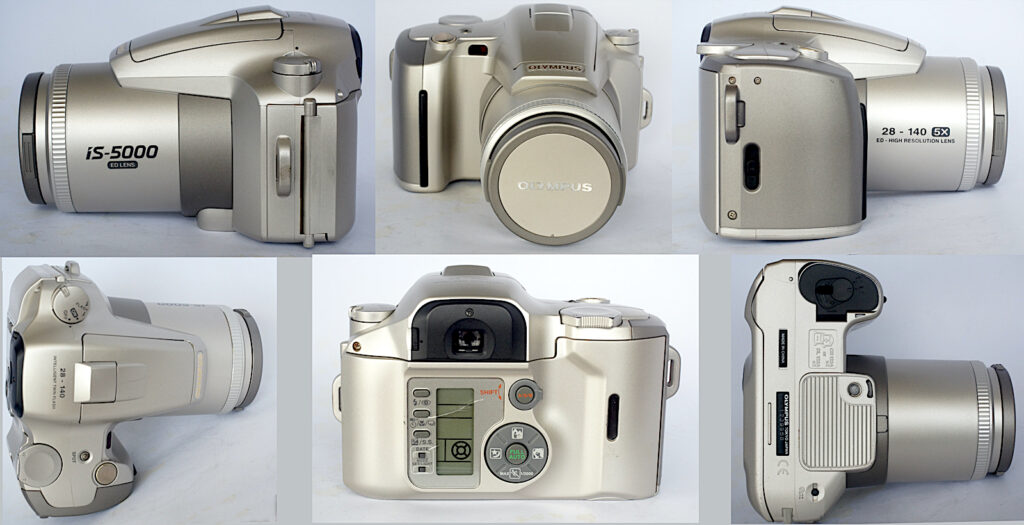
The IS-, or L- in Japan, series was introduced in 1990. The early models bore the legend “Made in Japan”, later becoming “Made in Japan” and “Assembled in China” and then this camera which simply states “Made in China”.
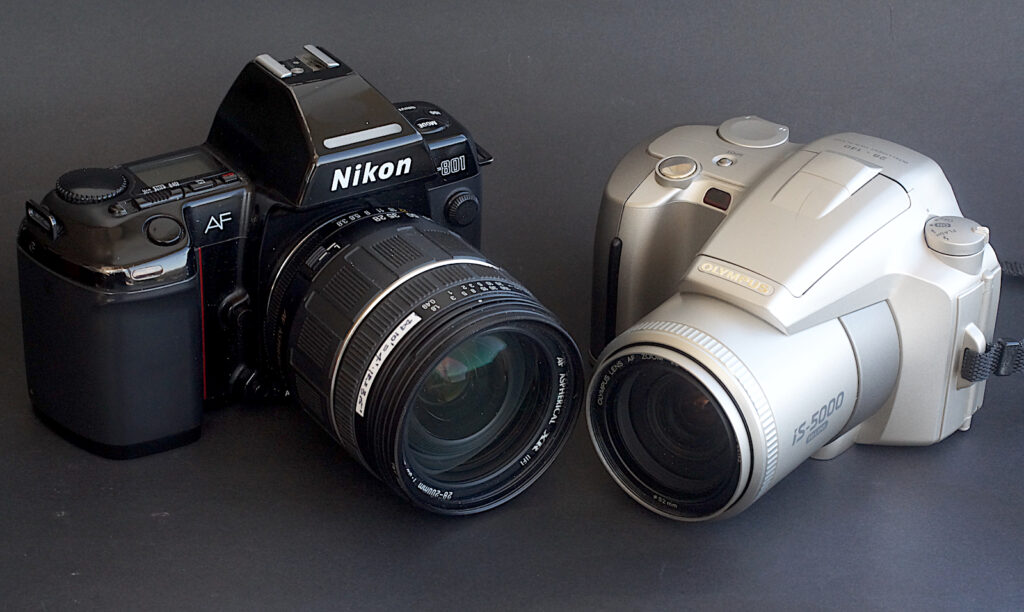
It is quite compact compared to my F801 and appreciably lighter. As mentioned, the design is very much in line with the digital bridge camera, though Olympus called it a zoom lens reflex (ZLR). The body is of mainly plastics construction, allowing a less angular design and computer electronics feature heavily, push buttons and nudge controls throughout. It does have an essentially SLR feel to it, however, so the shooting position is very familiar. Finish is an overall brushed aluminium with grey and black accents.
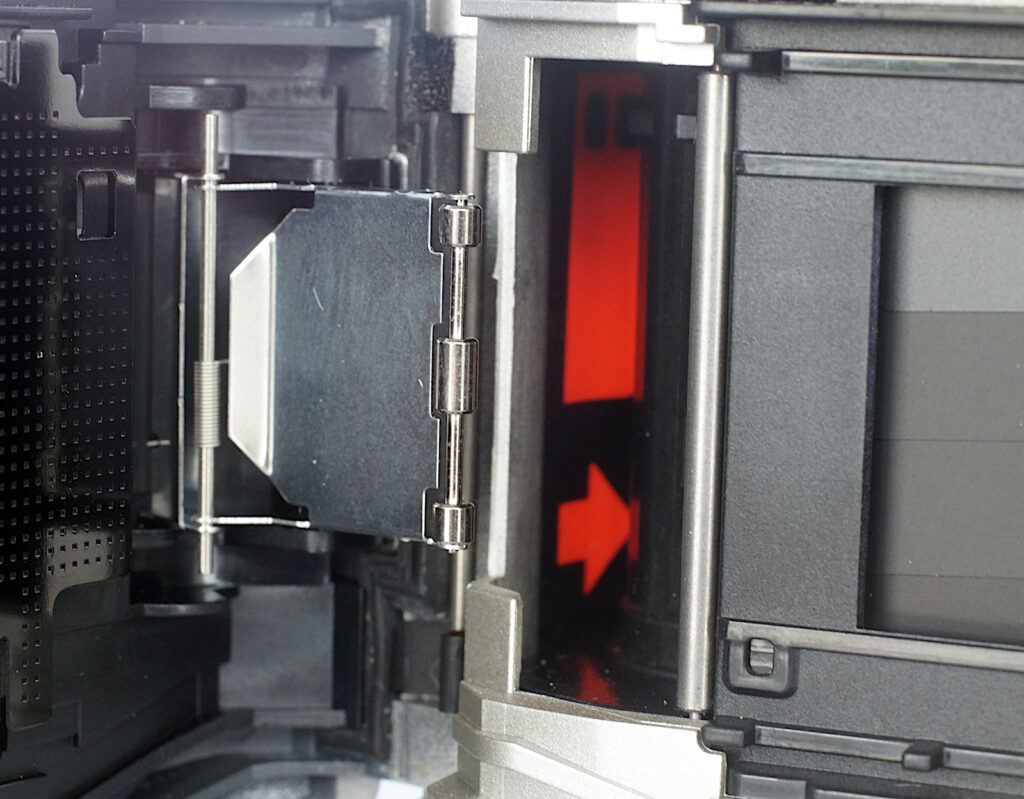
There is a retractible, twin tube flash atop the lens, very like many others, selected by the camera once deployed depending on distance and focal length set. Film is loaded quite conventionally and very simply with no need to engage the leader in a slot. It is captured by the take up spool which also transports the film as no cogs are visible where you would expect them. Closing the back brings up frame one without having to switch on. Rewind is automatic at the end of the film but there is a forced mid-roll rewind button tucked away on the base.
A tripod mount is provided and strap points at each end of the body.
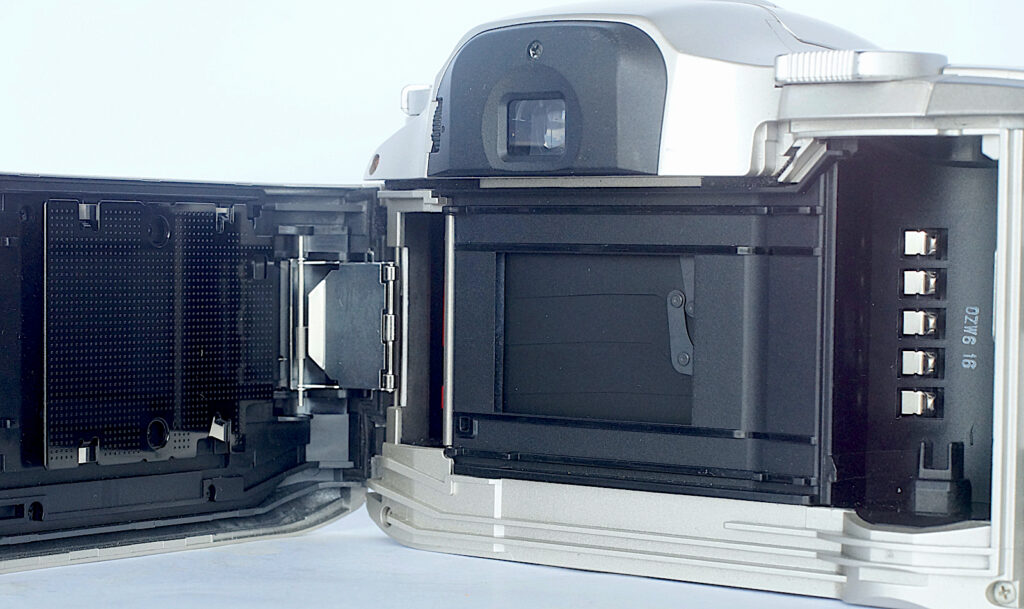
Ergonomically everything is well placed and grouped, and accessible if on the small side in some cases. Cosmetic condition is good apart from a crack in the glazed panel covering the LCD and another in the flash housing. No serious damage seems to have been caused apart from the occasional reluctance of the lens to dock itself fully on power off.
Everything is powered by a couple of 3v CR123A batteries housed in the base of the grip.
Lens and viewfinder
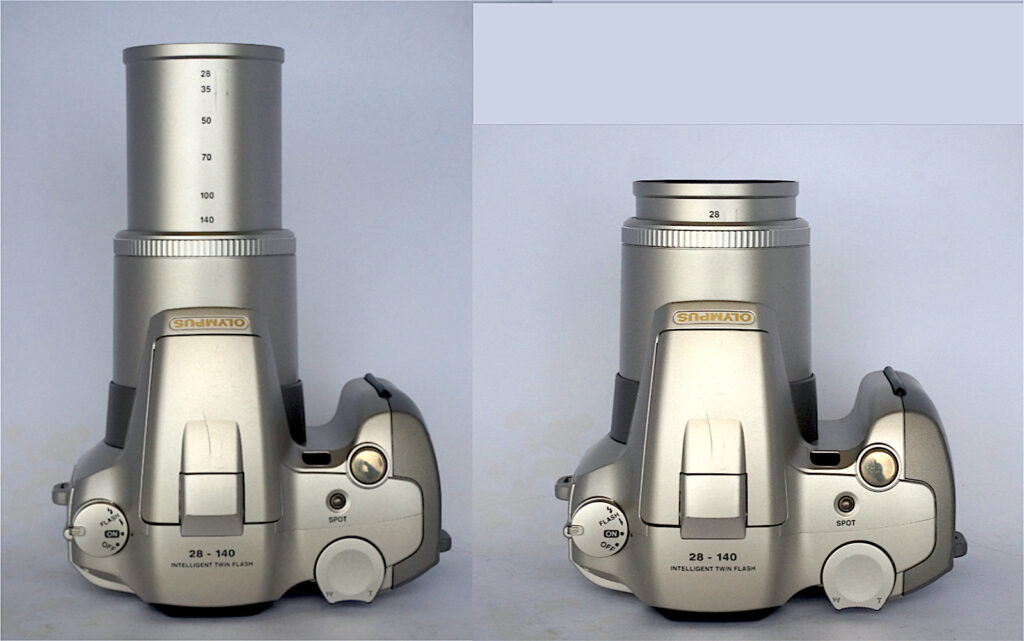
The Olympus IS-5000 lens is a built-in 28 to 140mm power zoom with a f4.9 to f6.9 maximum aperture. It has 15 elements in 10 groups with a single ED element. A 52mm filter thread is provided. Construction is the same as the 5/500’s 28-120 version so maybe this one has been “stretched” another 20mm. It isn’t as crisp at 140 as other focal lengths. Marketing?
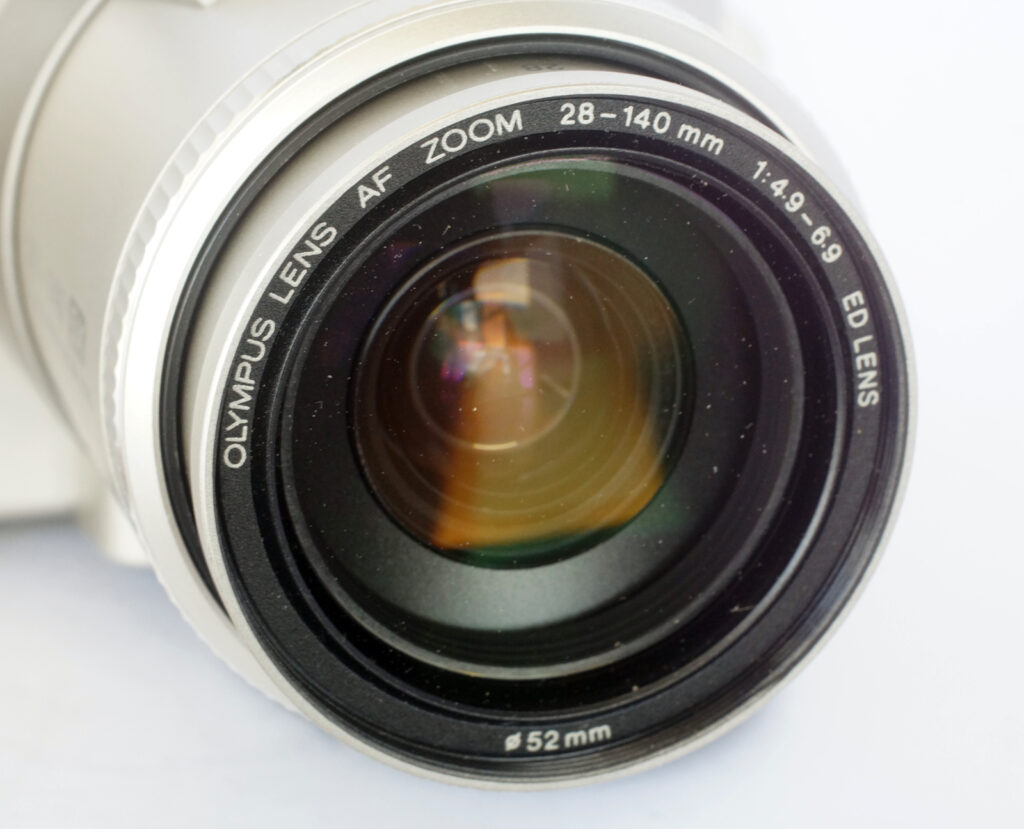
Focus is autofocus only but with focus lock on first pressure on the release. Predictive focus is provided in Stop Action mode. Focus range is from 0.6m to ∞ apart from standard telephoto when the range is from 0.9m to ∞.
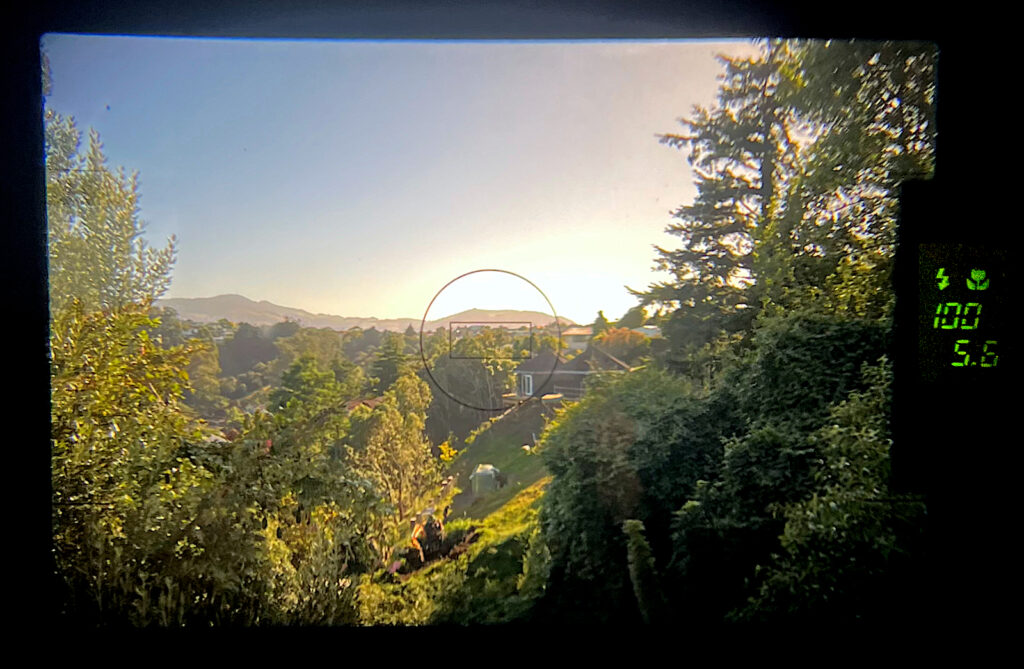
The viewfinder is TTL, 0.72x magnification at 50mm and showing 85% of the view-field. The limited maximum apertures make for a rather less bright screen, not noticeable in use. AF will no doubt be a little sluggish in lower light levels but with flash in use focus assist flashes are fired off.
A diopter adjustment is provided to the left of the eyepiece which is a great help to spectacle wearers. It is fiddly to use, like many of the controls, but is commendably positive and is not easily moved off its set point.
Hard to define, but the view seems much clearer than my F801, no doubt thanks to the more modern lens design and coatings despite the smaller apertures.
Controls
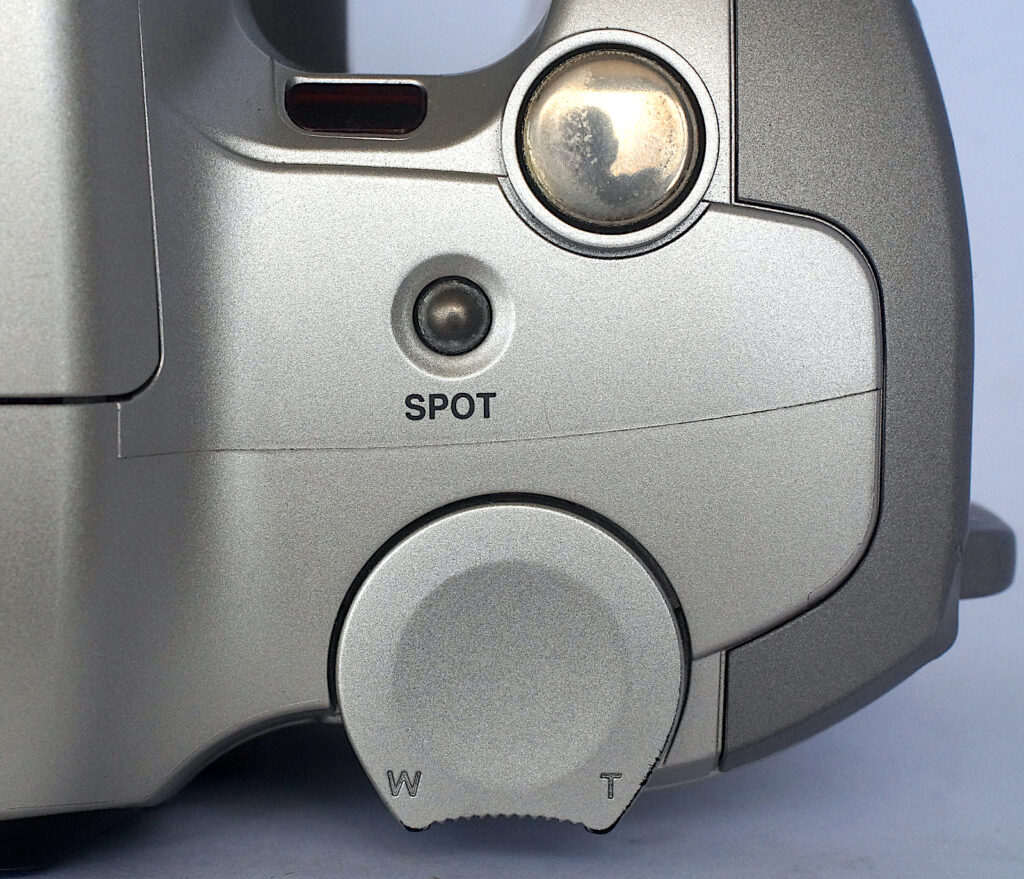
The controls for power on/off/flash, shutter release and zoom are fairly conventional and a reasonable size. There is a spot metering button on the top plate of the Olympus IS-5000 near the shutter release and everything else is handled by a panel centrally placed on the back.
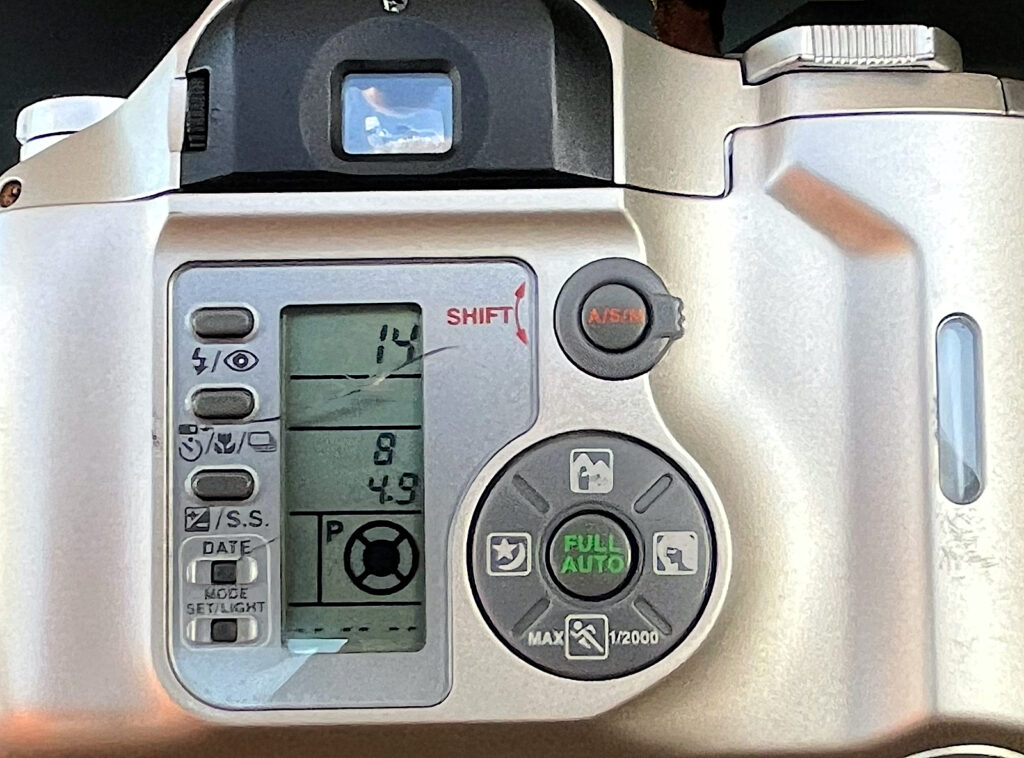
Just about every conceivable adjustment needed can be made on the panel using a push button and adjustment rocker arrangement. A large, central button takes you to fully programmed auto at any time, through selectable activity programmes to full manual control (PASM – which was definitely not a major design consideration). In fact, using the selection buttons in programme mode must have been the principal method of operation intended by the design and is the best approach for most subjects I found. Using it this way has everything under the right finger and thumb without needing to take the camera from the eye once familiar with the buttons. It covers the main aperture/shutter speed combinations neatly as well as spot metering in tricky conditions. The flash is raised with the on/off switch with the left thumb.
Finally, the back has a date imprinting capability with various date format options plus none. It goes up to 2032, still useful today if you want it.
Handling and use
I am fairly average size wise but the overall impression is that the designer had smaller hands and keener eyesight than me. This one challenged me more than most but fortunately it can be used mostly intuitively as mentioned.
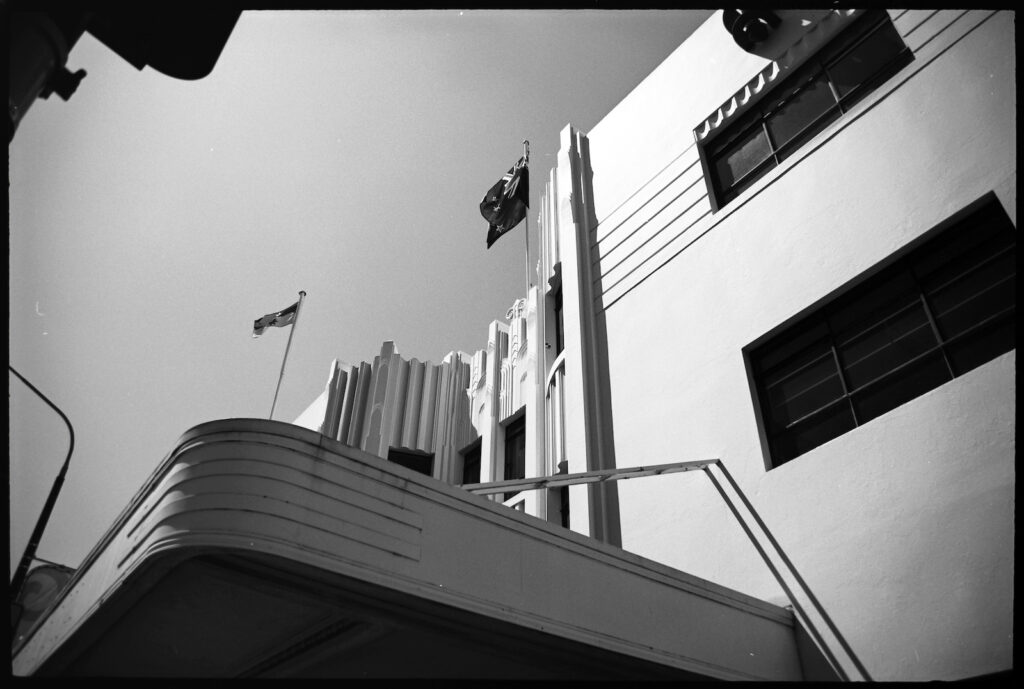
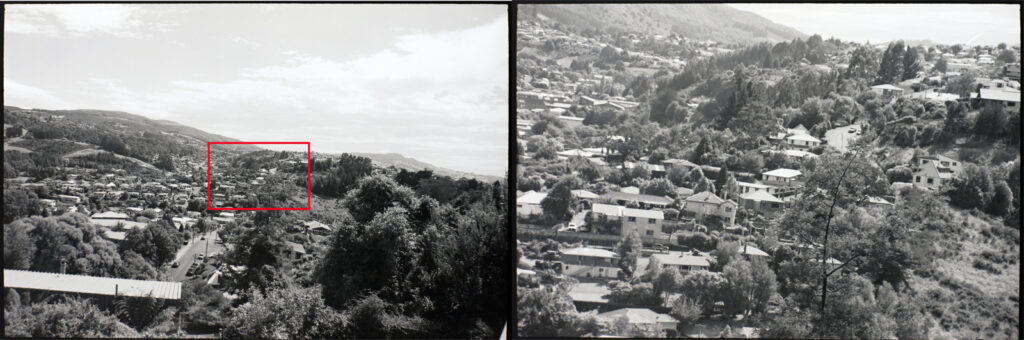
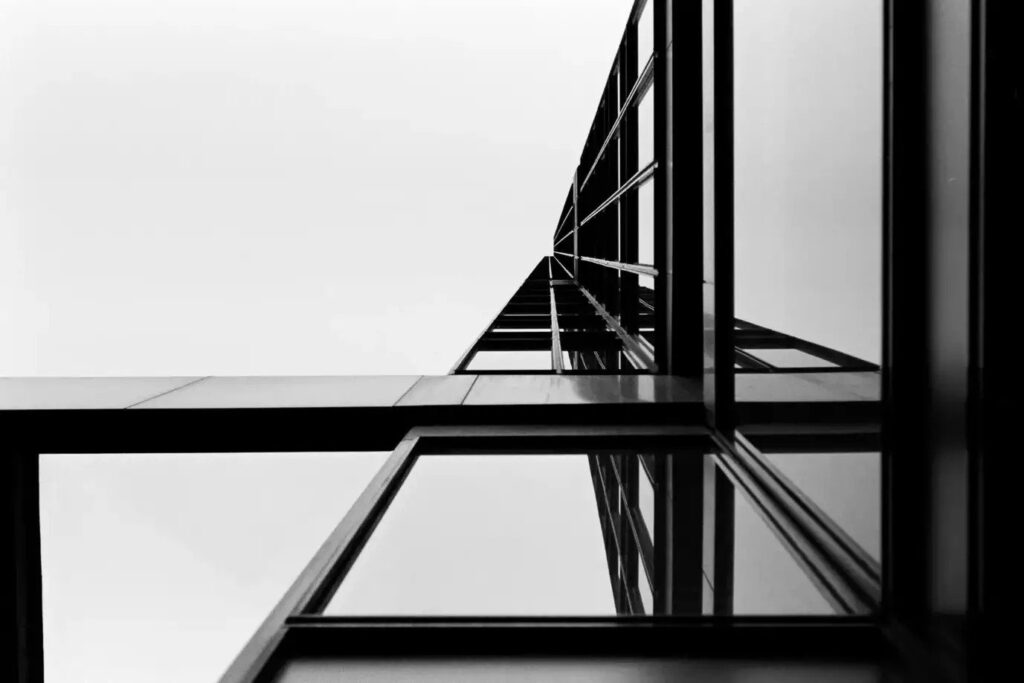
What had most impact on results was the 85% finder, loosing 5.4mm horizontally and 3.2mm vertically. I would ideally have cropped many of these examples shown to restore the composition I remembered but left them un-cropped for information. I think C41 trade printing tends to crop in slightly as a matter of course so this was probably trying to take it into account. Getting into the habit of locking focus before composing is also essential. Too many of my shots have the subject in the centre.
The Olympus IS-5000 handles and sounds like an SLR and all the controls are well placed for programmed use. More information in the finder with thumbwheel shift capability could be a bonus but that isn’t what it is designed for. Manual control is not a priority in the market this is aimed at. An interchangeable lens SLR would have more appeal to a “serious” photographer who sought that degree of control.
The important aspects are well designed, the shutter release in particular is as good as any I have used. The first pressure point is reached by simply resting a finger on the button, final release then requires a well differentiated, more positive press. The zoom also is well placed for the thumb and is quite controllable and spot metering is well placed when needed.
As mentioned, the eyepiece diopter adjustment allows me to see all the screen information with my glasses pushed up so generally a good experience apart from the small size of things.
I think the important thing to remember is that this camera is designed for the then modern consumer who ideally only wants to have to compose their images and not worry about f-stops or shutter speeds, needing only to select the programme option to suit the subject. Just a little more than simply “pushing the button” of a point and shoot but allowing for more control over composition.
Results
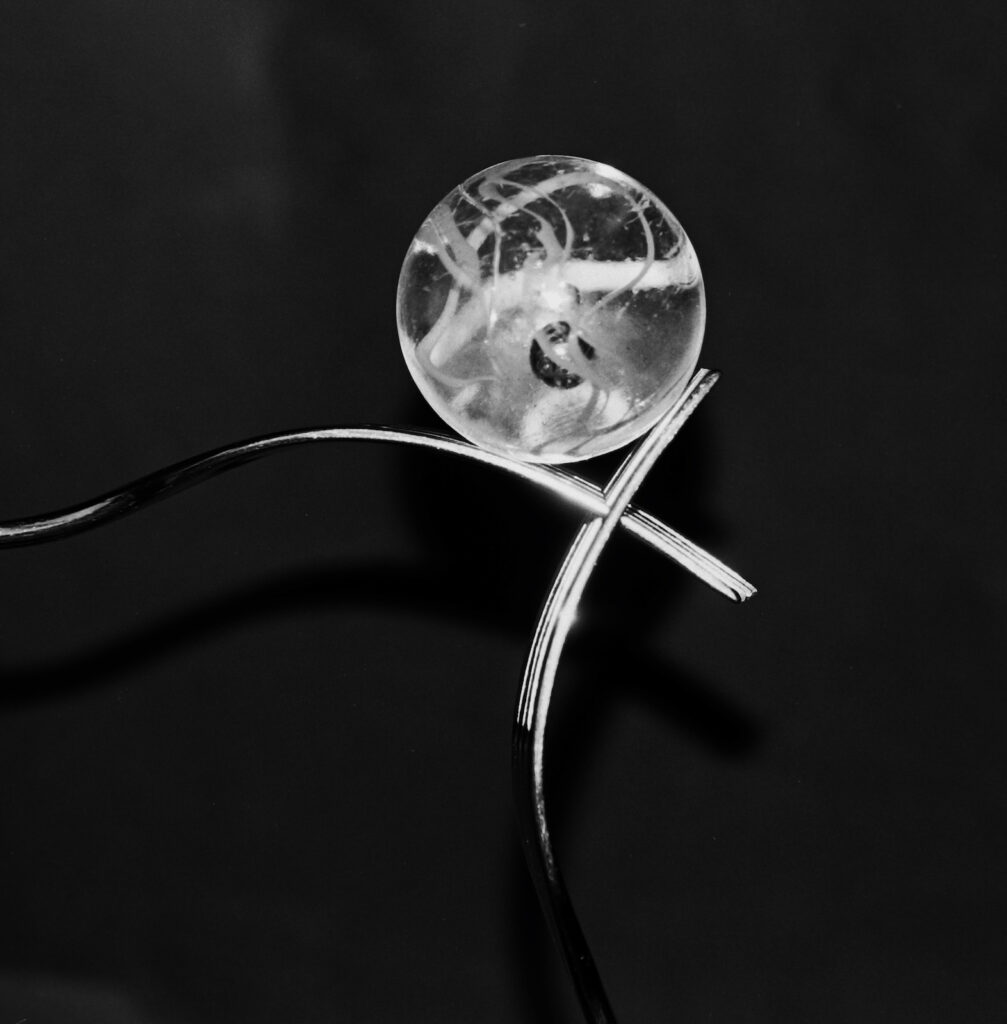
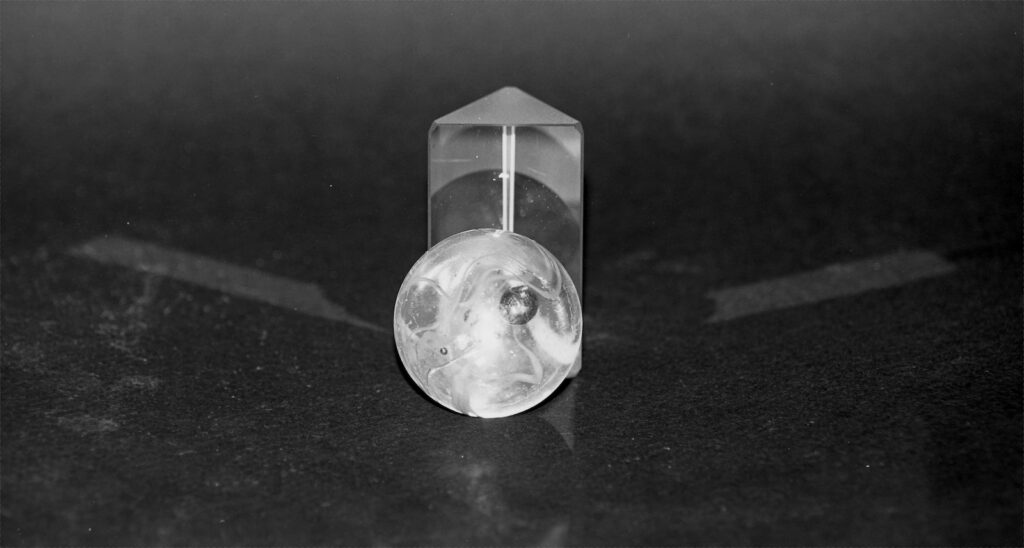
For my test film I loaded a Rollei Retro 80S processed in Neofin Blue which has very short development times, just 2 minutes with this film. I had uneven development my first time using this developer but I was more careful here to agitate thoroughly as recommended with better results.
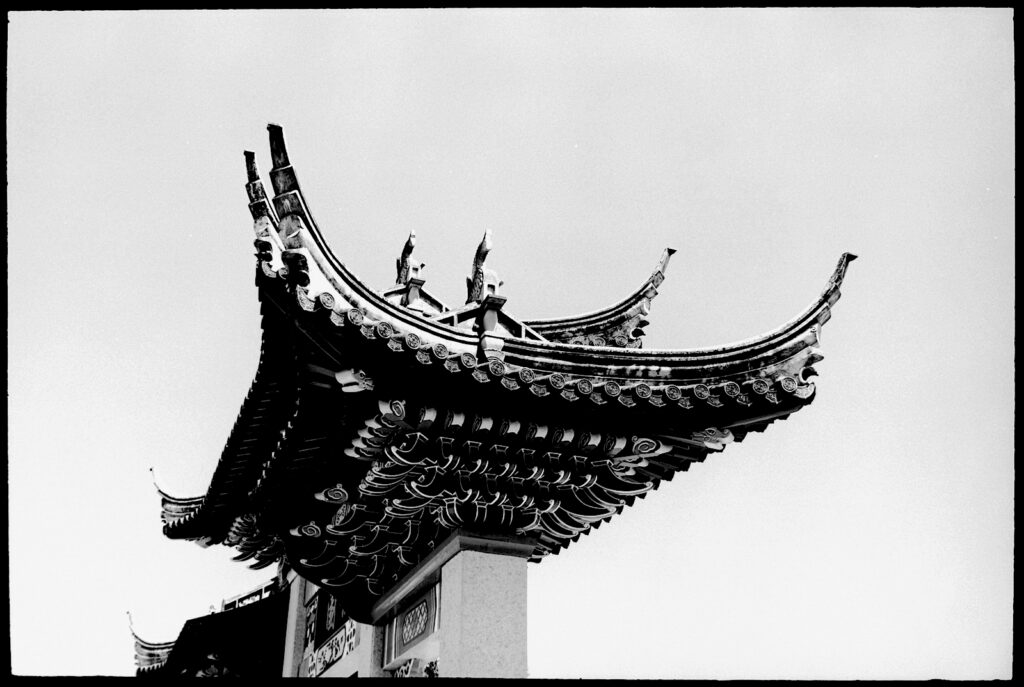
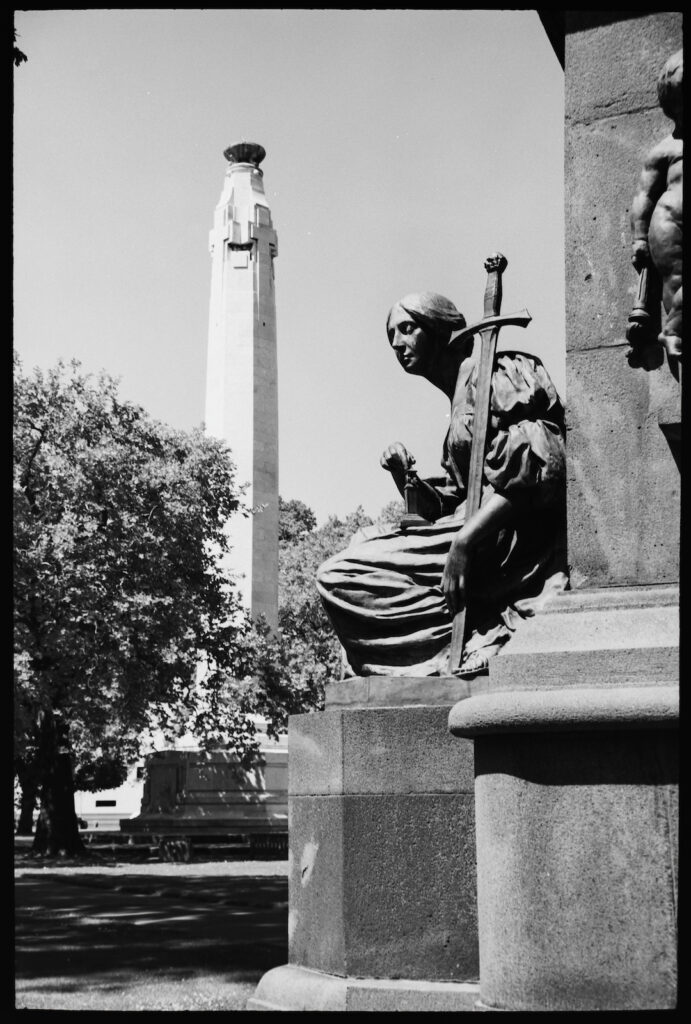
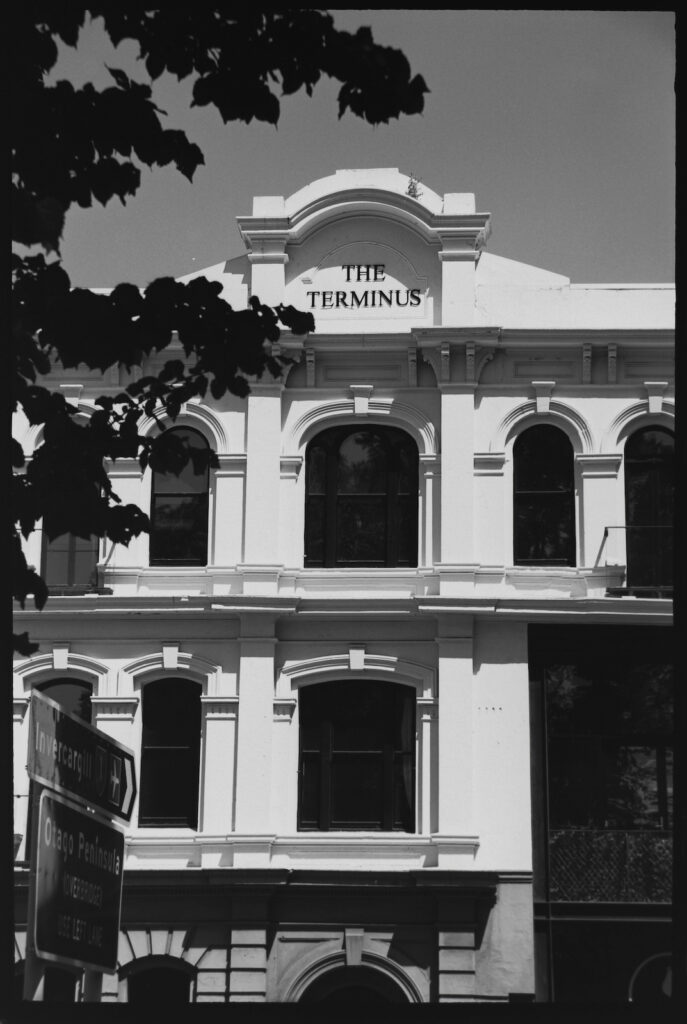
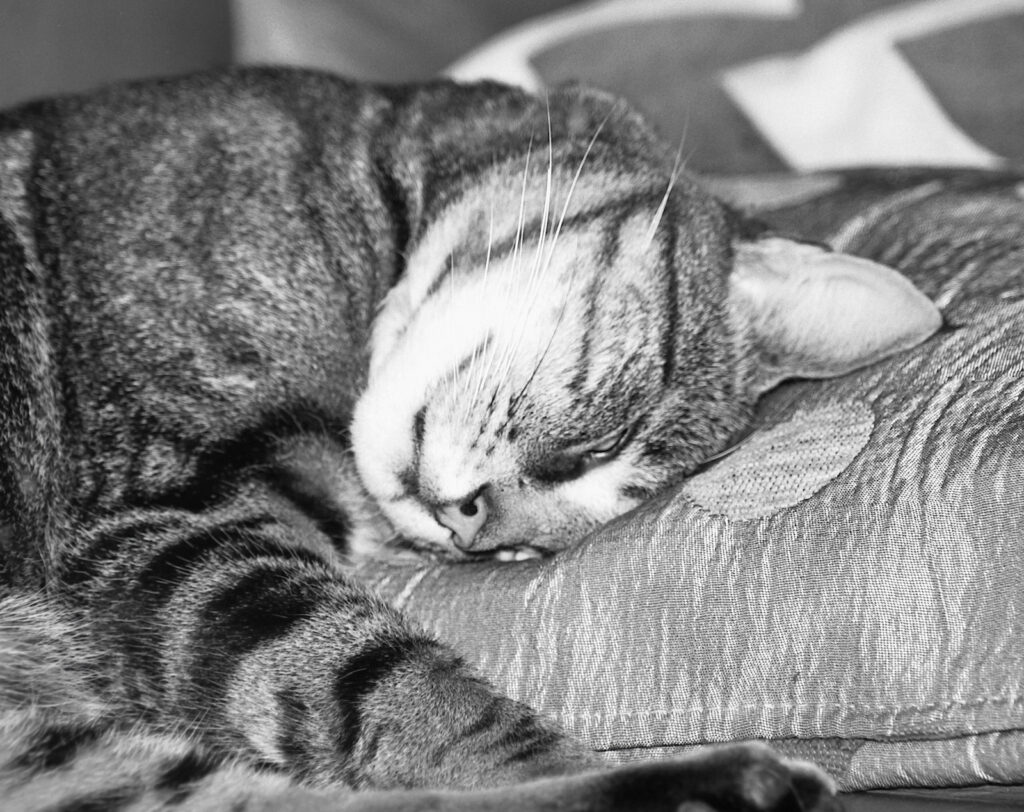

Conclusion
For what it represents, this is a very comprehensive design solution. I believe Olympus made a film compact with image stabilisation and if added here would definitely round out this one’s capabilities within its design objectives.
So is the Olympus IS-5000 the swan song of the film camera, or just using up the parts bin? All three “IS-5x” models, the 5/500/5000 are very similar and mainly vary in the complexity of the electronics fitted and related control panel. Film sales were already falling at this time but fortunately retained its appeal sufficiently for us to be able to continue enjoying using it today.
As it is, the IS-5000 really does achieve the “…we do the rest” claim of Kodak back jn 1888. Loading a film must have been the most challenging aspect of using the original box camera but even that is now reduced to just dropping in the cassette and lining things up.
Despite the hammering this example seems to have received, it still performs well, only the lens’ zoom mechanism showing a very minor problem, the main mechanical parts along with the film transport are fine.
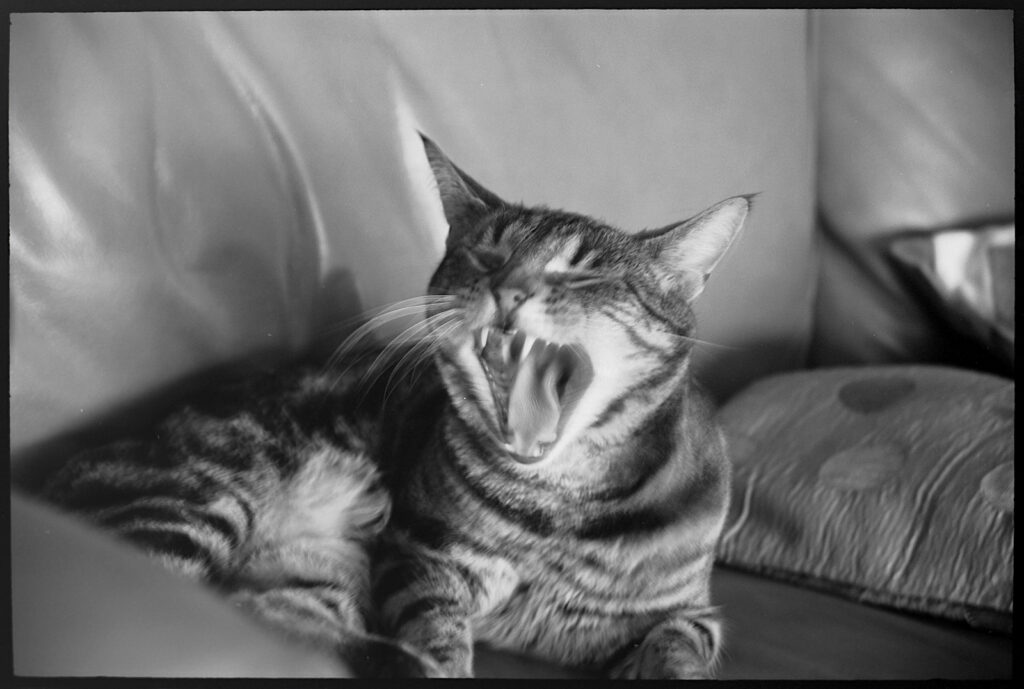
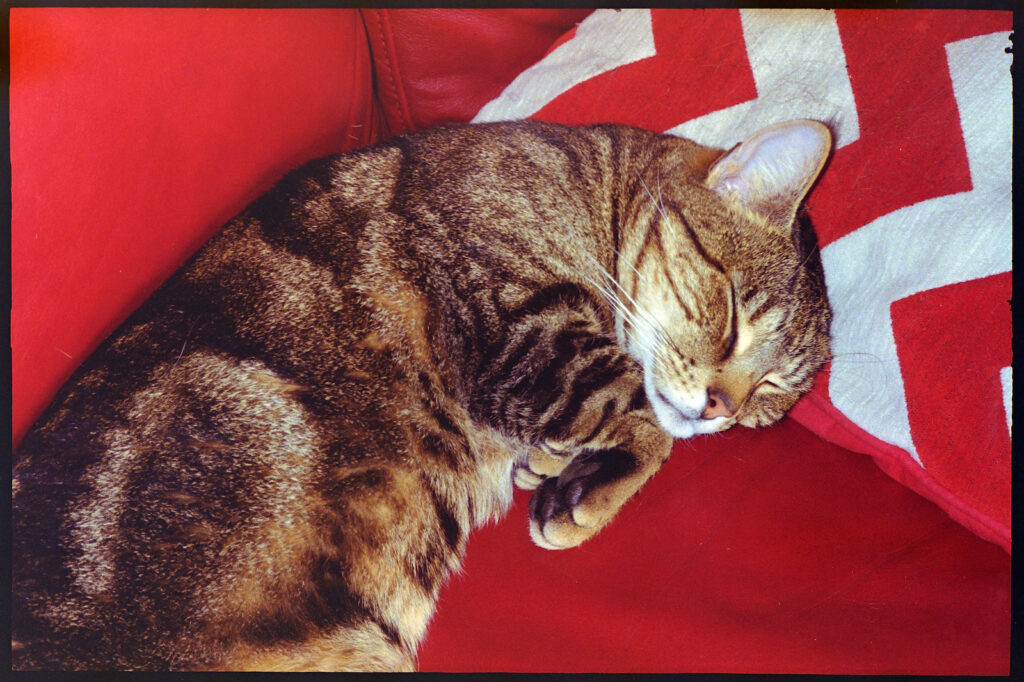
This really is the last chapter in these articles sampling consumer models stretching from Kodak’s second version of their box camera introduced in 1902 to this camera from 2002. A century of progress. I hope they haven’t been just one big yawn like the cat seems to think. I have learned a great deal from the research and the comments I have received along the way.
Share this post:

Comments
Bob Janes on Olympus IS-5000 – the Bridge to Digital
Comment posted: 20/03/2026
Walter Reumkens on Olympus IS-5000 – the Bridge to Digital
Comment posted: 20/03/2026
What I did notice back then, however, was that a great many people had multi-function cameras like the Canon A1, for example; they’d be standing in the camera shop wishing for a small, compact camera for their upcoming holiday, one that didn’t require so many adjustments. That was back in the 1980s. It hasn’t changed to this day, which is why the iPhone is ideal for the masses of casual snappers. Even the many bird photographers I come across almost every day in my area have the most expensive and state-of-the-art cameras, yet they mostly use fully automatic settings because they don’t know what they’re doing. They take hundreds of photos on the off-chance that one of them will turn out well. Only very few still know the ins and outs, and many of them can be found here on 35mmc.com. Thanks for the interesting article and your efforts, Tony.
Ibraar Hussain on Olympus IS-5000 – the Bridge to Digital
Comment posted: 20/03/2026
I wrote one of the is-3000 model which I don’t think you read https://www.35mmc.com/14/05/2025/olympus-is-3000-zlr-zoom-lens-reflex-with-expired-fuji-reala-100/#comment-feed
Similar. But your review blows mine out the water - as it’s coupled with your distinctive signature beautiful black and white work where you make even simple things look like art
These cameras are unfortunately unappreciated as because of the nature of when they were released and their automatic nature