

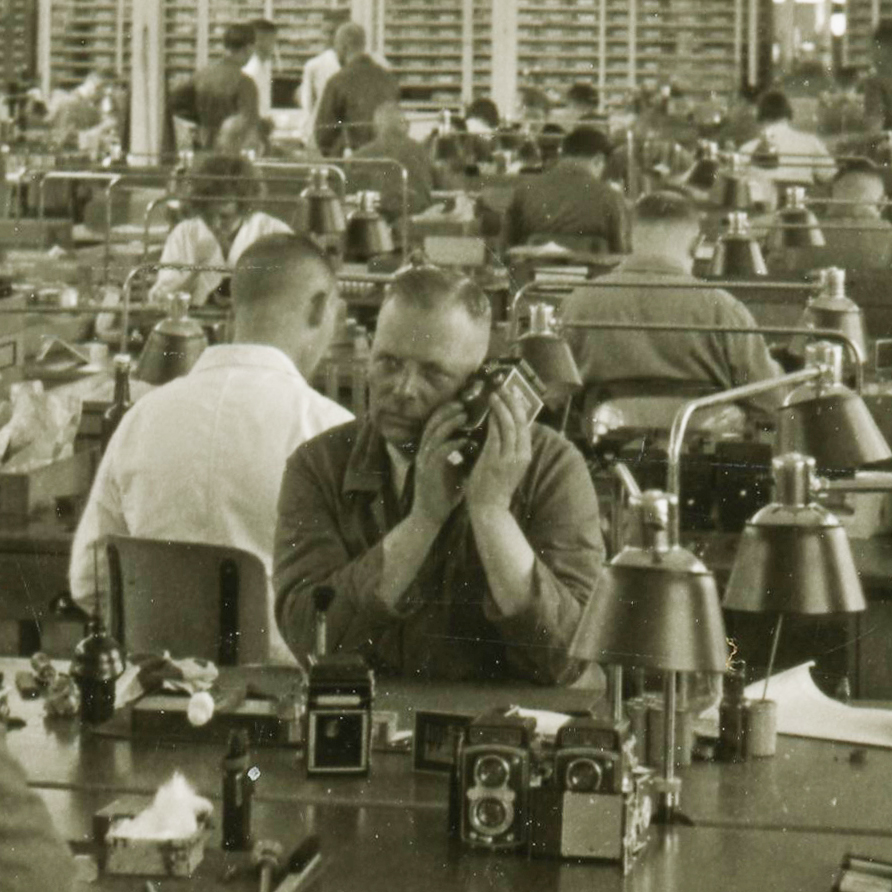
Today, 21st June 2026, is the 5th International Stereoscopy Day and this year also marks the 100th anniversary of Franke & Heidecke’s stereoscopic film camera, the Rolleidoscope. Therefore, I’d like to share a unique 3-D tour of the Franke & Heidecke Factory, Brunswick (Braunschweig), Germany, in 1938.
The 1930s stereoscopic photographs you will see in this post were taken with F&H’s stereoscopic cameras, the Heidoscope and the Rolleidoscope, are labelled as being photographed by Otto Schönstein, and were included in a special presentation set, which gave a virtual tour of the factory. If you need any help with viewing the images in 3-D, please see this post; I’ve aligned and reformatted them to make them easier to view, which also means they can work in a VR headset. If you can’t see stereoscopic images in 3-D, I’ve made a ‘wiggle’ video at the end.
This virtual 1930s factory tour is quite unique as I’ve only seen a mention of another example of this set in the German Historical Museum, who hold the remaining archives of the Raumbild-Verlag, the company who produced them, and does not appear to have been sold commercially. To understand the context and history of the Raumbild company, particularly their affiliation with the Nazi party, please see information from the German Historical Museum. Please consider the images in context of their era and circumstances of production, and view them and their accompanying text at your discretion. The museum dates this set to around 1937, but I’ve spotted a Rolleiflex Automat Model 2 in one of the images, which are said to have been produced from 1938.
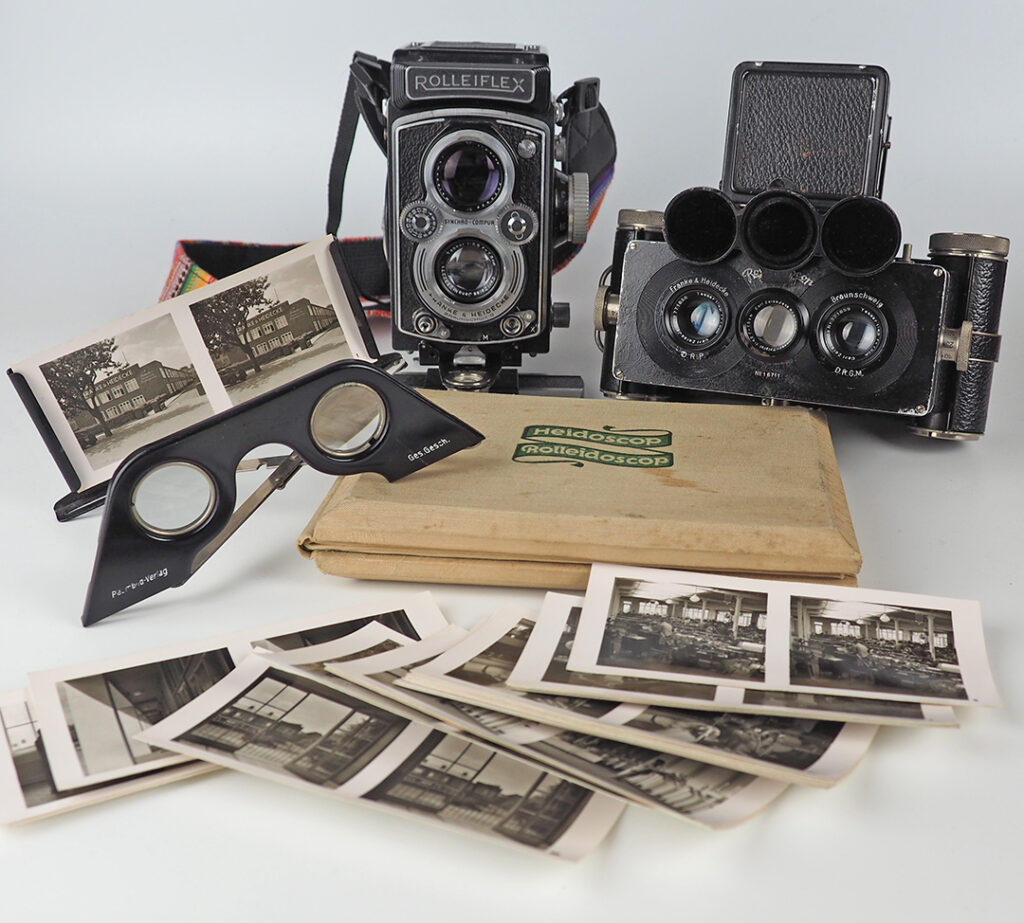
The Franke & Heidecke presentation set originally consisted of a wooden box covered in cloth to open like a book (mine is a bit grubby, sorry), with ‘Heidoscop Rolleidoscop’ on the cover. Inside the front cover is a metal Raumbild-Verlag folding stereoscope, in the middle is a book describing a tour of the factory in German, English, French and Italian, and inside the back cover are thirty 6x13cm stereocards (unfortunately I have two missing), taking you through the factory in 3-D along with the text. A virtual tour using the Victorian invention of stereoscopy and 20th century German precision and quality, was way ahead of its time.
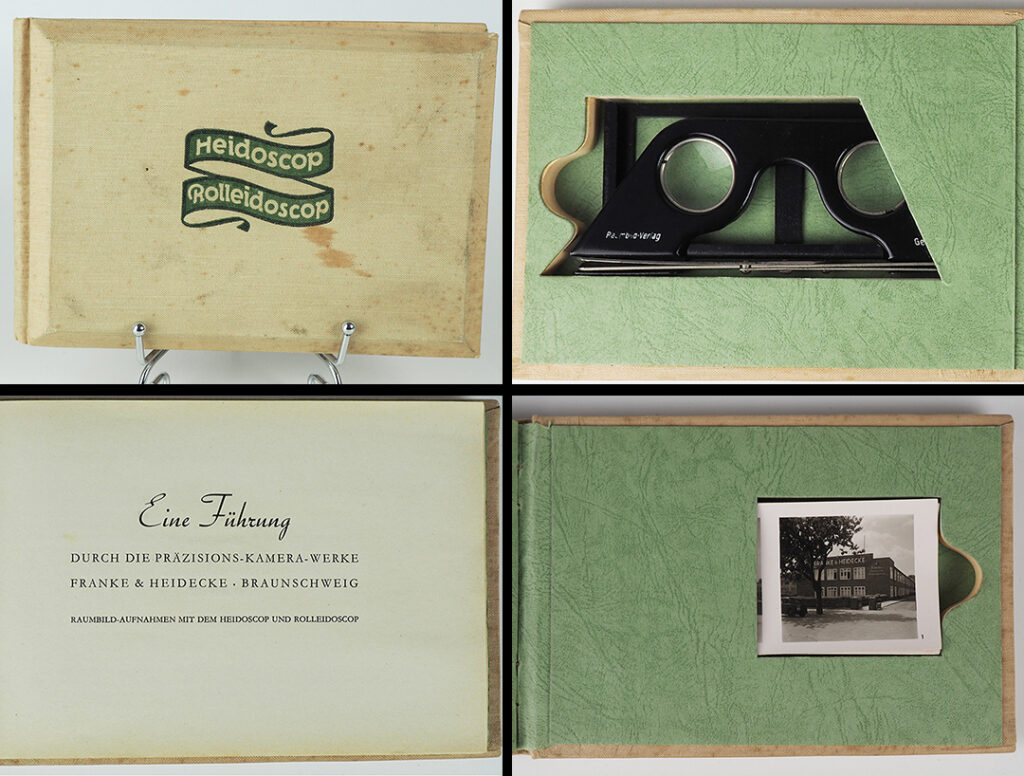
In the following section, I am directly sharing the book’s English version of the text, along with some of the stereoscopic images.
__________________________________________
“Visitors
BEING SHOWN OVER THE CAMERA WORKS OF
FRANKE & HEIDECKE
BRUNSWICK
Stereoscopic View[s] obtained with Heidoscope and Rolleidoscope
In 1921 the following announcement appeared in a photographic journal:-
“We beg to announce that early last year we opened a factory for the manufacture of highly specialised photographic apparatus. After extensive preparations we shall shortly place our speciality, the Stereo Reflex Camera ‘Heidoscope’ 45/107 on the market. The excellent design of the Heidoscope is the result of expert attention to every detail, combined with long years of experience in the construction of stereo apparatus. Franke & Heidecke.”
Thus was the Heidoscope’s arrival first announced. Only a few were aware of the sixteen months of patient and assiduous labour that went to the making of an instrument which within a few years was to achieve world-wide popularity.
Messrs. Paul Franke and Reinhold Heidecke, the founders and owners of the business, were confident of its success. Their enterprise and capacity were responsible for the establishing of the only factory in the world, which specialises in multi-lensed reflex cameras.
The Heidoscope was not the only product. It was soon followed by the Rolleidoscope – the stereo camera for roll film – and finally, surpassing all expectations, came the Rolleiflex and Rolleicord cameras. The Rolleiflex was a Rolleidoscope in half, so to speak. The experience gained in the construction of stereo precision instruments and the distinctive features of these models, such as the brightly illuminated image on the focusing screen, ensuring a quickness and accuracy of action hitherto unknown, were transferred to a roll film camera.
The business then grew by leaps and bounds. As early as 1929 a new factory had to be built which has been extended year after year, until finally emerging as the magnificent clinker building, 125 yds. long and 20 yds. wide, so well-known today. With its stretches of green lawn and well-kept flower beds, its white benches and large white-framed windows, no-one would guess it to be a factory employing more than 750 skilled workers and staff.
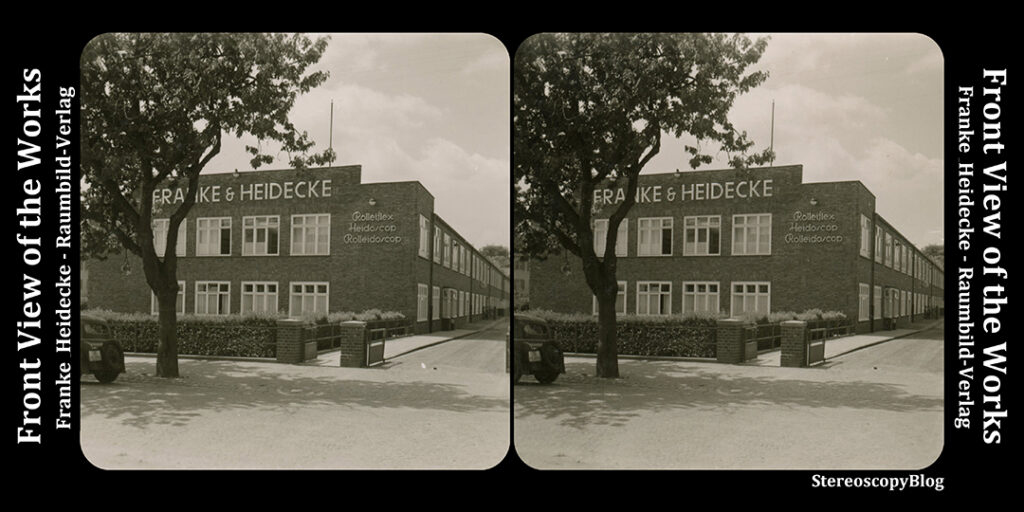
The factory itself is a fitting background for the fine work it produces. The excellence of its equipment and the care expended by the management in maintaining healthy conditions and efficient apparatus provide an active incentive for the workers. These surroundings are ideal for the highly skilled work in demand here. The same conditions prevail throughout the works:-
Let us pay a visit to one of the large workrooms, the Turning Department. The immediate impression is that the room is literally flooded with light. Each machine is electrically driven by its own motor. The grimy workshops of by-gone days darkened by a mass of machinery and conveyer belts have become here cheerful and well-lit rooms. This is a department with costly precision apparatus, some fully automatic, others partly automatic in operation. Fine screws, threads, knobs and mounts, sometimes so tiny as to be only 6/10 mm. in diameter are produced here automatically from long metal rods on special turning lathes. Such work requires precision instruments equal to those of watch-making factories !
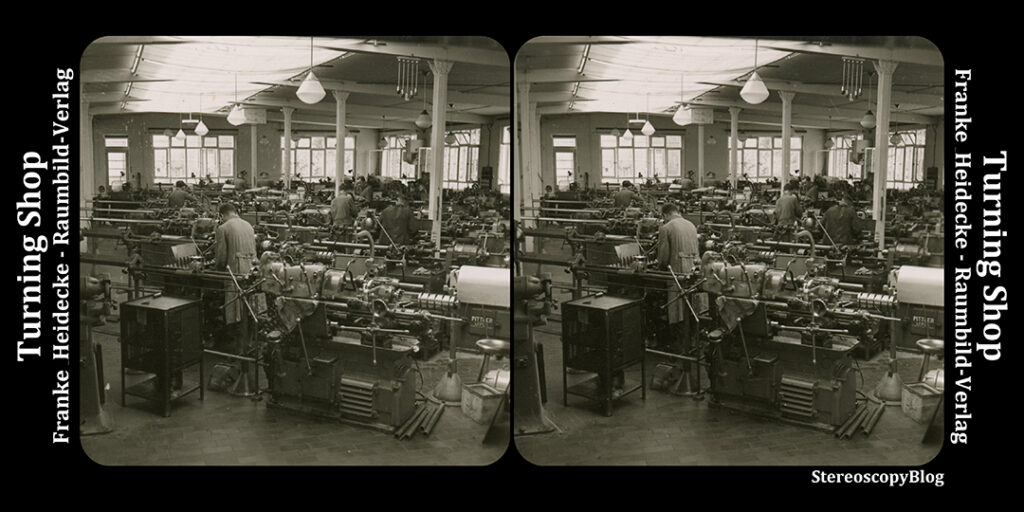
The machines themselves, whether they have been in service for some years or not, are all in excellent condition. A special department is devoted exclusively to the upkeep of the plant.
The next department we inspect consists wholly of drilling machines, one operating at a speed of 12,000 revolutions per minute. With highly complicated and powerful drills a dozen or more holes of different size can be drilled simultaneously in one operation.
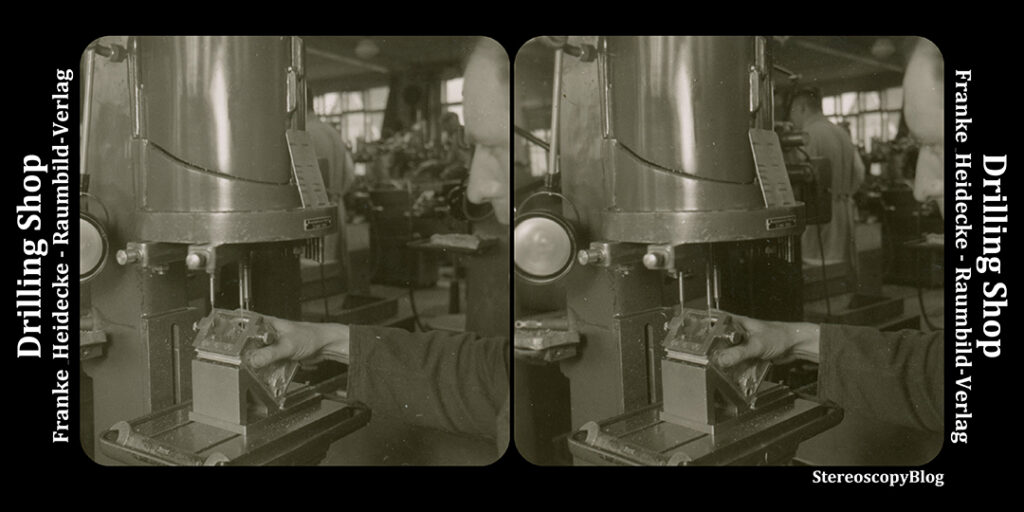
Grinding with modern vacuum apparatus for eliminating dust is no longer the unhealthy process of former days. A particularly interesting development is the automatic tooth milling apparatus which produces sprocket and bevelled wheels on the same principle as is employed in making motorcar gearing, –but on a miniature scale, of course–.
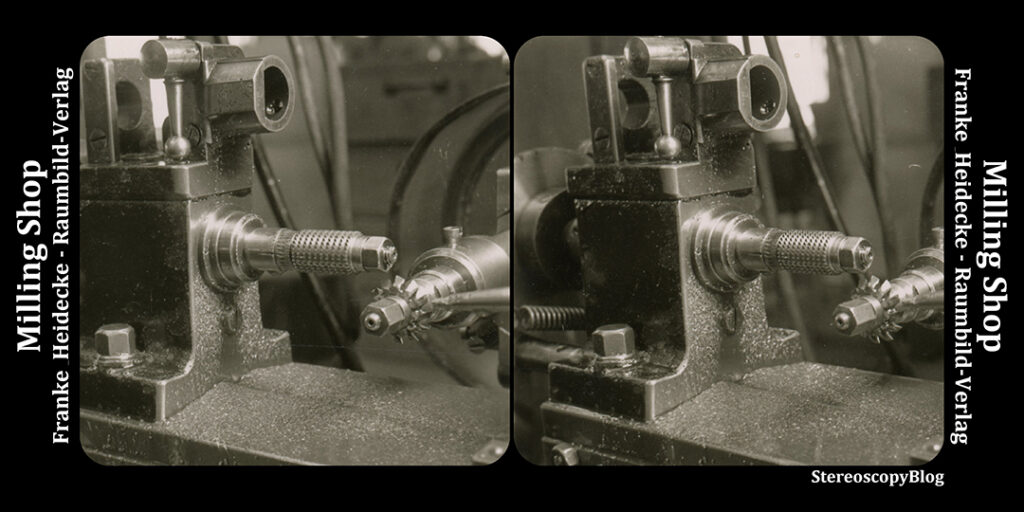
In passing we catch a glimpse of the cutting section, where thousands of tools are stacked in readiness, and then come to the Tool Making Department. Messrs. Franke & Heidecke make all their own tools, including even specialised machines. There is no type of machine tool that is not represented in this department.
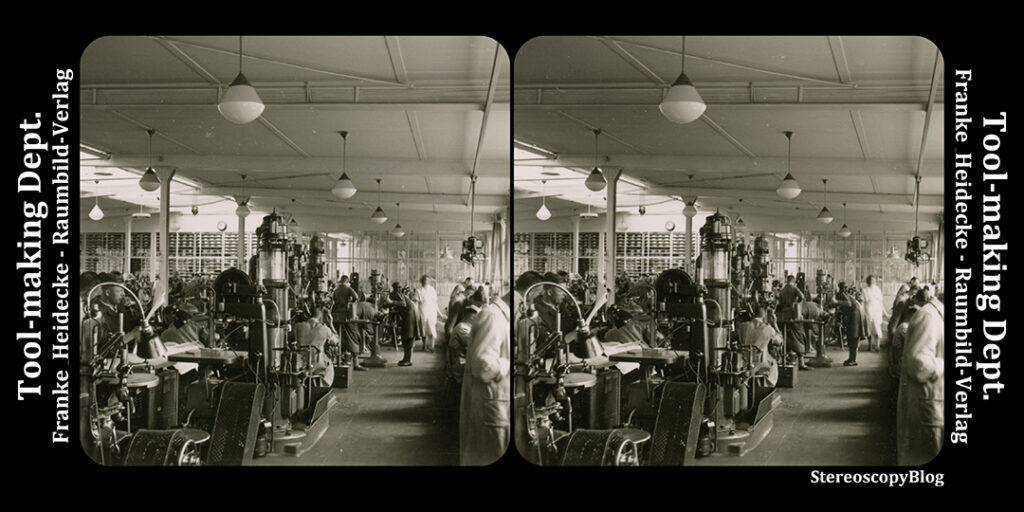
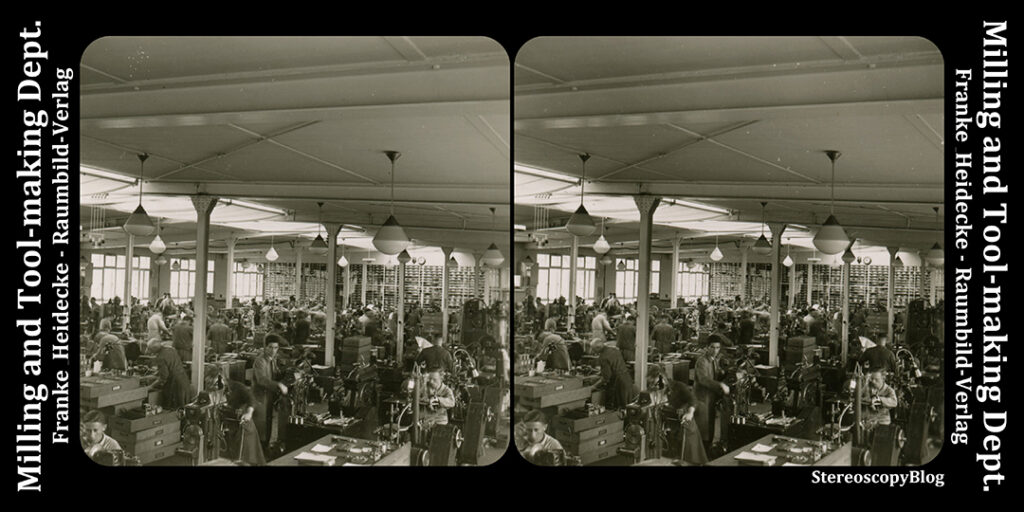
In the Washing room all oil and grease are removed from the parts, as otherwise nickel and varnish would not adhere.
In the Nickel and Chromium Plating plants brass pieces are suspended in suitable baths in order to produce a perfectly finished coating.
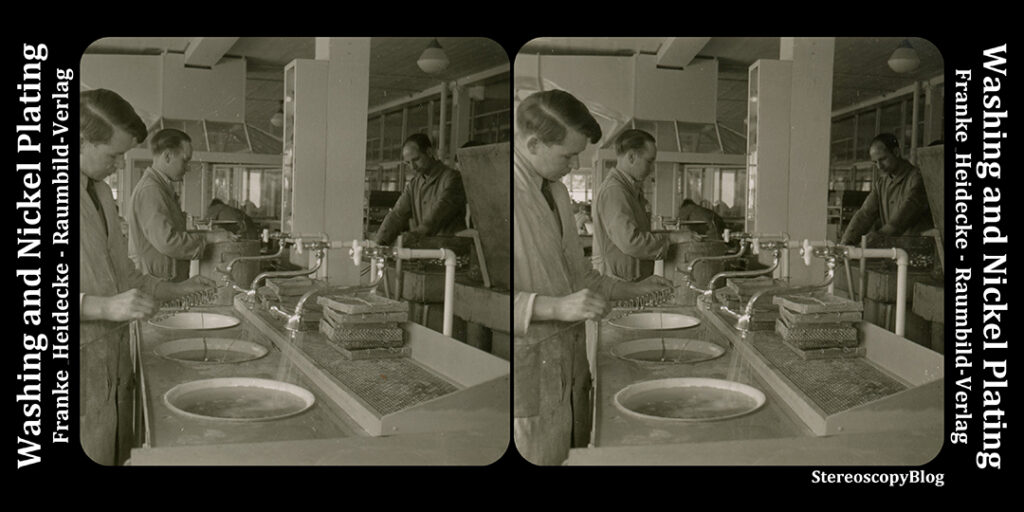
The Varnishing rooms would probably be avoided by most people for fear of spoilt clothes, but even ladies in the flimsiest of summer dress need not hesitate to visit Messrs. Franke and Heidecke’s varnishing rooms. The varnish is not applied with a brush, but by spraying. The vacuum device combined with each sprayer ensures that any remaining varnish dust is removed immediately by suction. A ventilation system is provided for renewing the air 30 times per hour ! The sprayed parts are dried in large electric furnaces.
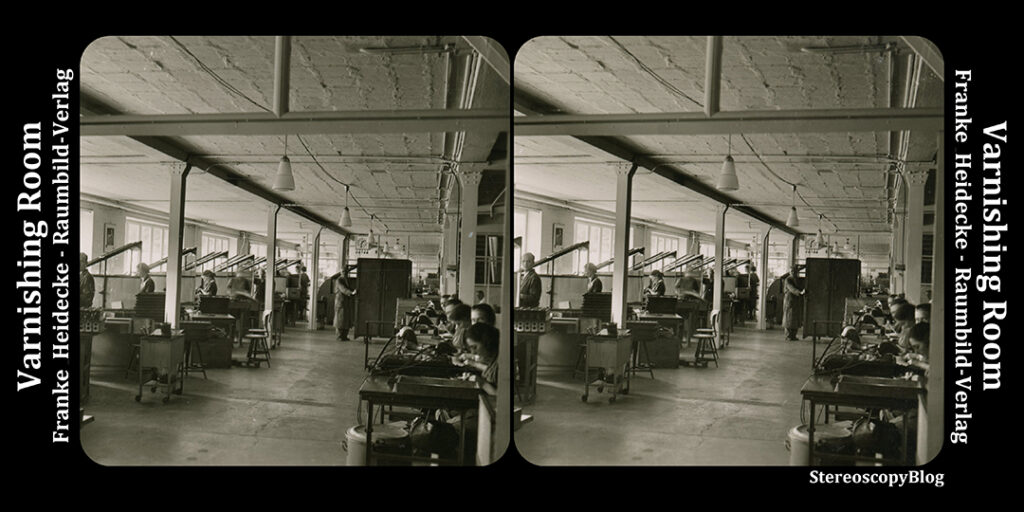
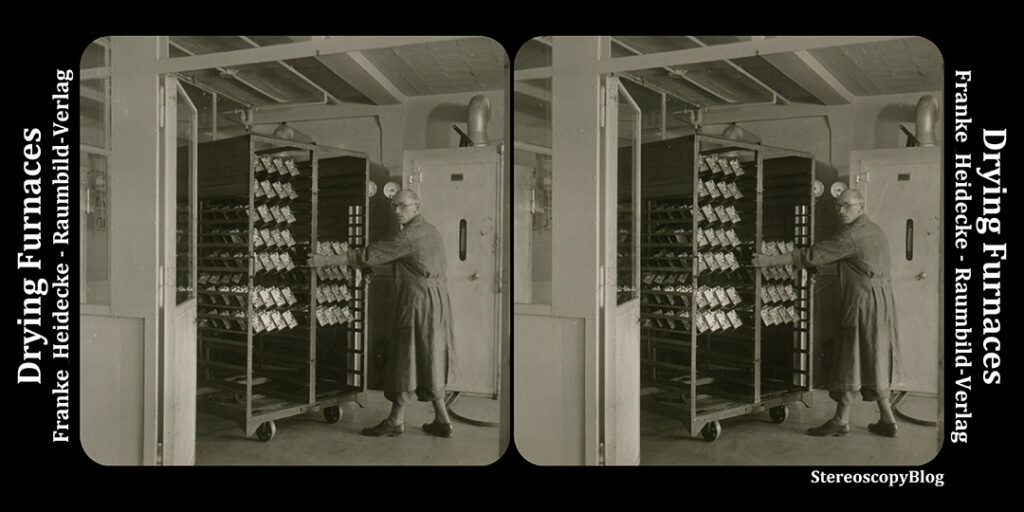
When all the parts have been punched, drilled, or cut, they are carefully tested in various ways. They are then finished off for assembly purposes.
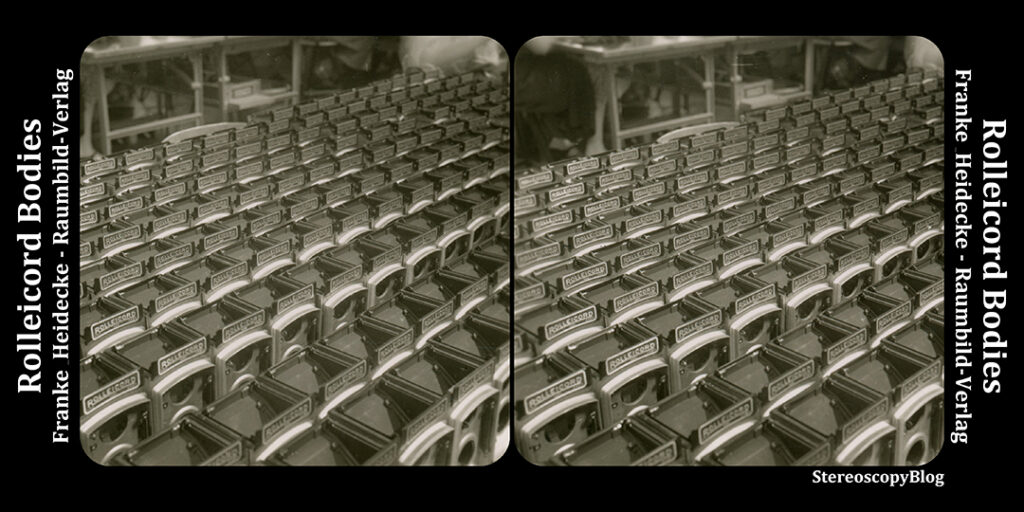
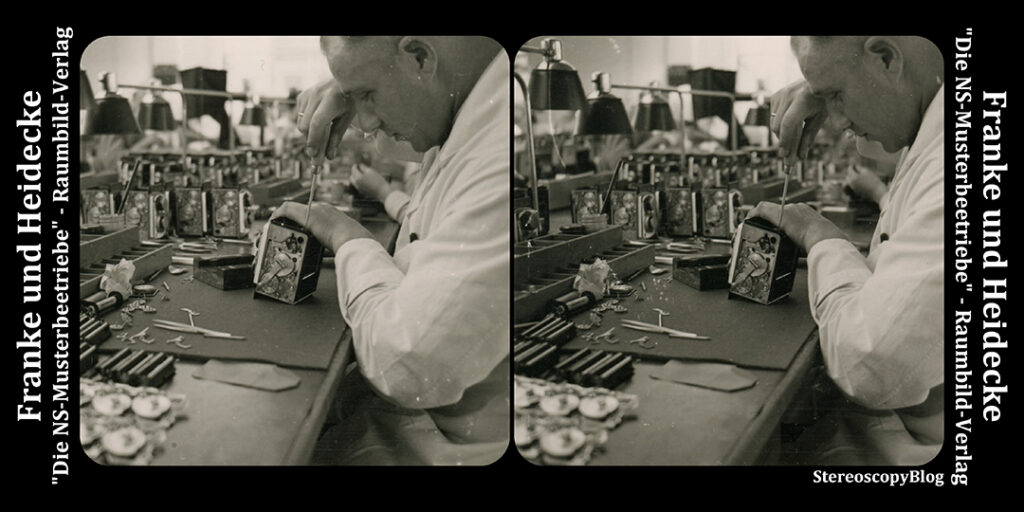
Passing the store-room, where all the parts lie in rows on the shelves, we reach the Assembling room. This is where the camera emerges as a finished product. Side by side down the room stretch tables, 20 yds. along, at which sit highly skilled workers, through whose hands the cameras pass in continuous succession.
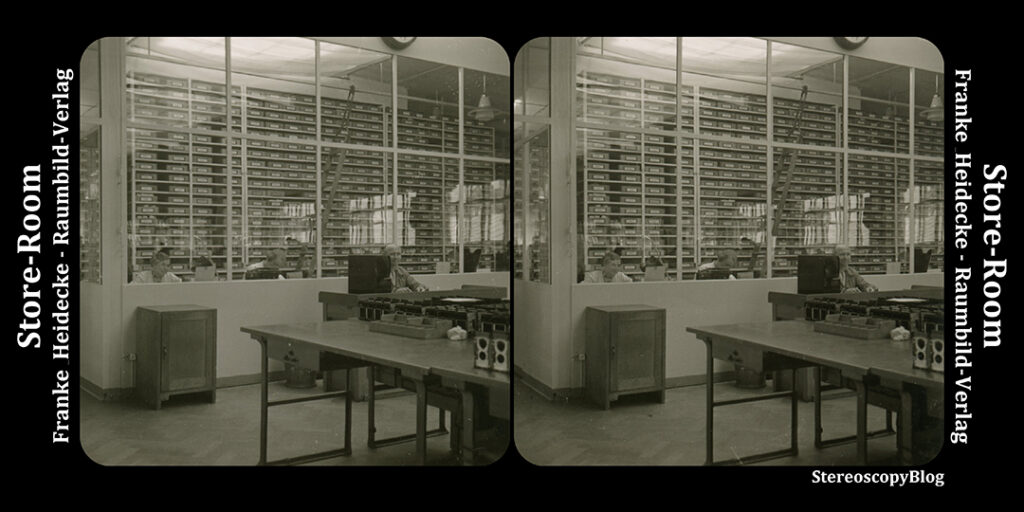
The Heidoscope and Rolleidoscope, as well as the Rolleiflex and Rolleicord cameras are equipped exclusively with Zeiss Tessar or Zeiss Triotar lenses. The shutters fitted to the stereo cameras are made on the premises, while the world-famous Compur shutter is used for the Rolleiflex and Rolleicord models.
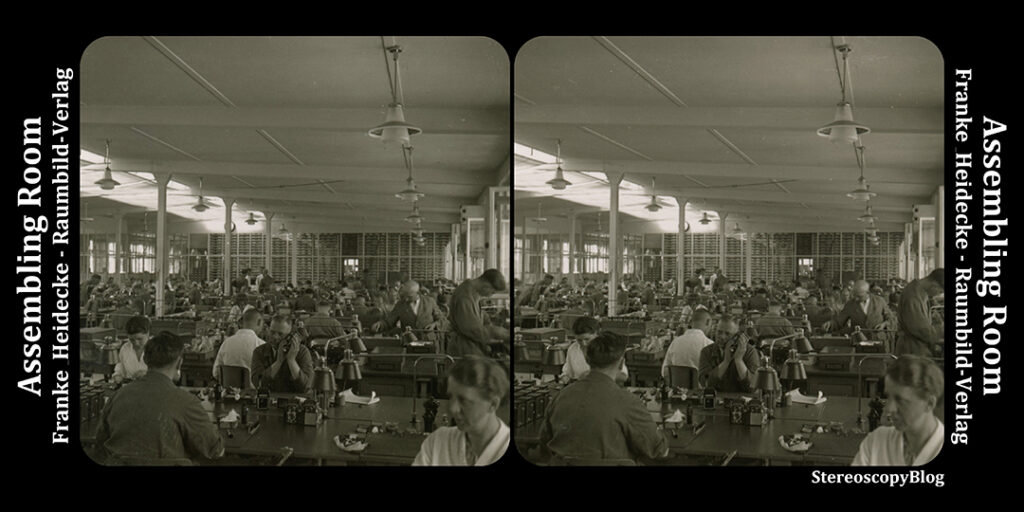
One final test and the cameras go to the Despatch Department to be sent to all parts of the world. One case with its metal lining is intended for tropical China, another beside it is addressed to Bahia. Visitors will be able to test their knowledge of geography here ! Who has heard of Tegucigalpa or Cucuta ? Or of the Island of Maui ? At any rate, Franke & Heidecke’s reflex cameras will be found on sale at any photo dealers in Shanghai, for instance, just as they are at home.
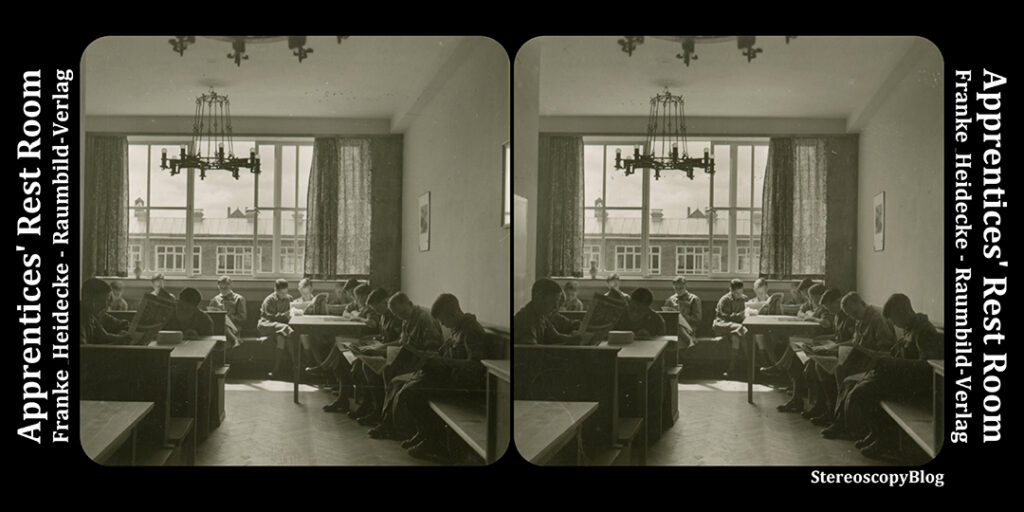
Characteristic of the high standards that prevail at Franke & Heidecke’s works is the Staff Building, handsome in design and with every modern convenience, with its demonstration rooms and accommodation for students, its assembly hall with seating capacity for the entire staff and, last but not least, its pleasant green spaces for recreation.
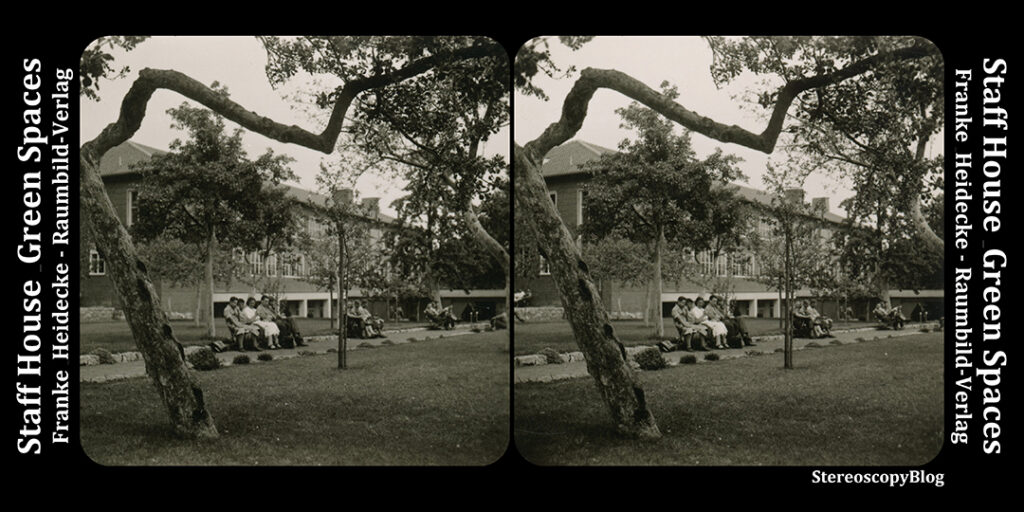
Finally, a well-trained staff with long years of experience behind them have contributed wholeheartedly to the development of the business ; and the world-wide popularity of the Franke & Heidecke products is evidence of the loyal co-operation of every member of the firm.”
__________________________________________
The Franke & Heidecke photographic works also appeared in a 1939 set produced by Prof. Heinrich Hoffman, of Raumbild-Verlag, ‘Die NS-Musterbetriebe’; a series of 200+ stereoscopic photographs of model German National Socialist factories and businesses, highlighting their activities during the Nazi era. I’m including the image in this post because I think the photograph itself is a great insight into the assembly of the Rolleiflex cameras, not for what the series was representing. Heinrich Hoffmann was a German Nazi politician and publisher, who was Adolf Hitler’s official photographer and a member of his inner circle. The Raumbild Verlag became a de facto photographic arm of the Propaganda Ministry of the Nazi Party, changing direction in terms of content after the regime’s defeat. This image and those from the factory set are shared as a unique insight into Franke & Heidecke’s manufacturing operation at the time and for the stereoscopic cameras which produced them, but the context of their time of production should not be overlooked, as all media produced was reviewed by the Nazi Ministry of Propaganda.
If you would like to learn more about the history of the Franke & Heidecke (Rollei) Company, particularly for context of their operations in the Nazi era and beyond, I really recommend Ian Parker’s 1992 book Rollei TLR – The History (The complete book on the origins of Twin-Lens photography).
To learn more about the Rolleidoscope on its 100th anniversary, please see this post, also on The Stereoscopy Blog, you can read about the experience of using a Rolleidoscop stereo camera in this post.
Rebecca
Share this post:

Comments
Ibraar Hussain on A Virtual Tour of the Franke & Heidecke Factory in 1938 – on International Stereoscopy Day
Comment posted: 21/06/2026
Fascinating stuff
Andrew on A Virtual Tour of the Franke & Heidecke Factory in 1938 – on International Stereoscopy Day
Comment posted: 21/06/2026
65% of the factory was destroyed by bombing in WW2, but afterwards they had the luck (like Volkswagen) to find themselves in the British control sector, and the British Control Commission helped them get back up and running producing civilian cameras again. The history might well have been different if they had been in another control sector.
Comment posted: 21/06/2026
Comment posted: 21/06/2026
Comment posted: 21/06/2026
Comment posted: 21/06/2026
Russ Rosener on A Virtual Tour of the Franke & Heidecke Factory in 1938 – on International Stereoscopy Day
Comment posted: 21/06/2026
Thanks again for this fascinating glimpse into the past.
Gary Smith on A Virtual Tour of the Franke & Heidecke Factory in 1938 – on International Stereoscopy Day
Comment posted: 21/06/2026
CHRISTOF RAMPITSCH on A Virtual Tour of the Franke & Heidecke Factory in 1938 – on International Stereoscopy Day
Comment posted: 21/06/2026
Paul Quellin on A Virtual Tour of the Franke & Heidecke Factory in 1938 – on International Stereoscopy Day
Comment posted: 22/06/2026
Comment posted: 22/06/2026
Tony Warren on A Virtual Tour of the Franke & Heidecke Factory in 1938 – on International Stereoscopy Day
Comment posted: 24/06/2026
Gerard on A Virtual Tour of the Franke & Heidecke Factory in 1938 – on International Stereoscopy Day
Comment posted: 26/06/2026