

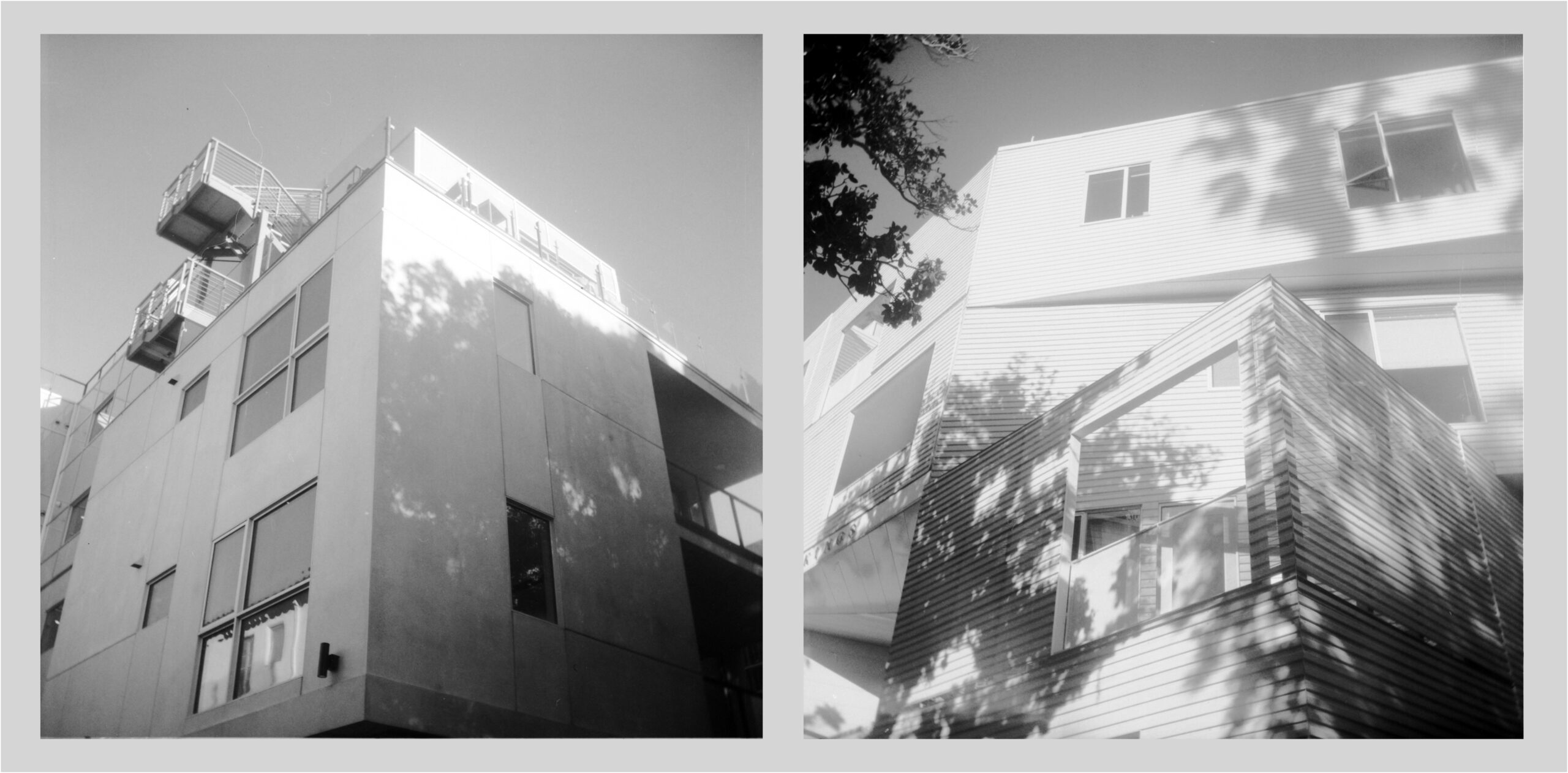
This is a tale of how of the two types of camera designers that influence the camera experience and a camera by one of the two came into my life.
It is a simple camera, just a pseudo-TLR with two apertures, one shutter speed, a cloud filter that can be rotated in/out and two focussing distances: (closeup/distance). It uses 620 film – the same film as 120 in the same square medium format, just on a thinner spool. This means either re-spooling 120 film twice in the dark or using 620 film. Like 120 film, 620 requires two spools, one for supply [film roll] and for takeup. 620 spools are available for sale along with 3d-print versions. After printing two spools, I used a 3d printed device to re-spool 120 film twice, to maintain the order of the frames.
I found it a joy to use, in spite of the work.
Background
Constraints
The camera reminded me of this Igor Stravinsky quote:
the topic of The more constraints one imposes, the more one frees oneself. And the arbitrariness of the constraint serves only to obtain precision of execution.
Igor Stravinsky (1970). « Poetics of Music in the Form of Six Lessons « ”, p.65, Harvard University Press
So, this simple camera is certainly a constraint.
That leads to the topic of design considerations and designers.
Camera Design/Designers
Cameras are designed not only as utilitarian objects but sometimes go beyond that narrow role.
Let’s talk about design and designers, acknowledging first that photographers are primarily interested in whether a camera works (is usable) and only then if it somehow works for us.
There are, however, other attributes that we unconsciously consider: how a camera both makes us feel and appeals to our design sense, lest we not forget that photography is about the process not just the final image.
It’s the journey, not the destination.
Two types of camera designers
Camera designers fall into two camps:
- engineers
- industrial designers.
An industrial designer was responsible for the camera under consideration.
Engineers
Engineers are primarily interested in the engineering aspect of cameras (and film) and do not stray outside that somewhat limited domain. Here are two that fall into that camp.
- Hubert Nerwin – worked for Zeiss Ikon (e,g, Zeiss Ikon Contessa) and later for Kodak, developing 126 (aka Kodapak cartridges and Instamatic cameras.
- Heinz Waaske – worked for Wirgin (e.g. Edixa Reflex) and later for Rollei (e.g. Rollei 35).
Both designers are worth exploring.
Industrial Designers
Industrial designers are involved in product design over a wide range of domains and scales, not just cameras.
With an interest in architecture and design, I gravitate to influential industrial designers, remembering two who had designed cameras as well as other objects
- Walter Dorwin Teague (Kodak Bantam Special)
- Giorgetto Giugiaro (Nikon F3)
Walter Dorwin Teague is often deemed the « Dean of Industrial Design ». Art Deco. An F3 with its red stripe is one of my cameras.
Art Deco and Mid-century modern cameras
My interest spans Art Deco and mid-century modern, which brings to mind the industrial designer Raymond Loewy, referred in the press as
- The Man Who Shaped America
- The Father of Streamlining
- The Father of Industrial Design.
Loewy had a long career (late 1910s – 1970s).
After working in Paris, France, Loewy moved to the states following WWI. There he created a variety of iconic designs from corporate logos to the classic, iconic glass soda bottle [Coke] and even automobiles [Studebaker Avanti].
I suspected that Loewy just might have designed cameras. He did.
Loewy’s Wikipedia entry contained a thumbnail image link to a Anscoflex II – a minimalist grey- green pseudo-TLR for Ansco, a camera so appealing that I just had to have one.
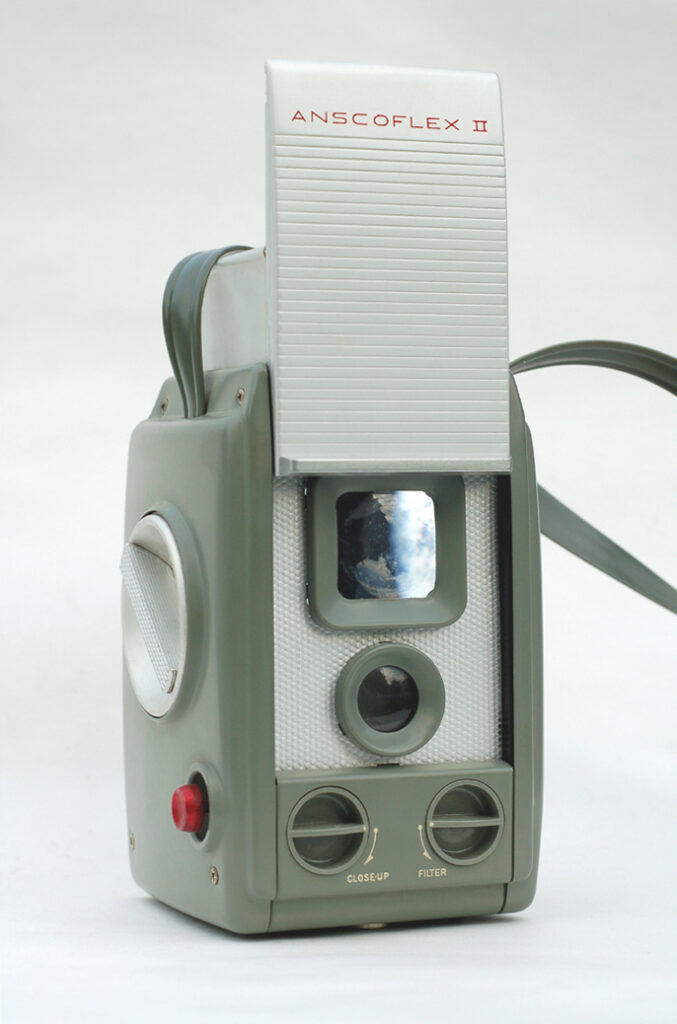
A few days later one arrived, complete with flash and case [under 80$US including shipping]. And it worked.
« Loewy also made other Ansco products « and is credited with the Anscomark M [rebadge of Ricoh 999], Anscoflex Flash Clipper outfit, Rediflex outfit, 2A Home Developing outfit and the luggage style case for the Pioneer (Ansco Jr. Press outfit). »
source
Ansco engaged another industrial designer – Henry Dreyfuss – for the Ansco Pioneer and the Ansco Automatic Reflex 3.5.
During research, also discovered that the Purma Special was « attributed to Raymond Loewy’s London office » (Art Deco Cameras). The camera appears in the catalogue of The Metropolitan Museum of Art. The Purma Special was odd, with its three shutter speeds dependent on how the camera was held: horizontally or vertically [in one of two orientations].
Ansco
Ansco, based in Binghamton, NY, not far from its competitor Kodak in Rochester NY (220km}, also manufactured cameras and film.
Ansco acquired a US patent from Hannibal Goodwin – Photographic pellicle and process of producing same (US610861 1898-09-13). Later Kodak produced its own version of flexible film, breaching Ansco’s US patent. Ansco sued Kodak, settling in 1914 for the equivalent of $161M today, after Kodak almost destroyed the firm.
In 1985, Polaroid launched an even larger suit against Kodak for instant film, which Polaroid settled for the equivalent of $2,7B before its bankruptcy. Another industrial designer – Henry Dreyfus – refined the final design of the iconic SX-70. He was responsible for another ubiquitous design, the Honeywell T87 , a thermostat in production since 1953.
Alas Ansco has disappeared while Polaroid and Kodak are now mere shells of their former selves,.
Now Kodak has emerged from bankruptcy, destroyed by the digital camera it actually invented (1975) and patented (1978). Kodak did not miss the digital revolution, it just did not bother to promote it, preferring the steady cash flow of film.
Just remember that Upstate New York was the Silicon Valley of its day. Silicon Valley will also see its eventual decline.
Anscoflex II
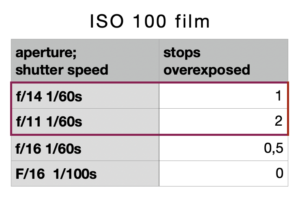
The original Anscoflex camera had a single shutter speed, single aperture and fixed focus lens (6’ to ♾️). The Anscoflex II added a shutter speed, an aperture and two filters that flipped into place – one for clouds on b./w and a closeup ( 3’ – 7’) but used separately. The Ace Sure-flex, made in India, added another aperture and another shutter speed. They were pseudo TLRs – basically box cameras that looked like a real TLR but with uncoupled viewing and taking lenses, just like the Zeiss Box Tengor. In 1956, the price of the complete Anscoflex II kit was 27,95$US (roughly 333$US today).
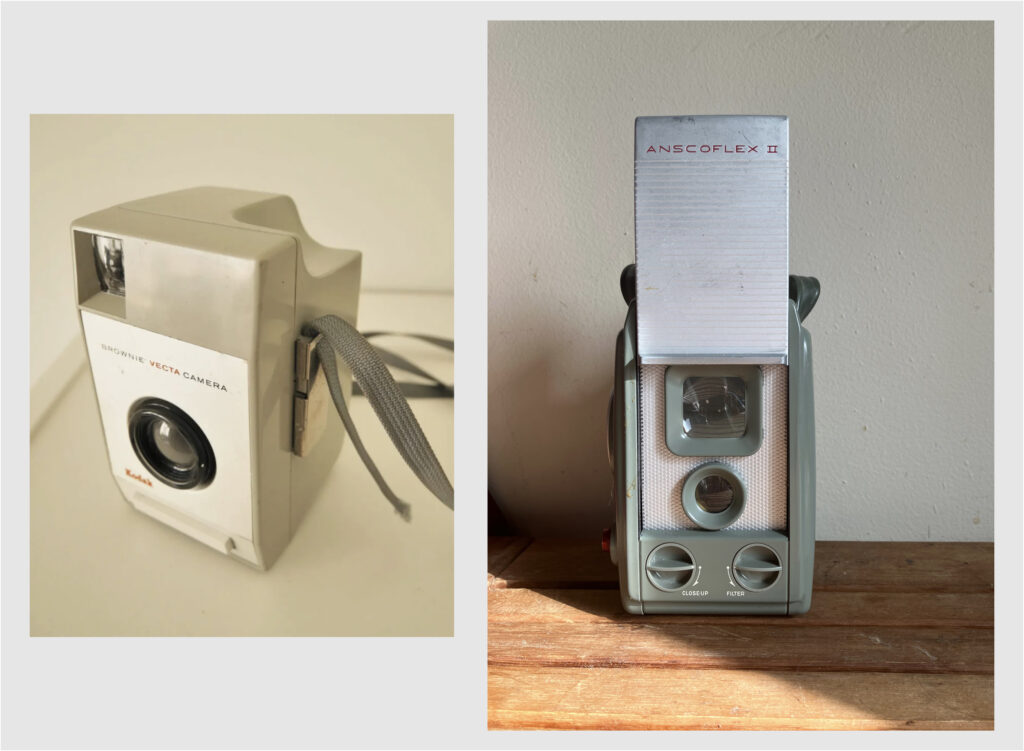
Compare Kenneth Grange’s design of the Kodak Brownie Vecta (1963 – 1967, 127 film) with Raymond Loewy’s Anscoflex II.
I prefer the Anscoflex II. I had no problems using it, unlike Charles Hingham had with a Kodak Brownie Vecta. The Anscoflex II is all of a piece, while the Vecta is not. Let’s just say Kodak designs from the mid-century on are cluttered.
Kenneth Grange, like Raymond Loewy, was an industrial designer, responsible for InterCity 125, the British Rail High Speed train. Grange remained in the UK, unlike the French Raymond Loewy who moved to the states.
Conclusion
That’s how the Anscoflex II entered,.
This was one of a series of posts on camera designers, percolating for sometime, with these designers, in the engineer camp:
- Heinz Waaske of Wirgin and Rollei
- Hubert Nerwin of Zeiss Ikon, Graflex and Kodak.
- Yosihisha Maintani designer of the half-frame Olympus Pen S (1960), his first design to be manufactured in-house.
And yes, I do have examples of cameras from each designer,
Share this post:


Comments
brad sprinkle on Thoughts on camera designers – sometimes simple pays off
Comment posted: 27/11/2026
Great article and oh so timely! I just ran a roll of re-spooled Ferrania P30 through my Anscoflex II. I highly recommend this combination to anyone wanting to try an Anscoflex II.
I know this can be a tricky emulsion to work with due to its narrow latitude so here are the specifics of the weather conditions, location, and film processing data.
Full sun -November, Detroit, Michigan
Internal yellow filter engaged
D76 1to1 / 13.5 minutes/ 3 inversions per minute/ 68 degrees.
I love to read articles promoting these wonderful cameras. Thanks again for taking the time for this in depth write up.
Cheers,
Brad