

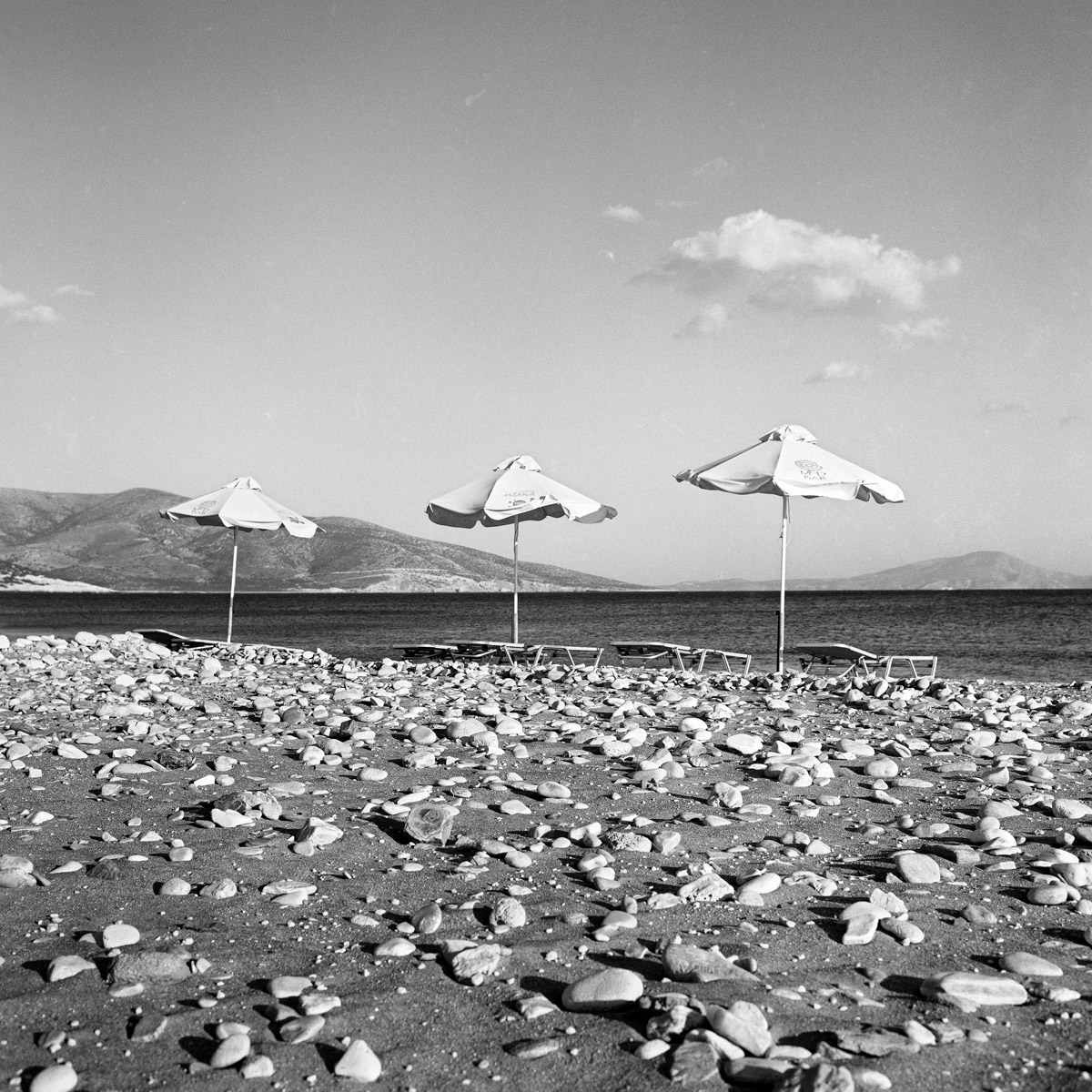
I haven’t been back to Greece for a long time. I don’t know why I love the islands of the Cyclades archipelago so much, but every time I visit, my days are certainly dedicated to photography. I even believe my first photos – different from the usual souvenir shots – were taken in the 1990s on the beaches of Santorini. At the time, I had a compact point-and-shoot camera, like a perfect tourist, but combined with black and white film, it gave me the feeling of capturing the essence that only black and white can convey. Over the years, I’ve returned many times, visiting different islands, with different people, but each time with one or more cameras.
But what captures me about those landscapes? First of all, the space, the horizon that always ends in the sea. Then the rock, inhospitable, arid, yet capable of forms that speak of time, wear, and wind. Then comes the sky, rigorously blue, clear, full of color, almost incapable of clouds. And finally, the undisputed protagonist, the sea. It surrounds everything, it captures everything: landscape, vegetation, people, everything has the character of the sea on these islands and speaks its own language.
The photos I’m including in this article today are of the island of Naxos and date back to around 2013. In those years, digital photography was already dominant, but 50-megapixel cameras or affordable digital medium format cameras didn’t yet exist. It was easier (and cheaper) to find a medium format film camera and buy some 120-format rolls. I solved this problem by buying an old Rolleiflex 3.5, which, despite its compact size, gave me slides and large-format black-and-whites. At the time, that was still possible.
These photos take me back to days in June when I wandered the island in search of fine art shots. The first shot was taken near the island’s port, beneath the promontory where the Portara stands. Here during the day, lots of young people bathe, and stopping to watch them takes me back to my youth.
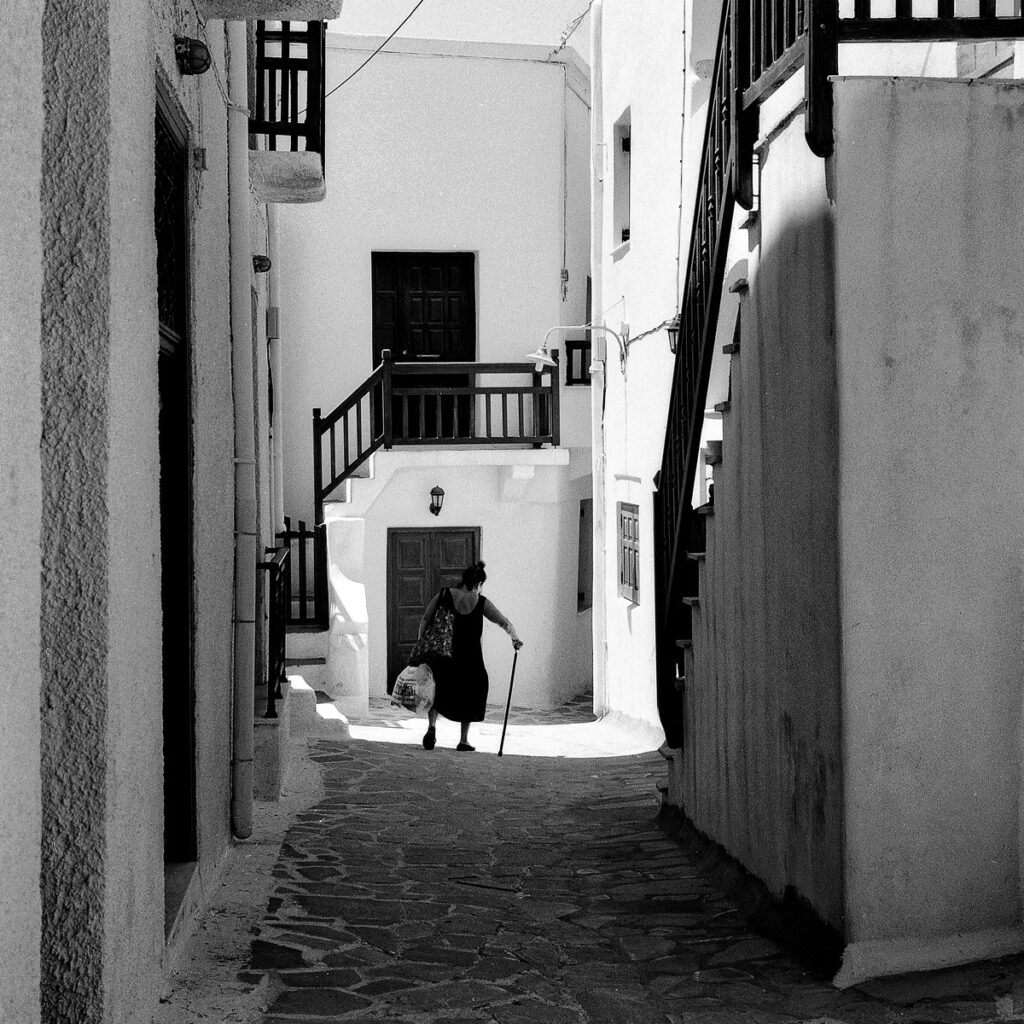
 The second shot was taken nearby, when I was getting lost in the streets of the main town, characterized by the Venetian warehouse atop the hill on which it sits. Here in the morning, you can often find many locals shopping and strolling the island’s whitewashed streets.
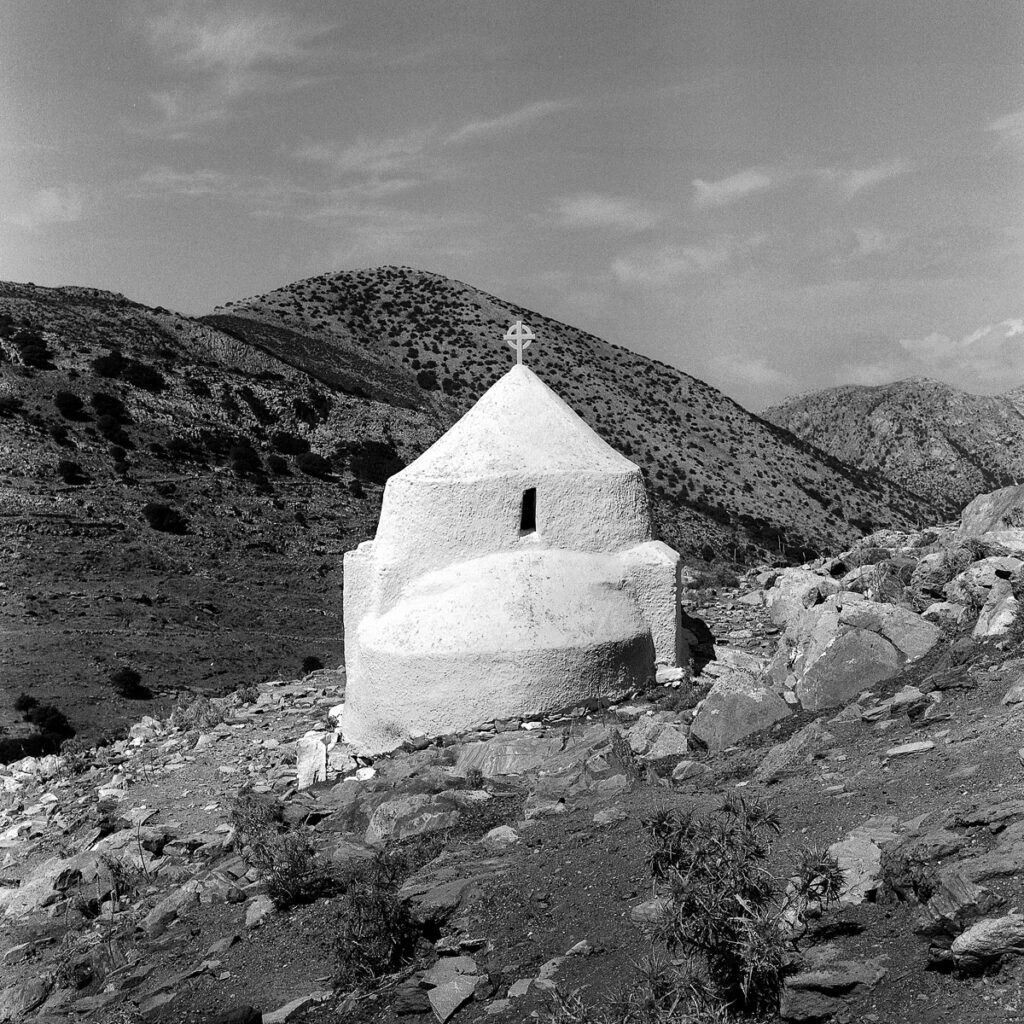
But the most beautiful part of this island is its unexplored side, the roads that climb the rocks and lead to secluded beaches. The journey itself to reach them is full of striking panoramas: inhospitality meets the sacred, immersed in the silence of the wind.
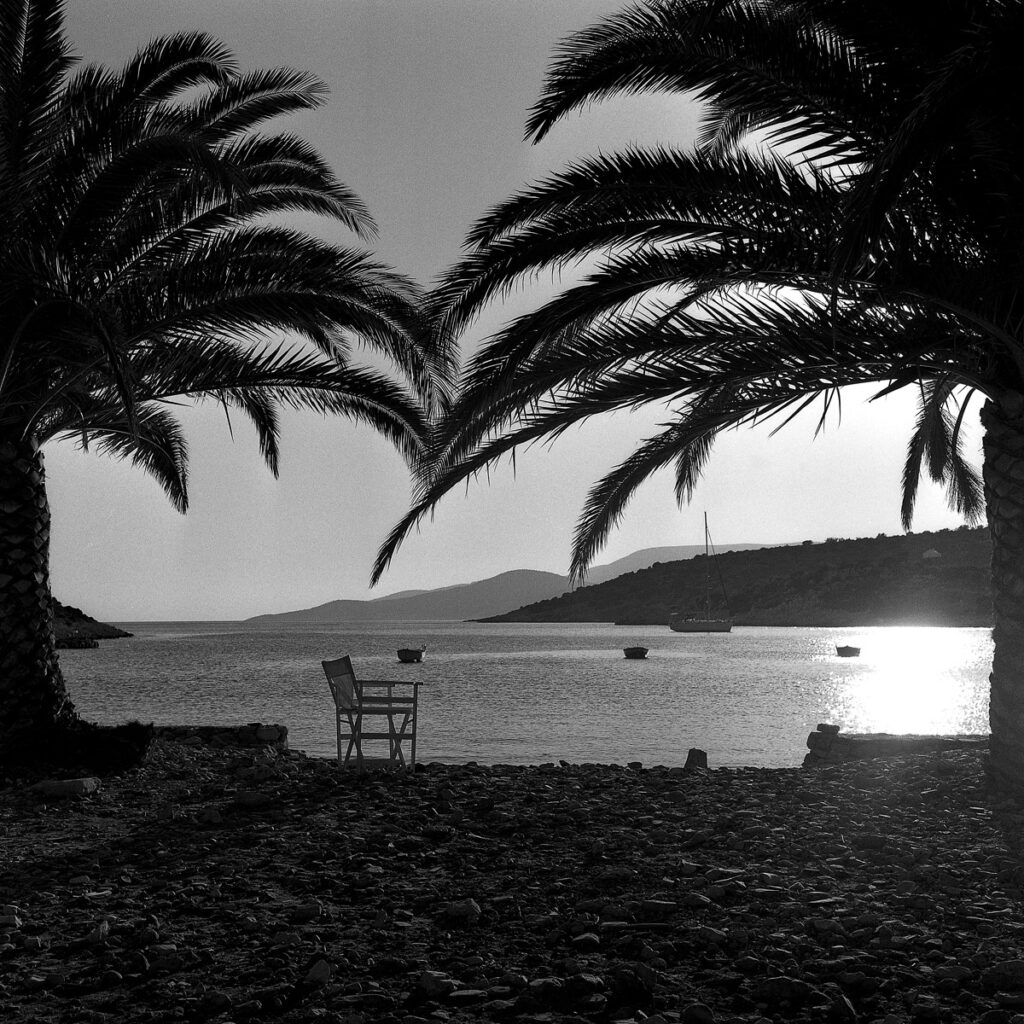
 Thus, going up and down narrow, poorly paved roads, you arrive at the coastlines that open onto views that seem to come from other planets. The sea merges with the sky and the rock, interspersed with a few buildings that rise along winding paths. Here, peace is assured: human presence is strictly essential, and you can enjoy long hours of silence, perhaps accompanied by herds of sheep. Nothing more.
In the photo, you can see a Kalantos sunset, which I still remember for its infinite quiet.
 Finally, the image at the top is a view of Kastraki beach, which remains deserted and unexplored even during the busiest tourist weeks. Naxos is the largest island in the Cyclades and also the one where you can wander the longest, taking photos. I still remember it, even though in later years I traded it for Milos.
Share this post:





Comments
andy hertig on 5 Frames from Naxos Island
Comment posted: 26/12/2025
Cheers and Happy New Year!
Andy
Gordon Ownby on 5 Frames from Naxos Island
Comment posted: 26/12/2025
This is how travel photography is done!
Scott Bassett on 5 Frames from Naxos Island
Comment posted: 26/12/2025
Eric on 5 Frames from Naxos Island
Comment posted: 26/12/2025
Alexander Seidler on 5 Frames from Naxos Island
Comment posted: 27/12/2025