

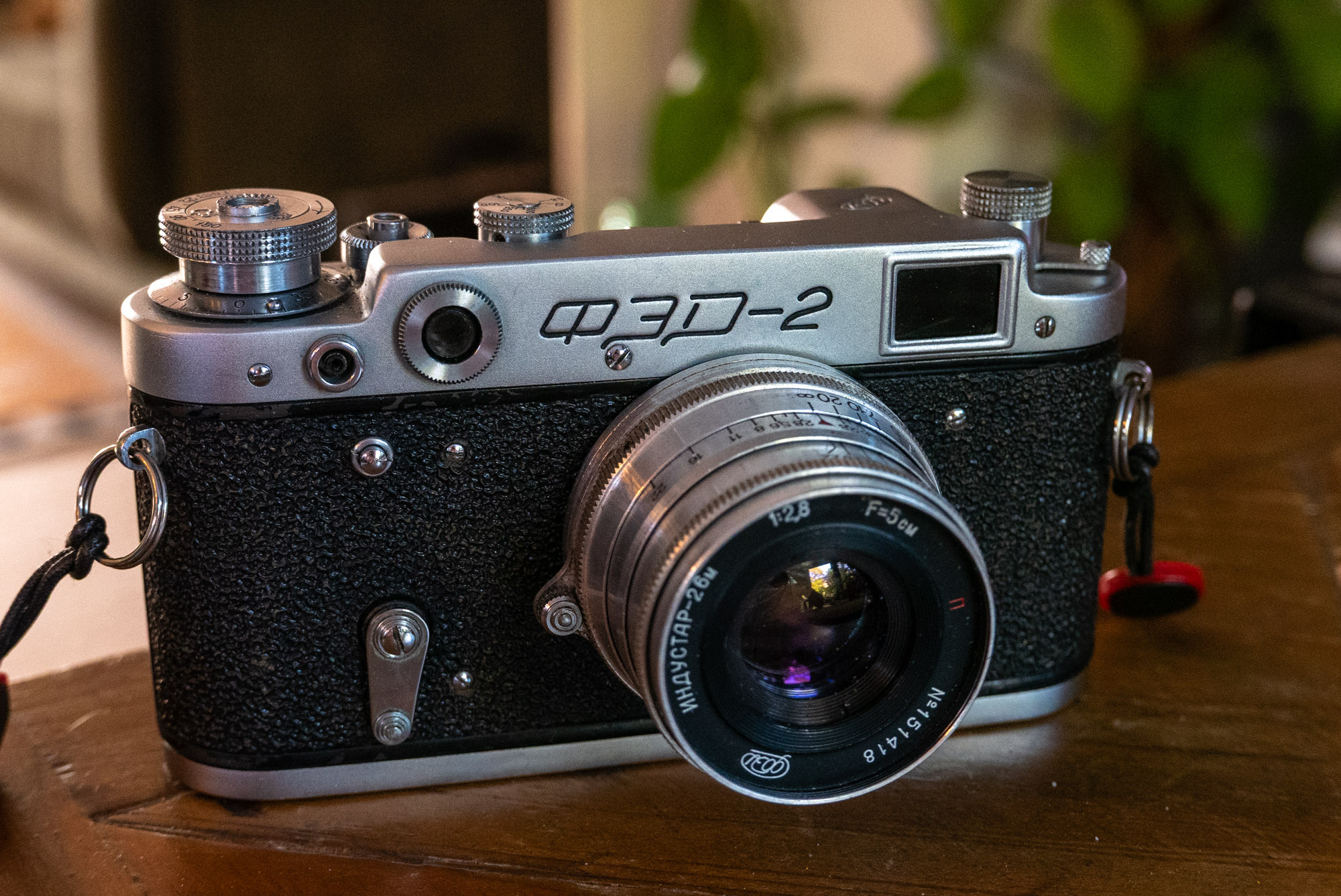
Once in a while, on a whim, I fancy shooting something different to what I otherwise have in my camera cabinet. We all know that feeling of GAS, I’m sure. Of course, like most normal (non-billionaire) people I’m suffering under the weight of end stage capitalism and so feel permanently skint… And what does skint plus GAS equal…? Well, in short, something cheap. This particular bit of something cheap is a FED-2 which I got with the lens from my mate Steve, otherwise known as Kosmo Foto (or more specifically Cameraburo) for £60!
To be fair, it was more than a whim. I have a couple of Soviet lenses that I’d decided I wanted to be able to shoot on a camera they were actually designed for. As you probably know, these lenses will mount to Leica thread mount (ltm) cameras (and M-mount cameras with adapters), but given critical focusing situations they’re not a perfect match. Funnily enough, my LTM camera doesn’t even have a rangefinder, so I could have shot them fine by zone focusing for the sorts of subjects I shoot with that camera… but, my GAS nagged me about the idea that I would be able to critically focus these lenses if I had a camera they were actually meant to be used on.
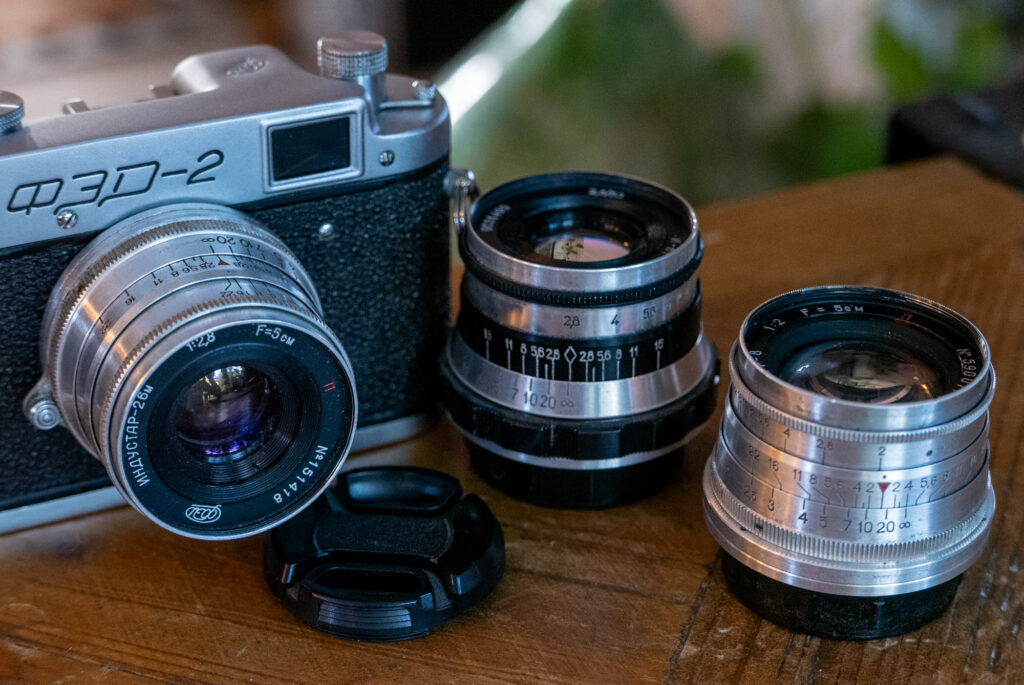
Quite often in these sorts of situations I would do a load of research online, read around reviews, find various recommendations, weigh up options and generally enjoy the process of doing so too. I did, in fact, do a bit of this, but I’ve been down this specific road before. The issue I find is that quite a lot of Soviet cameras are pretty horrible looking, so just as before, I’d found myself a little bored reading about them. GAS, I often find, is fuelled by aesthetics – call me shallow, but give me a bunch of ugly cameras to choose from and honestly I get pretty bored even in the usually exciting research phase.
Of course, there are a few that look nice, but in some cases it’s just because they look like Leicas (eg Fed 1, Zorki 1) – I don’t want a camera that looks like a Leica, if I wanted that, I’d have Leica GAS… and that’s GAS I can’t afford to have (see last summer’s review of the iiig)! The only two camera I could think of that either didn’t look awful or didn’t look like a Leica were the Zorki 4 and FED-2 (YMMV, of course…). I’ve already owned and enjoyed shooting a Zorki 4 that someone very kindly serviced for me some years ago in a previous cycle of FSU camera GAS. But I sold that one, so didn’t want another as it felt like I’d just be buying a camera I owned before that would definitely be less good condition than the last one.
At this stage, I’d pretty much settled on the FED-2, but thought it worth asking an expert – so I got in touch with Steve… and do you know what he recommended? The FED-2, obviously. Well… that’s not entirely accurate… he also suggested Zorki 6 and a Zorki 1, but I locked into the response that confirmed my personal biases rather than listening to anything else he had to say… We had a chat on the phone, he had a dig through his stock, found me FED-2 and we did a deal. Not long later I was the proud owner of a new-to-me and seemingly perfectly functioning FED-2… well, perfectly functioning for a Soviet camera at least; it obviously has its quirks!
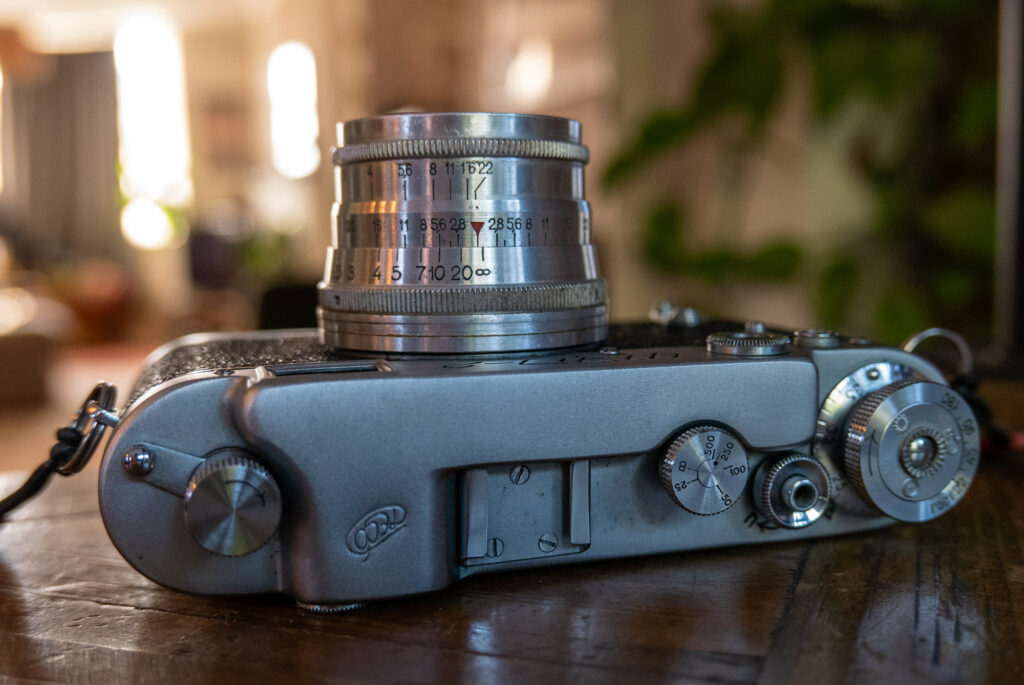
The FED-2
There were reasons I had honed in on the FED-2 too, and reasons I wasn’t sure about it. In fact, my primary area of interest and primary concern were also both mentioned in the little bit of dialogue between me and Steve, those being the long RF base length and the overall size of the camera respectively. Aside from not looking like a Barnack Leica, and also not looking like it’s made of brittle plastic in the way some of the later Soviet cameras do, these two factors were front and centre for me in my thinking – now I have the camera of course, I have a lot more to say!
Size and shape
Camera size is always going to be a factor in my thinking – 35mmc was born out of my enjoyment of pocketable point & shoot cameras, and though I now more regularly use much bigger cameras, the draw of something easy to carry, very regularly pulls me back. In the summer I prefer something that fits in my jeans or shorts pocket – a Contax T or Rollei 35S maybe, or my Pentax Q or Panasonic LX100. This time of year (it was still winter when I wrote this) actually allows a slightly bigger camera as I am comfortable stowing cameras in my larger coat pockets, but for a casual carry-everywhere, I still don’t want something too big or heavy. Leica M cameras feel like they’re too big for a coat pocket, but my Barnack camera works. My Panasonic LX100 works a treat too, whereas the Nikon Zf is too big.
Fortunately, the FED-2 works quite nicely for this time of year and my bigger coat pockets. I have actually been carrying it with a strap a bit too, but it also fits nicely in my coat pocket. It is, in fact, probably quite similar in size to the IIIg that I reviewed last summer. It’s certainly bigger than my Leica ic, but to my relief, it’s definitely not Leica M size.
Build and design
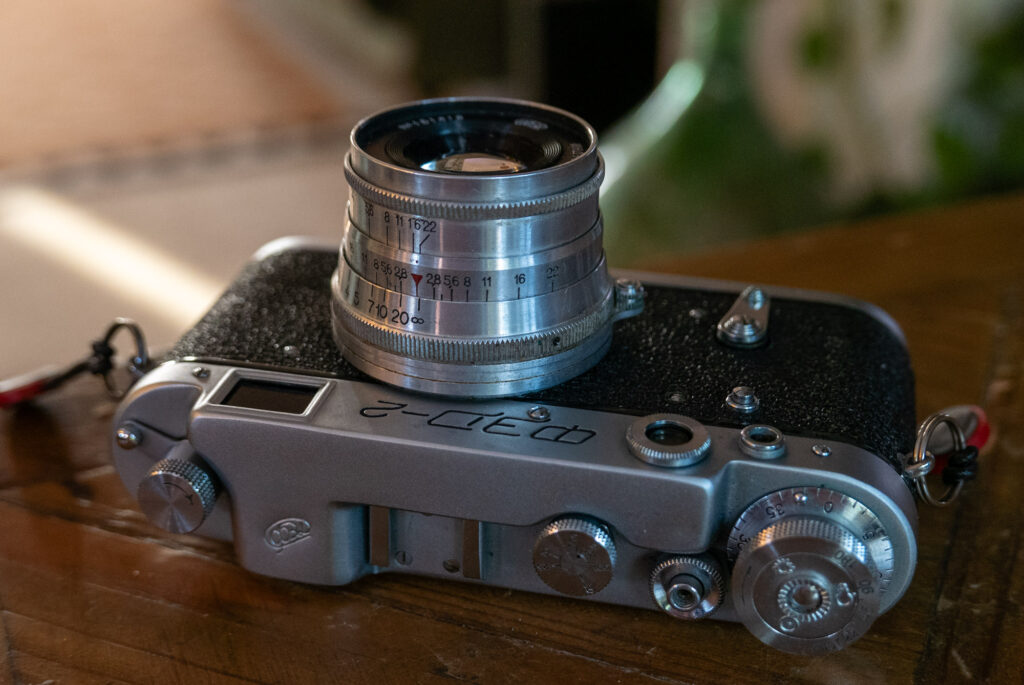
This is very much a comment on the camera I have here, but this particular FED-2 feels really solid too. It can feel a little difficult to make comments on older cameras and build quality. This camera is probably from the late 50s or early 60s – that’s a lot of time for a camera to have had a hard life. Though it’s also not unreasonable that a camera could have survived that same period of time being well kept and hardly used in a camera cabinet, or even just in a box in the dry in the bottom or a wardrobe or whatever. I’m fairly certain that my FED-2 fits in the latter category, as though there are some signs of age, it’s actually very clean.
It’s quite weighty, but not unpleasant to carry all day. The metal of the body feels robust. The controls all feel pretty precise too – way more than I usually associate with Soviet cameras. There is a bit of play in the rewind control, and advancing the film makes a bit of a creaking sound, but nothing too serious.
The shutter sped dial should only be set after the shutter is cocked. It’s also the type that has to be pulled upward against a spring-load and then rotated for the shutter speed to be set, so doesn’t feel as nice a rotating/clicky shutter dial such as that on my Leica M4-P for example. With that said though, it still feels surprisingly precise.
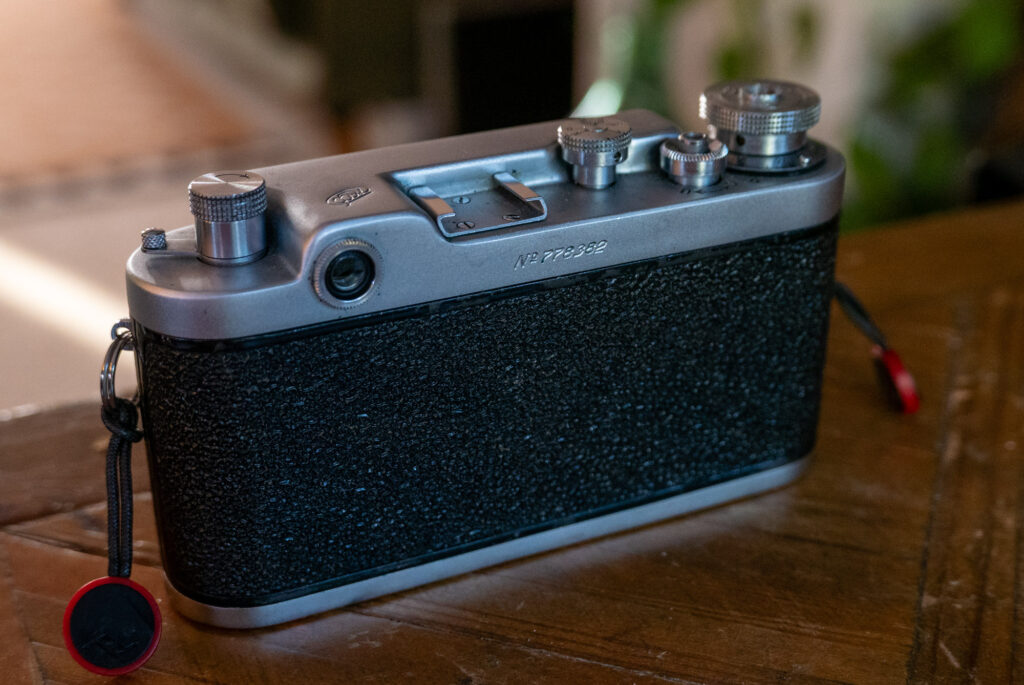
I like the design of it too. It feels like it takes cues from both Leica Barnack cameras and Contax Rangefinders whilst still having a look of its own. It’s quite low profile, meaning it looks quite sleek in my opinion. This is helped by the control dials being on a lower level of the top of the camera than the viewfinder/rangefinder. As I have alluded, I also think it is a design sweet spot in the FED series, the FED-1 was very much a Leica copy, then the couple of FED-3 designs just look a lot more clunky and were the beginning of the series being taller and less sleek by comparison. The FED-4 and 5 with their selenium meters and plastic viewfinder frames on the front are just ugly to me too.
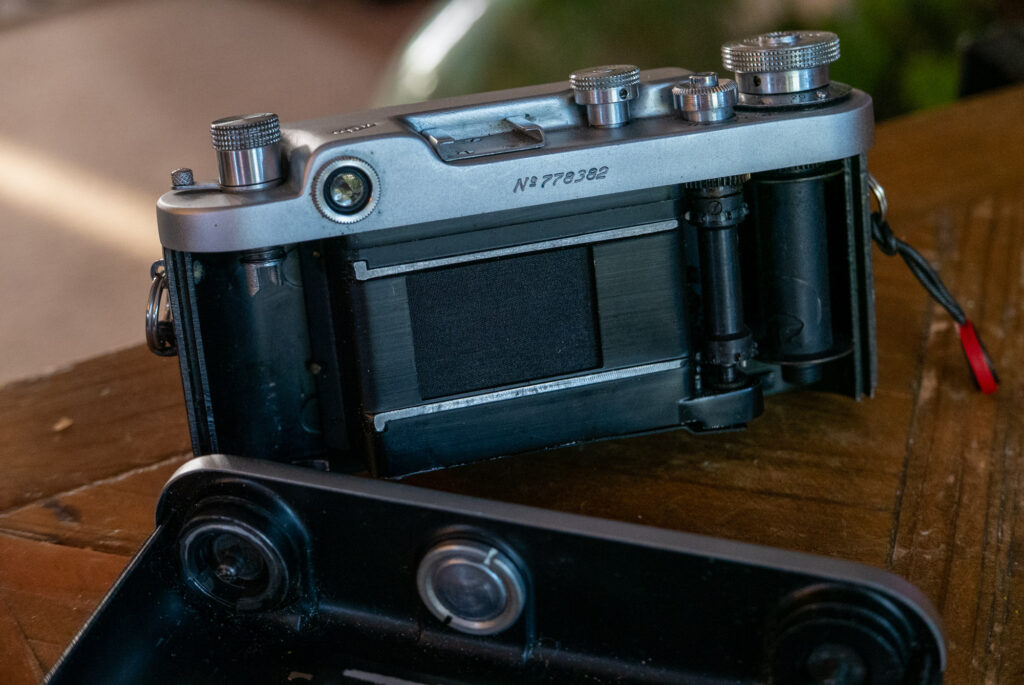
The back is removable making it easier to load than a lot of Leica cameras too.
Viewfinder
If you look at the later FED series cameras you will see the top plate is a lot taller. The advantage of this should be pretty obvious when looking at the cameras – the viewfinder is bigger. With that said, the finder on the FED-2 isn’t all that tiny, but it’s not exactly up there with a Leica M, far from it. In fact, looking through it, it feels smaller than the viewfinder window on the front of the camera might have you think. I am lucky with this copy that the finder is pretty much entirely free of haze and dust. It is quite dim, though this is really only noticeable in lower light. In day light it’s perfectly usable. It’s also worth noting that there are no frame lines in the viewfinder, it is just for 50mm framing. There’s obviously no parallax correction in the finder, so close-up framing might not be all that accurate either.
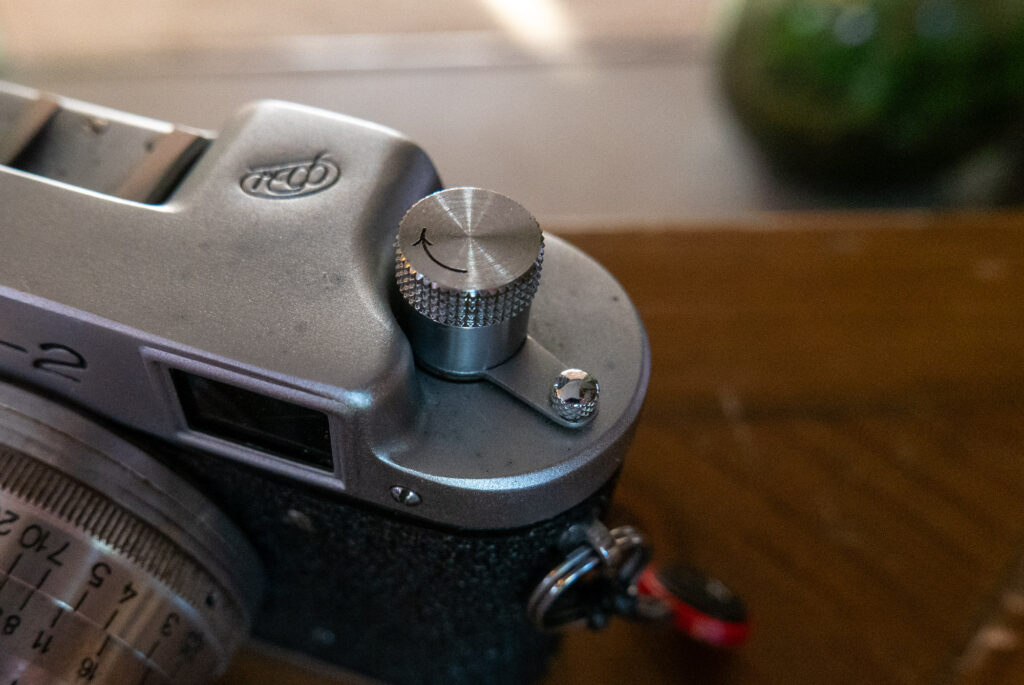
Finally, there’s also a diopter adjustment lever. When I first got the camera, I couldn’t believe how blurry the viewfinder was. I then clocked the diopter adjustment lever, set it to my eye, and could barely believe how sharp it became. This is definitely a useful feature – not even Leica M cameras have one of these. The disadvantage is that it is quite lose on this camera and so I am constantly knocking it and then having to reset it to my eye.
Rangefinder
The overall viewfinder is also tinted slightly blue in my camera. By comparison, the circular and slightly soft-edged rangefinder patch isn’t blue-tinted, in fact it might be slightly warm-tinter. This helps to provide added contrast to the patch making it pretty easy to get a good sense of focus. As mentioned above, it also had a long rangefinder base length, apparently 68mm. There is a negative magnification in the viewfinder though, which will lower the effective base length, but it still feels pretty precise when focusing to me!
Controls and Dials
Starting on the top left shoulder of the camera, as mentioned is the diopter adjustment which sits under the rewind dial. The dial is quite small, so feels like it needs turning a lot to rewind the film. Fortunately it lifts upward away from the body of the camera which makes it easier to turn. To rewind the film, it’s worth noting that the solar around the shutter button needs pushing down and twisting to lock the button down.
Not a control or dial, but the next feature along the top plate is the cold shoe. Being a FED-2c, my camera has a flash sync port on the front of the top plate of the camera next to the round rangefinder window.
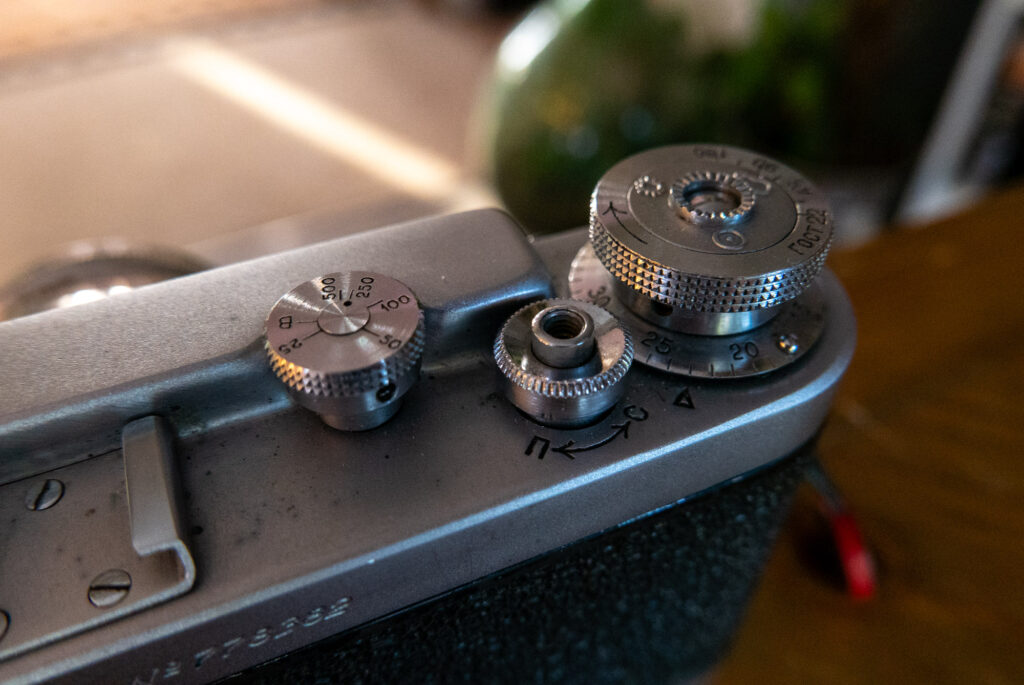
Next is the shutter control. Again, being a slightly earlier FED-2c, mine has B (for bulb) and then 1/25th, 1/50th, 1/100th, 1/250th and 1/500th speeds.
The shutter speed follows with the rewind collar, then on the top right shoulder there’s a film advance and shutter cock dial. This dial has a frame counter at its base and a film reminder dial on top. The reminder dial has three symbols – a sun, a light bulb and a circle with a dot in it (not sure what that’s supposed to signify…?). The film speed reminder is in GOST numbers from 22 to 180 – google tells me this is equivalent to 25 to 200 ISO, so not terribly useful even if you can remember the conversion.
Finally, on the right face of the camera there’s a self timer. I’m not insane, so I am not testing this feature – I don’t trust this things on any older cameras, so certainly don’t trust this one on a fairly elderly Soviet camera!
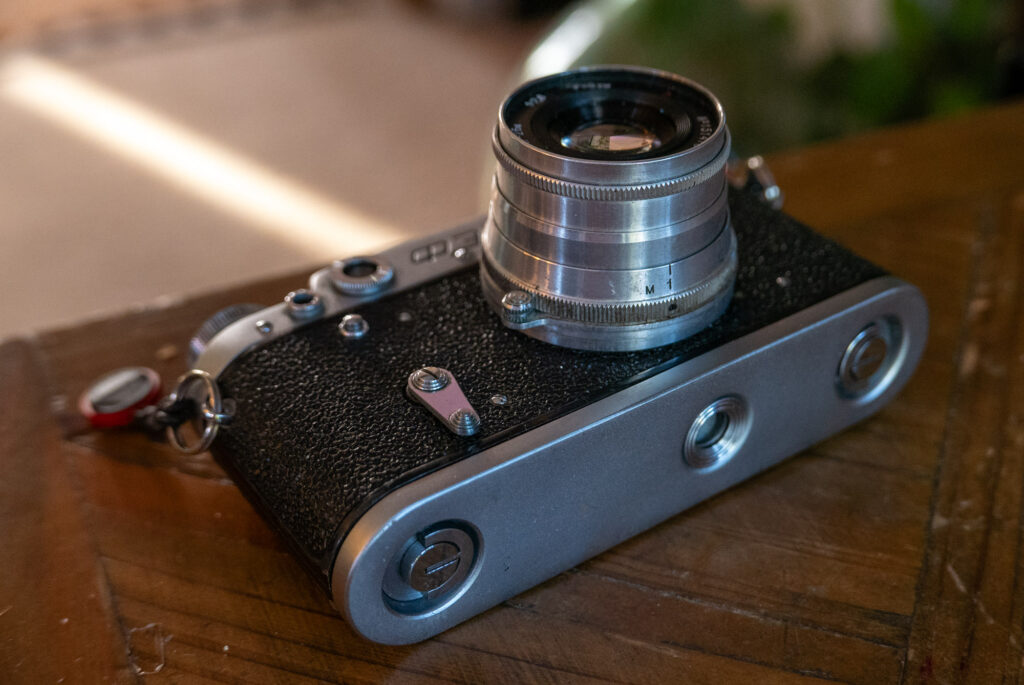
In use
For a large part, the only thing that makes this particular FED-2 not feel really great to use is the lens. I’m not reviewing the lens here, so I’m not going to let it impact my thoughts, but compared to the camera it is pretty loose feeling making the whole experience feel less precise. This doesn’t really surprise me mind – finding a soviet lens from this era that doesn’t feel like this before a pretty solid service is rare. Even after a service they can feel pretty crapy too.
Aside from the feel of the lens, I’ve found it to be a pretty nice camera to use. As mentioned, the diopter adjustment persistently de-setting itself is pretty annoying, and the creaking film advance also hints at this not being perfectly precise. As also mentioned, the viewfinder is a little small and dim, though with mine being clear of dust and haze, at least in daylight it’s perfectly pleasant to use.
If I was being super picky though, I suppose I might point out that the shutter button feels like it’s in a weird place. But then… one of my all-time favourite cameras is the Nikon F, so complaining about the position of the shutter button doesn’t feel like it is something I can really have to much of an issue with…!
Some Photos


More photos here
Final thoughts
It’s probably fair to say that I have been lucky with this particular copy – it’s in great condition and certainly appears to have had a fairly easy life. Though, I should at this point once again shout out Steve Dowling (Kosmofoto / Cameraburo) for selling me a very nice copy of the camera – I do have the advantage of knowing the guy, and I said I would write a review of the camera, so if I was a cynic, I might think he sent me a decent copy hoping it would get a good review. Fortunately, I don’t need to be a cynic when it comes to Steve – he is a good guy, and is definitely a retailer of cameras I would recommend as being honest and trustworthy.
All that aside, if you can get yourself a decent copy, I do think the FED-2 is a genuinely decent camera for the sort of money they go for. Being a Soviet camera, finding a decent one is possibly not going to be as easy as finding a decent Japanese camera from the same era maybe – though at this stage, buying a camera from the middle of last century isn’t without risk, regardless of brand… and at least here, the financial risk is pretty low. Of course, the FED-2 definitely has its little niggles and quirks, but what cameras from this era don’t? For me, working around and with these sorts of quirks is part of the fun anyway.
Ultimately, for me personally, I am very happy with the purchase of this FED-2. I have been very pleasantly surprised by how nice this particular camera is to use, and indeed how solid it feels. It has absolutely scratched the itch I had for a Soviet rangefinder… I now have even more of an excuse to buy more 50mm Soviet lenses which I am not going to complain about either!
You can find more about the various versions of the FED-2 here on camera wiki
There’s also another review here on 35mmc
Shout out to Analogue Wonderland who develop and scan my film for me – more info on their services here
It’s also absolutely worth checking out Steve’s website Kosmo Foto here and his retail site Cameraburo here – maybe buy a camera off him too, just like me with 35mmc, he also needs support to keep doing what he’s doing! He’s a good guy too!
Share this post:

Comments
Paul Quellin on Fed-2 Soviet Rangefinder Review (with a little nod to Cameraburo)
Comment posted: 20/04/2026
Neil Lloyd on Fed-2 Soviet Rangefinder Review (with a little nod to Cameraburo)
Comment posted: 20/04/2026
Ibraar Hussain on Fed-2 Soviet Rangefinder Review (with a little nod to Cameraburo)
Comment posted: 20/04/2026
The lens is also pleasingly sharp and resolves well
Do you use an external light meter?
I am in the same (probably worse) skint boat so you’re not alone
Omar Tibi on Fed-2 Soviet Rangefinder Review (with a little nod to Cameraburo)
Comment posted: 20/04/2026
Not sure if Steve mentioned it, but some of the older FED-2 models came with different colors of Vulcanite, so there are blue and green FED-2s floating around out there! There's also a late model, paired with the Industar-61, that has a nylon body.
For Soviet cameras, lenses, and parts in America, Yuri/Fedka has always done me right. He knows his stuff and always makes sure his gear is in good, working order.
Have fun toting this around and shooting!
Comment posted: 20/04/2026
Charles Young on Fed-2 Soviet Rangefinder Review (with a little nod to Cameraburo)
Comment posted: 20/04/2026
I struggled with the film take-up spool in the Fed. I resolved the problem by attaching the film to the takeup spool with a bit of Scotch tape.
A few years ago I went a group tour to China. The others were shooting with small digital cameras. They said I was the guy with the BIG camera!
Charles Young on Fed-2 Soviet Rangefinder Review (with a little nod to Cameraburo)
Comment posted: 20/04/2026
Russ Rosener on Fed-2 Soviet Rangefinder Review (with a little nod to Cameraburo)
Comment posted: 20/04/2026
Walter Reumkens on Fed-2 Soviet Rangefinder Review (with a little nod to Cameraburo)
Comment posted: 20/04/2026
Jeffery Luhn on Fed-2 Soviet Rangefinder Review (with a little nod to Cameraburo)
Comment posted: 20/04/2026
Nice review of the Fed-2! I've owned a number of Soviet era cameras because a high school student of mine was from Ukraine and when she told me her grandfather (retired camera store owner!) was coming for a visit I asked,
"Do you think he could bring me a couple Soviet era cameras?" Bingo jackpot!!!! He brought a suitcase full to sell in the US. I helped him list his cameras on eBay and he gave me deals on two Movkva 120s, a Zorki, and a nice Fed 3. He drank me under the table with Russian vodka and his granddaughter had to drive me home. The next morning I had a vicious hangover and four nice cameras!!! The Mockva cameras are very good, but oddly laid out. The Zorki never worked well, but looked interesting. The Fed-3 operates flawlessly and is a favorite. I lost contact with the family, but heard that they emigrated to Germany when the war broke out. Safe, I hope. When I use these cameras I get a faux headache, but it goes away!
Mike Brooks on Fed-2 Soviet Rangefinder Review (with a little nod to Cameraburo)
Comment posted: 21/04/2026
Michael Jardine on Fed-2 Soviet Rangefinder Review (with a little nod to Cameraburo)
Comment posted: 21/04/2026
Kodachromeguy on Fed-2 Soviet Rangefinder Review (with a little nod to Cameraburo)
Comment posted: 22/04/2026
Geoff Chaplin on Fed-2 Soviet Rangefinder Review (with a little nod to Cameraburo)
Comment posted: 26/04/2026
Charles Young on Fed-2 Soviet Rangefinder Review (with a little nod to Cameraburo)
Comment posted: 18/05/2026
I set the exposure by using a selenium cell exposure meter.
NO BATTERIES TO MESS WITH!