

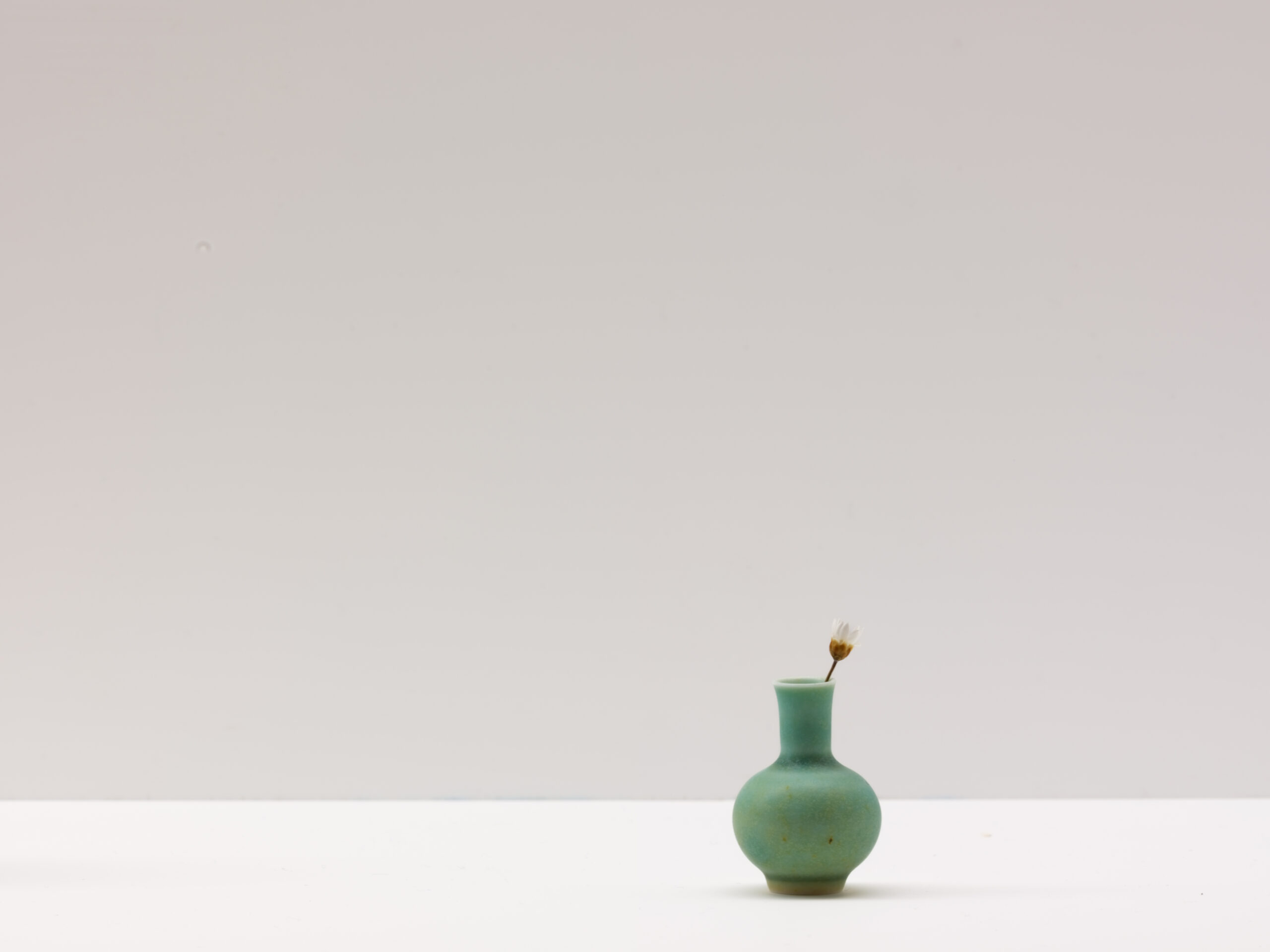
This article documents a close-up photographic study of miniature ceramic vases using a Fujifilm GFX 100 II medium format camera (sensor size 33×44 mm, 102 megapixels) and a few GF lenses. I was asked by the Fujifilm House of Photography in London, where a small collection of pots by the artist Yuta Segawa is on display, to conduct this project. None of the objects exceeds six or seven centimetres in height.
My aim was not to create a record of these objects, but among other things, to test how far a viewer’s perception of the size of an object could be manipulated through in-camera decisions such as choice of lens, working distance or depth of focus. In macro photography, small changes in these parameters can alter how an object is read by those looking at a photograph of it.
Working with the GF 110mm macro tilt-shift lens, alongside other GF lenses of my choice, I approached the objects with a deliberate constraint. I did not allow the work to drift towards technical demonstration or straightforward product documentation.
I used Laura Wingfield, a character in Tennessee Williams’ The Glass Menagerie, as inspiration for a way of looking at objects, and aimed to transfer her gaze to this project.
The character Laura Wingfield in Tennessee Williams’ The Glass Menagerie, gave me a reference point for how to look at small objects.
Let me explain. In the play, Laura lives with her mother, Amanda, and her brother, Tom, in a household that can barely make ends meet during the Depression. Each of them finds a different way of coping. Laura turns inwards, withdrawing into a world shaped by her collection of glass animals.
What interested me in the play was how those miniature glass objects gain weight and presence through Laura’s attention. I wanted to borrow her gaze. I set myself the task of recreating how she sees her collection (as a world she retreats into) and applying that way of seeing to photographing Segawa’s tiny ceramics.
As part of my research to work out what this gaze actually was (or could be), I revisited the three screen adaptations of the play (easily found online) to see whether this way of looking was ever expressed visually. What stood out was that, although the glass animals are often shown and handled, the camera in those adaptations rarely adopts a perceptual position shaped by Laura’s attention. More often, it observes her looking at and interacting with the objects. The glass animals are part of the scene, but not part of a constructed way of seeing.
So, from this point on, I began to develop my own working approach.
Scale, Attention, and a Working Method
My first task was to explain to myself what this gaze was. In The Glass Menagerie, Laura’s glass animals do not change physically, yet they become “complete” when she looks at them. This means that their “psychological” or “perceived” scale is not something fixed by their actual size in the real world; it is produced through an act of looking.
Transferring all of that to my task of photographing the ceramic vases, I worked out how a small group of objects can be presented as a part of a self-contained visual world. It meant working very deliberately with framing and with focus. For example, using depth of field to guide attention across fragments of an object. Shallow focus, controlled distance, and positioning all contribute to a situation where only parts of the subject may be “fully present” (i.e. in focus) at any one time.
The tilt function on the GF 110mm macro lens became useful for my approach. Rather than using it to maximise the use of the depth of field that was available in any given set up, the tilt movement allowed the in-focus area to be placed very carefully on particular curved surfaces of the little vases, say, a rim at the top or on some other detail. It allowed me to work very deliberately.
At the same time, I sought to remove certain external references (e.g. hands, rulers, obvious environmental cues) in order to prevent the viewer from immediately realising that the object in a particular photograph is actually a miniature and not a life-size object.
Therefore, decisions I took on cropping, focus, and lens choice all became part of the creation of a particular perception. Seen in sequence, the resulting images behave like attention shifts. As if you are looking at details within a collection, and as you move your eyes, you may concentrate first on one aspect, then on something else, and so on.
Depth of Field, Magnification, Format, and Diffraction
At close focusing distances, depth of field in macro photography behaves differently from everyday photography. It becomes extremely shallow right away when you get close. It is influenced far more by magnification and working distance than by aperture alone. Even when stopped down, only a thin plane of the subject can be rendered sharply at any one time.
The tilt function on the GF 110mm macro lens moves the plane of focus so that it can be positioned where I wanted it, because, instead of being always parallel to the sensor as in any regular lens (or lens without movements), the focus plane could be made to follow rims, or edges, or some other surface. In practice, this meant that it was easier to place sharpness where it mattered or where I wanted it.
Shift movements were used alongside the tilt to maintain framing without altering camera position. This was easier than lifting or lowering the camera on the tripod. I could keep my eye on the electronic viewfinder turned 90 degrees upwards, and control the framing.
Focus stacking was used sparingly, typically in two frames, only when tilt alone could not provide sufficient depth where I wanted it. In many cases, tilt did reduce the number of stacked exposures that would have been required instead.
Diffraction itself is a natural optical effect that becomes more apparent as apertures get smaller. When dealing with high-resolution digital sensors, particularly those with small pixel pitches, the softening effect can sometimes begin to appear earlier in the aperture range than the format may suggest (e.g. diffraction appears at smaller apertures in medium format situations than smaller formats such as Full Frame, APS-C or Micro Four Thirds). In practical terms, this means that while stopping down improves depth of field, it eventually begins to affect fine detail.
There is no fixed “correct” aperture in macro work. It is always a compromise between sharpness, depth, and optical behaviour at a given working distance. For the 33×44 mm sensor I did not go beyond f/16.
Image Construction: Removing Scale
In Laura Wingfield’s mind, the glass menagerie takes on a sense of full-scale presence. That is her world.
This became the starting point for how I approached the photographic setup. To hide scale (so that the viewer would not immediately realise that the vases in the photograph are miniatures), I did a number of things. The camera was positioned at roughly the midpoint height of the vases, rather than above or below them. This horizontal alignment was important. It places the viewpoint in a neutral position, closer to how objects are typically encountered at human scale, rather than immediately signalling “miniature” through a top-down perspective. The second thing, is that objects were photographed on a simple shelf against a plain, light background, with diffuse overhead lighting. This controlled environment removed most external references that might reveal their true size too quickly (such as surrounding objects, hands, or complex spatial context.). Lens movements on the GF 110mm tilt-shift played a key role in aiding this task. The shift function allowed easy framing while keeping the camera body level. This preserved vertical lines and avoided perspective distortion that would otherwise introduce at least some cues about space and distance.
In combination, these decisions (camera height, background simplicity, controlled lighting, and lens shift) created a space in which the objects could appear as ceramic pieces of unknown size on a shelf. In this ambiguity, the viewer is not given a clear external reference point, and is instead left to infer size through attention to form, surface, and spatial relationship. You can now judge for yourself if the environment and positioning of the objects in the picture below achieve this. Could those vases be normal size?
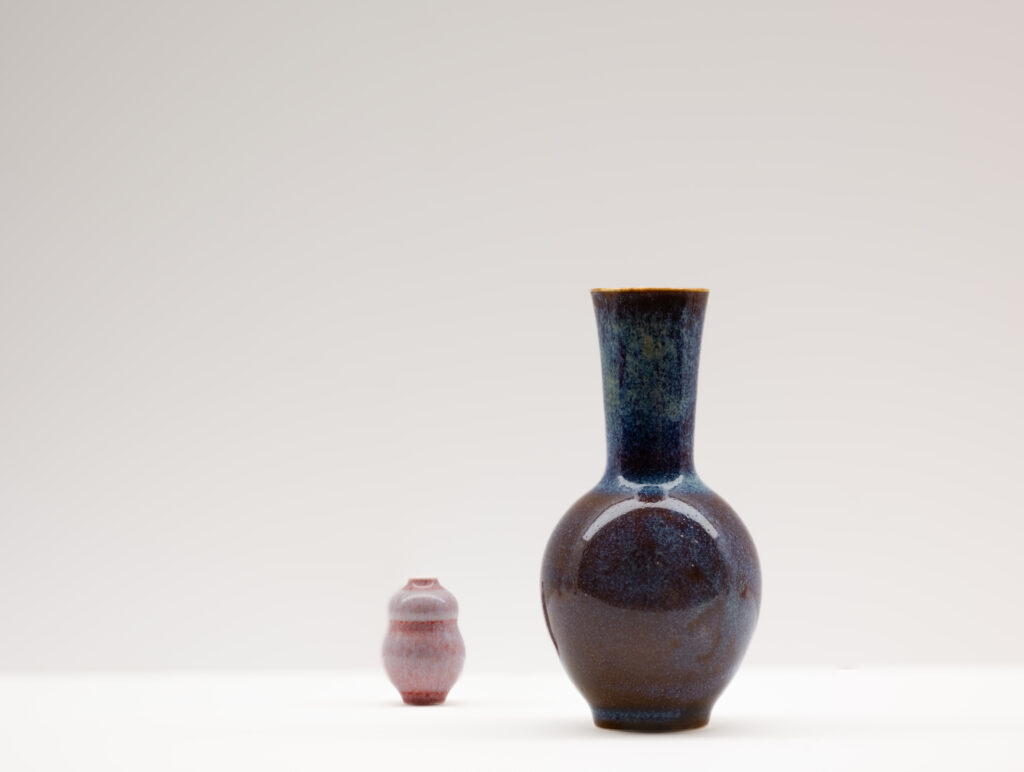
It gives a ±8.5° tilt and shifting of up to ±15mm. Rotation adjustment of up to ±90° can also be combined with a parallel or perpendicular tilt and shift adjustments. Its built-in sensors record the level of shift and lens rotation. The composition draws the eye to the objects and to the ambiguity of scale between them. The vases could be read as small objects on a shelf, or as forms that exist independently of scale altogether. Much depends on the viewer’s own experience of encountering objects in domestic space.
Lens Case Studies
The differences between the lenses were not only optical. In the way I used them for each picture, I hoped to invite the viewer to share my perception.
Can you tell at once that this is a miniature vase? Or that this is a miniature flower?
GF 110 mm Macro T/S (Tilt and Shift)
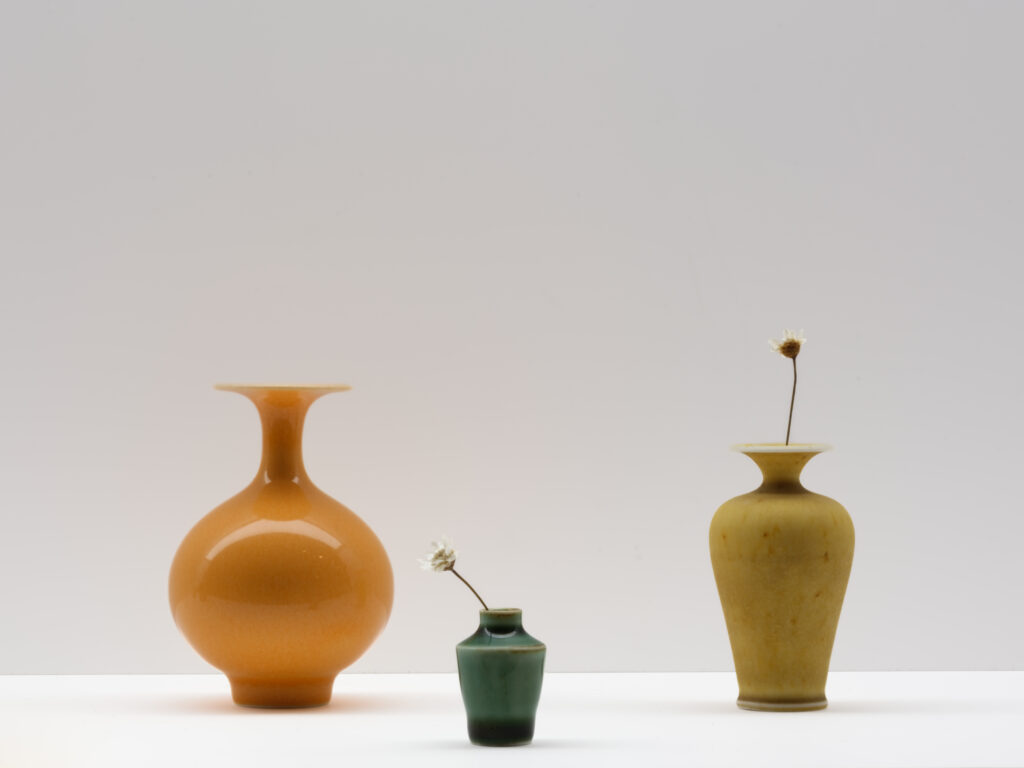
As I indicated already, the tilt-shift lens allowed control over the plane of focus, making it possible to place sharpness selectively across specific parts of the composition. By tilting the lens, I could align the focus plane with elements such as the rims of the tiny vases, dried flowers, and other intricate details, while allowing other areas to fall gradually out of focus. The shift function, used alongside tilt, helped maintain vertical lines and avoid perspective distortion, keeping the geometry of the scene stable while adjusting composition.
Focus becomes a form of attention: it does not describe everything equally (i.e. as if I had used bracketing for focus and everything would have been in focus), but instead, it is placed on a specific area of the composition. Had this been a moving image, it could have recorded the sliver of focus moving through the composition.
In this sense, attention is directional. It moves along surfaces, pauses on details, and releases the rest into softness. I aimed to construct “Laura’s gaze” through selective sharpness.
At the same time, the composition used could have been the same if the objects had been full-size, reinforcing the ambiguity of size. So a question to the reader is now in order. The objects are small, but in the photograph, do they seem to you like miniatures or life-size?
Technical note (GF 110 macro T/S)
Both tilt and shift movements were used. In some cases, two images were combined using focus stacking to slightly extend the area of sharpness. However, I limited this, as I was interested in preserving a selective, almost dream-like rendering, rather than bringing everything into full focus through, for example, the creation of a deeper stack.
It gives a ±8.5° tilt and shifting of up to ±15mm. The rotation adjustment of up to ±90° can also be combined with a parallel or perpendicular tilt and shift adjustments. Its built-in sensors record the level of shift and lens rotation.
Cropping into an image created with the GF 110 macro T/S
The available resolution (100 megapixels from a 33×44 mm sensor) offers safe scope for cropping. This works well, provided that the point of focus actually falls within the area you crop into. This is crucial; otherwise, you are simply enlarging blur.
In my case, I wanted to focus on details in the glaze, including its small imperfections. At this scale, these become clearly visible and can be used, in terms of “Laura’s gaze”, to suggest the close inspection of a small part of an imagined world.
At the same time, these details can also point to something more grounded: the presence of traditional craftsmanship in the ceramic vases, with those very imperfections as evidence. As the artist explains online, this “hand-made” quality (where imperfections are left visible) is inspired by William Morris and the Arts and Crafts movement.
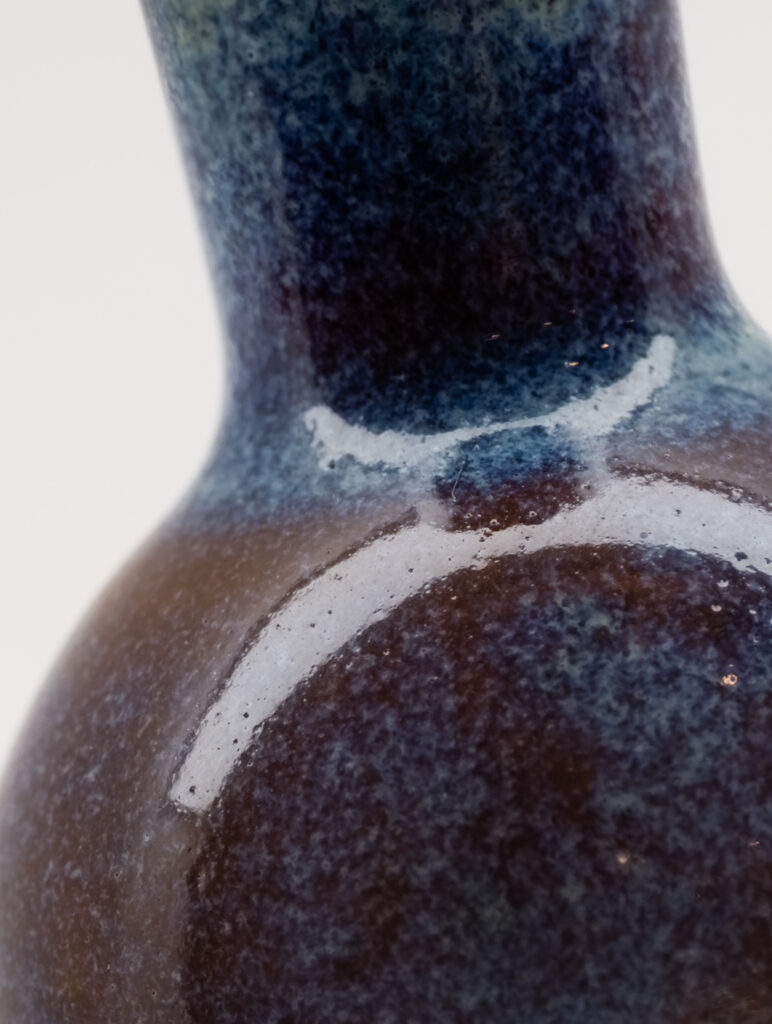
This is close to how Laura engages with her glass animals: she does not take them in all at once, but attends to them in parts, giving each fragment its own presence.
The tight crop strengthens the idea that a partial view could perhaps stand in for the whole through the workings of the viewer’s imagination. The photograph moves away from simply describing an object and can instead be seen as showing a way of seeing, where attention narrows, and the subject is experienced through fragments rather than as a complete overview.
GF 500mm f/5.6 Telephoto “Tele-Macro”
Although not a macro lens in the conventional sense, the GF 500mm f/5.6 lens offers close focusing capability that extends its use into a sort of “tele-macro” approach. At its minimum focusing distance of 2.75 metres, it achieves approximately 0.2x magnification, which allows frame-filling compositions of very small objects. This makes it possible to work at a scale where miniature subjects can be rendered with a strong sense of presence within the frame. (The characteristic also lends itself for some specialist applications such as surgical photography, where frame-filling detail can be captured from a working distance that avoids physical proximity.)
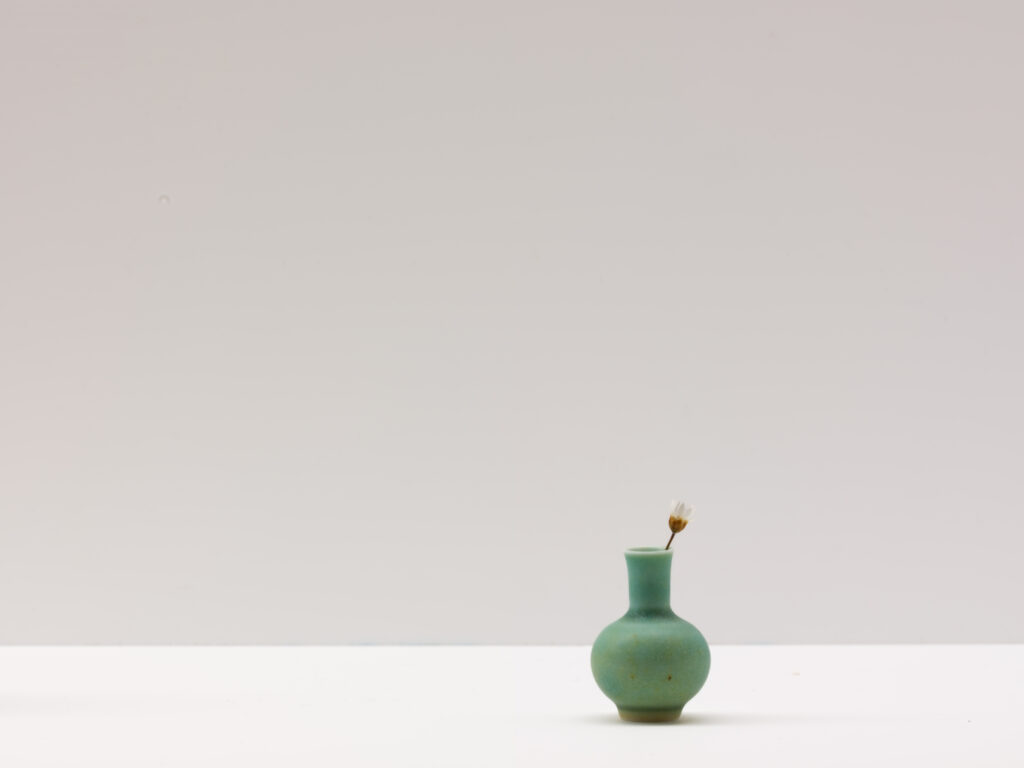
The long focal length (equivalent to a 396mm lens in 35mm terms), introduces compression of space. This effect plays a central role in how scale is obscured in these photographs. Depth cues that would normally signal the true size of the objects are reduced, and spatial relationships are drawn closer together within the frame. Again, as in some of the photographs using the GF 110mm T/S lens, a miniature vase can be read in the photograph as life-size depending on what surrounds it and how those relationships are arranged.
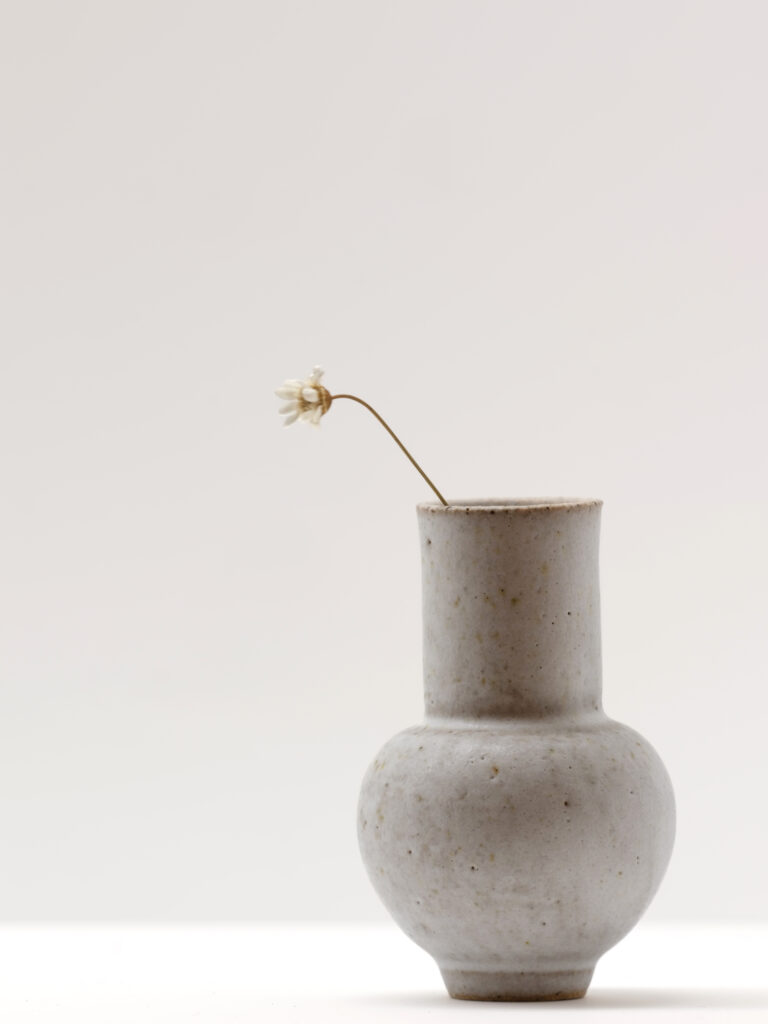
In these images, the arrangement begins to feel like something you might see at full scale. The positioning could just as easily belong on a shelf in a sitting room. In other words, it follows a spatial logic that would not feel out of place in a larger environment.
The tiny dried flowers help reinforce this reading. They establish a sense of relational scale within the frame, making the scene feel more grounded and believable.
The effect is strengthened by lens compression. These images were made with the GF 500 mm lens, from a distance of about three metres. Here, the background is seamless and white, but if it had included detail, the long lens would have changed how those elements are perceived. The familiar “flattening” effect brings background elements into closer visual proximity with the subject than they physically occupy.
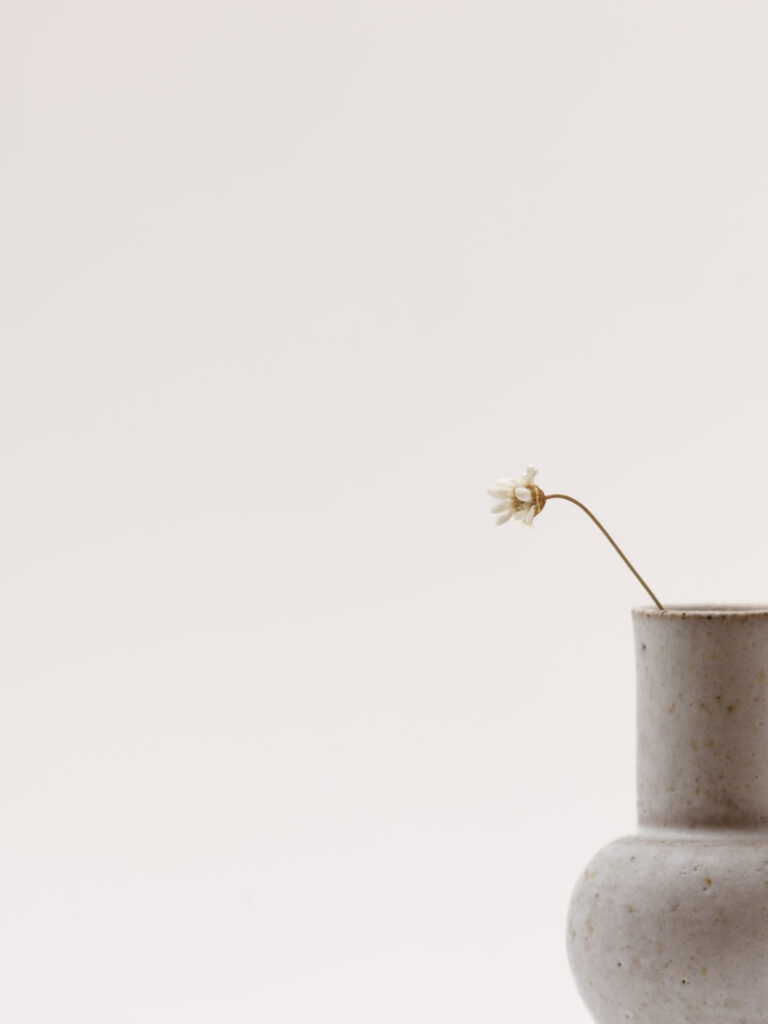
Is it an effective visual trick? At first glance, it could read as ordinary in scale, perhaps a vase for a coffee table, the sort that might be filled with flowers from the garden.
The ability to produce a frame-filling image from a distance reinforces the idea that scale is not something inherent to the object itself. If you were to judge only from the photograph, scale becomes something constructed through visual conditions.
In this sense, “Laura’s gaze” works through the compression and reorganisation of space, allowing small objects to exist, for a moment, as if they were ordinary household size.
GF 30mm f/5.6 T/S (Reintroducing Scale Cues)
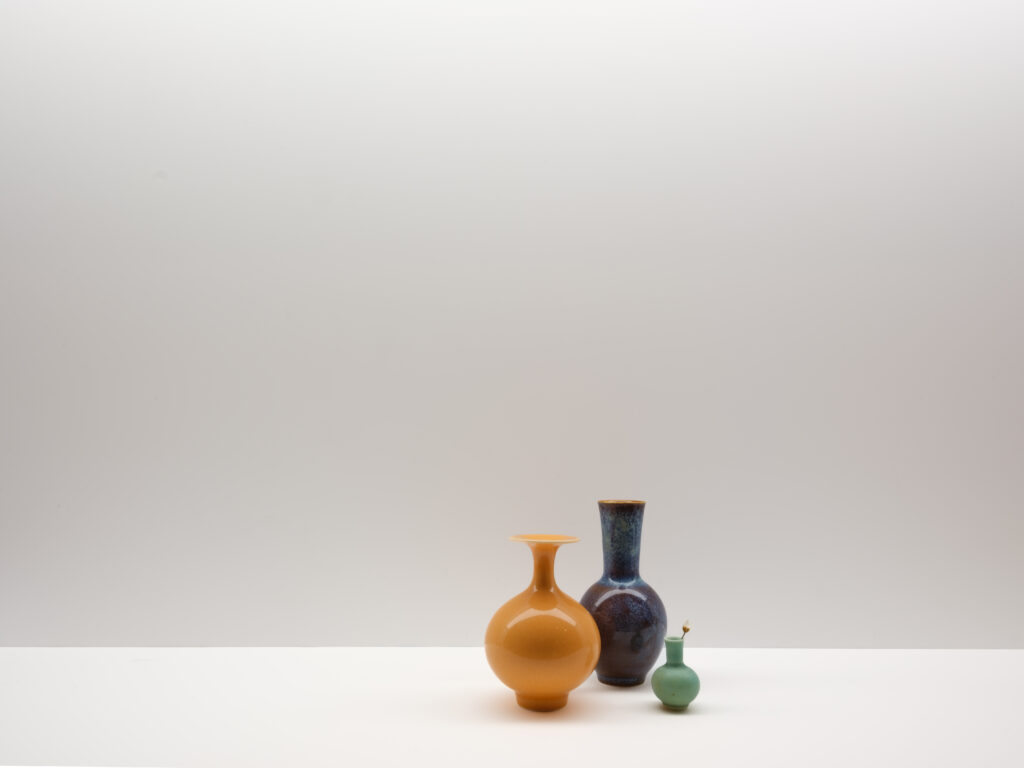
The GF 30mm f/5.6 T/S lens (equivalent to 24mm in 35mm terms) introduces a wider field of view that begins to re-establish spatial context within the frame, even with a seamless background. From this perspective, there are more visible cues that suggest the size of the environment in which the vases are placed.
As a result, the viewer is more likely to interpret the objects as small or as elements observed within a larger space that, in the photograph, appears to be viewed from a more distant position. Or, the viewer might begin to think they are small simply because they are seen from far away.
The wider angle of view and the elevated perspective introduce spatial information that had previously been reduced or removed when I was using longer lenses. The viewer is given more environmental context, and with it a framework for judging size that may be becoming clearer to read. The smallness of the objects becomes legible again in relation to their surroundings.
The size of the objects is defined in part by their position within an environment. In this sense, the use of the GF 30mm f/5.6 T/S lens demonstrates the boundaries of that gaze: once distance, context, and spatial detail become visible again, the image shifts away from size ambiguity and returns to a more direct reading of the objects as being on a miniature scale.
It gives a ±8.5° tilt and shifting of up to ±15mm. Rotation adjustment of up to ±90° can also be combined with a parallel or perpendicular tilt and shift adjustments. Its built-in sensors record the level of shift and lens rotation.
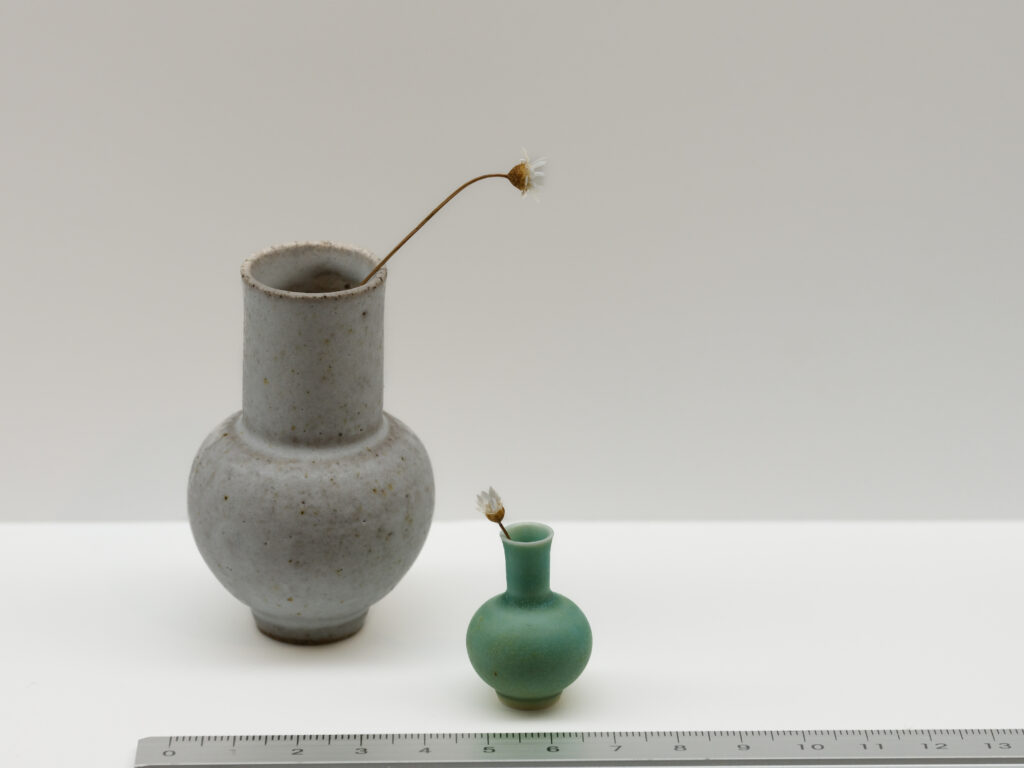
GF 120mm f/4 Macro, and now, there is a ruler in the photograph
A natural question arises as to why the autofocus system and focus bracketing were not used to produce extended depth of field across the entire composition. This approach would have allowed the vases to be rendered with uniform sharpness from front to back, creating a fully resolved image in which all elements are equally legible.
While this method has many practical applications, it did not align with the intention of my project. My aim was to preserve a more fragmented way of seeing, where only selected areas are brought into focus and others are allowed to fall away.
In this sense, the decision not to rely on full focus bracketing is not a rejection of the technology, but a deliberate choice about how perception was shaped within the project.
Conclusion:
I used the GF 110mm tilt-shift to direct focus across selected surfaces of the vases, placing sharpness where I felt it was needed, while allowing other areas to fall away. With the GF 500mm, I worked from a distance to achieve a compressed sense of space, where relationships between objects could be rearranged and scale became dependent on framing. The GF 30mm T/S reintroduced environmental context, bringing spatial cues back into view and making the size of the objects more immediately legible. The GF 120mm macro was used to construct a focus-stacked image, with a ruler in the frame, to confirm sizes to the viewer.
Across these decisions, scale is not treated as an intrinsic property of the objects. It is shaped through how I chose to present them in a photograph, i.e. how much of the scene I allowed to become in focus at any given moment, and how much environmental detail I chose to hold back.
The vases remain unchanged; they are what they are in the real world. But my way of looking at them, and recording them in the photographs, changes from frame to frame. I borrowed “Laura’s gaze” to look at the objects and their relationship with other vases and the place where they were located, and to reproduce that way of seeing in the photographs.
Some Further Notes, Technical and Otherwise.
• All work was done on a tripod using ambient light only. I did not use additional lighting or flash. These are not 1:1 macro images, but close-up studies made at lower magnifications. The use of macro lenses reflects the convenience of their close-focusing precision (e.g. long focus throw that facilitates finding the right “spot”) rather than a pursuit of maximum reproduction ratio.
• The two tilt and shift lenses are manual focus lenses.
• The camera was a Fujifilm GFX 100 II set to ISO 80. Length of exposures typically ranged from 0.5 to 3 seconds depending on lens and subject.
• The Fujifilm GFX100 II camera also includes a feature I did not use for this project, but could have (provided the tripod is completely stable and the subject remains still). This is the “pixel shift” function. It uses the camera’s in-body image stabilisation (IBIS) to move the sensor and capture up to 16 images. These are then combined in dedicated software to produce a single 400-megapixel .DNG file from the 100-megapixel sensor.
• Focusing was manual, using red focus peaking. The tilting viewfinder made low-angle work easier, as I was not working tethered. At times, I switched to a monochrome “film simulation” (LUT or picture profile). This made the peaking highlighting focus clearer in the viewfinder, while I continued to capture RAW files with full colour information.
• Apertures were generally set between f/11 and f/16. Even at these settings, depth of field at macro scale is extremely limited. I used tilt where needed to align the focus with the subject’s geometry, especially across curved surfaces, and only turned to focus stacking when tilt alone was not enough.
• Not to overstate the obvious, but the “tilt” function does not increase depth of field. It simply lets you place the available depth of field exactly where it is needed. In that sense, it helps you use depth of field more efficiently. It can also be combined with focus bracketing, meaning fewer frames may be needed to achieve the desired result.
• Lens choice was practical. Each lens was used simply for what it allowed in the moment.
• Shift movements were used for framing control without tilting the camera, which helped keep verticals straight and maintained consistent proportions. This was especially useful when working from slightly elevated or offset tripod positions.
• Focus stacking was used sparingly in this project. The camera can automatically bracket focus using autofocus, where the lens allows it. Whether focusing manually or automatically, the images must be combined outside the camera during post-production.
• A note when working in macro with different formats: what changes and what remains the same. At true 1:1 magnification, the lens projects a life-size image onto the sensor. This optical relationship does not change between formats. Whether that image falls on a medium format sensor, full frame (24×36 mm or thereabouts), APS-C (23.5 x 15.6 mm for those manufacturers who use the 1.5 crop), or smaller formats (micro four thirds is 17.3 x 13 mm and the crop factor is 2), the projection itself remains the same. What changes is how much of that image is recorded.
Smaller sensors capture a tighter portion of the image circle, which results in a narrower field of view and the impression of greater magnification when compared at equal output size. This is not an optical increase in magnification, but a difference in framing and subsequent enlargement.
This distinction becomes more noticeable in the resulting image, especially when prints or files are viewed at the same size. Smaller formats require more enlargement to reach that output size, which can make both detail and even optical imperfections (such as noise or diffraction) more visible.
• The world of macro and microphotography is vast, and this exercise is necessarily limited to the lenses I have mentioned and to what I chose to do with them. Within the Fujfifilm GFX system there are extension rings, as well as a plate that allows mounting a Fujfifilm GFX camera to the back of a 4×5 view camera, which in turn would be using a large format lens. There is the possibility of using a 1.4x teleconverter on the 500mm lens.
Beyond this, the range of third-party accessories and lenses is extensive: diopters could be placed in front of lenses, bellows systems, microscope attachments, macro bellows lenses, and even the adaptation (via smart adapters) of macro and tilt-shift lenses from full-frame systems, as well as macro focusing rails and more. There are also legacy medium format lenses and accessories from the film era, whose optics can cover the sensor far more generously than full-frame lenses, opening yet more combinations and possibilities.
• And a final point, do we need to recall that seeing is never a direct recording of the world, but an active process of interpretation? The brain constantly builds a sense of size, distance, and space from visual cues such as perspective, lighting, overlap, and familiar relationships between objects. Trompe-l’oeil works directly with this process. The same mechanism is at play in photography, where a flat image can still convincingly suggest depth, scale, and presence. The very effect of cinema and moving images is part of this same illusion, which can produce a convincing experience of a living world. When these cues are carefully arranged (or deliberately withheld), the mind can be led to misread a miniature as something full-scale, or to accept a constructed space as real.
Note: The word “menagerie” is traditionally used to describe a collection of animals, often kept for display. It is perhaps most familiar in this context through Tennessee Williams’ The Glass Menagerie, where the word refers to Laura’s small collection of glass animals. I extend the term here in a slightly broader, metaphorical sense to describe the grouping of miniature ceramic pots I photographed. While no animals are involved, the sense of a carefully assembled, varied, and intimate collection remains, and it is this quality that the word is intended to evoke.
Featured Image: Fujinon GF 500 mm, f/5.6
Share this post:

Comments
Charles Young on A Menagerie of Miniatures – Photographing a dollhouse-size world
Comment posted: 24/05/2026
Chuck
Comment posted: 24/05/2026
Bill Brown on A Menagerie of Miniatures – Photographing a dollhouse-size world
Comment posted: 24/05/2026
I create miniature original works with graphite, colored pencils and gouache. As a young boy I painted my Hot Wheels in exacting detail to match actual cars on the drag racing circuit. I recently began photographing those cars from the 1970's. Your description of intent and process is very helpful. You might enjoy the work of this artist: https://www.jeraldmelberg.com/artists/35-christopher-clamp/works/1-paintings/21031-christopher-clamp-cat-s-game-ii-2023/
Thanks for the interesting Post and I think your next step would be to print the images as if the scale was life sized. Maybe 24" - 30" ?
Comment posted: 24/05/2026
Michael Flory on A Menagerie of Miniatures – Photographing a dollhouse-size world
Comment posted: 24/05/2026
Comment posted: 24/05/2026
Art Meripol on A Menagerie of Miniatures – Photographing a dollhouse-size world
Comment posted: 24/05/2026
Comment posted: 24/05/2026
Comment posted: 24/05/2026
Comment posted: 24/05/2026
Comment posted: 24/05/2026
Gary Smith on A Menagerie of Miniatures – Photographing a dollhouse-size world
Comment posted: 24/05/2026
Comment posted: 24/05/2026
Michael McGrath on A Menagerie of Miniatures – Photographing a dollhouse-size world
Comment posted: 23/06/2026
Comment posted: 23/06/2026