

The French composer Maurice Ravel, whom you likely know from his ubiquitous Bolero, lost his battle with history. Despite his protestations, he is now labeled an Impressionist, lumped together with the other titan of the movement, Claude Debussy.
History’s confusion is understandable. On the surface, Ravel and Debussy sound similar enough with their non-functional harmonies, whole-tone scales, and dreamy orchestrations. But where Debussy embodied impressionism in the purest sense, writing music with broad gestures that breezily suggested other gestures, Ravel was a Swiss watchmaker; every note served an exacting architectural purpose, to the harmony, to the melodic line, to the timbre, to the long-form structure of the piece.
Ravel was really a neoclassicist. He did not want to be conflated with Debussy, but history didn’t care.
Poor Ravel’s mislabeling is not just a musicological curiosity. It happens to photographers too.
My friend recently ribbed me (gently) for being a landscape photographer. He knew full well I’d yet to reconcile my love for the subject with my indifference toward the genre. How is it possible to like shooting landscapes and yet feel so distant from landscape photography?
I found my answer in Ansel Adams, Henri Cartier-Bresson, and someone they both admired.
Ansel Adams and Henri Cartier-Bresson
Ansel Adams is to landscape photography what Henri Cartier-Bresson is to street photography. The casual observer can easily see the differences in what they shoot, but the curious observer understands the most interesting differences are in how and why they shoot.
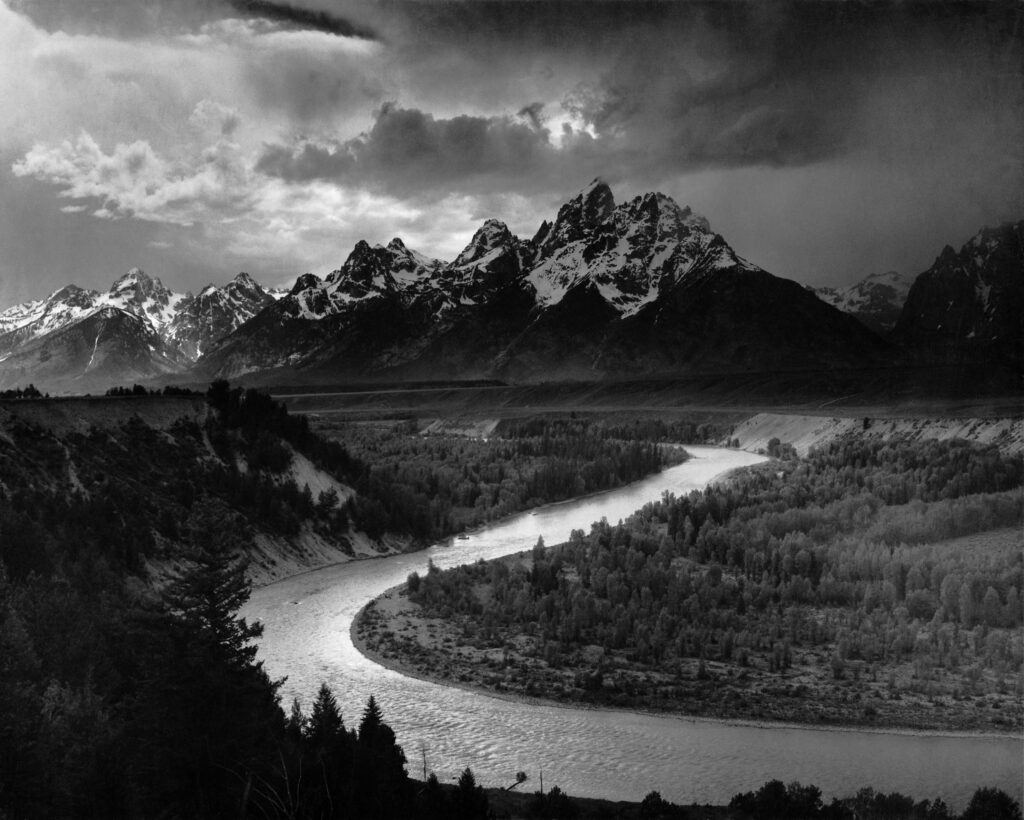
Adams constructed the photograph. He pre-visualized the outcomes, worked for hours in the field capturing what he needed on his tripod, and spent hours more in the darkroom transforming tonal values in service of that vision. All to express the sublimity of nature.
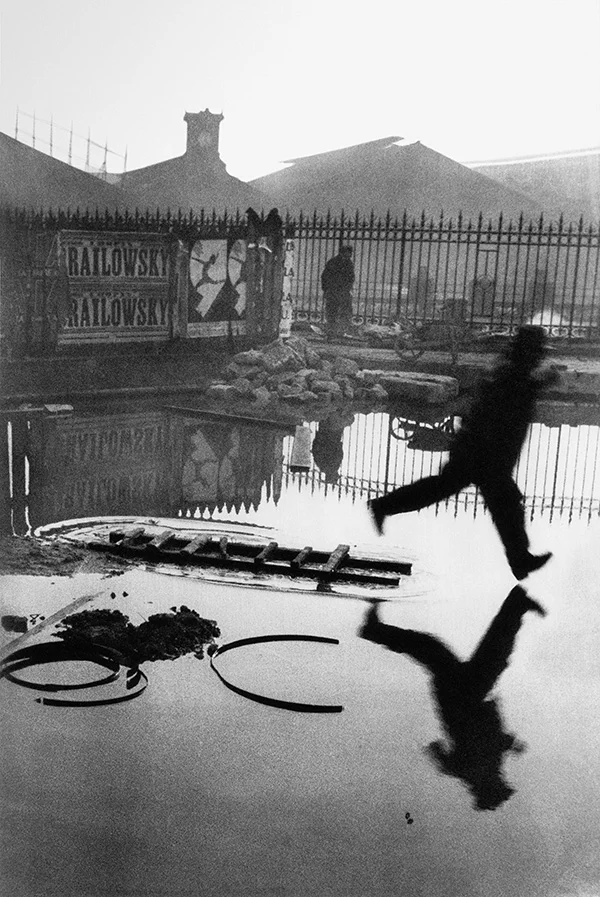
Bresson noticed the photograph. He famously refused to crop and avoided darkrooms. His tiny camera was not a tool of construction, but an extension of the eye, one responsible for noticing that unrepeatable confluence of geometry, light, and human-life: Bresson’s famous “decisive moment.”
What Their Practice Has Become
“The world is going to pieces and people like Adams… are photographing rocks!” – Henri Cartier-Bresson
Groundbreaking and brilliant as Adams was, his practice is often driven to caricature today: the golden hour pilgrimage to a geolocated overlook, the subject and composition reverse-engineered from someone else’s photo, the edit that screams for your attention, so you attend, only to find yourself at a loud spectacle that somehow managed to say nothing.
“I still believe there is a real social significance in a rock—a more important significance therein than in a line of unemployed.” – Ansel Adams
Caricatures exist for Bresson’s self-proclaimed inheritors too: any random street corner with some human in motion, unsettling invasions of privacy while on the hunt for pathos, humanism replaced with exploitation and voyeurism.
Neither genre nor their caricatures speak to me philosophically, so I no more want to be conflated with them than Ravel did with Impressionism, but I photograph landscapes… a lot. So I have to reckon with not feeling like a landscape photographer.
For a long time I thought maybe I existed on the midpoint of a line defined by Adams and Bresson. But there exists someone else, a third vertex ahead and respected by them both, who clarified how I see: Paul Strand.
Paul Strand
Paul Strand is not a household name, yet he casts a long shadow over both Adams and Bresson. The first photograph of his I ever saw was made a generation before Adams or Bresson captured their most celebrated photos. I was at an art museum, and it stopped me in my tracks.
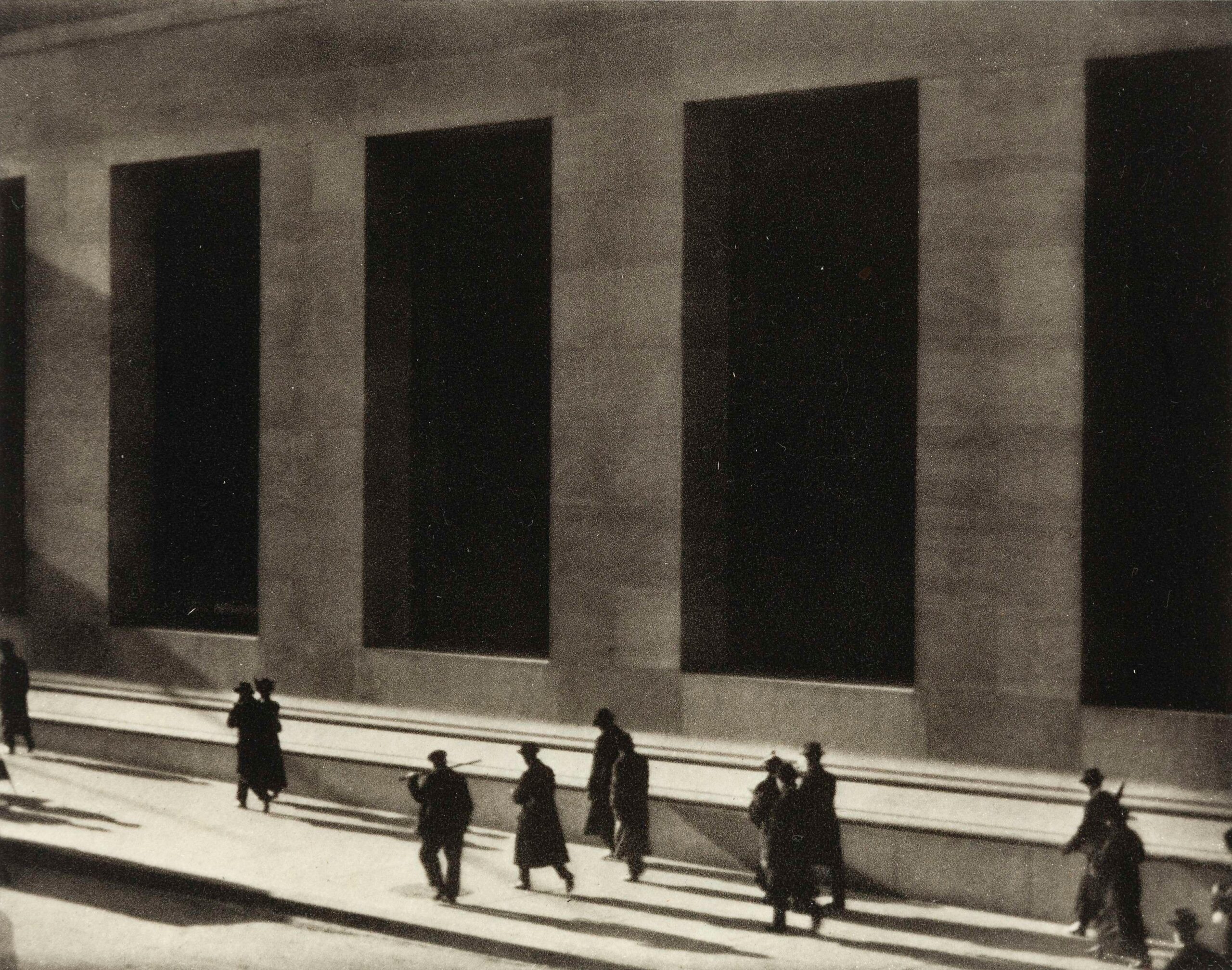
Look at the balance he achieved in an era without influencers peddling compositional dogma.
Look at the formal clarity he sculpted out of that brutal New Orleans afternoon light.
Look at the tonal control you will recognize in Adams’ iconic vistas.
Look at Bresson’s decisive moment as it contrasts the architectural and humanistic stillness.
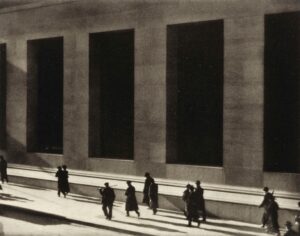
There is no performance. The figures are not posed. The scene is not arranged. And yet the geometry of light, architecture, and human life feels as inevitable as Adams’ mountains and as spontaneous as Bresson’s stolen moments.
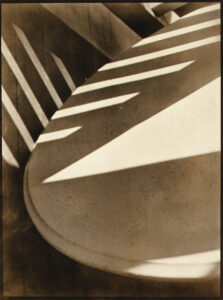
Strand thought about the rectangle of the photograph the way an architect thinks about a building: every element had to justify its presence and contribute to the whole. He was deeply influenced by Cubism, and you can feel it in how he organized space. Shapes interlock. A shadow isn’t so much a shadow as a geometric form in dialogue with the object it is cast upon. He was applying Cubist spatial logic to the real world as we see it.
Strand’s sculpture of light is equally rigorous. He wasn’t interested in pretty or moody light. He was interested in revelatory light, light that described surfaces and separated planes. Rather than merely glow, they clarify in their refusal to let atmospheric prettiness substitute for structure and substance.
He did this without losing sight of his humanism, his desire to dignify the marginalized, or his argument for a more equitable world. And he did all this at a time when photography was considered not a real art but rather a refuge for failed painters.
Strand elevated the craft, and it should be no wonder that Adams and Bresson admired him for the pioneering master that he is. He is far more than a midpoint between Adams and Bresson. He is the leading vertex from which both originate.
Paul Strand is the shapes and tones before an image resolves into a porch and its shadow.
What Ansel Adams, Henri Cartier-Bresson, and Paul Strand showed me was that subject matter and philosophy are not the same thing.
I am not so much a landscape photographer as I am a light-shape-and-color photographer. I have read somewhere the term for this is formalism.
And so my invitation to you is this:
Read between the lines.
Hear beyond the notes.
Look past the scene.
You know, the kind of thing Paul Strand would do.
______________
This is my first essay ever (not including the ones I had to write for school). Thank you so much for spending the time to read and reflect.
I will be happy to hear your thoughts here or on Instagram.
Derek Zhao
Share this post:

Comments
Chuck on I Photograph Landscapes, But I’m Not a Landscape Photographer – What Paul Strand taught me about looking past genre
Comment posted: 01/07/2026
Comment posted: 01/07/2026
DeeDee Yelverton on I Photograph Landscapes, But I’m Not a Landscape Photographer – What Paul Strand taught me about looking past genre
Comment posted: 01/07/2026
Comment posted: 01/07/2026
Bill Brown on I Photograph Landscapes, But I’m Not a Landscape Photographer – What Paul Strand taught me about looking past genre
Comment posted: 01/07/2026
Comment posted: 01/07/2026
Andrew L on I Photograph Landscapes, But I’m Not a Landscape Photographer – What Paul Strand taught me about looking past genre
Comment posted: 01/07/2026
Comment posted: 01/07/2026
Gary Smith on I Photograph Landscapes, But I’m Not a Landscape Photographer – What Paul Strand taught me about looking past genre
Comment posted: 01/07/2026
Comment posted: 01/07/2026
Ibraar Hussain on I Photograph Landscapes, But I’m Not a Landscape Photographer – What Paul Strand taught me about looking past genre
Comment posted: 01/07/2026
For me photography is just feeling - don’t Adams say ‘forget how it looks, how does it feel?’ . Or some such ? Whatever it was I think it is very true. It is other People who often bracket photographers into groups with labels, Don McCullin once said this, and I paraphrase “people label me as a war photographer - I’m not a war photographer, I’m just a photographer”.
As for me - I just like taking pictures, could be anything.
Comment posted: 01/07/2026
Comment posted: 01/07/2026
Comment posted: 01/07/2026
Comment posted: 01/07/2026
Comment posted: 01/07/2026
David Hume on I Photograph Landscapes, But I’m Not a Landscape Photographer – What Paul Strand taught me about looking past genre
Comment posted: 01/07/2026
Comment posted: 01/07/2026
Tony Warren on I Photograph Landscapes, But I’m Not a Landscape Photographer – What Paul Strand taught me about looking past genre
Comment posted: 02/07/2026
People tend be labelled more and more these days probably for a need to confirm their credentials as whatever they do. I champion the value of being an amateur, in the sens e that one does what one does for the love of doing it. So I agree with your closing words but add do it from the heart.
Comment posted: 02/07/2026
Michael Flory on I Photograph Landscapes, But I’m Not a Landscape Photographer – What Paul Strand taught me about looking past genre
Comment posted: 02/07/2026
Comment posted: 02/07/2026
Philip Bovey on I Photograph Landscapes, But I’m Not a Landscape Photographer – What Paul Strand taught me about looking past genre
Comment posted: 02/07/2026
Comment posted: 02/07/2026
Danilo Leonardi on I Photograph Landscapes, But I’m Not a Landscape Photographer – What Paul Strand taught me about looking past genre
Comment posted: 02/07/2026
Comment posted: 02/07/2026
Geoff Chaplin on I Photograph Landscapes, But I’m Not a Landscape Photographer – What Paul Strand taught me about looking past genre
Comment posted: 04/07/2026
Well written and thoughtful article, give us more.
Comment posted: 04/07/2026
Scott Ferguson on I Photograph Landscapes, But I’m Not a Landscape Photographer – What Paul Strand taught me about looking past genre
Comment posted: 04/07/2026
Welcome to 35mmc! I hope you continue to contribute, I like your reflections on two titans of the medium along with a very interesting, but lesser known, but still brilliant photographer. I've only been doing film photography as a fairly serious hobby/avocation for about 2 years, also coming from a background in film & television, and have been sharing my learning curve on 35mmc for about 18 months. I think being a part of the 35mmc community has been the single most significant factor in my improvement over than time -- the readership is a deep source of experience, ideas and inspiration, and from time to time friendly competition. Coming up with ideas for projects or posts has often shaped what I end up shooting, whether its trying out different lenses or film stocks, or techniques that I've learned from other more experienced photographers here, as well as our very generous and inclusive leader, Hamish. I tend to shoot whatever I'm interested in shooting at any given time, but also what is in front of me. For the first 8 months of shooting film, I was in Canada, and spent a lot of time shooting landscapes, very much inspired by and in the giant shadow of Ansel Adams, often on a Hasselblad. Since coming back to New York, I've gravitated toward shooting people on the streets, and while I love shooting on a Leica with a 50mm lens, and would love to be able to find the kinds of frames people like Bresson and Paul Strand to, I've ended up being most inspired by a chance encounter with one of the great living US street photographers, Jamel Shabazz, who managed as a non judgmental insider to share the pride and joy of people from communities like Harlem and the Bronx. In about 5 minutes he showed me how to make street portraiture a fun collaboration with your subject, and I've been shooting in that style more than any other for about a year.
I look forward to seeing some of your work here on 35mmc, but meanwhile am very impressed with your instagram feed!
Best,
s
Comment posted: 04/07/2026
Michael Murray on I Photograph Landscapes, But I’m Not a Landscape Photographer – What Paul Strand taught me about looking past genre
Comment posted: 22/09/2026
Comment posted: 22/09/2026