

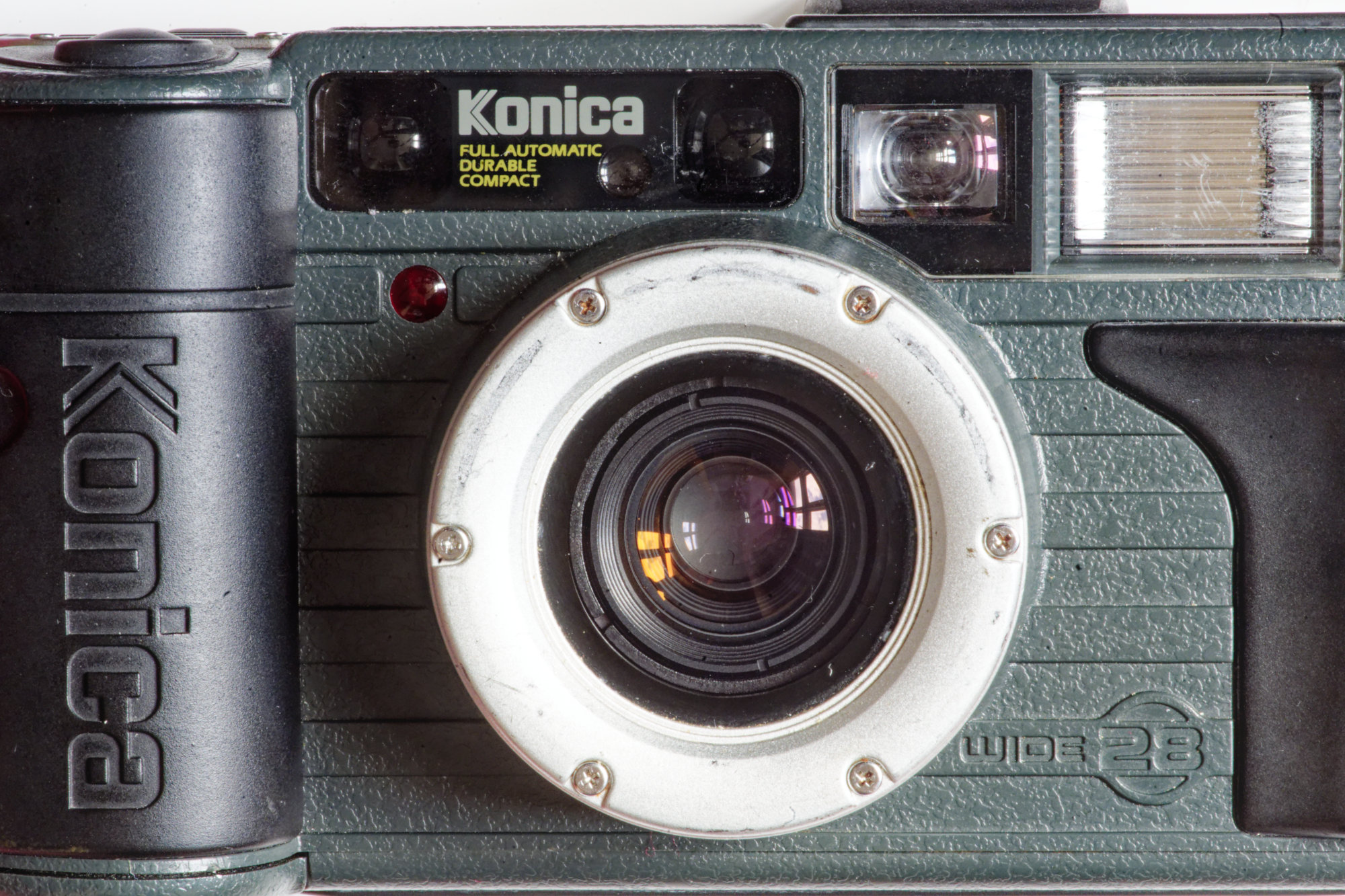
It isn’t pretty and, (despite what it says on the front of the camera) it’s not compact either. But the series of cameras known variously as the Konica Wide 28, Off-road Wide 28 and Genba Kantoku 28, are very much worthy of note.
The Genba Kantoku (On-site supervisor) concept
The first Genba Kantoku/MS-40 camera from 1988 was a ruggedised camera with a fixed 40mm Autofocus lens. Its general layout was similar to the twin-lens Konica MR 640. It was intended for use on construction sites where it might be subject to more knocks than a normal camera could be expected to survive. Its construction and JIS4 rating meant that it would take some rough handling and a fair amount of inclement weather.
Later versions had twin lenses, a zoom lens, a 35mm lens or (like the subject of this review) a 28mm lens.
The camera I’m reviewing was the first model with a 28mm lens. It was released in 1990. In western markets, the camera was called the ‘Wide 28’ or ‘Off-Road Wide’. These days, its major appeal is as a go-nearly-everywhere compact-ish camera with a genuinely wide lens.
Later versions
The specification and controls of these cameras remained reasonably standard over the next 11 years, but a number of variants were produced over time. I stress, I’ve not actually used any of these, so would be grateful for any corrections or insights in the comments.
- The ‘New’ Wide 28 had a shorter ‘snout’, around the lens. It seems to have retained the linear rear door catch. These cameras also have status lights outside the main viewfinder, which suggests that the viewfinder may have been redesigned.
- The next version of the Wide 28, released in 1994, was called the 28WB. It was largely similar, but had a higher weatherproof rating (JIS7, enabling it to be submerged in up to 1m of water for 30 minutes). In addition it had an autofocus system that could cope with close-up shots without needing a specific setting, a backlight compensation option and had a rotary rear door catch. This may have been for easier use with gloves or to get a better seal on the rear door.
- The 28WB Eco came out in 2001 and featured colour variants (orange seems quite common). It also had an infrared remote option. The ‘ECO’ tag seems to refer to more efficient flash charging.
- I’m not sure when the 28HG was released. It may have been limited to Japanese markets. I say this because the only user manual in English I could find had some quite curious/bizarre translations that suggest it was not widely distributed in the West. The HG looks to have been similar to the 28WB, but sporting a bigger flash with more output and a viewfinder positioned slightly right-of-centre in relation to the lens.
The body in question
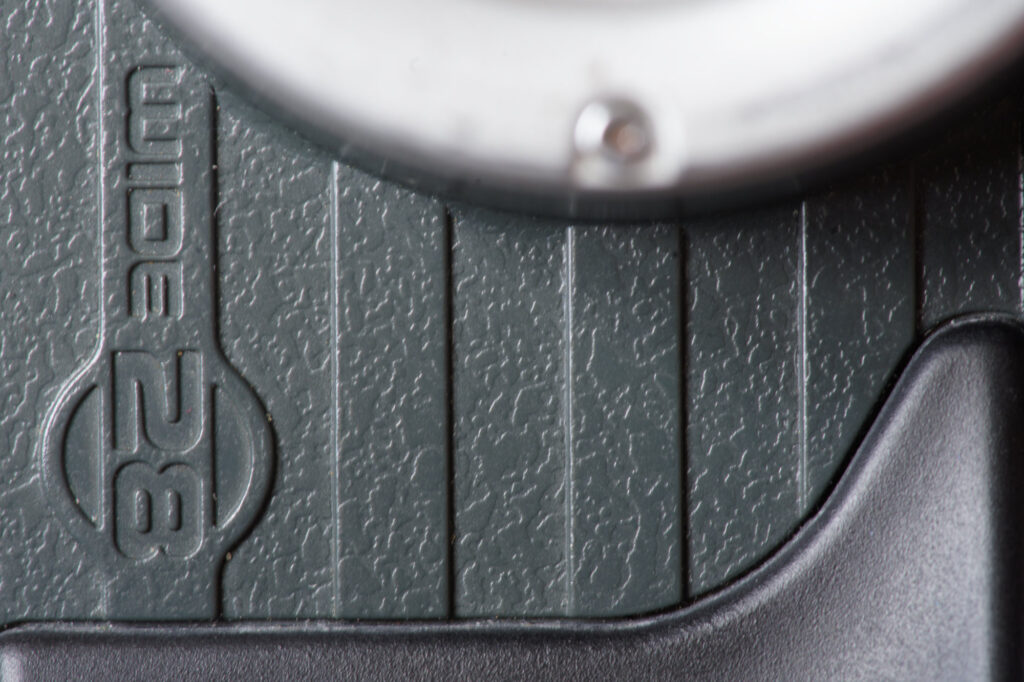
My copy is the original Wide 28, and as that is the name on the front, I will refer to it as that for the rest of this review.
As it is only IPX4/JIS4 rated, it can shower, but it can’t take a bath.
A look around the camera
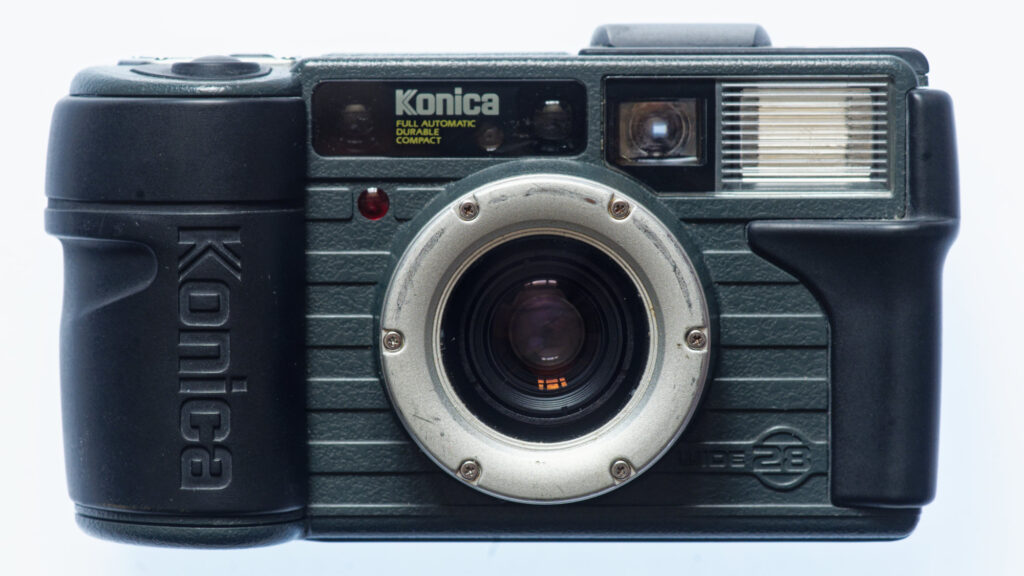
The Konica Wide 28 features large rubber grips at each end, which seem designed to keep hands out of the way of the lens and flash. Note the top-plate ‘bump’ above the viewfinder, which is one of the distinguishing features between the original and ‘New’ versions of the Wide 28. The two windows on either side of the horizontal ‘Konica’ logo are for the AF system. The CdS cell for automatic exposure is just beneath the ‘a’ of ‘Konica’.
Placement of the screws around the lens is slightly different to the ‘New’ and WD versions. The relatively high amount of scuffing on the silver ring on an otherwise quite clean camera might be due to the lens hump sticking out a bit more than on the later cameras. The red LED North-West of the lens, lights when the shutter fires and flashes in self-timer mode while the top-plate LCD counts down from 10.
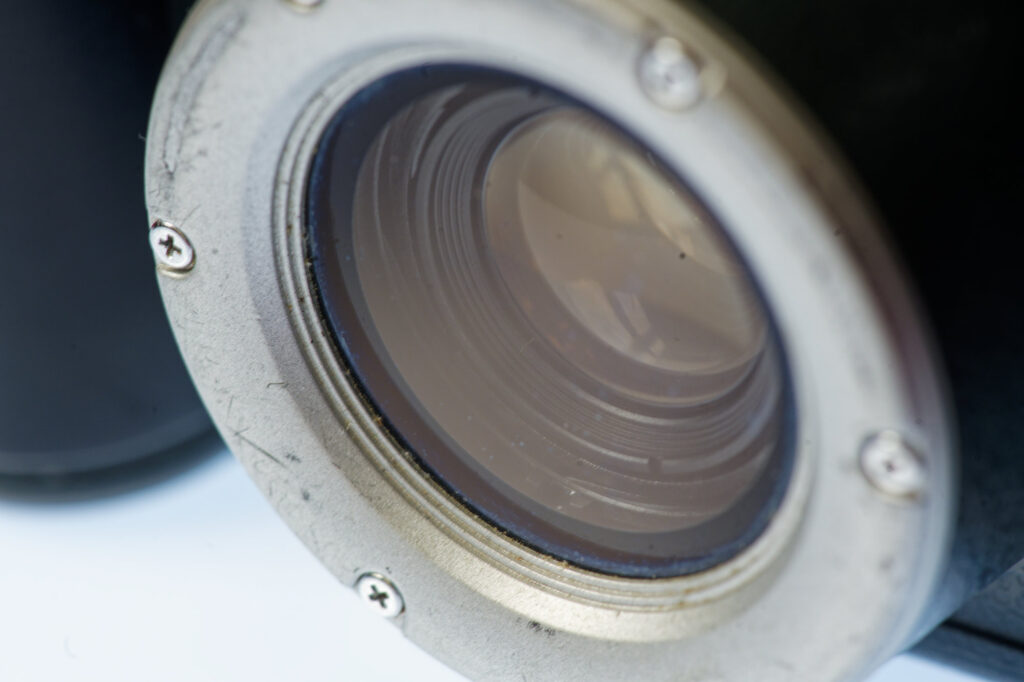
The lens consists of 8 elements in 7 groups, with a maximum aperture of f/3.5. The shutter goes from 1/4 to 1/280 – if you are in ‘flash off’ mode and the auto exposure doesn’t think 1/4 at f/3.5 is sufficient, it will give a 2 second exposure, but there doesn’t seem to be a gradient between 1/4 and 2 seconds – I presume it stops down the lens slightly to give the correct exposure with the 2-second exposure. The aperture goes from circular to a concave kite shape as it stops down.
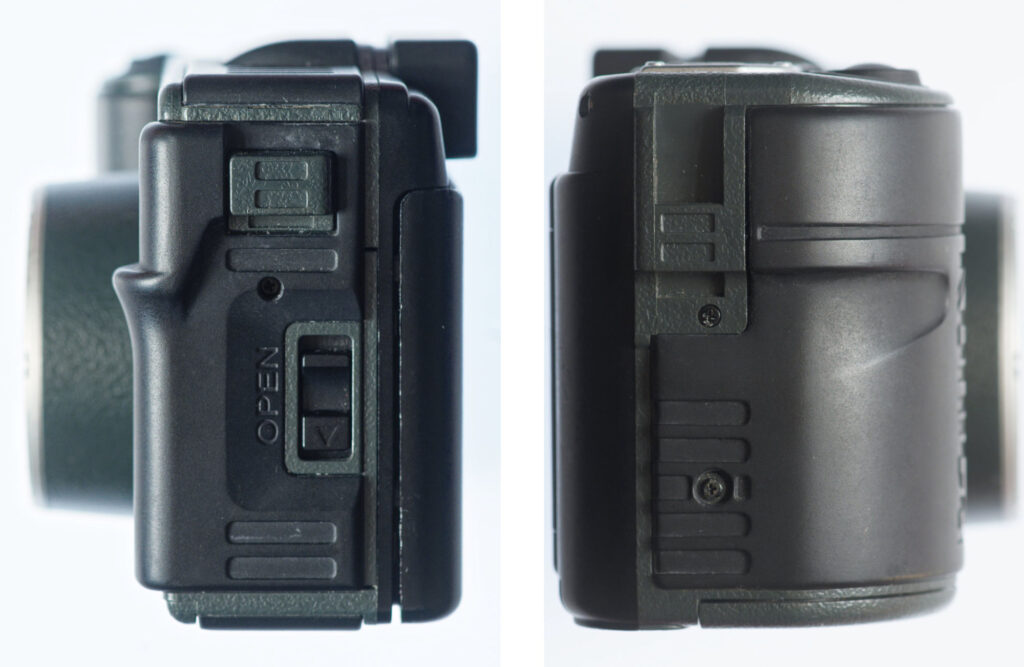
The ends of the camera are suitably clad in robust rubber.
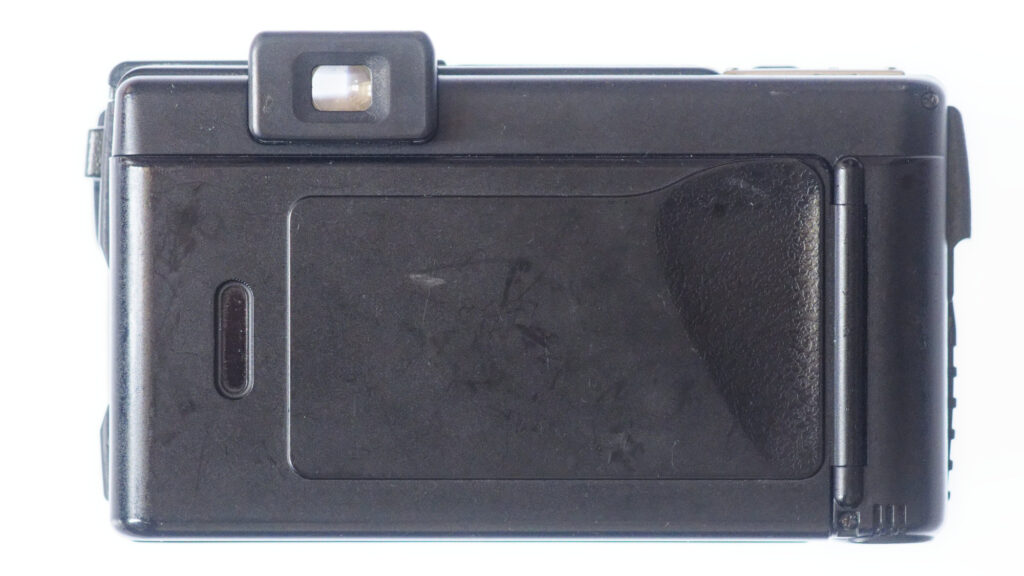
The rear of the Konica Wide 28 is relatively featureless on this (non-databack) model. Note the window in the film door to show the cassette loaded.
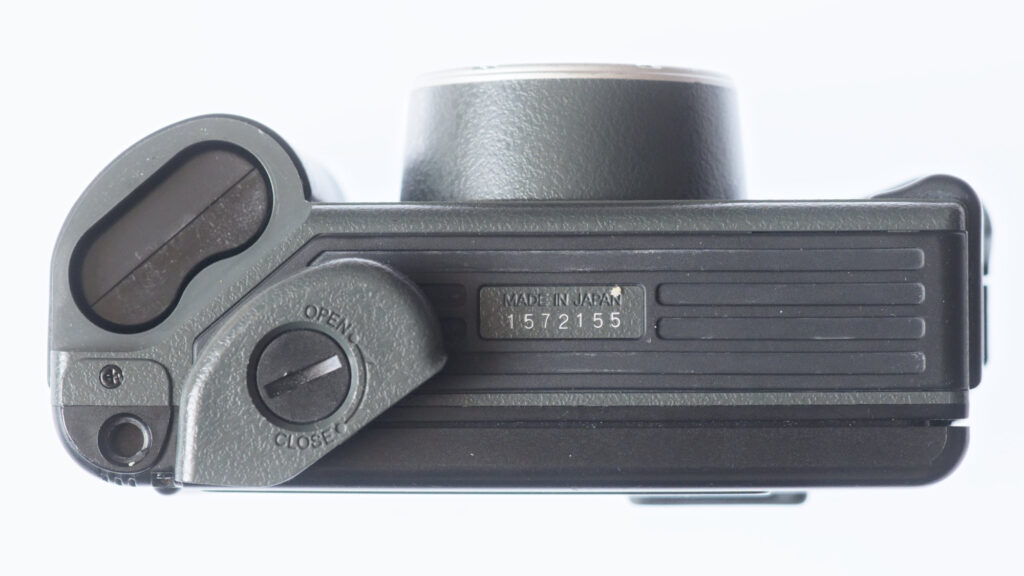
The battery door for the 2CR5 battery can be opened with thumb-pressure and is completely detachable (so check it is there before you buy used), Note the placement of the tripod bush, which looks like a bit of an afterthought. Not ideal, but there if you need it.
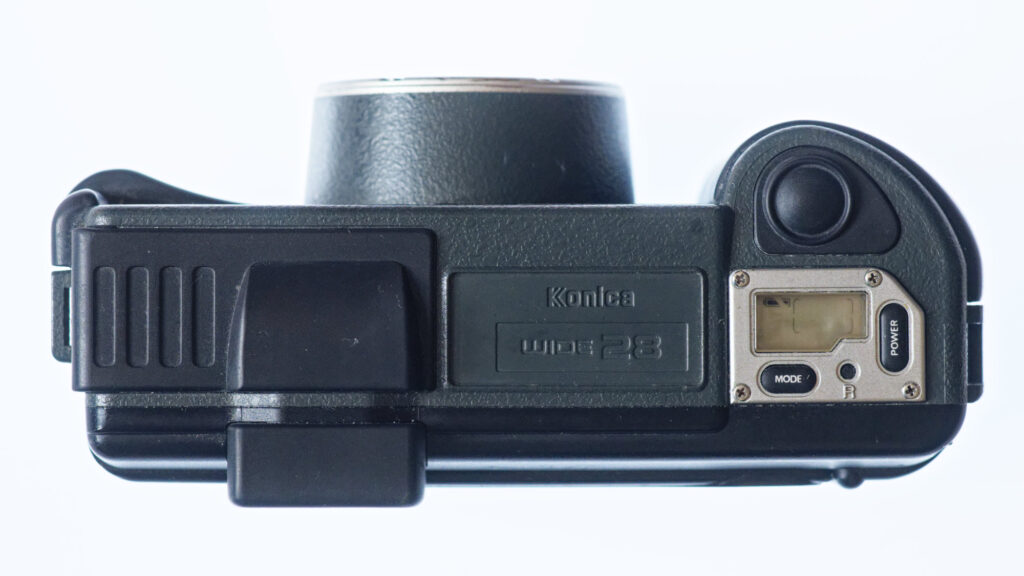
Note how much the lens sticks out beyond the grip on the right on this original model. There is no shoe (I guess adding a hot shoe might have compromised the JIS4 rating). Many reviews mention a little name holder insert on other models, but this one seems to only have a space where a paper label could be stuck, without any grooves to take an insert.
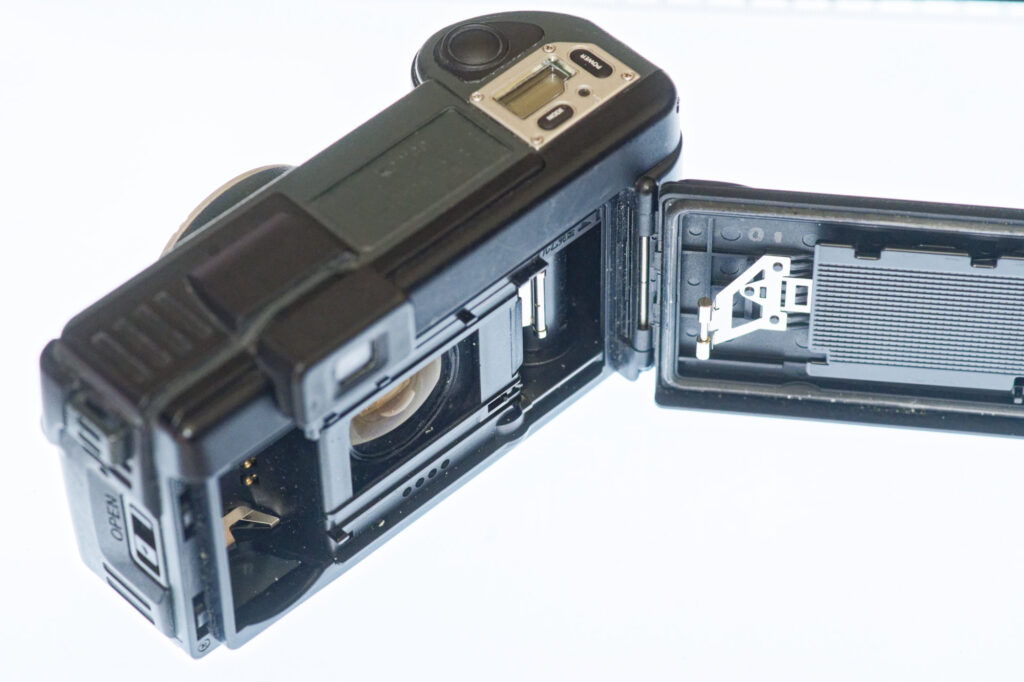
The film chamber interior sports automatic DX contacts, databack connections under the film gate and gubbins to deal with automatic film loading on the door.
Film loading is quite straightforward, with the leader simply being laid across the back of the camera with the end aligned to the marks before the film door is closed. Film is wound to the first frame once the camera is powered on. A failed load shows ‘ae’ blinking on the LCD. In the unlikely event of this happening, simply open the back, reposition the film to the indicated marks and close the back again.
Cameras were either supplied with a plain back or a databack that could imprint the date; they don’t seem to have been designed to be user-swappable, although all the cameras seem to have the electrical contacts for communication with the back under the film gate. The databack is powered by its own CR2032 battery, but from what I can glean, the year of the date only goes up to 2019.
The rear element of the lens is very close to the film plane, but does not move during focusing. The 28WB is reported to feature a 5 element lens where the rear element seems to be more inset. I’m not sure which lens the ‘New Wide 28’ uses, but I suspect it is the 5 element version due to the exterior profile. The redesign may have been to accommodate the shorter ‘snout’ and closer AF focus distance of the later cameras.
Controls
As you can see from the above tour, the shooting controls are concentrated around the right-hand end of the top-plate and consist of a shutter release, a power button, a mode button and a rewind button. An LCD display shows you the frame count, battery status and ‘mode’ when the power is switched on. By default, the camera is set to use the flash automatically if it thinks the shutter speed is going into ‘camera shake’ territory. Setting options are made by repeatedly pressing the ‘Mode’ button.
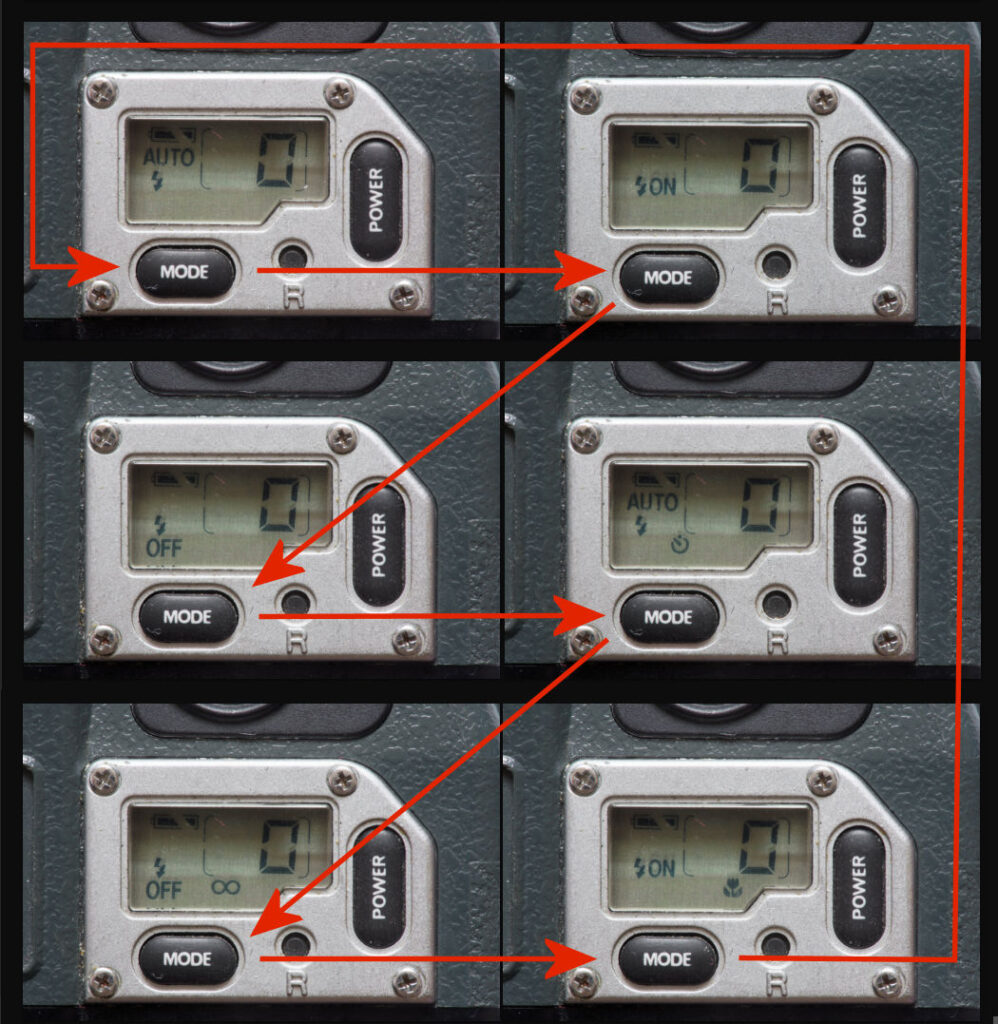
- The first press forces the flash on (for fill-flash if the subject is back-lit)
- A second press switches the flash off
- A third press turns on the self timer and switches the flash to auto
- A fourth sets the focus to infinity and sets the flash off again*
- A fifth sets the lens to focus as close as 0.5m and forces flash**
- A sixth gets you back to the beginning again.
*The lens doesn’t actually move to infinity focus when infinity focus is set, instead it motors forward to the infinity setting when the shutter release is pressed. I’m not sure why the normal resting point of the lens is beyond infinity, but I guess the designers of the AF system must have had their reasons.
**From what I can make out, the ‘close focus’ mode simply sets to as close a focus as possible with an aperture as small as possible to give depth of field between 0.75 and 0.5M (hence flash on to give lots of light). Unlike the infinity setting, the lens moves when the close-up setting is selected. Later models seem to have been able to AF as close as 0.5M without this ‘kludge’.
Unfortunately, the camera does not remember past settings when it powers-on. My routine tends to be power on, then two stabs of the mode button…
Limitations
On any camera with this few controls, there will be limitations.
If you have film that is not DX coded, the camera will expose it as ISO 25. This seems an odd choice and is difficult to confirm, but the ISO 25 info comes straight from the user manual, so I’ll trust it and make sure to use DX coded film.
The Konica Wide 28 sets ISO automatically with DX-coded films between ISO 25 and 3200.
While it would be nice to be able to push or pull film, it is still possible to ‘fake’ the DX coding on a 135 cassette by adding a stick-on DX label, or by scratching off paint or covering up a patch with a bit of tape. What you won’t see is any confirmation from the camera about what ISO value is set.
The Konica Wide 28 rewinds automatically at the end of a film – if you want to rewind early to process part of a roll, you can use the rewind button, but as the leader always goes back into the cassette, reloading to use the rest of the film will be problematic. I saw a warning not to operate the rewind button when the back was open, so naturally, I tried it out. Strangely, pressing the rewind button while the back was open started the self-timer.
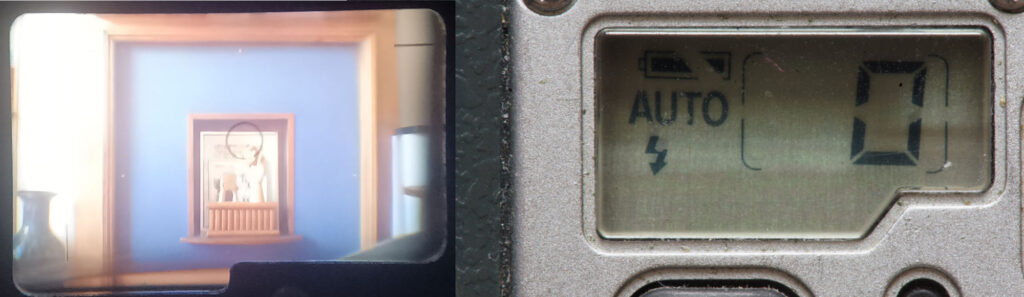
The sample image I shot through the viewfinder with my phone was really small and murky. I ended up mocking up the coverage to give a decent idea of what you see against what you get.
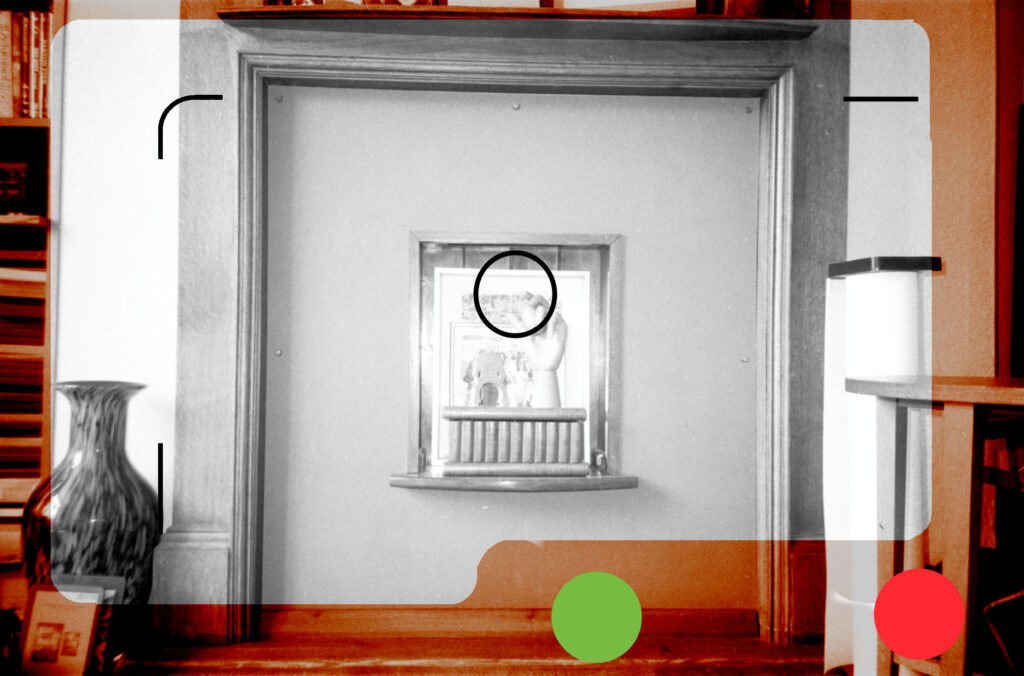
While the viewfinder gives you a reasonably decent idea of what the camera will focus on, it only shows you about 75% of what will actually be shown on the negative (less than that if you also discount the lump cut out of the bottom right of the viewfinder to show the status lights). There are no bright lines, just a black border to indicate the edge of the frame. Even the parallax guides are simple black lines.
The green indicator LED light below the screen shows constant with an AF lock and blinks if the subject is out of range (ie too close). The red LED light to its right shows that the flash is charged and will blink if flash is set to ‘off’ and the camera thinks it is too dark to hand-hold.
In use
The Konica Wide 28 is the sort of camera that you can just stuff into a bag or pocket (although the pocket would have to be reasonably big). Although it somewhat resembles a brick, it is relatively light (400g without a battery or film).
Choice of settings is limited. Changing settings is a button-stabbing exercise while peering at the tiny top-plate LCD.
The good, the bad, and the ugly
To take those in reverse order…
The ugly bit is fairly obvious. This is a camera that fell from fairly high up in the ugly tree, and then hit a fair few branches on the way down. Having said all that, a lot of very good cameras have been somewhat aesthetically challenged. Quite apart from its chunky/brutalist/industral design, its rugged nature invites use in environments that are not going to further enhance its appearance. My camera is in reasonable condition; other reviews on the internet show cameras daubed with paint, scuffed or that have had lumps taken out of them. These cameras have lived a life.
Where the bad comes in is with the viewfinder. The viewfinder is small, dark and doesn’t give a true impression of the true width of the lens. There doesn’t seem to be a good reason for the viewfinder to be this bad. It isn’t a simple tunnel viewfinder. It has optics to place the eyepiece on the back higher than the window on the front of the camera. It’s just that giving a reasonably accurate idea of what will actually show up on the edges of the frame doesn’t seem to have been an objective in the design.
I can only hope that the viewfinder of the ‘New Wide 28’ and later cameras were an improvement. From what I can glean from the Japanese language user manual I have for the 28WB, it does seem to have proper bright lines and the status lights don’t intrude on the bottom right of the visible area, but whether the view is bigger, brighter and more accurate, I do not know.
Because of the disappointing viewfinder, I found that the Wide 28 was an uninspiring camera to use – at first.
After having processed the film, I started to appreciate the camera as a whole.
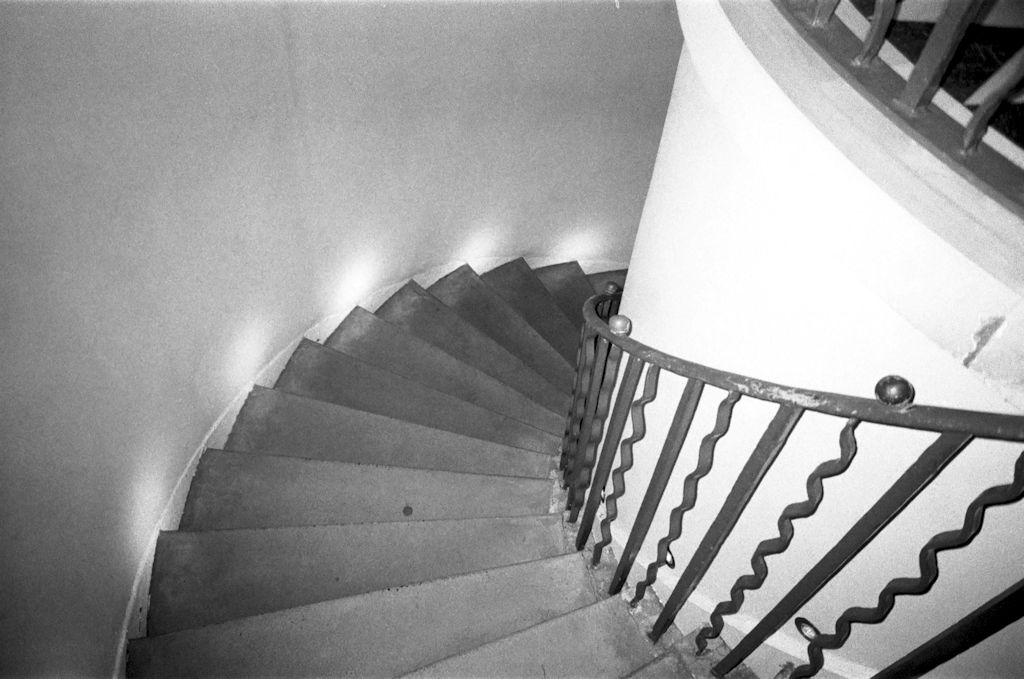
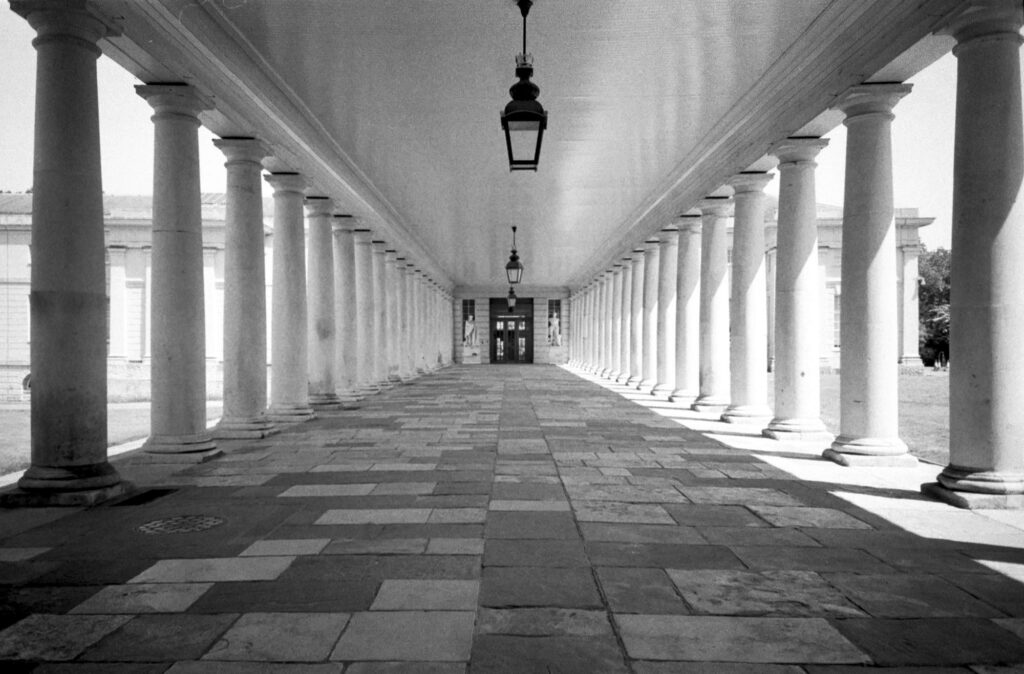
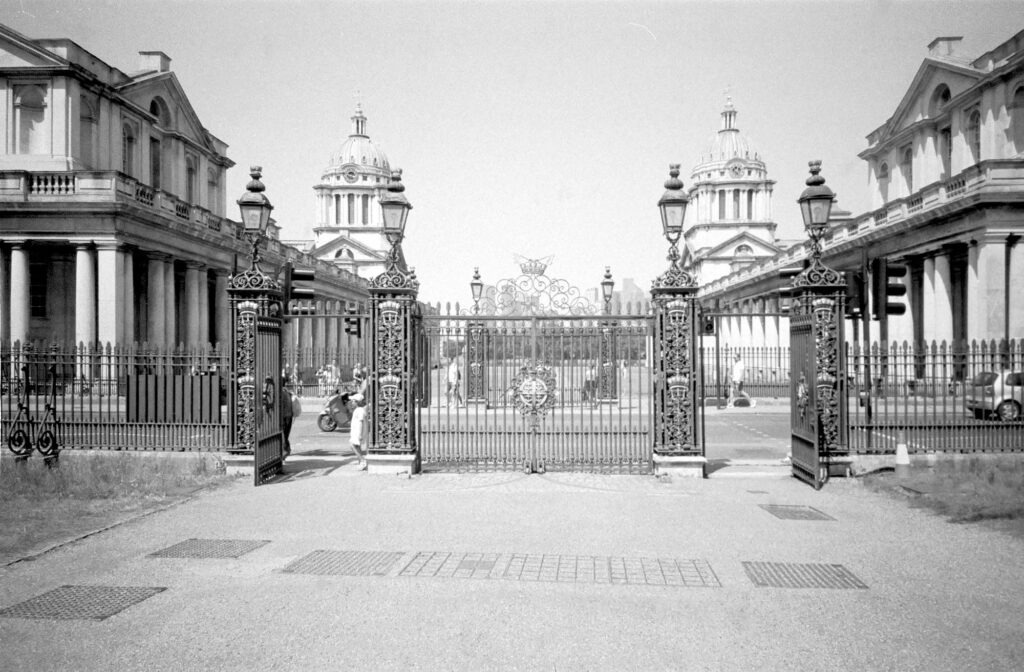
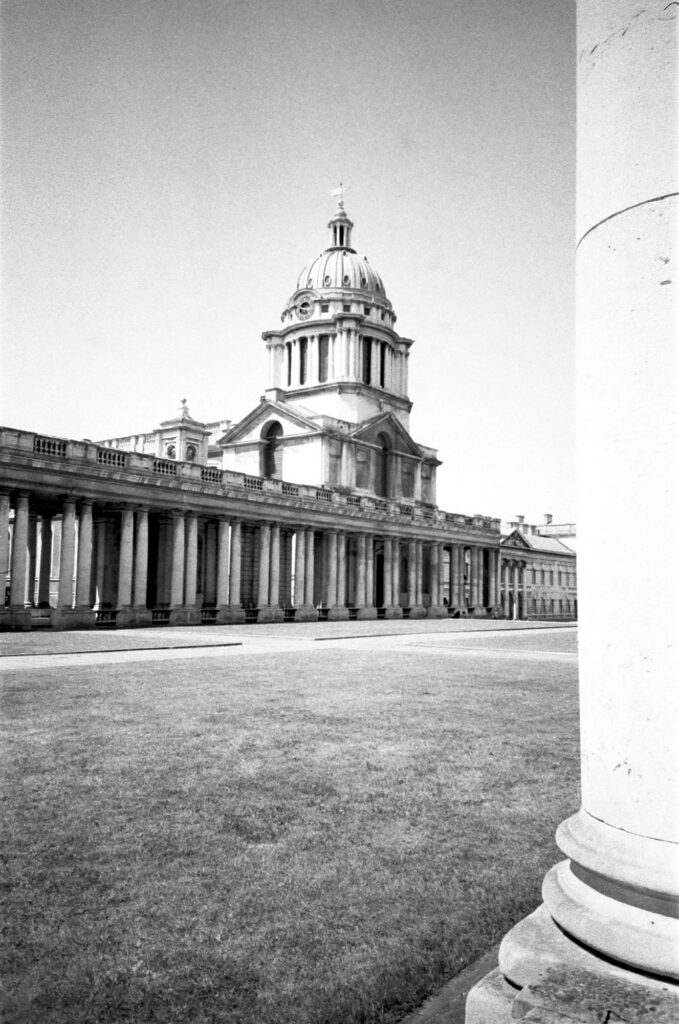
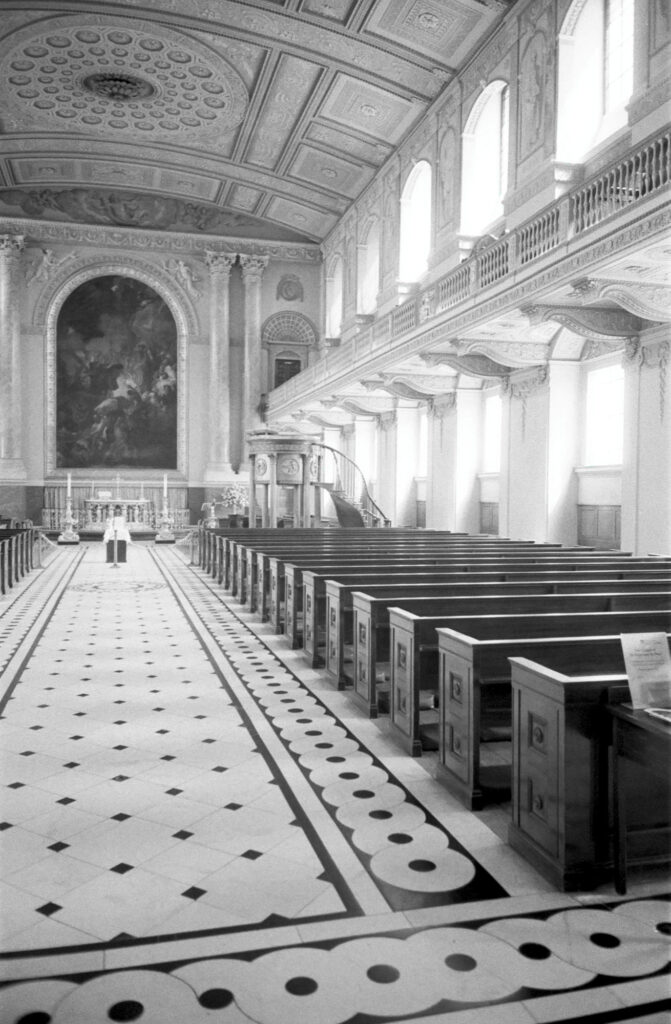
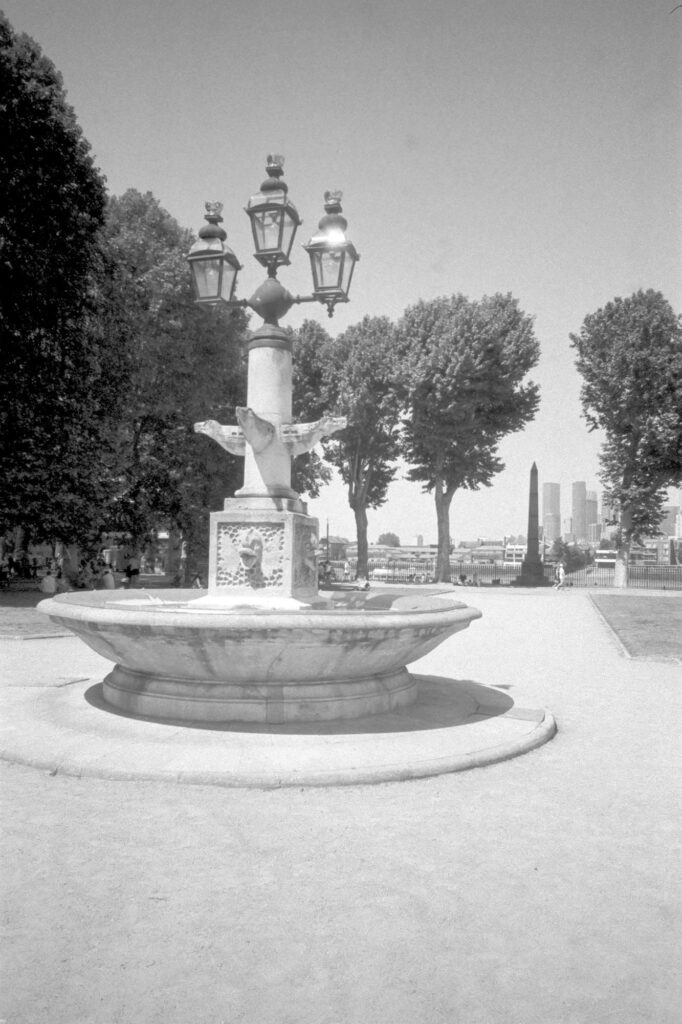
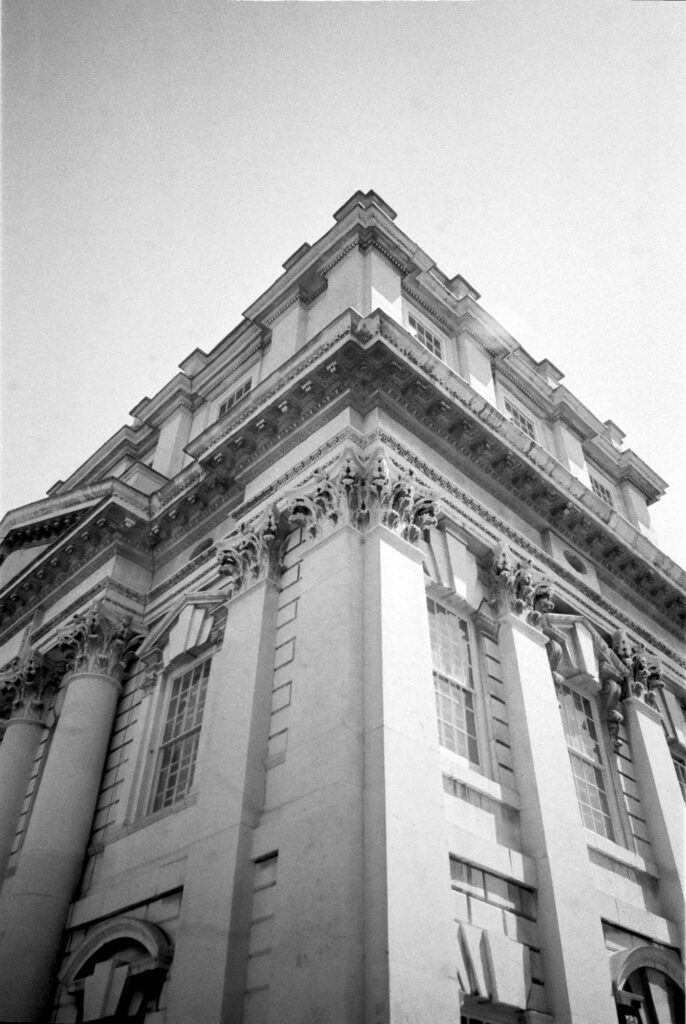
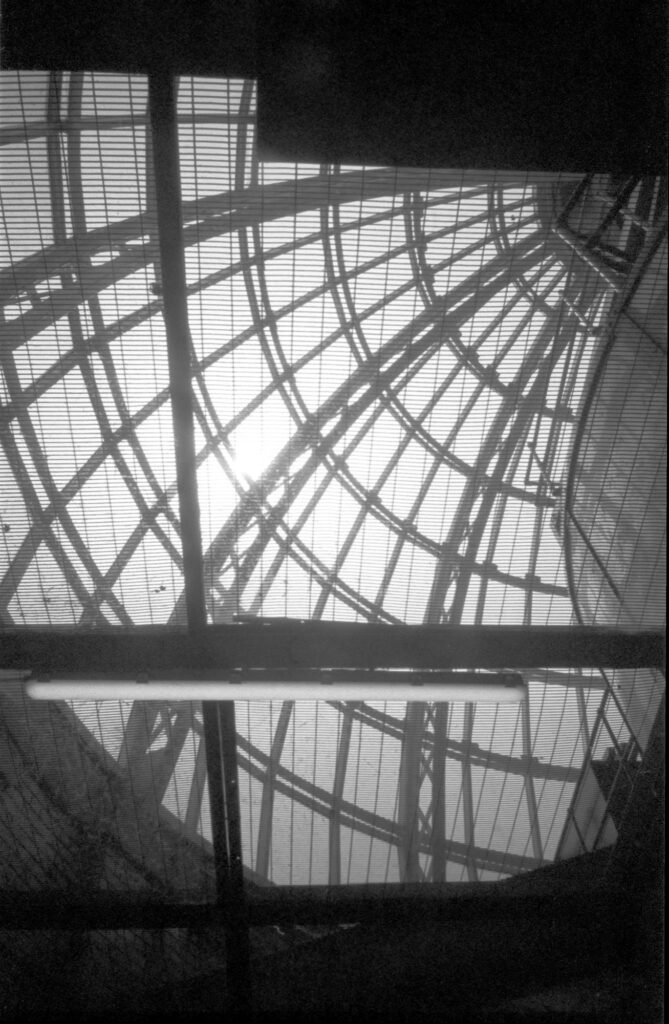
Because the lens is good, very good. No matter that you are limited to focus on the centre of the frame – on a 28mm lens focus is unlikely to be a huge issue anyhow. Exposure is fine (the only overexposure I came across was from the flash on my viewfinder framing shot). Critically, the shots were far wider than I had expected from the viewfinder. Distortion is minimal, and the image on the film is impressively sharp.
Not only that, but the camera seems intent on squeezing every last bit of width out of that lens…
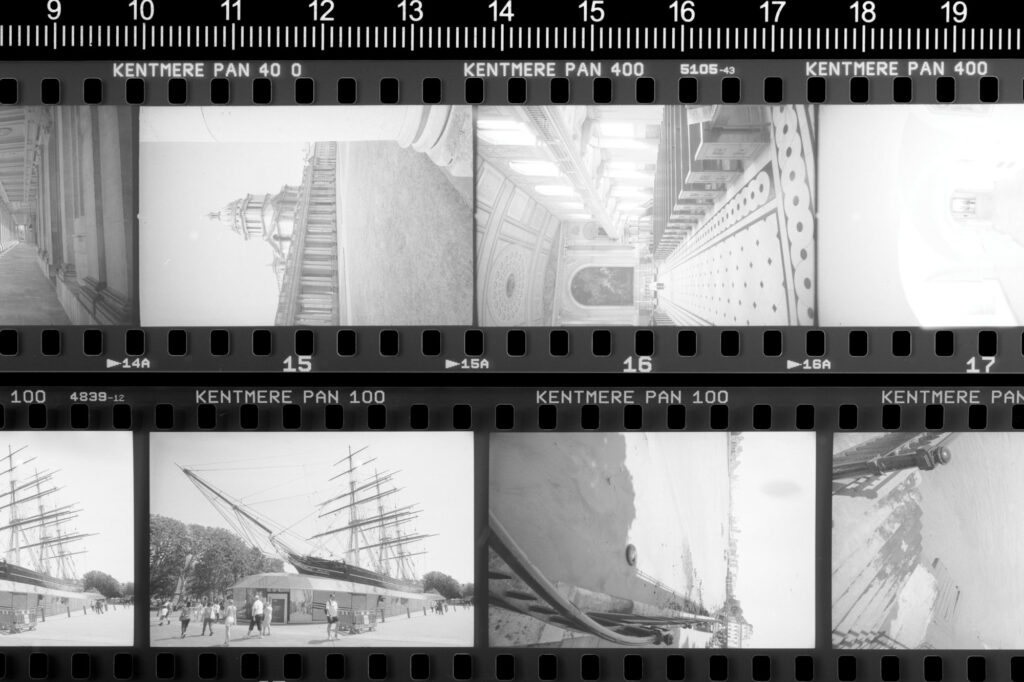
The Wide 28 gives the tiniest gaps I’ve ever seen between 35mm frames without any overlap and appears to shoot 37×24.5mm negatives…
Pictures
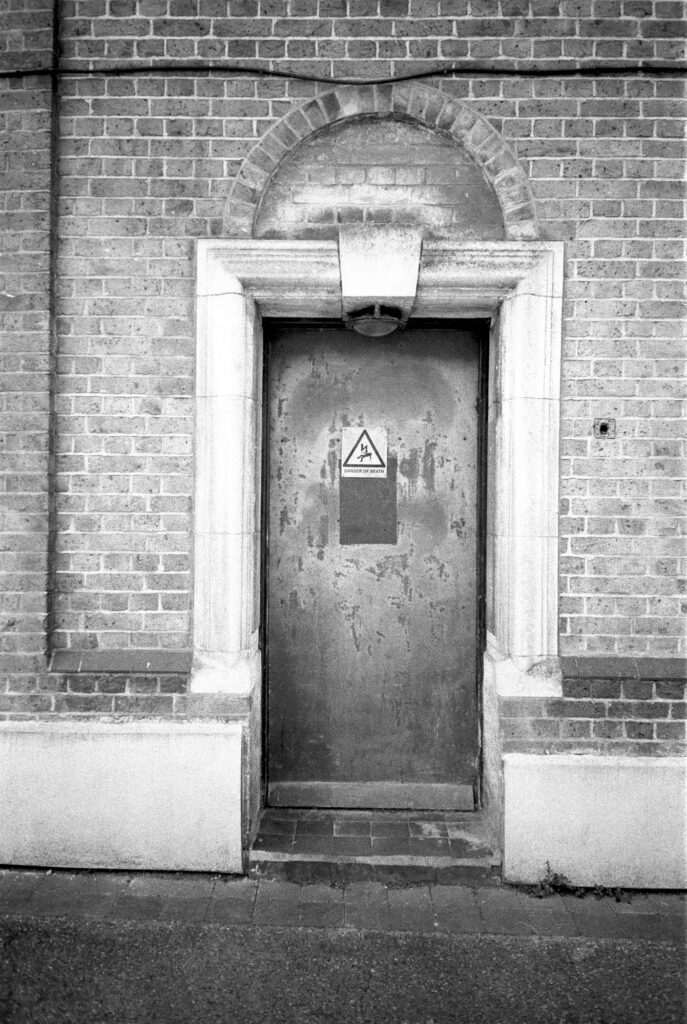
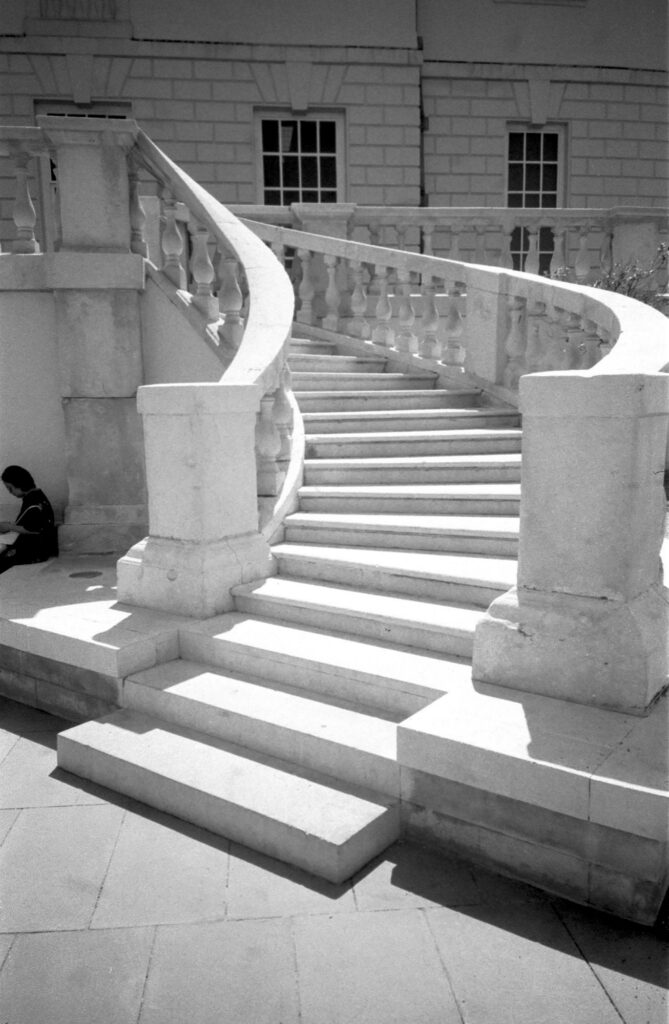
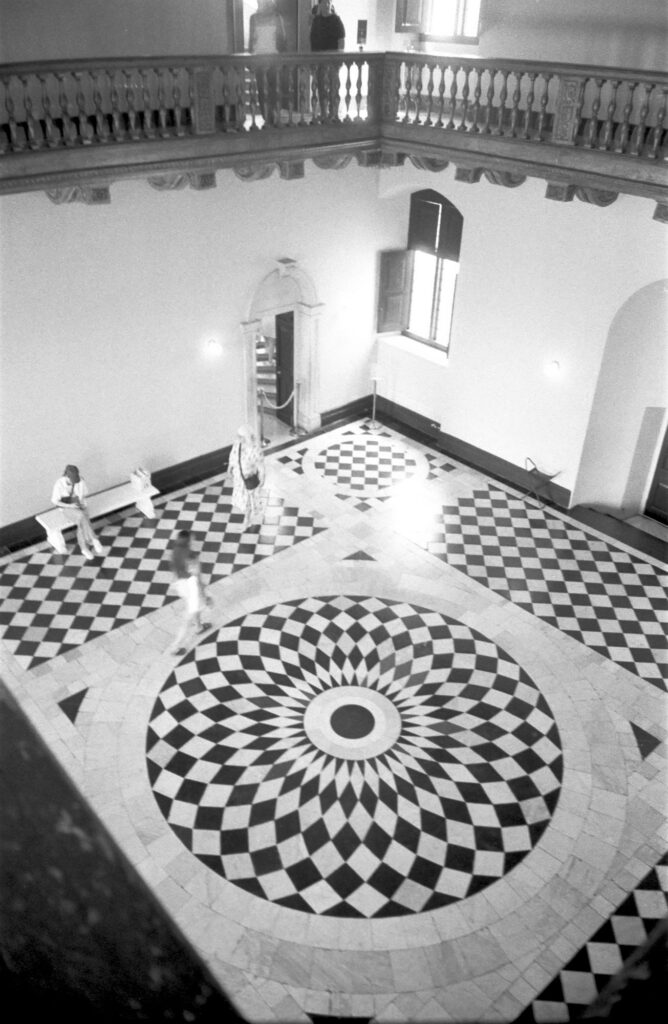
These pictures were all taken with the Konica Wide 28 on an afternoon trip to Greenwich. The film was Kentmere 400, developed in 1:50 R09.
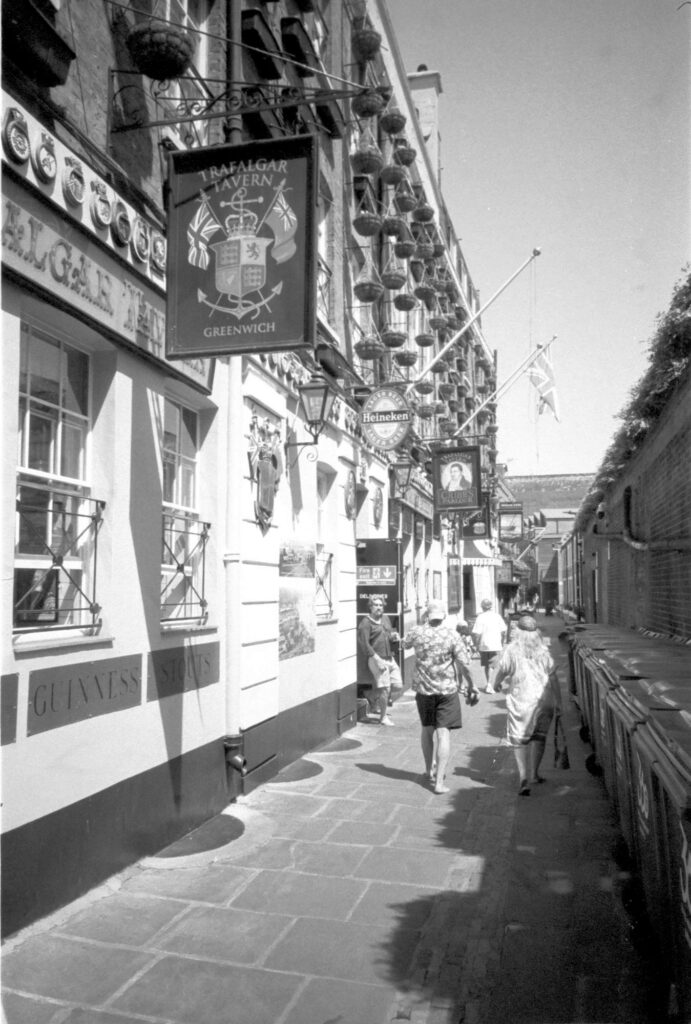
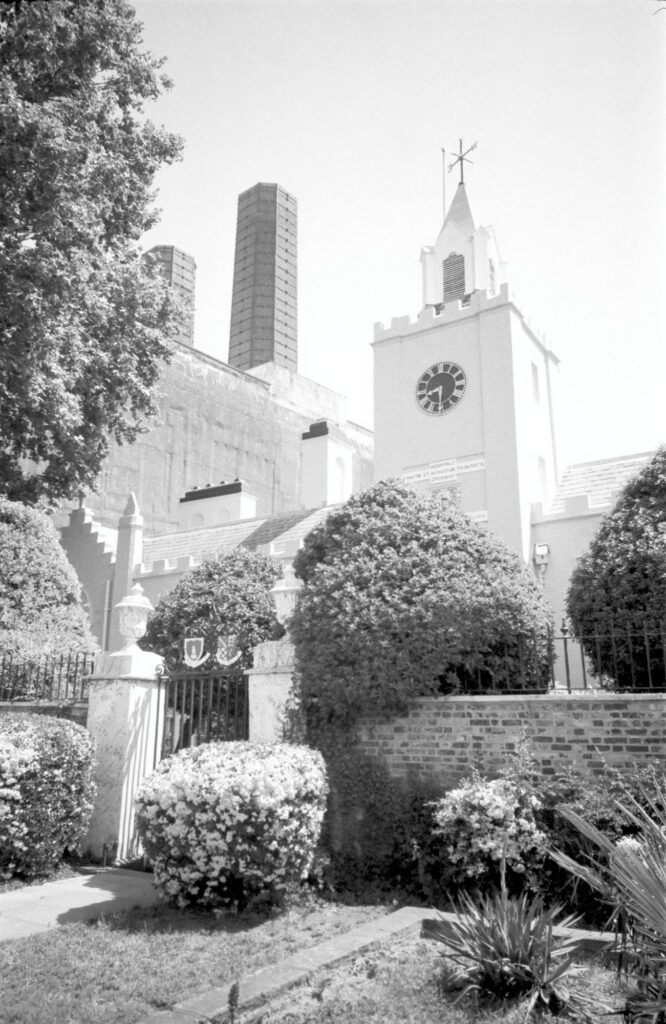
Conclusion
The 28mm f/3.5 lens used on the Konica Wide 28 is surprisingly good. The angle of view and quality of the lens make it a remarkable camera even before you consider that its build means you can take it places you would not dream of taking another camera with half as decent a lens.
If you come across one of these cameras, or one of its successors, I’d say they are well worth trying out. I’d love to know what others think of the viewfinder of the ‘New’, WB and HG for comparison.
This Konica Wide 28 deserved a better viewfinder. Because of the lack of other controls, composition and timing are the main creative controls open to the photographer here. It would be nice to think that the viewfinder in later versions was helping photographers judge them better. Things would be easier if the Camera had a conventional shoe, as it could at least take an accessory finder. Maybe I need to make some modifications.
Aftermath
The Genba Kantoku line carved itself out a bit of a niche for over a decade. It went from a tool intended for a specific work purpose to a camera that people found use for outside the construction site. In the digital age, once Konica Minolta had given up on cameras, the same niche was largely occupied by Olympus and Pentax with their ‘Tough’ digital cameras. But in the days of film, the Wide 28 (in its various guises) was the Kantoku.
Share this post:

Comments
furlongphoto on Konica Wide 28 / Off-Road Wide 28 / Genba Kantoku 28 – The Original
Comment posted: 10/07/2026
I last used it on a sail across the Java Sea a couple of years ago where I required a rugged camera for that environment, and got some wonderful results. I can put aside its ugliness because I know that lens punches well above its weight. Of all the compacts I own, this is possibly my favourite. I think mine is the same version as yours and I can't say I have much of an issue with the viewfinder. I just sometimes feel like I'm cheating with its all-auto settings.
Comment posted: 10/07/2026
John Bennett on Konica Wide 28 / Off-Road Wide 28 / Genba Kantoku 28 – The Original
Comment posted: 10/07/2026
It, too, is the 28mm model, and I was lucky enough to find an unused “new in the box” example on eBay.
I posted a few of my first photos on Flickr here.
https://flic.kr/s/aHBqjCYK14
Comment posted: 10/07/2026
Comment posted: 10/07/2026
Gary Smith on Konica Wide 28 / Off-Road Wide 28 / Genba Kantoku 28 – The Original
Comment posted: 10/07/2026
Comment posted: 10/07/2026
Evan Bedford on Konica Wide 28 / Off-Road Wide 28 / Genba Kantoku 28 – The Original
Comment posted: 10/07/2026
Comment posted: 10/07/2026
Walter Reumkens on Konica Wide 28 / Off-Road Wide 28 / Genba Kantoku 28 – The Original
Comment posted: 11/07/2026
I’ve come across a few cameras in this category where you have to worry that the display might break by the time you get to the next roll of film, rendering the camera unusable. The optical quality is actually always decent, even among the competitors of the time. With Konica, however, this doesn’t surprise me at all; not only are their Hexanon lenses top-of-the-range, they’re also greatly underrated and are available at bargain prices today. A Hexanon AR 3.5/28mm or 1.8/40mm is available on eBay, together with, for example, the Konica Autoreflex TC, for less than this rather insignificant camera in Konica’s history.
Thank you for the detailed report and the photos. I use a few Konicas myself, but I wasn’t familiar with this one yet.
Comment posted: 11/07/2026
Comment posted: 11/07/2026
Comment posted: 11/07/2026
Comment posted: 11/07/2026
Comment posted: 11/07/2026
Comment posted: 11/07/2026
Comment posted: 11/07/2026
Jeffery Luhn on Konica Wide 28 / Off-Road Wide 28 / Genba Kantoku 28 – The Original
Comment posted: 11/07/2026
I enjoyed your posting and loved the photos. Great job. That camera does two impressive things:
1- Takes very good shots.
2- Displays attitude.
It was a brilliant marketing move, backed up by robust performance! It reminds me of the boom box designed and sold by the Stanley Corp. They make construction equipment. Very clever product!
Comment posted: 11/07/2026
Omar Tibi on Konica Wide 28 / Off-Road Wide 28 / Genba Kantoku 28 – The Original
Comment posted: 12/07/2026
Ibraar Hussain on Konica Wide 28 / Off-Road Wide 28 / Genba Kantoku 28 – The Original
Comment posted: 13/07/2026
David on Konica Wide 28 / Off-Road Wide 28 / Genba Kantoku 28 – The Original
Comment posted: 18/07/2026