

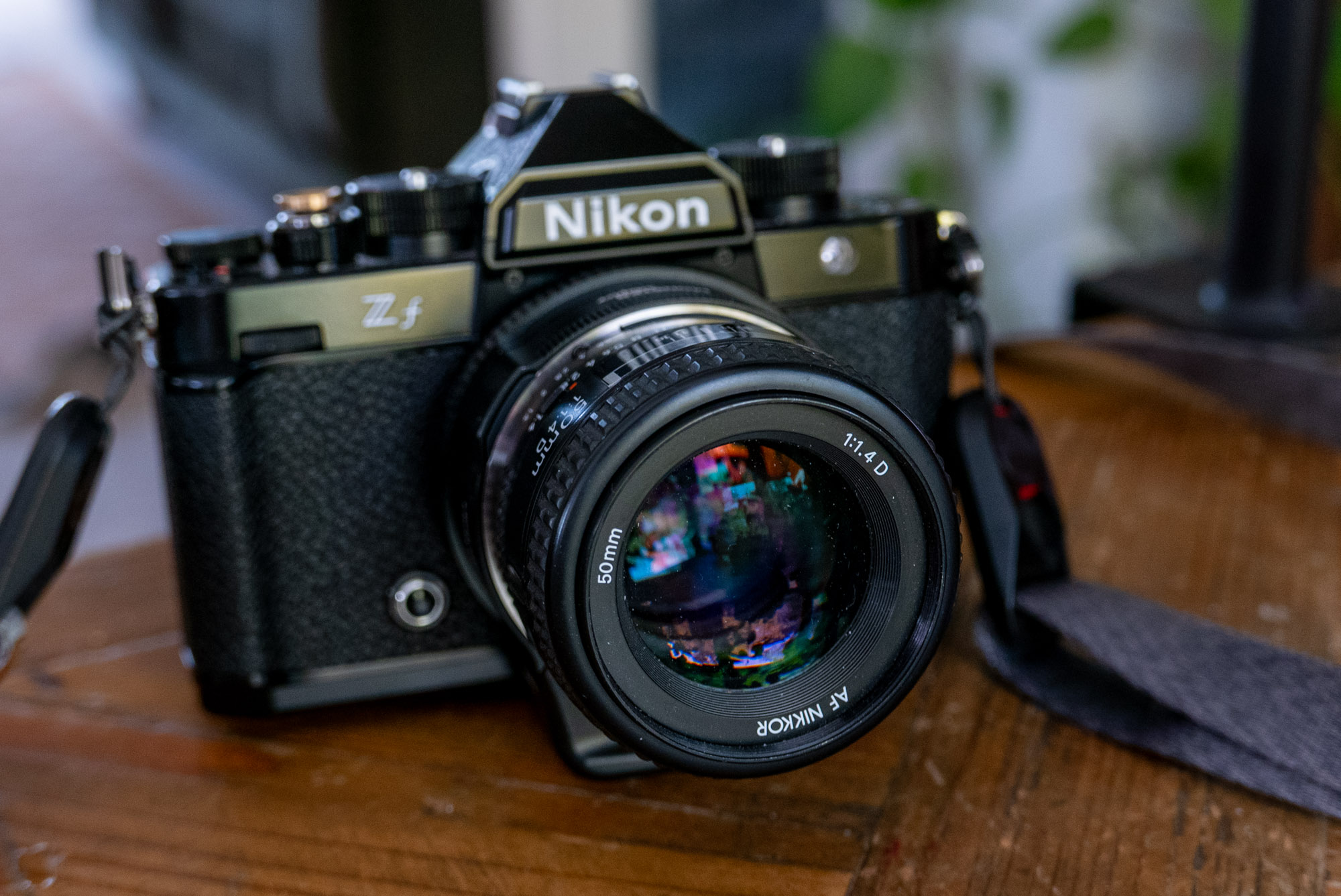
I started writing this as just a commentary on how well the Nikon 50mm f/1.4 AF-D lens works on the Monster Adapters LA-FZ1, but as I’ve written it started to unravel into something a little bit more about the lens itself. I’ve ended up talking about my history with it as a lens, as well as a bit about the lens’s background and context within fast 50s over the last 20 or so years. I’ve also ended up commenting quite a bit on the lenses rendering too – mostly as I have sort of rediscovered it as a lens that I really quite like. As a result, I decided to make this into a two-parter. This first part is a mini-review of the lens itself, and part 2 (which you can read here) is more specific to this lens on the Monster LA-FZ1.
The Nikon 50mm 1.4 AF-D
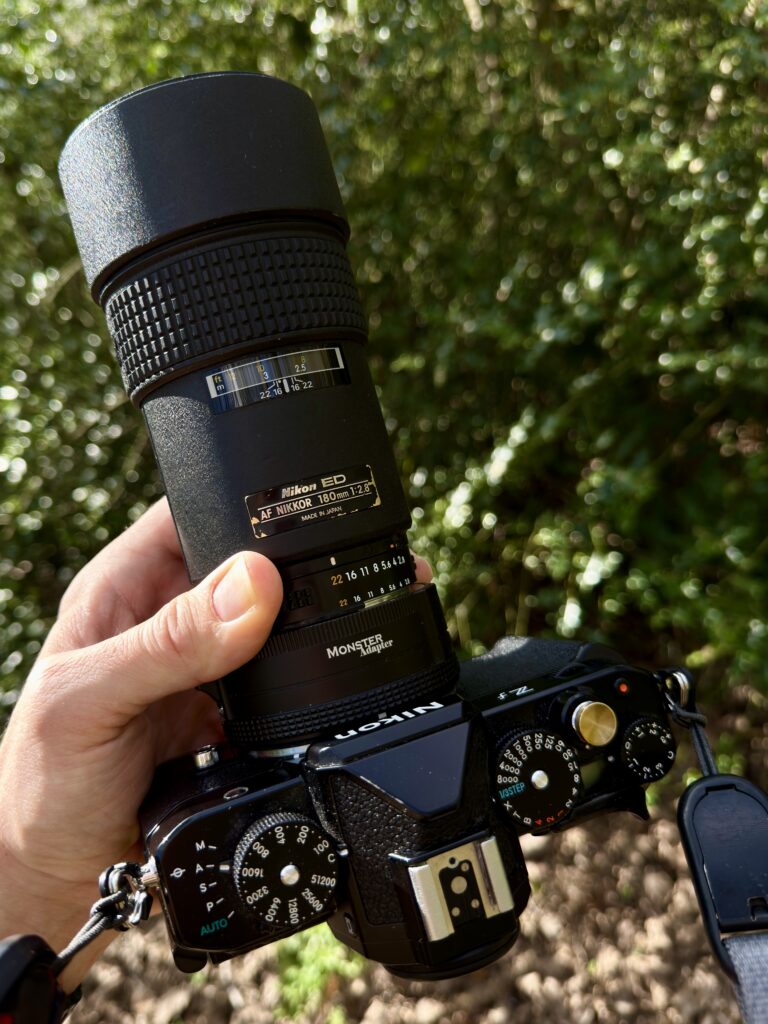
The Nikon 50mm 1.4 AF-D is the lens I had so far used most on the Monster Adapters LA-FZ1. I now have a dedicated ~50mm for my Z system, but it’s a very recent acquisition, so for a while if I fancied shooting 50mm, I’ve been attaching the Nikon lens. Fortunately, where the 180mm I have otherwise enjoyed is only just manageable in how well it works, the 50mm 1.4 definitely fits within my definition of working in an “expected way” (see bottom of my intro post), albeit with the occasional wobble.
The Nikon 50mm 1.4 AF-D is now a bit of a hero of a lens in my world – but we have had a bit of a bumpy relationship over the years. Way back in the early-to-mid 2000s when my photography hobby really exploded I bought a load of Nikon kit that came to me in a sequence I can no longer recall. Somewhere between buying my first SLR (a Nikon F60), getting a job in a camera shop, upgrading to an 801s, and then buying my first DSLR (a Nikon D70s), I bought two Nikon prime lenses: the 35mm f/2 (a lens I still own to this day) and the 50mm 1.4. The 50mm was the king of low light in my world – having a lens this fast when I first bought it felt like a dream come true.
The Nikon 50mm 1.4 AF-D is a lens that harked back to the era of film. In fact, as I understand it, the optical formula is the same unit focusing 7 elements in 6 groups design as the previous AF (non-D) model and indeed the manual AIS and AI lenses that came before. This dates Nikon’s use of this formula all the way back to the 1970s. But, it was also still Nikon’s fastest 50mm prime lens when their earliest DSLRs were released. They had started producing their AF-S lenses, but hadn’t yet rolled out replacements for the whole range of prime lenses.
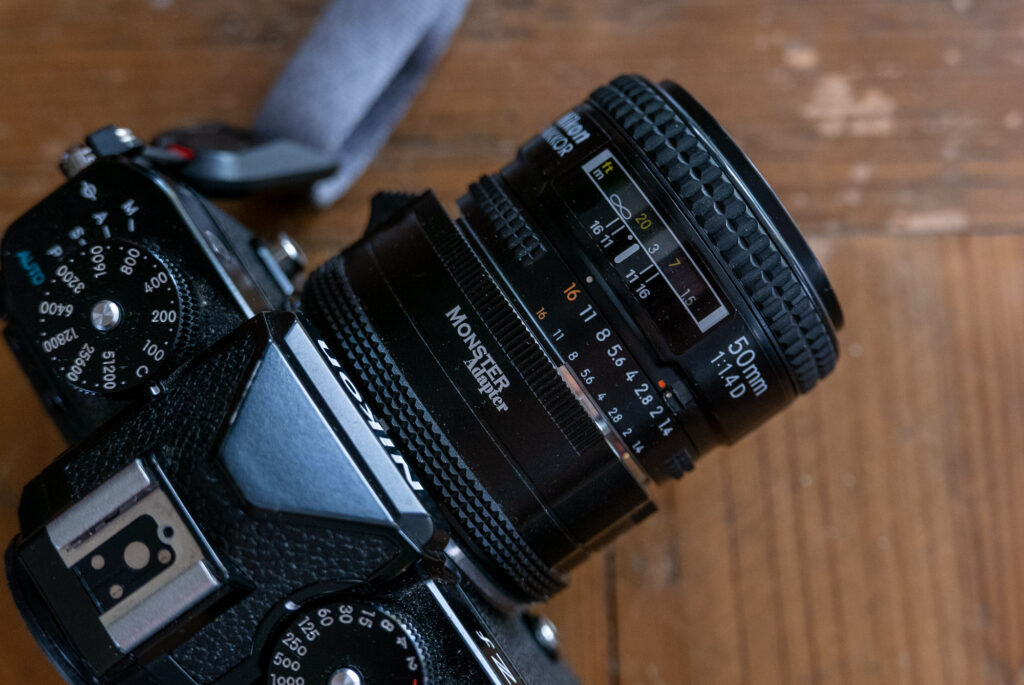
Back then, digital cameras had much poorer low light capabilities in terms of both their maximum ISO and how noisy images were at these maximum settings. I’m not sure if noise reduction in editing software even existed then either – if it did, it certainly wasn’t as advanced as the technology is now. As such, that extra stop of light gathering power between the 35mm f/2 I had and the 50mm 1.4 really meant something to me – as it no doubt had done for the countless photographers over the years prior. I’m sure none of this is news to many of you reading this, I’m just trying to provide some background and positive context around this lens, as what I otherwise want to say is that in terms of its optical performance, it really isn’t all that amazing when compared to more modern fast 50mm lenses!
I sold my first copy of the Nikon 50mm 1.4 AF-D, and unlike the 85mm 1.8 which I’ve owned 3 times now, I only just recently bought back the 50mm. The reason being was that I remembered its optical flaws more than much else about it. I respected it for what it had offered me back in the early days of ownership, but I also remembered when I started to experience much better quality prime lenses. For example, there was the time when Sigma released their 50mm Art lens that just totally overshadowed the Nikon in objective terms. The Nikon works at 1.4, but best results are definitely had at portrait distance. At further distances wide open its innate soft and glowy rendering just takes over a bit – and on digital SLRs, with their ever-increasing pixel counts, it just couldn’t keep up with more modern formulas. Unlike the Nikon, the Sigma – at least as far as I remember – was just as impressive at f/1.8 at 1m as it was at 10m.
Digital cameras ushered in lenses that were designed for digital cameras. These days pretty much all lenses are objectively awesome, but it’s not that long ago that we went through this period of lenses getting notably better. As I say, now all my modern lenses are this good. Even from lower-budget brands I don’t expect anything other than pretty impressive levels of sharpness, even wider open, and even when the subject is a fair distance away.
Like many other photographers though, seeing and experiencing this increase in objective quality has had two almost diametrically opposed outcomes for me. The first is an admiration and appreciation for modern lenses (in my case especially in the context of my professional work). Second is an increased appreciation for what came before. There are lenses like the 85mm 1.8 AF-D that I’ve never really stopped enjoying or being impressed by, and there are also lenses such as the 180mm AF that have recently experienced for the first time and found to be incredible – and incredibly to my taste in terms of their overall optical characteristics for that matter. But as I’ve said, I’d almost written off the 50mm 1.4 AF-D as a bit of a relic because of how specifically it had been replaced with “better” lenses both within my kit – and probably more importantly in my mind! I’d never really thought too much about its character as something potentially interesting, it was simply replaced with objectively better lenses and then sort of forgotten.
That was until I bought another one a year or so back. I’d been looking for a Nikon F301 and spotted one on eBay with a 50mm 1.4 AF-D mounted to it. It also somewhat inexplicably came with 5 SD cards… It sold, to me, for about £90. This is, I will concede more than the average price of a Nikon F301. But, more importantly it’s also quite a bit less than the average price of a Nikon 50mm 1.4. The SD cards were probably worth a tenner too. Camera and lens were both mint condition, so I came away a happy customer. I also came away somewhat inspired to get some enjoyment out of the 50mm 1.4 lens. Funnily enough, I was initially let down shooting it on a Nikon D90 – it just missed focus a lot. I thought it was broken to begin with, but after persevering with it on my D700 a little further down the road I found it was working fine. Looking back at my Flickr, it seems I haven’t kept any of the pictures from those experiments on the D700, but I do remember a little spark of interest in the lens being re-ignited. It had all the flaws I remembered, but it also had a charm I’d forgotten.
Nikon 50mm 1.4 AF-D Optical characteristics
As I remembered, it’s far from sharp wide open. It’s ok at nearer distances where it has clearly been designed/calibrated to work best, but at 5m and beyond, wide open it falls apart a little. There’s a lot more glow to what’s in focus that seems to increase the further away the subject is.

Actually, stopping it down even just a little bit seems to help a lot – in fact by f/2 it’s a much more respectable lens in terms of objective quality measures in almost every way. It’s nice to know I can rely on it to take a good quality photo stopped down, but I have more modern lenses I can take advantage of if good quality is my goal!

Though to be honest, as with a lot of my more vintage lenses, I’m really not that fussed how they perform stopped down, it’s the wider apertures where the character is strongest that I’m most interested.

The Nikon 50mm 1.4 AF-D is definitely interesting wider open too! Like many lenses from this era, I think the more simple fewer-element design makes for rendering that feels to me to be a lot less “clinical” than modern lenses. I don’t really like using that word – it’s a bit of a cliche, but it’s hard to avoid as it feels particularly accurate here.

There’s just more of a roundness to the rendering, there’s 3D pop and nice strong colours too. There is a bit of a reduction in contrast wide open, a bit of veiling flare occasionally, but both add to rather than detract from the overall look of the images the lens can produce, especially in the right kind of light.

The wide-open bokeh is also quite interesting. It’s not too wild – I used to have a Nikon 50mm 1.2 AIS lens and that thing could produce bonkers bokeh in certain circumstances. This lens isn’t quite as crazy, but it definitely has some character.

To begin with, depth of field feels very narrow. I know it’s a 50mm 1.4, but modern well corrected lenses that are sharper wide open can seem to have a more broad depth of field. That’s not the case here – because there’s always a little bit of glow when wide open, the transition to out of focus seems quite dramatic and, well, glowy. The bokeh when the subject is close up is then quite “good” by most standards, i.e. there’s not too much edginess about it, though it’s not so smooth that it’s just dull and 2-dimensional.

With the subject further away, fall off still feels quite quick, but what edginess there is closer-up is certainly enhanced, but not so much that backgrounds become too distracting or unattractive – in my opinion at least.

Just like with the sharpness characteristics, it definitely feels like a lens that’s best used at portrait distances and a little beyond for the nicest results. In fact, overall, portrait distance shots are where I’ve had the most success. The slight wider-open softness, the subtle veiling in certain light, the 3d pop, good colours and subtly interesting bokeh have combined to produce some images I’ve been really quite pleased with!

Build Quality
No lens review, or even mini-review from me would be complete without a comment or two on build quality. This is subjective too, but even as someone who loves this era of Nikon lenses, it’s not really too hard for me to see the flaws in the way they feel.
I’ve read plenty of comments online about them being not particularly hard wearing – but I’m not so quick to write them off in that sense. There’s a lot of these lenses around still, and even though I cracked a part of my 35mm f/2, it still survived a drop with a heavy camera attached to the back of it, and continued to work just fine. Durable or otherwise though, the plasticky nature of the build doesn’t win them much favour when compared to older manual focus lenses from Nikon, or even the later AF lenses that just have a nicer look and feel to the plastic they are made of.
It’s also true that the manual focusing control on them feels pretty crappy. Once you disengage the AF screw drive, like the majority of the AF and AF-D Nikon lenses, the manual focusing control just rotates freely without any resistance. This feels quite jarring if you’re used to either older manual focusing lenses that have nicely damped focusing. The issue was, the screw drive and the focus control wheel were both directly coupled to the focusing control, so the focus control couldn’t be damped as it would slow down/impact the focusing speed.
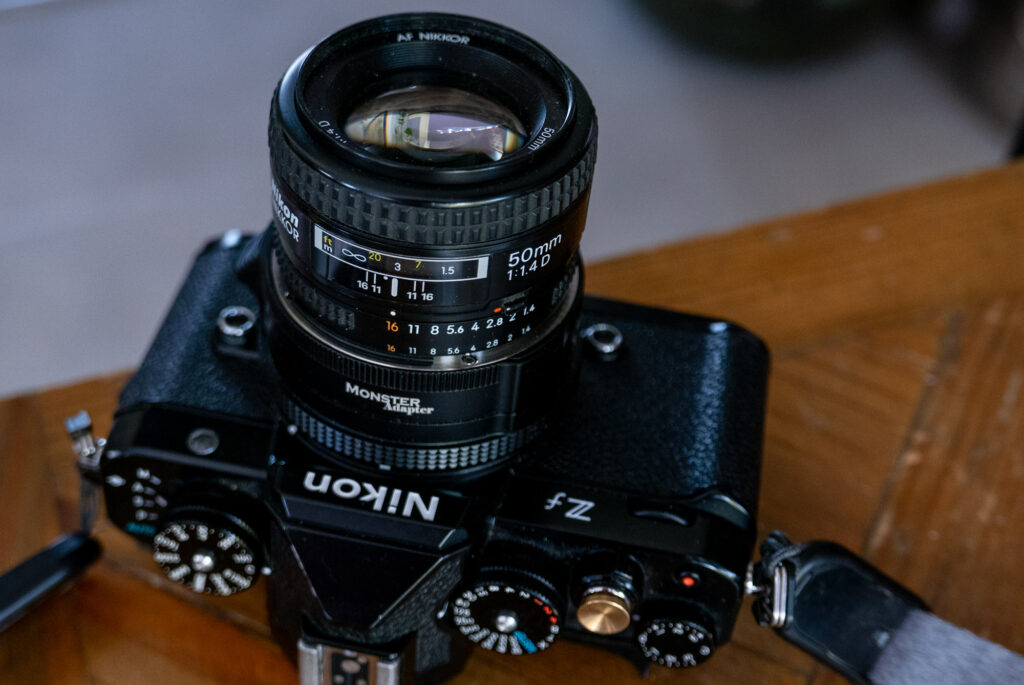
Actually, the Nikon F301 that I bought with the lens was a camera that was manual focus and designed to use with this era of Nikon lenses. And of course, the aperture control on the lens is there solely for the purpose of these lenses being used on older manual focusing cameras, so it’s not as if manual focusing wasn’t a consideration in the design of these lenses… it was just secondary to the AF capability, which was of course the new exciting technology of the day!
I suppose, in summary, the Nikon 50mm 1.4 AF-D looks and feels like a lens of its era. It’s a little clunky, a little noisy, a little plasticky and a little crappy feeling when it comes to the using it in manual focus. But, perhaps because of my Nikon bias, and my bias toward gear of this era because of when I first got into photography in a big way, none of this bothers me particularly. And as I say, I don’t think they deserve the reputation they have for not being hard wearing either.
Final thoughts
I’m pleased I’ve ended up writing this mini-review. It wasn’t my intention when I set out, but it’s ended up being an enjoyable one to write. As I’ve said, I feel like I’ve rediscovered this lens as something different to how I remember it. There was a time when I was seeking higher wide-open performance and this lens got left behind – I wrote it off as lower quality and not up to the task of fulfilling my requirements. By the time I sold my first one I was well into my career making money as a photographer, digital cameras had reached a quality that they were showing up lenses like this as not really keeping up with the cameras in terms of objective overall quality. I’d started buying lenses that did keep up and was happier with the results – especially within my professional work. What’s interesting is that around that same time (possibly a little before) my photography forked. Down one road was the professional work where objective quality was a goal. Down the other was my hobby where I was shooting film, playing with older lenses, and generally experimenting.
The Nikon 50mm 1.4 AF-D didn’t fit down either path though. It wasn’t good enough for professional work, and I obviously didn’t see it as interesting enough for my hobby, so it just found itself in a place in my personal photography history as a lens that didn’t fit me – and that’s just how I remembered it. All these years down the line, discovering it again I have found that it is indeed true that it falls short of modern lenses when it comes to the more objective ways of measuring quality – especially when shot wide open. But, as someone who has experienced a lot more lenses in the intervening years, I’ve also grown to understand what I do and don’t like in terms of the more interesting characteristics older lenses can present, and when shot wide-open I’m finding myself more than pleasantly surprised on what it has to offer in these terms.
Good news for me in some ways, as I now have a modern ~50mm that is objectively superb on the Zf (more on that coming soon), and I now also have an AF lens I can use on the Zf that has a load more character. The bad news is, it’s made me wonder about the Nikon 85mm 1.4 AF-D – which is another lens I used to own and left behind because of its lack of wide-open objective quality. I might have to add one of those to my collection again soon too…
Share this post:



Comments
Gary Smith on Nikon 50mm 1.4 AF-D Mini-Review
Comment posted: 12/04/2026
Graham Line on Nikon 50mm 1.4 AF-D Mini-Review
Comment posted: 12/04/2026
The 1.2 lens's genesis is reported at https://imaging.nikon.com/imaging/information/story/0049/
Comment posted: 12/04/2026