Panasonic C 2200 ZM Mini&Zoom

By Tony Warren

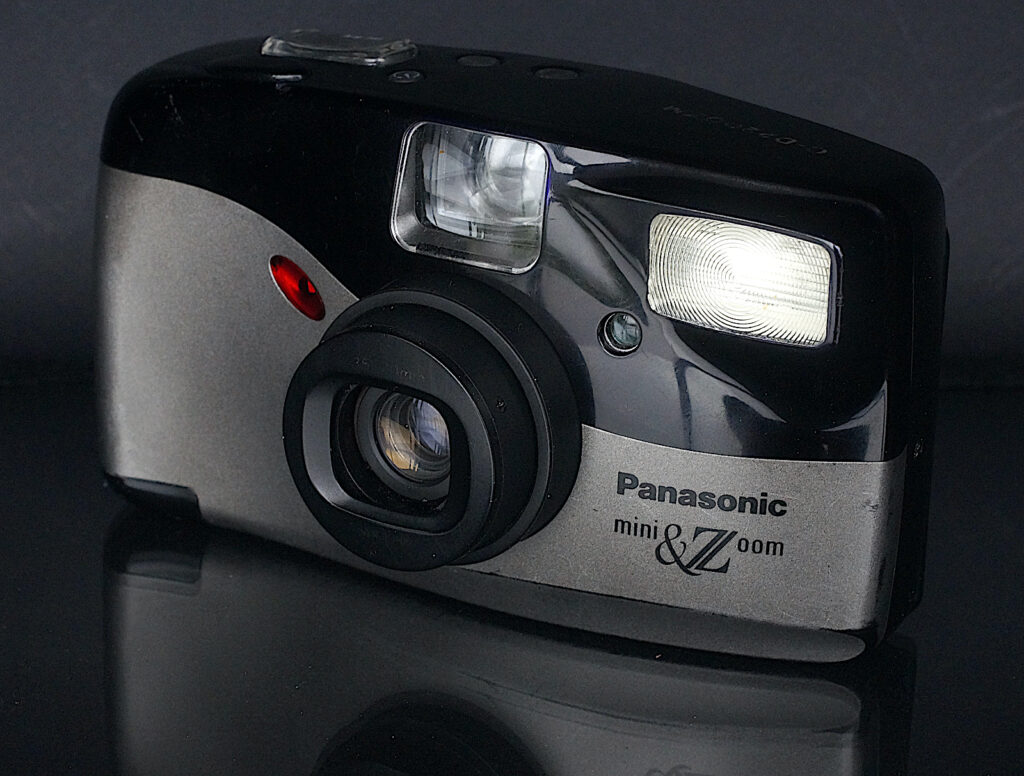
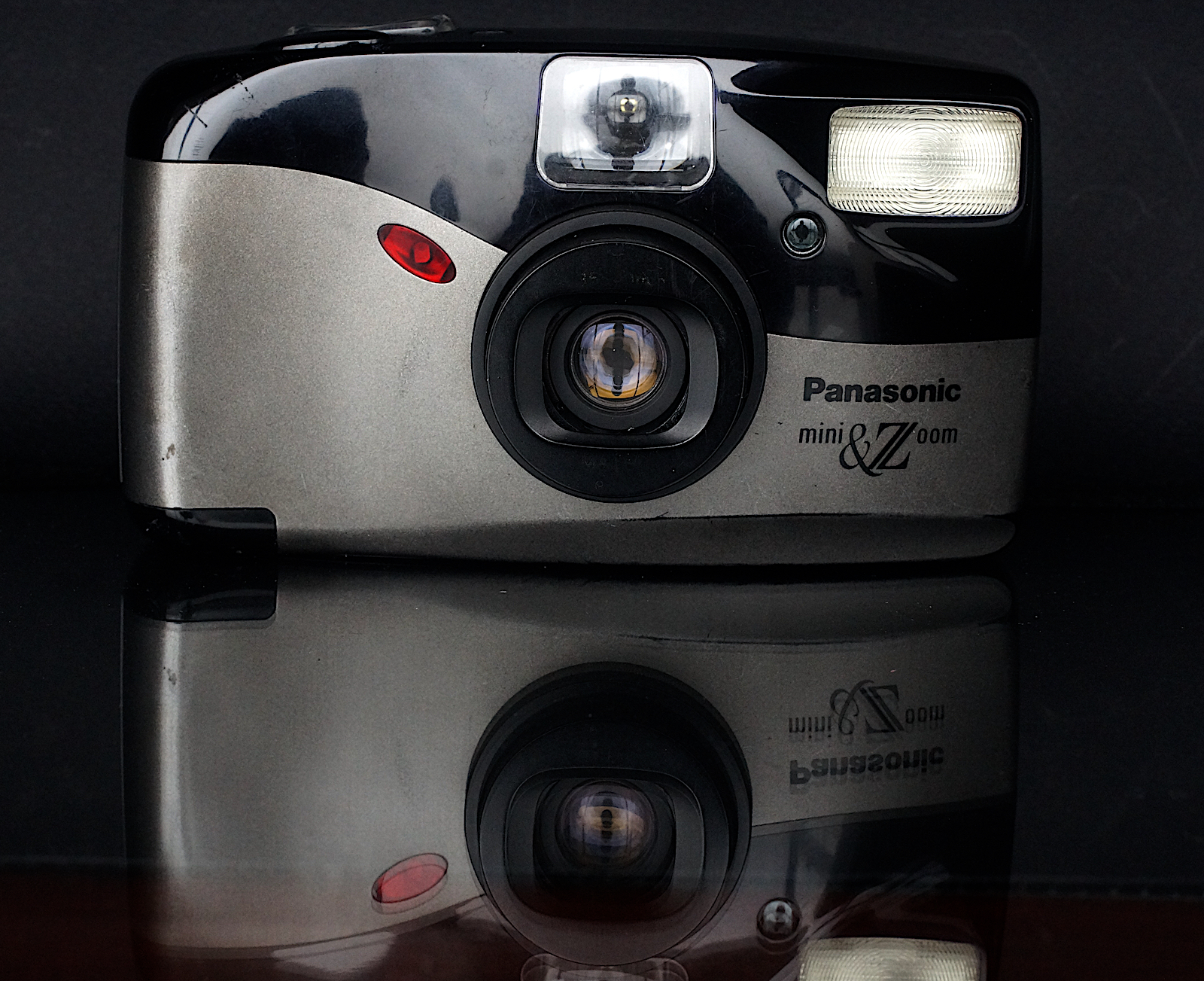
One of my remaining pleasures in life is discovering obscure details of less common cameras that escaped my notice when they first appeared and I came across this intriguing camera, the Panasonic C 2200 ZM Mini&Zoom.
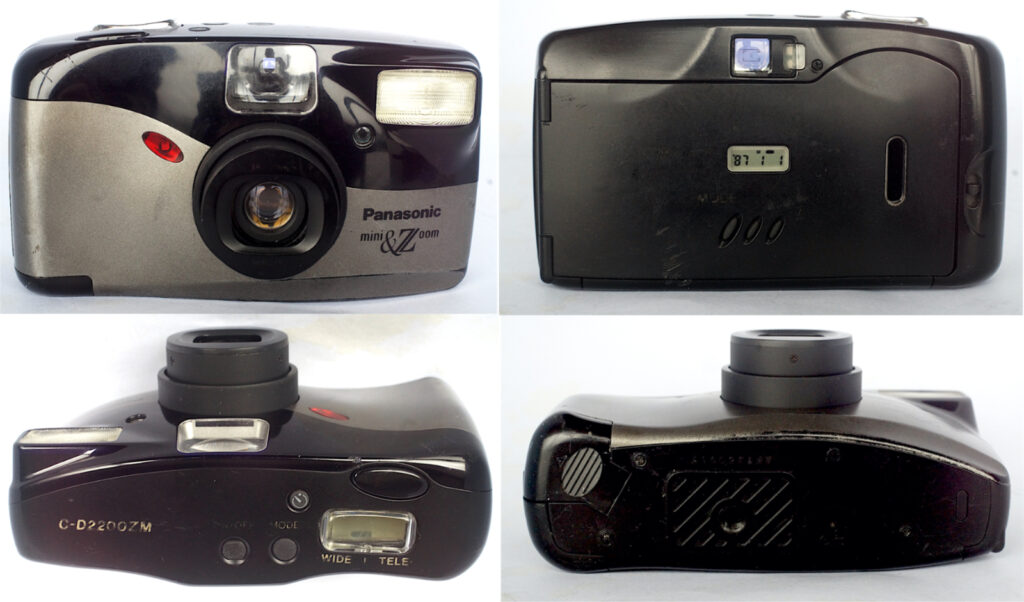
The model

What little Google searches produced suggests that it is (possibly) a close relative of a Leica Mini Zoom, slightly restyled, with (possibly) a Leitz design zoom lens (possibly) made by Minolta in a body that shares (possibly) its chassis with a Nikon and was manufactured (possibly) in Indonesia. The only likely firm bit is that the electronics are Panasonic’s, the only name appearing anywhere on the camera. Whew! What a mish-mash but containing some of the most respected names in the business. To add to the confusion the Leica Forum states that this Leica was made by Kyocera in Japan.

It is reported to have been introduced in 1992, or maybe 1993 according to Camera-Wiki, based on an advert, but with the start date on this one’s date imprinting back being 1987, I am not sure about either date. Mckeown’s 12th doesn’t even mention it.

It is a 35mm compact, auto everything, including built-in flash with over-rides and options. There was a panorama insert offered as an optional extra but this was a seperate component, clipping into the film gate before loading a film and was not built in and selectable on a frame by frame basis unlike some models with this feature.

The camera

Unfortunately, these largely plastic bodied 1980-90s consumer cameras can be past their best after some 30 years, especially if well used.

Initially, this Panasonic C 2200 ZM was lifeless and seemed to have power supply problems with signs of a taped down battery door. But when a battery was inserted the lens popped out and went straight back in, the camera remaining unresponsive otherwise. This made me suspect the door was a red herring and I turned my attention to the on/off button. This turned out to need some force with a finger nail and on one side of the button rather than the centre to bring things to life. Simply pressing on it with a finger had no effect. So we were in business.
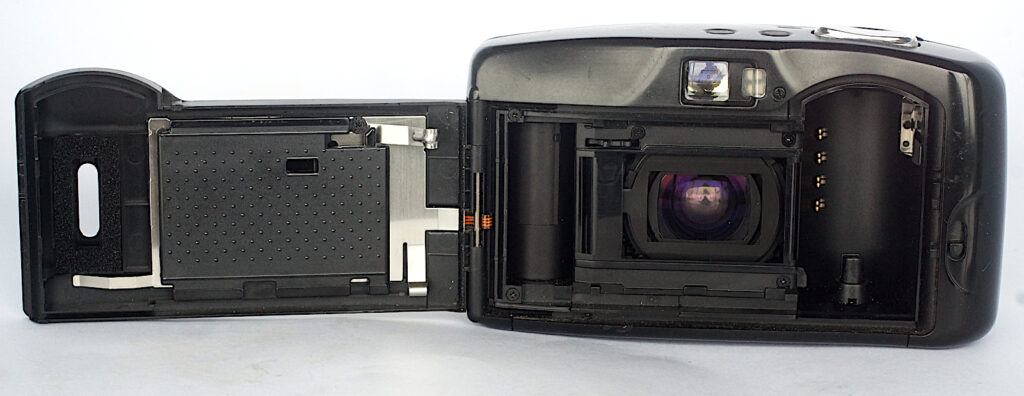
With the back open. Some very crisp mouldings and good quality of the general construction are apparent.

The Panasonic C 2200 ZM is a major step up from the Point and Shoot models that were so common around this time, with user options to appeal to a more advanced snapper as well as a complete novice.

It has a good all round specification, moderately sculpted to fit the hand and offering a good grip with controls well arranged. The novel zoom rocker is combined with the transparent LCD cover and sits conveniently just behind the shutter release. The mode, on-off and self-timer buttons sit just to the left, all accessible with the right index finger. A recessed button on the base allows rewinding mid-roll if necessary, needing a ball pen to operate. Date controls are central on the camera back but only go up to 2019.
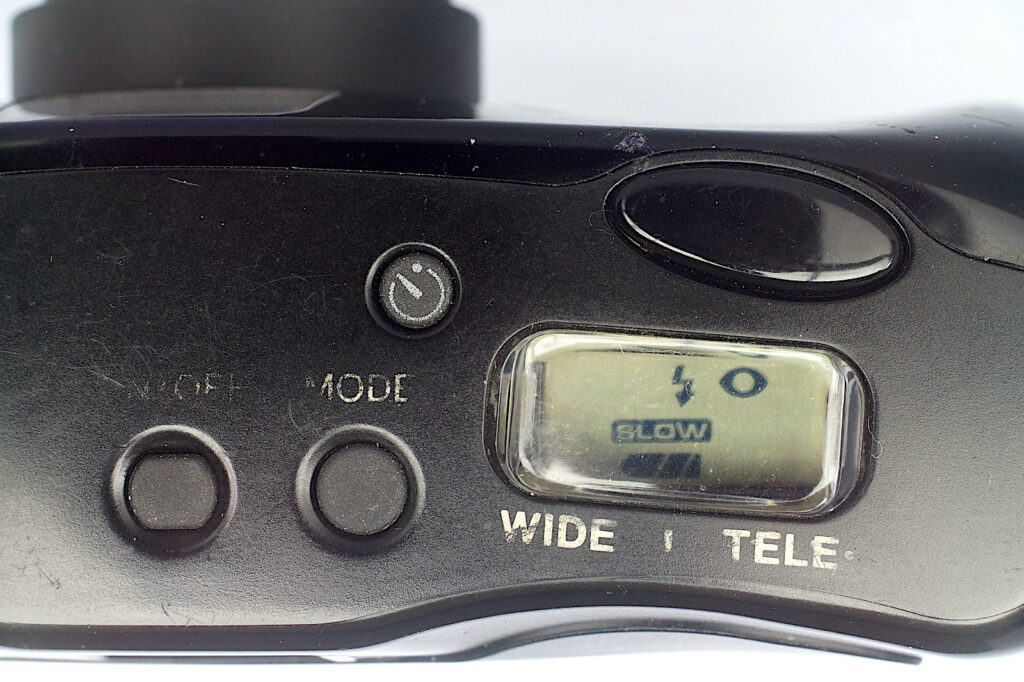
The control group is well arranged for ready access with the right index finger. And the novel rocker cum LCD.

The mode button takes you through a series of options: auto flash on, auto flash on with redeye reduction, flash always on, flash on with redeye reduction and B, flash off and an infinity lock with flash off for shooting through glass. It defaults to auto everything and 35mm when powered on. The delayed action gives approx. 10 second delay with a progress light on the front.

The zoom rocker is not very large making the graphics quite small.
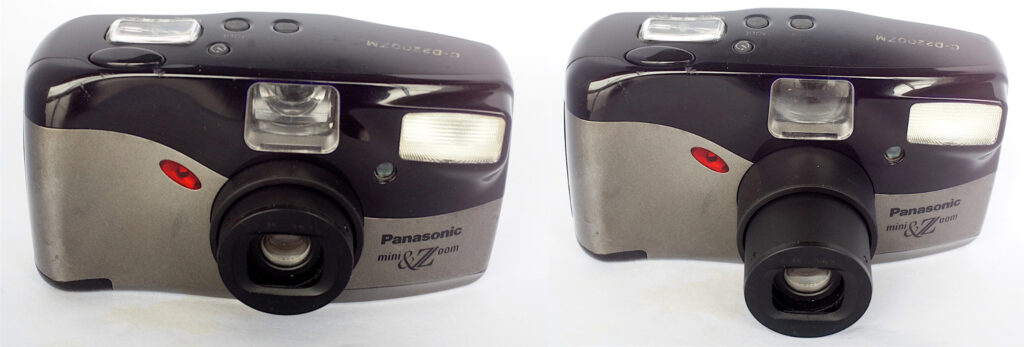
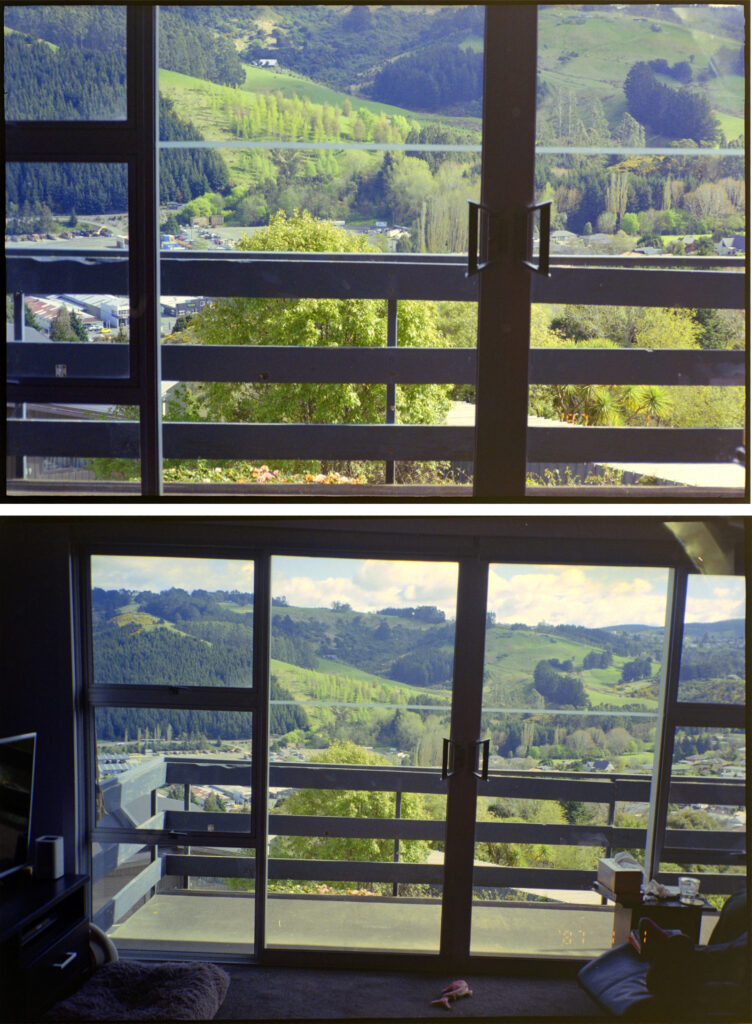
With the lens at each end of its zoom range.
The zoom range.
The zoom range.
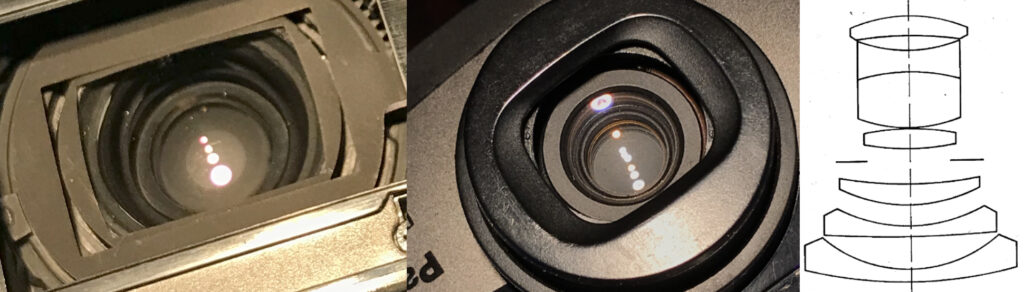
The lens reflections.

The Panasonic C 2200 ZM lens design is of 7 elements in six groups, 35-70 zoom, f4-f25, with 0.6m closest focus and in a shutter speeded 1/4 – 1/300sec. All the technical specifications are mostly the same as the Leica Zoom Mini, but a check on the lens shows eight reflections in front of the shutter and four behind, so there are only two elements behind the shutter, the Elmar section from the Orphan Cameras Zoom Mini manual shown here has three. So the lens design and/or shutter location appear to be different on this camera, or an earlier design perhaps.

Auto-focus, auto-wind/rewind, auto-exposure and delayed action with film speed set by DX code between ISO 50 and 3200 are also features. Frame numbering is on the LCD and doesn’t show with the camera off.
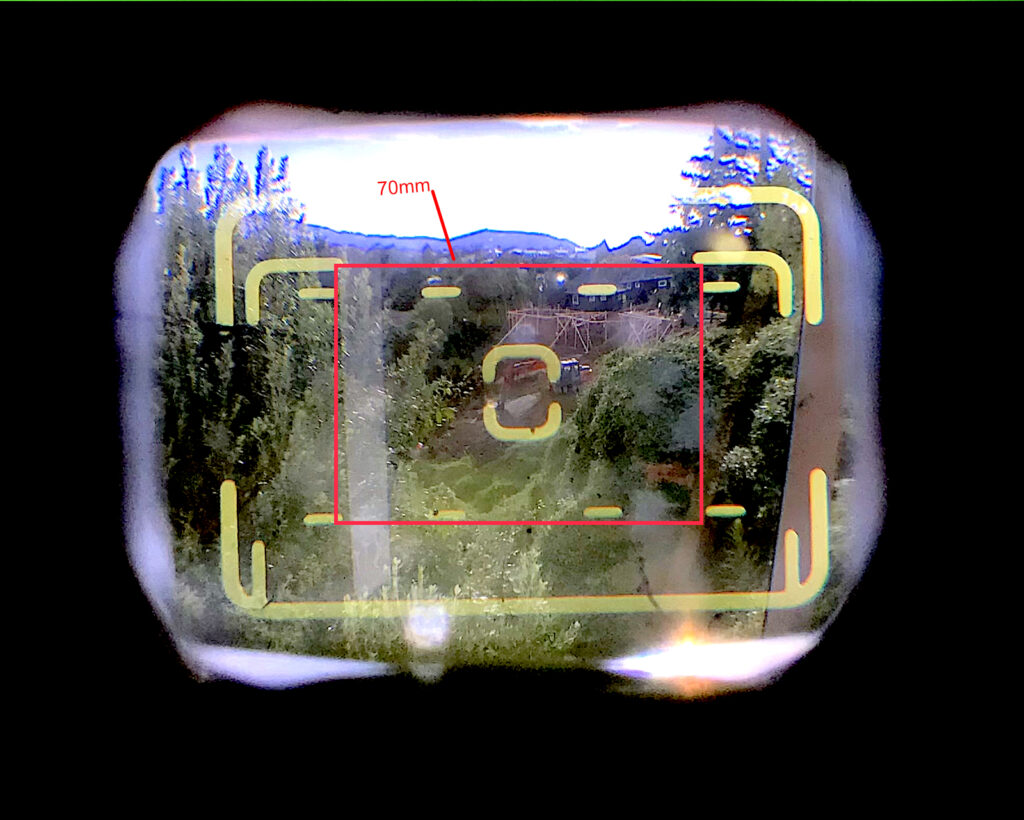
The finder at 35mm zoom setting. I have overlaid the 70mm frame.

The finder is quite easy to use even wearing glasses and shows the suspended frame, close up adjustment, focus spot and the panoramic frame. The reflected frame can be quite dim in poor light, possibly due to the deep finder housing shading it.

The finder zoomed with the lens at first but it now seems to be stuck on 35mm, there were some suspicious grinding noises after a time in use. Loose or stripped gears maybe? The 70mm setting can be estimated using the inner points of the close-up/panorama indications in the finder.

Unusually, the finder shows the magnified image size when focussed at closest distance, not simply the parallax offset. This is the same as found on some the Nikon compacts, the only times I have come across it but there could be others. It would be necessary with the lens focussing down to 0.6m when the the framing will be noticeably affected.

Even left on 35mm it becomes a very advanced auto everything compact.
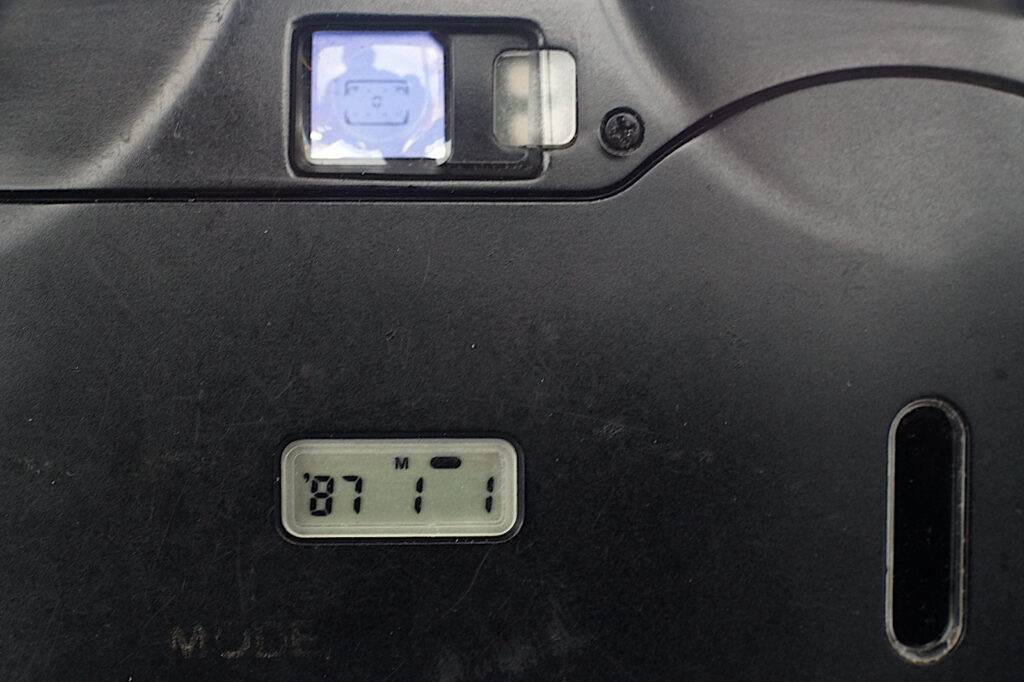
Detail of the back showing the date setting panel and buttons, and the finder and the adjacent warning lights.

Two warning lights are placed to the right of the eyepiece indicating exposure and focus acquisition, and flash ready when in use. Both lights can flash as a warning when flash is not ready, too close to focus or when a slow shutter speed is set.

Power is supplied to the Panasonic C 2200 ZM camera, flash and date back by a 3v CR123A lithium battery, claimed to give approx. 18 24exp. rolls.

The example here is the date imprinting version, the C-D 2200 ZM, and has clearly been well used. It reminds me of the Olympus XA that lived in my pocket for years so that the paint on the back was almost completely rubbed off and the rest thoroughly scuffed. This one is scuffed with much of the screen printing barely legible.

The date setting usefully has an option of turning it off, retained when powered down but lost when the battery is removed for a long period. Worth a check before shooting to avoid some tedious cloning.

Much of this data is taken from the Leica Zoom Mini owner’s manual found on the invaluable Orphan Cameras web site plus various online items and supports the theory that the two makes are basically the same beast because I can find few significant functional differences between the two.

In use

In the hand, the Panasonic C 2200 ZM feels very solid with controls falling readily to the right hand. It could be used one-handed if needed, helped by the wrist strap. I did find myself pressing the zoom rocker instead of the shutter release at times but that would improve with familiarity. The more spread out controls of the Leica may have the edge in this respect.

Loading is simple and rewinding happens automatically at the end of the film. It winds the film completely into the cassette.

Auto-focus is quite slow at times causing some shutter lag. It requires the central spot to be on the subject but partial pressure on the release locks both focus and exposure to allow reframing as needed.

As mentioned, the finder is unresponsive to the zoom control, an inconvenience but doesn’t cause too many problems. I tended to use it as a 35mm all the time like an auto-focus, auto exposure, autowind XA only zooming in when I needed to get close.

Results

I loaded a Kodak Colorplus 200 to see what it could do.

A pair of NZ Rail diesels at rest.
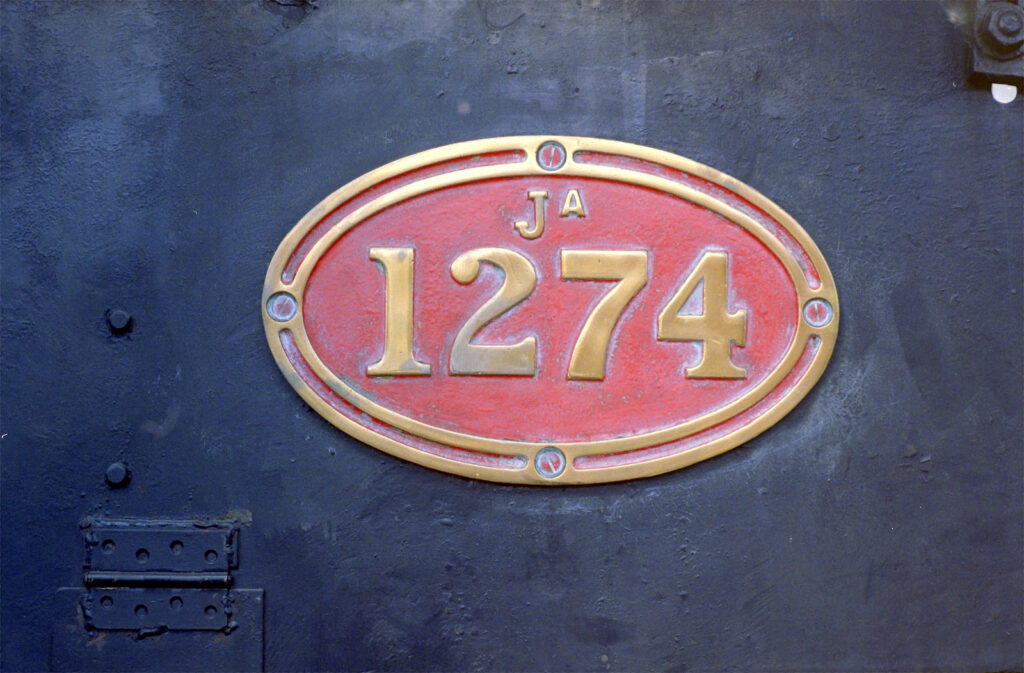
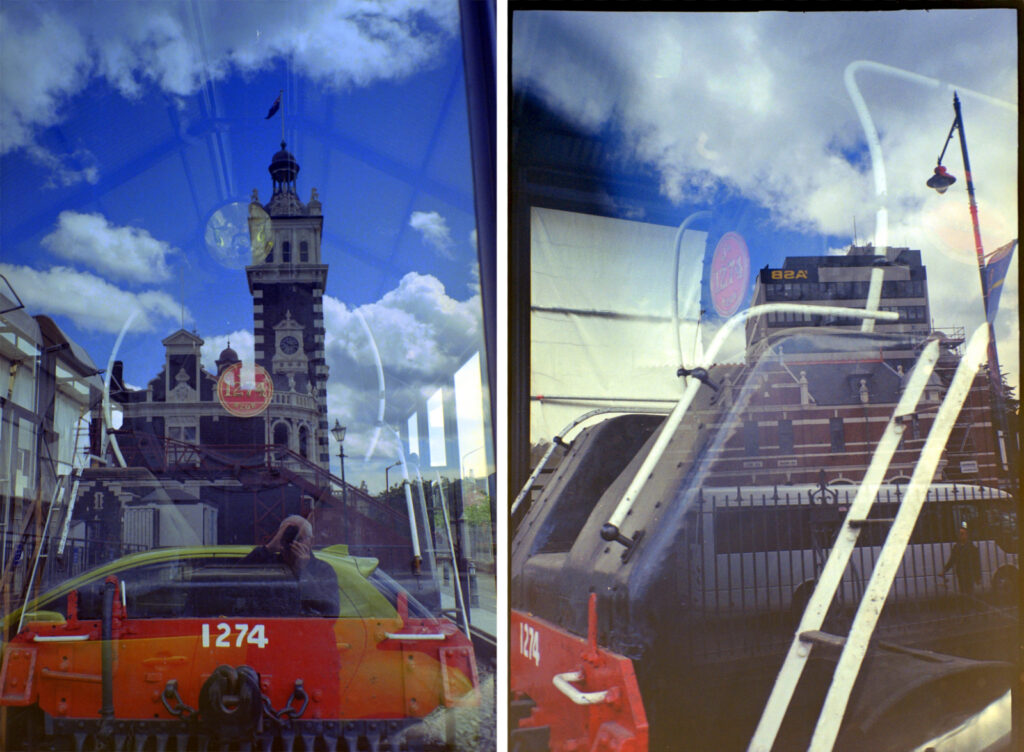
No. plate of steam locomotive preserved and displayed at the Toitu Early Settlers Museum, Dunedin. Photo thrugh glass.
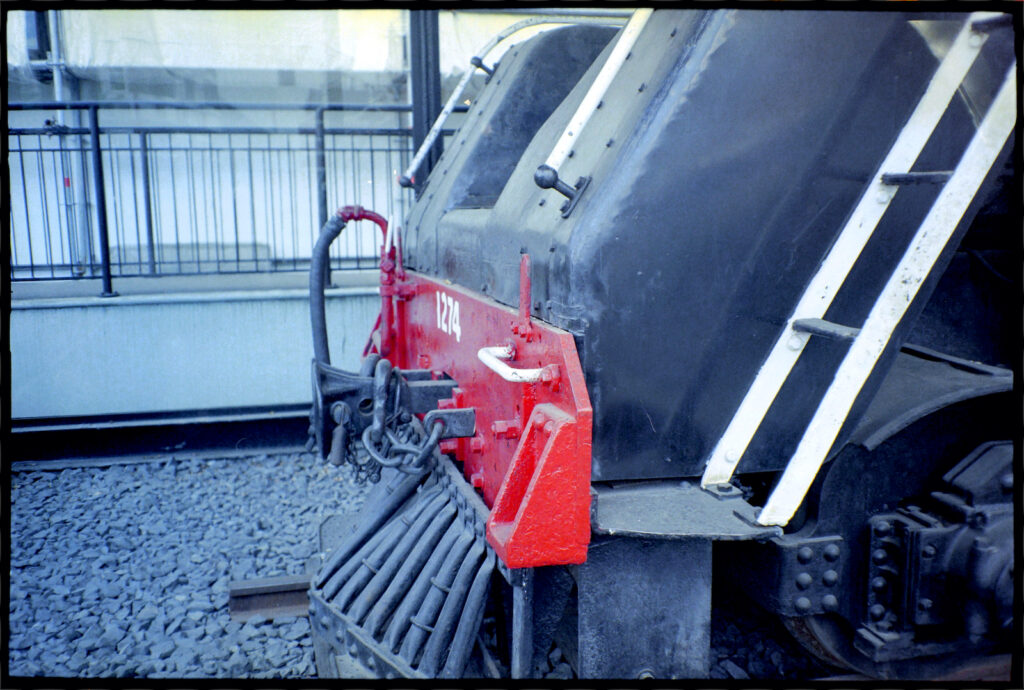
Buffer beam of same loco, photo taken through glass.
Two reflection shots. Intentional on left with historic railway station reflected in glazed enclosure for displayed loco. Right hand despite holding camera close to glass.
How a window affects autofocus. During rain storm.
An example of the definition possible.
“Your’s is coming , sir.”

16

Overall the results are very good but there is a variable light leak in one corner of the frame which needs investigation, apparently coming from the lens assembly and seems to have started when the finder stopped zooming.

Final comment
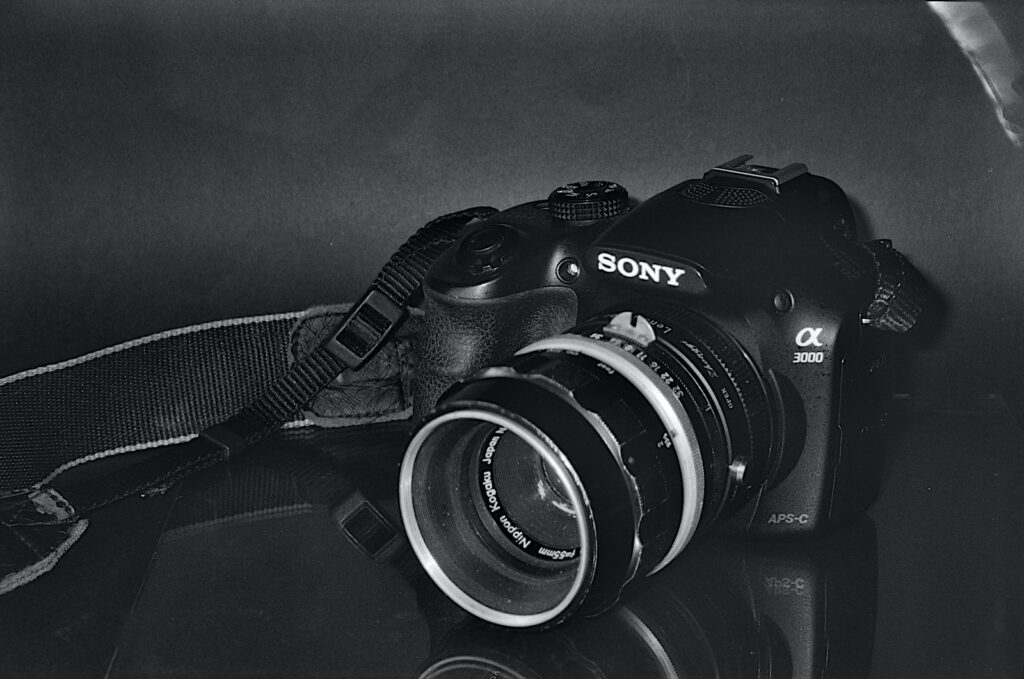
The biter bit - the feature image reversed.
The biter bit – the feature image reversed.

The Panasonic C 2200 ZM is a sophisticated, well specified camera that appeals on several levels. It can be a simple switch on and shoot P&S, a pocketable, versatile go everywhere camera or one to use in less usual situations such as through windows or where flash isn’t allowed.

The 1987 start for date imprinting is in contrast to the Leica version which starts at 1994 when the camera was introduced but both end at 2019. It makes me wonder if it was originally a Panasonic design, or even a collaborative prototype with Nikon, that Leitz later adopted and adapted for the Mini.

With new materials and methods being introduced, it is reasonable to assume specialisations developed in particular areas leading to sub-contracting for specific components. And of course Leica has partnered with both Minolta and Panasonic in several areas, subsequently collaborating with Panasonic even more in the digital era.

Share this post:

About The Author

By Tony Warren
In my 60 or so years of serious involvement in photography I have seen the demise of the viewfinder, the rise of the SLR and the eclipse of them all with the meteoric development of the digital camera. Through it all, however, and above all else, the image is what it is all about so I now use film alongside digital. Whatever is the most appropriate or practical. My contributions will hopefully be useful for anyone interested in using film and also how a died-in-the-wool antique like me is continuing his life-long addiction in the digital age, using both platforms. The major benefit of an extended retirement is that I can spend most of my time nowadays with photography and writing about it.
Read More Articles From Tony Warren

Find more similar content on 35mmc

Use the tags below to search for more posts on related topics:

Donate to the upkeep, or contribute to 35mmc for an ad-free experience.

There are two ways to contribute to 35mmc and experience it without the adverts:

Paid Subscription – £2.99 per month and you’ll never see an advert again! (Free 3-day trial).
If you think £2.99 a month is too little, then please subscribe and I can manually edit the subscription value for you – thank you very much in advance if this is what you would like to do!

Subscribe here.

Content contributor – become a part of the world’s biggest film and alternative photography community blog. All our Contributors have an ad-free experience for life.

Sign up here.

Make a donation – If you would simply like to support Hamish Gill and 35mmc financially, you can also do so via ko-fi

Donate to 35mmc here.

Comments

Bob Janes on Panasonic C 2200 ZM Mini&Zoom

Comment posted: 16/11/2025

Imagining the complex connections to get the viewfinder to zoom along with the lens, it is hardly surprising that such features stop working.
The co-operation you outline at the start of your article is remarkable, but this was the same sort of time that a lot of these camera companies had also been co-operating on the specification for APS...
Reply

Leave a Reply

Your email address will not be published. Required fields are marked *


Tony Warren replied:

Comment posted: 16/11/2025

Too true Bob. There are some extensive gears visible which appear to be plastic hwich would be another factor I suppose. That APS was a collabration makes sense given the manufacturers involved but something I didn't know.

Reply

Leave a Reply

Your email address will not be published. Required fields are marked *


Michael Zwicky-Ross on Panasonic C 2200 ZM Mini&Zoom

Comment posted: 16/11/2025

At the time these cameras came out we had an electrical shop majoring in Panasonic items, from breadmakers via vacuum cleaners to plasma televisions and the area 'rep' persuaded us to take a selection of these cameras. Not a good idea. They didn't sell and we ended up using them as competition prizes.
Reply

Leave a Reply

Your email address will not be published. Required fields are marked *


Tony Warren replied:

Comment posted: 16/11/2025

That is very interesting Michael. Can you remember what year that was? It may shed some light on its origins.

Reply

Leave a Reply

Your email address will not be published. Required fields are marked *


Gary Smith on Panasonic C 2200 ZM Mini&Zoom

Comment posted: 16/11/2025

Tony, you should be an archivist for Camera-wiki. Interesting article.
Reply

Leave a Reply

Your email address will not be published. Required fields are marked *


Tony Warren replied:

Comment posted: 16/11/2025

Thanks Gary but too much like hard work these days.

Reply

Leave a Reply

Your email address will not be published. Required fields are marked *


David Hume on Panasonic C 2200 ZM Mini&Zoom

Comment posted: 17/11/2025

Wow! Thanks for this… It turns out there is one of these sitting on my desk as I write this. It's the non-date version and it has a totally black body. It also has a little panorama mask in a container that sits on its strap. So you can put this in and it masks the shots down to some sort of panoramic mode. For this reason I assumed it was a junk camera but thanks to your article I will look on it with new interest and maybe run a roll through it. It was one of those cameras I bought in the days when charity shops were awash with five dollar cameras. I think my daughter used it a bit but I have not. So there you go. Your article has added a new camera to my collection which until now was just a lump sitting on my desk.
Reply

Leave a Reply

Your email address will not be published. Required fields are marked *


Tony Warren replied:

Comment posted: 17/11/2025

Thanks David. Interesting that you have the panorama insert. I can't see it being a huge attraction, not being able to be selected frame by frame. Most have that option rather than having to commit a whole film to the format. I don't think you will be disappointed if you put a film through it.

Reply

Leave a Reply

Your email address will not be published. Required fields are marked *


Dave Powell on Panasonic C 2200 ZM Mini&Zoom

Comment posted: 19/11/2025

An interesting looking camera with very good results indeed, Tony! I love articles like this about lesser-known point-and-shoots.You should also write a short piece about diagnosing internal lens structures based on surface lens reflections. Haven't heard of that... and am intrigued! (I'm a little confused, though-- was the final Sony Alpha photo supposed to go with a different article?)
Reply

Leave a Reply

Your email address will not be published. Required fields are marked *


Tony Warren replied:

Comment posted: 19/11/2025

Thank you Dave. There was a lot of technology going into these cameras when it hadn't fully matured. The last photo of the Sony was taken with the Panasonic in the same set (biter bit). Apart from me not allowing for parallax it is pretty good quality wise. Don't think the lens construction would make a complete article. Simply, each surface of a lens's elements throws back a reflection of a light source held in front of it. So a simple meniscus gives two, a simple 3-element gives six while a Tessar will also give six even though it has 4-elements because the cemented rear pair only produce 2 between them (only two surfaces reflecting). The cemented pair of the Elmar shown does the same as the Tessar but with more components. So it is basically a guide really.

Reply

Leave a Reply

Your email address will not be published. Required fields are marked *


Mats on Panasonic C 2200 ZM Mini&Zoom

Comment posted: 20/11/2025

It's an interesting camera for sure. I have a black copy. Mine had the exact same symptom as yours. I had to use a pen to turn it on. The I spent some days exercising the on/off button every once in a while until it would turn on with just a normal press of my finger. It had the light leak as well. This is something that plagues these models. The Leica mini zoom as well. Manged to fix that with some thin black tape around the inner lens barrel. I could see the light leak from the back when holding a flashlight to the front. Mine seems to overexpose by around 2-3 stops as well. So all in all a pretty unreliable camera.

The lens though. I was very surprised by the sharpness coming out of this unassuming zoom point and shoot. The detail and sharpness I would get is something that few of my other point and shoots can match. Maybe the Leica lens is even better, but I can't imagine it could be much better as the sharpness on my copy is already very very good.

Kodak and Vivitar made had versions of this camera as well. I have a copy of the little known Kodak version (Kodak star zoom 70) and it only seems to differ in functionality from the Panasonic in that the Kodak version will auto turn off after some minutes (something I hate in point and shoots) while the Panasonic (and Leica I believe) will stay on until you press the power button. I think the Nikon is a more distant relative sharing only the same body. And I think Yashica made a few models based around the same body as well. So the history of this camera is intriguing but somewhat complicated and confusing.
Reply

Leave a Reply

Your email address will not be published. Required fields are marked *


Tony Warren replied:

Comment posted: 20/11/2025

Thank you for such an interesting response Mats. It seems to parallel my experiences with the camera and maybe helps explain why Michael's store didn't sell them well. After a lot of research, I get the impression that Panasonic were feeling their way somewhat with this model and had connections with a number of other camera makers to share component design and production. The Nikon connection I believe relates to earlier models having looked at Camera-Wiki's Panasonic page. The Nikon compacts don't look like this one, more like a number of other makers offerings from a little earlier. The Kodak connection is a surprise though. Maybe they were already feeling the ponch as digital took hold. And one source I found claimed Yashica (Kyocera) made the Leica Mini Zoom. I agree about the lens. Whether it is a Leitz design or not it is very good, not bitingly sharp but with excellent detail rendering and no distortions. Thanks once again and if my patch doesn't work I will investigate the thin tape you applied to the lens barrel.

Reply

Leave a Reply

Your email address will not be published. Required fields are marked *


Mats replied:

Comment posted: 20/11/2025

Kodak actually rebranded quite a few point and shoots through the 80s and 90s. In the 80s Chinon bodies, in the 90's they rebranded the Minolta Riva Pico, Riva 105EX, and this camera. The lenses on all of them are solidly above average for a point and shoot. I guess Kodak didn't want to tarnish their name with lousy lenses. You are right about the Kyocera connection. There has been some time since I did my research on this camera but, but I seem to remember it was cooperative effort by Panasonic and Kyocera. I think the updated Leica Z2X is also basically the same camera with some minor differences, right down to the light leak around the lens barrel. The lens might not be bitingly sharp if compared to an SLR or rangefinder lens, but compared to other compact zooms of the time I have to say it preforms well above expectations. The Leica Mini (non zoom version) has an equally interesting history, with "clones" made by several of the major Japanese companies. Anyway, thanks for the article on this relatively unknown camera!

Reply

Leave a Reply

Your email address will not be published. Required fields are marked *


Tony Warren replied:

Comment posted: 20/11/2025

Thanks again for this extra information. I guess that the industry was struggling to meet the challenges of digital in this period and manufacturing costs would be a major factor. Quality would be easier to maintain with producing in greater numbers spread over several brands. It is a fascinating period. I guess in our small way we added to the problem in the mid 90's when our inspectors swapped their film cameras for Olympus 1.3Mp digitals. Those guys went through so much film, the cost of the digitals was revovered in no time. Progress I guess, but I feel rather guilty in a way now. When I said the lens wasn't bitingly sharp etc I meant it was like a really good older lens with that very natural detail rendering, something I really appreciate. Again, thank you for adding such valuable additional information to my rather limited offering in comparison.

Reply

Leave a Reply

Your email address will not be published. Required fields are marked *


Leave a Comment

Leave a Reply

Your email address will not be published. Required fields are marked *