5 Frames with a Minolta CLE – The Myth of the Straight Line

By Yuan Zhang

We like to tell ourselves that the photographic journey is a logical progression—a straight line from beginner gear to our ultimate aesthetic baseline. If I had known in my early days how good the 1981 Minolta CLE actually was, I could have theoretically bypassed the entire rangefinder vanity fair. I could have saved myself the immense financial and mental detours of owning a Leica M6 TTL, an M7, and a Konica Hexar RF.

But that is a retrospective lie. The truth is, human curiosity requires contrast. I needed to experience the weight, the electronic quirks, and the premium price tags of those alternative routes just to earn the diagnostic wisdom required to appreciate what this tiny, plastic-shrouded Japanese street scalpel is actually accomplishing.

When my Minolta CLE and M-Rokkor arrived from a dry-stored shelf in Hokkaido last week, I didn’t mount the lens to find a luxury status symbol. I mounted it to find out if early-80s engineering could hold its own against my modern 60-megapixel digital standards. What I found on that first test roll wasn’t the soft, muddy nostalgia of the point-and-shoots we grew up with, but an aggressive, shadow-hungry, hyper-resolving image engine that completely unlocked my street workflow.

Here are five frames that proved why the most unassuming box in the M-mount ecosystem is the one that belongs in my hands.

The lens I chose to go with the CLE was a late-batch M-Rokkor 40mm f/2, intentionally bypassing the earlier Leitz-badged version. The late-production Minolta variant features upgraded multi-coatings, yielding significantly higher micro-contrast. It did not disappoint.

On my test roll of choice—the humble, modern Fujifilm 200 (which is technically rebranded Kodak Gold 200 on the inside)—the lens exhibited a massive tendency for high local contrast, especially under the biting midday sunlight on busy Hong Kong streets. Yet, that isn’t to say it draws with a sterile, purely modern rendering. Wide open, out-of-focus highlights still retain a smeary, dreamy, vintage tendency. The polarized character of the glass effectively gives you two distinct rendering styles in one lens, depending entirely on your chosen aperture.

A quiet moment of connection amidst the midday bustle. Sheung Wan Market

When I decided to feed the newly purchased CLE a roll of consumer-grade Fujifilm 200, I was mentally prepared for a series of underexposed images with muddy shadows, mediocre color, and flat contrast. Luckily, that didn’t happen.

This haunting anxiety of underexposure began the moment I purchased a brand-new M6 TTL a few years ago. Both the Leica M6 TTL and M7 calculate exposure by reading light reflecting off a central white spot painted onto the shutter curtain, which occupies only about 13 percent of the frame. This essentially turns their metering system into a rudimentary spot meter.

I still remember coming home from a trip to Japan, hoping to see a captured moment of my wife dipping her feet in the cold water of the Kyoto suburbs. Instead, I realized the M7 had been fooled by the bright reflections on the water’s surface, drastically underexposing the frame and rendering the image useless. The Minolta CLE, despite being born two decades ahead of the M7, utilizes a far more sophisticated, real-time off-the-film metering matrix that averages the global scene, delivering incredibly accurate automatic exposures on the fly.
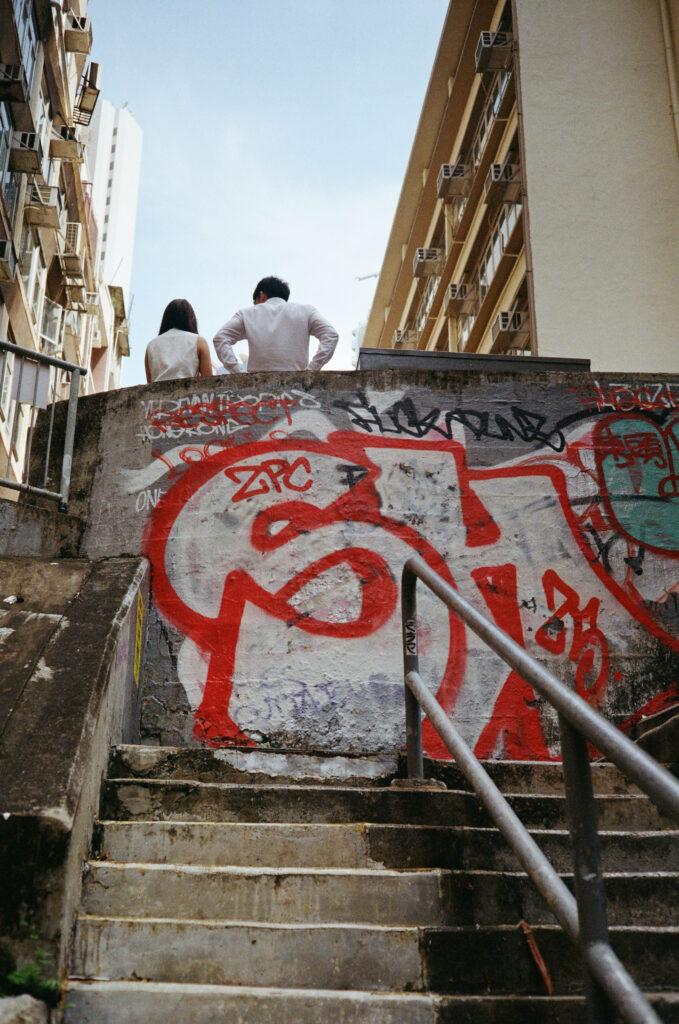
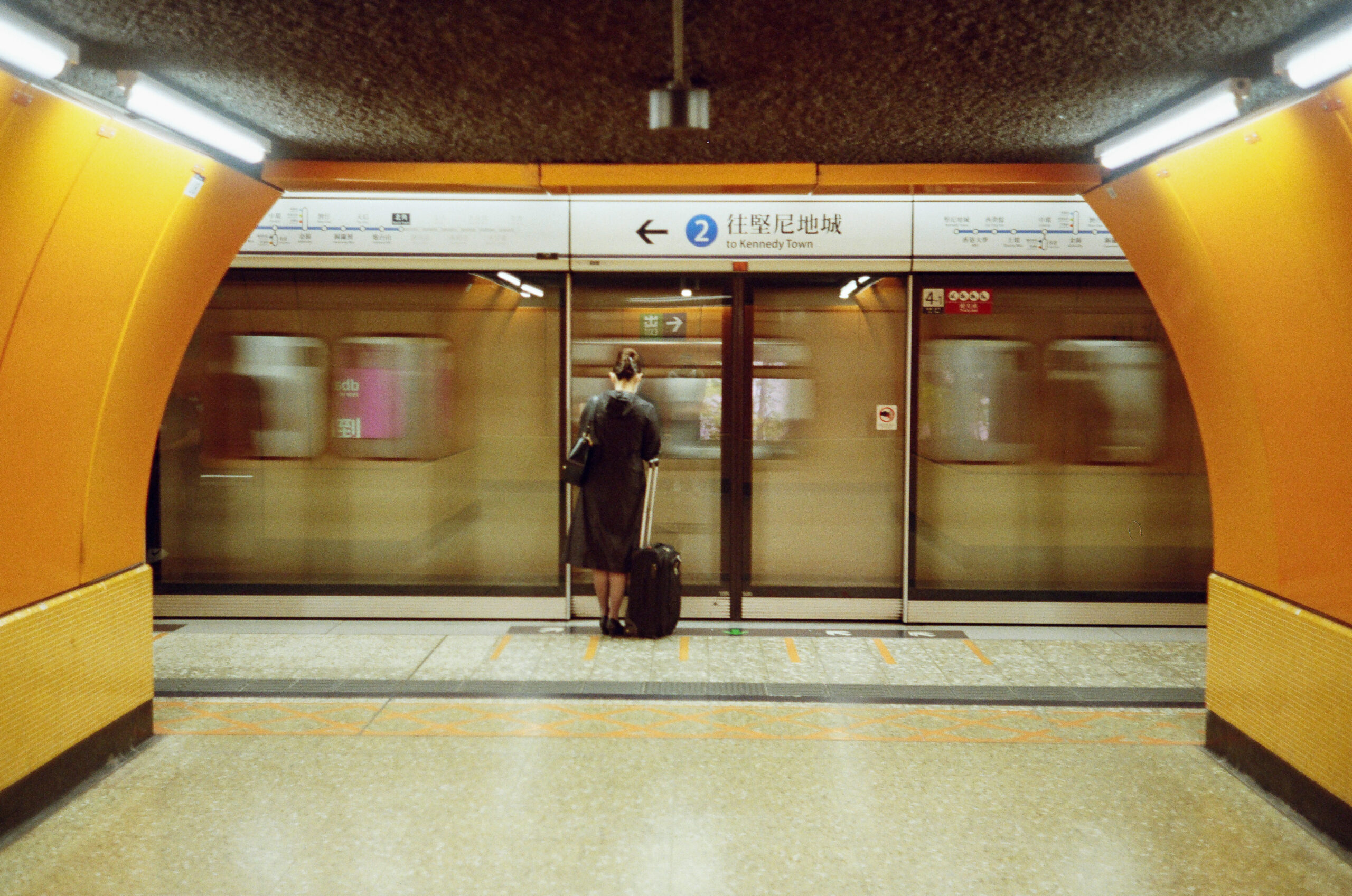
A mid-day reprieve above the concrete stairwells.

For the most part, I consider myself a wide-angle street photography hobbyist. The close proximity of candid street shooting boosts my adrenaline and keeps me hunting for the next scene. This spatial preference is exactly why I initially gravitated toward the 0.58x viewfinder of the M6 TTL, the Hexar RF, and now, this Minolta.

While I don’t limit myself strictly to a 28mm lens, shooting with glasses (or sunglasses on the street) means that having wide, low-magnification frame lines visible on the perimeter is a massive versatility advantage. Unlike the Leica M6, the CLE’s viewfinder has almost zero focus patch flare or “white-out.” And unlike the Hexar RF, it provides native 40mm frame lines—a focal length I find incredibly intuitive.

A few physical observations on the finder: the actual image captured on film appears to be slightly wider than the 40mm frame lines suggest at longer distances. Furthermore, the focus patch, quite like the Hexar, has a rather narrow eye-placement sweet spot; your eye must be aligned perfectly on-axis to maximize patch contrast, particularly in dim lighting.

Manual labor remains a vital logistics engine. Bonham Strand, Sheung Wan

A lot of us born in the 1980s grew up carrying multi-packs of Kodak Gold 200 from big-box retailers to our summer family vacations. Although those old photos and scans immediately trigger joyful childhood memories, the objective quality of those images was never great. Back then, my parents’ camera of choice was a premium, consumer-level Olympus Mju Zoom.

Testing this Minolta setup made me realize just how optically advanced elite camera engineering actually was back in the 1980s by comparison. Realizing that a pocketable camera and lens system manufactured over forty years ago can produce absolutely uncompromised, razor-sharp images on modern scan benches never fails to bring a smile to my face.
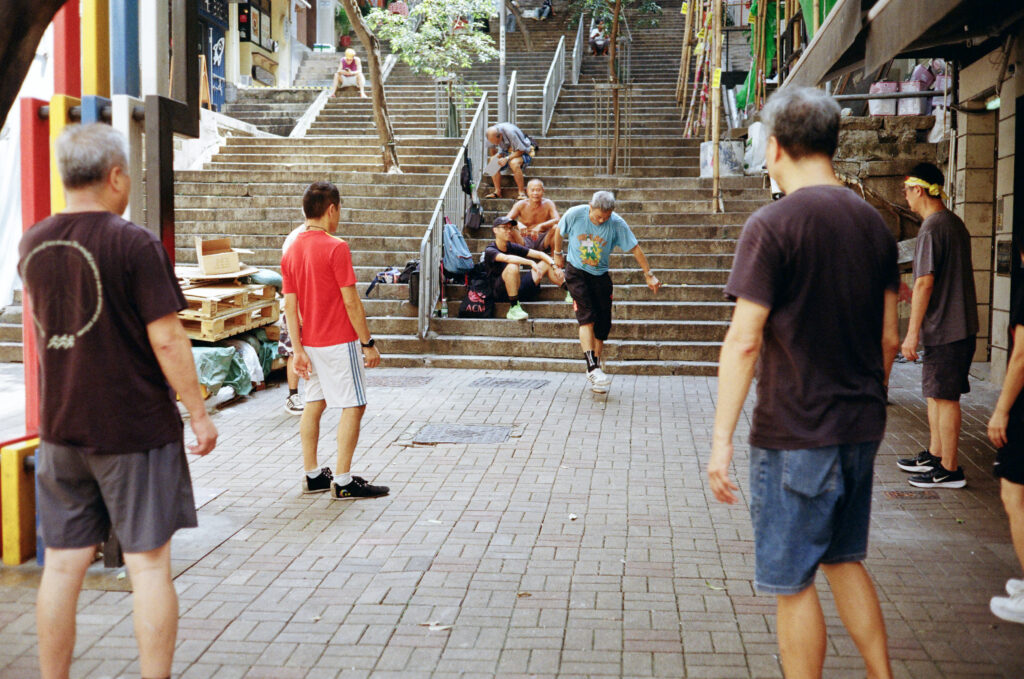
A neighborhood circle practicing Jianzi (shuttlecock kicking), a traditional local street sport.

P.S. After years of lurking as a quiet admirer of the site, it feels incredibly rewarding to step up with my first community contribution. I’m immensely grateful to Hamish for helping me get this piece put together, and it’s a true privilege to finally add something back to the platform that has shaped so much of my own perspective on gear.

Share this post:

About The Author

By Yuan Zhang
A self-taught street photographer with a background in broadcast television, dedicated to hunting for a compelling story in every frame.
Read More Articles From Yuan Zhang

Find more similar content on 35mmc

Use the tags below to search for more posts on related topics:

Donate to the upkeep, or contribute to 35mmc for an ad-free experience.

There are two ways to contribute to 35mmc and experience it without the adverts:

Paid Subscription – £3.99 per month and you’ll never see an advert again! (Free 3-day trial).

Subscribe here.

Content contributor – become a part of the world’s biggest film and alternative photography community blog. All our Contributors have an ad-free experience for life.

Sign up here.

Make a donation – If you would simply like to support Hamish Gill and 35mmc financially, you can also do so via ko-fi

Donate to 35mmc here.

Comments

Nigel Gardner on 5 Frames with a Minolta CLE – The Myth of the Straight Line

Comment posted: 22/10/2026

Great article - I’m not a Minolta or Leitz user. i prefer my glass to say Carl on it. But the CLE is a wonderful bitof ingenuity. I don’t think the debt Leitz users owe Minolta is really appreciated
by many.

Thanks for the post and great images.
Reply

Leave a Reply

Your email address will not be published. Required fields are marked *

Yuan Zhang replied:

Comment posted: 22/10/2026

Thank you for reading, Nigel! I completely understand the love for Carl Zeiss glass—there's an undeniable magic to those lenses. And you're so right about that historical connection. Isn't it wonderful when two industry giants collaborate and create a spark of brilliance that we still get to appreciate decades later?

Reply

Leave a Reply

Your email address will not be published. Required fields are marked *

Martin on 5 Frames with a Minolta CLE – The Myth of the Straight Line

Comment posted: 22/10/2026

Thanks for the article, a wonderful piece! It's a great little camera. I don't have any M-mount lenses for mine but use LTM glass with an adapter.
Reply

Leave a Reply

Your email address will not be published. Required fields are marked *

Eric Norris on 5 Frames with a Minolta CLE – The Myth of the Straight Line

Comment posted: 22/10/2026

The CLE is a great little camera. Some purists might be shocked, but I find that the aperture priority auto operation makes the camera fun and inviting to use.
Reply

Leave a Reply

Your email address will not be published. Required fields are marked *

Yuan Zhang replied:

Comment posted: 22/10/2026

Thank you, Eric! I totally agree!

Reply

Leave a Reply

Your email address will not be published. Required fields are marked *

Graham Line on 5 Frames with a Minolta CLE – The Myth of the Straight Line

Comment posted: 22/10/2026

When I bought my CLE in the mid-90s, local Leica mandarins assured me the electronics would explode in my hand in the near future. I'm still using it 30 years later, with an M4P in the bag as backup.
Aperture priority works very well and the light weight of the body and smooth shutter are assets. The finder is absolutely brilliant. My lenses are an assortment of Leitx, Minolta and Voigthander.
Reply

Leave a Reply

Your email address will not be published. Required fields are marked *

Yuan Zhang replied:

Comment posted: 22/10/2026

Thank you for reading, Graham! It cracks me up to hear about those 90s doomsday warnings from the Leica mandarins. Thirty years later and still no explosions! As a total newcomer to the CLE, I actually panicked just yesterday when my slow shutter speeds dragged out with an empty film chamber, only to realize the clever metering brain was just staring at the black pressure plate waiting for film. It’s amazing how robust these 'fragile' electronics actually are.

Reply

Leave a Reply

Your email address will not be published. Required fields are marked *

Eric Rose on 5 Frames with a Minolta CLE – The Myth of the Straight Line

Comment posted: 22/10/2026

Back when the CLE first came out I instantly fell in love with it. Unfortunately at the time I couldn't afford it. At the time I was using a Minolta HiMatic 7s which also has a stunning lens. Thanks for the write-up.
Reply

Leave a Reply

Your email address will not be published. Required fields are marked *

Jeffery Luhn on 5 Frames with a Minolta CLE – The Myth of the Straight Line

Comment posted: 22/10/2026

Yuan,
Thanks for the entertaining article with good pix. My favorite sentence: "I could have theoretically bypassed the entire rangefinder vanity fair."
That made me chuckle! I'm 74 and I don't see an offramp for me anywhere. My wife complains, "What am I to do with this stuff after..."
I reply, "Dear, just sell it by the pound."

About Hong Kong: I spent many years there and had a small studio on Cameron Rd in Tsim Sha Tsui. That was back in the early 1980s through 1990. Photos I see of that place today are much more neon saturated than I recall. I fondly remember the various arcades with photo stores. David Chan was my favorite. I would buy something one day, and swap it out after a week. David made a fee and I got to play with lots of gear. Is he still in operation? Jeffery Luhn
Reply

Leave a Reply

Your email address will not be published. Required fields are marked *

Yuan Zhang replied:

Comment posted: 22/10/2026

Hi Jeffery, so glad that line brought a smile to your face! Wow, a studio on Cameron Road in the 80s — you must have captured some incredible moments during Hong Kong's golden neon era. You’re so right about the shift in look today. Speaking of those unique night lights, I've always been mesmerized by Greg Girard's photography from that exact era, which beautifully emphasized Hong Kong’s moody, atmospheric nighttime glow. I'm a total newbie to all of this, but are you by any chance familiar with his work? Also, to answer your question: yes, David Chan is definitely still up and running! His shop on Kimberley Road is a legendary spot for camera hunting, and he's still as passionate as ever. It's a huge honor to have an old-school TST local reading my very first post!

Reply

Leave a Reply

Your email address will not be published. Required fields are marked *

David Rusling on 5 Frames with a Minolta CLE – The Myth of the Straight Line

Comment posted: 22/10/2026

Good article and photographs. I like the idea of the Minolta CLE but I don't think that the viewfinder / framelines suit me, I'll stick to my M2. I half convinced myself that Fuji 200 had more of a green bias, but, you're right, it's Kodak Gold. Despite wanting to avoid Kodak Gold on my return to film, it's turned into my 'old reliable'.

By the way, I'm a 35mmc newbie too, with an article coming out in November.
Reply

Leave a Reply

Your email address will not be published. Required fields are marked *

Yuan Zhang replied:

Comment posted: 22/10/2026

Thanks for the warm welcome, David! It’s great to connect with a fellow newbie here, and I’ll definitely be keeping an eye out for your article in November. The M2 is such a beautiful, classic baseline — I completely understand why you stick with it. And don't worry, the whole Fuji/Kodak gold box trick fooled me completely at first too, until I started pixel-peeping the scans. Good luck with your upcoming piece!

Reply

Leave a Reply

Your email address will not be published. Required fields are marked *

marco on 5 Frames with a Minolta CLE – The Myth of the Straight Line

Comment posted: 23/10/2026

You are right that, like almost any other pursuit, a personal photographic journey is not a logical progression [through line]. After all, unless we do a great deal of research, we do not know all the options/equipment nor how we each might suit us. We develop our taste/preferences over time. If it were a straight-line journey, it might not be as interesting.

Have a Leica CL with Minolta Rokkor 40/2 and 90/4. Since Leica seemed beyond my price point,. Discovered a lower-entry point [not screwmount] through Analog Insights [YouT***]. Favouring 40mm lenses on 135 cameras, the CL frame lines work for me. The only downside – the obsolete mercury battery, which can easily be circumvented.

Remember that Minolta and Leitz teamed up in 1972, when Leitz was on the verge of bankruptcy. The fruits of that joint venture were the M Mount range finder [Leica CL] and the R series SLRS. Minolta developed the CLE after they ended their cooperation.
Reply

Leave a Reply

Your email address will not be published. Required fields are marked *

Yuan Zhang replied:

Comment posted: 23/10/2026

You put it beautifully, Marco — the journey wouldn't be half as fun if it were a straight line! The Leica CL with that 40mm Rokkor sounds like an absolute dream of a pocket setup. Thanks for the historical reminder about the 1972 partnership, too. As a newcomer, it’s just amazing to see how well these old electronics and lenses hold up decades after the companies went their separate ways.

Reply

Leave a Reply

Your email address will not be published. Required fields are marked *

Walter Reumkens on 5 Frames with a Minolta CLE – The Myth of the Straight Line

Comment posted: 23/10/2026

A brilliant article and some great photos. A warm welcome to the community, Yuan!
A really excellent camera – I’ve read a lot about it but haven’t had the chance to hold one in my hands yet. From this range, I own the Minolta M-Rokkor 90mm/F4, which I use on a Voigtländer Bessa or, with an adapter, on mirrorless cameras.
As some commentators have already mentioned, what would have become of Leica if there hadn’t been massive technical support for Minolta’s M and R series around 1970–72? At the dawn of the digital age, it was another major Japanese company that stepped in. Thanks for the article, Yuan. I’m already looking forward to more articles.
Reply

Leave a Reply

Your email address will not be published. Required fields are marked *

Yuan Zhang replied:

Comment posted: 23/10/2026

Walter, thank you both so much for reading and for the incredibly warm welcome to the community! I’m still learning so much about the history behind these systems, but it really is fascinating to think about how much collaboration went on under the hood between Germany and Japan back then. It makes shooting with this little setup feel even more special.

Reply

Leave a Reply

Your email address will not be published. Required fields are marked *

Erik Brammer on 5 Frames with a Minolta CLE – The Myth of the Straight Line

Comment posted: 23/10/2026

Great photographs alongside an insightful article! I use a Leica CL as a compact nighttime or travel companion and would say that the mechanics are inferior to a Leica M3 or M2, but it's still a great little machine. I guess that the Minolta CLE metering system is indeed superior to the quasi spot meter of the Leica CL which requires a bit more thought when metering.
Reply

Leave a Reply

Your email address will not be published. Required fields are marked *

Yuan Zhang replied:

Comment posted: 23/10/2026

Thank you Erik! I don't have much experience with the CL, but you are correct and the metering of the CLE is very dependable.

Reply

Leave a Reply

Your email address will not be published. Required fields are marked *

Geoff Chaplin on 5 Frames with a Minolta CLE – The Myth of the Straight Line

Comment posted: 23/10/2026

What a great start - article and pictures, and an interest grabbing title too! So you missed out on the M3? Shame - it's got the best meter (your brain!) 60mp digital? - don't be afraid to show those images too. I look forward to seeing more of your work.
Reply

Leave a Reply

Your email address will not be published. Required fields are marked *

Simon Atkins on 5 Frames with a Minolta CLE – The Myth of the Straight Line

Comment posted: 23/10/2026

I really enjoy using my CLE, its a very capable camera in such a small size. The only slightly annoying feature is the lack of metering in manual. I could never work out why Minolta didn't figure a way for the meter to work in manual.
Reply

Leave a Reply

Your email address will not be published. Required fields are marked *

Brashtown Czar on 5 Frames with a Minolta CLE – The Myth of the Straight Line

Comment posted: 25/10/2026

Your shutter curtains are running at unequal speeds. Zoom way out and view your images at thumbnail size. One side of the frame is much darker at faster shutter speeds. That means lubricants have dried out and things are dirty and the camera needs servicing generally. (Don't let someone just increase the spring tension to 'fix' this!)
Reply

Leave a Reply

Your email address will not be published. Required fields are marked *

Yuan Zhang replied:

Comment posted: 25/10/2026

Thank you for reading, and you have a sharp eye! This particular camera indeed has 'shutter capping' issue, which only occurs randomly at 1/1000s, usually in tandem. The partial underexposure was caused by a wrong firing timing of the second curtain. It is being inspected and serviced by my trusted tech as we speak. As a matter of fact I was aware of this behaviour right from the start, but was not sure if it's an issue until much later.

Reply

Leave a Reply

Your email address will not be published. Required fields are marked *

Leave a Comment

Leave a Reply

Your email address will not be published. Required fields are marked *