

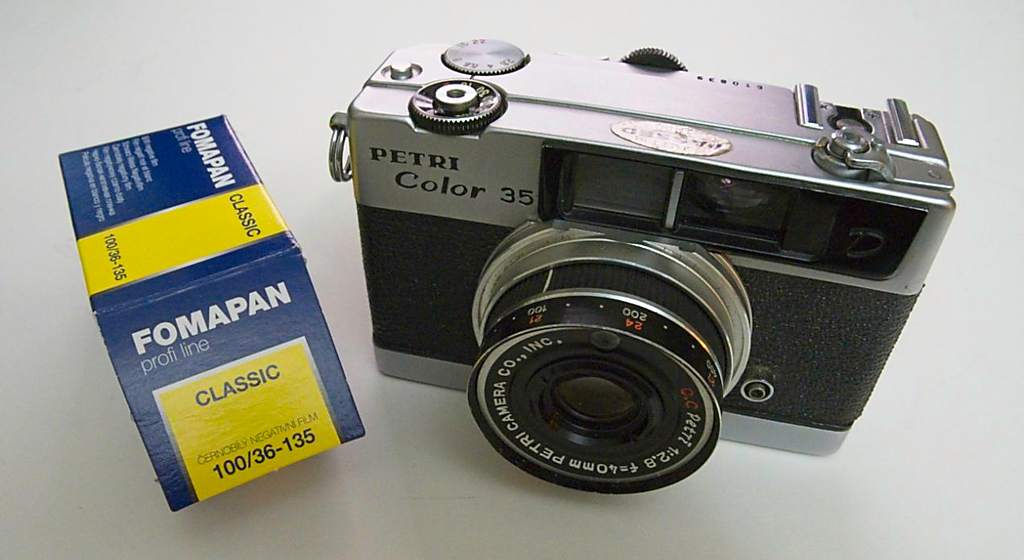
When I see a camera going cheaply in a charity shop, I tell myself that if it turns out to be good it will turn out to have been a good buy but if it doesn’t, then I will have made a donation to a good cause. This just happened when I came across an interesting camera I had never seen before – a Petri Color 35 D. It seemed potentially too good a bargain to be missed. There was a note saying that the shutter had been tested but the meter had not. Inside the case was a receipt for a repair, in 1987, saying that the viewfinder glass had been replaced but there was something that could not be fixed because the necessary part was no longer available. I decided that the price was well within what I would be happy to donate to the charity, so bought it.
Naturally, I looked it up on the web, only to find Hamish has reviewed a very similar model (very similar, except mine has a fastest shutter speed of 1/300 instead of 1/250). I decided the battery was dead, but as the manual says clearly that the battery has to be 1.3 volts and my only spare was an SR44, I removed the battery and decided to test it immediately with a roll of Fomapan 100, a film that I had never tried. (A significant issue is that the battery can be replaced only when there is no film in the camera.)
The test site was Blanchland, a village built on the site of a former abbey, presumably with stone taken from the abbey when it was demolished, though with a few of the abbey’s buildings still in use. It was a dull day, with intermittent drizzle, so fairly low contrast. Exposure was set using an OM4Ti, though it hardly changed at all. The village is spoiled by parked cars but it is easy to see why it is in demand as a film set.
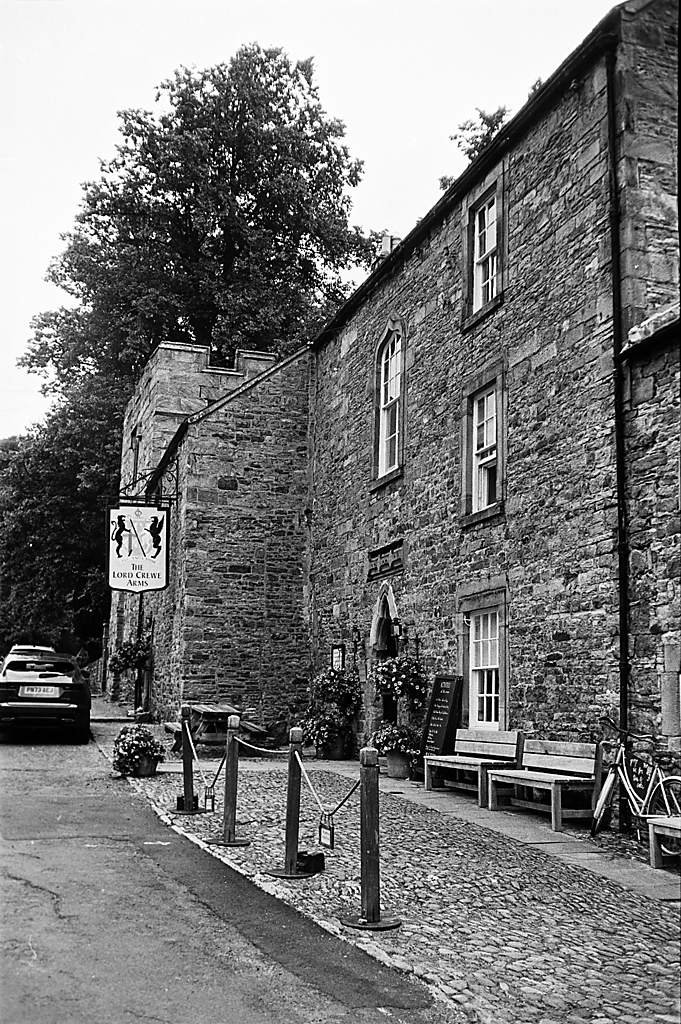
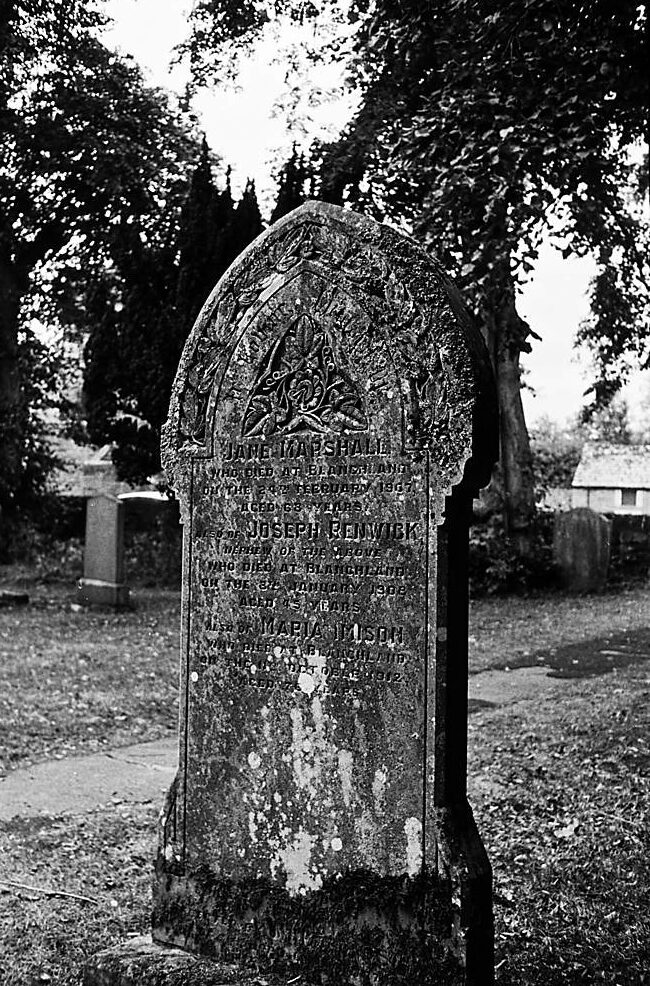
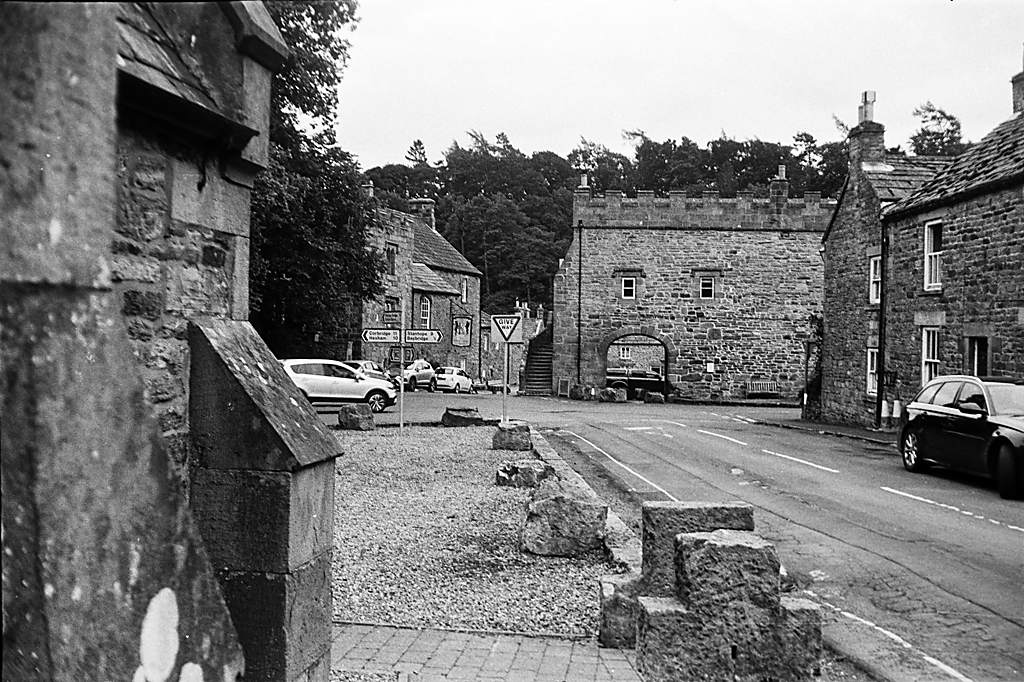
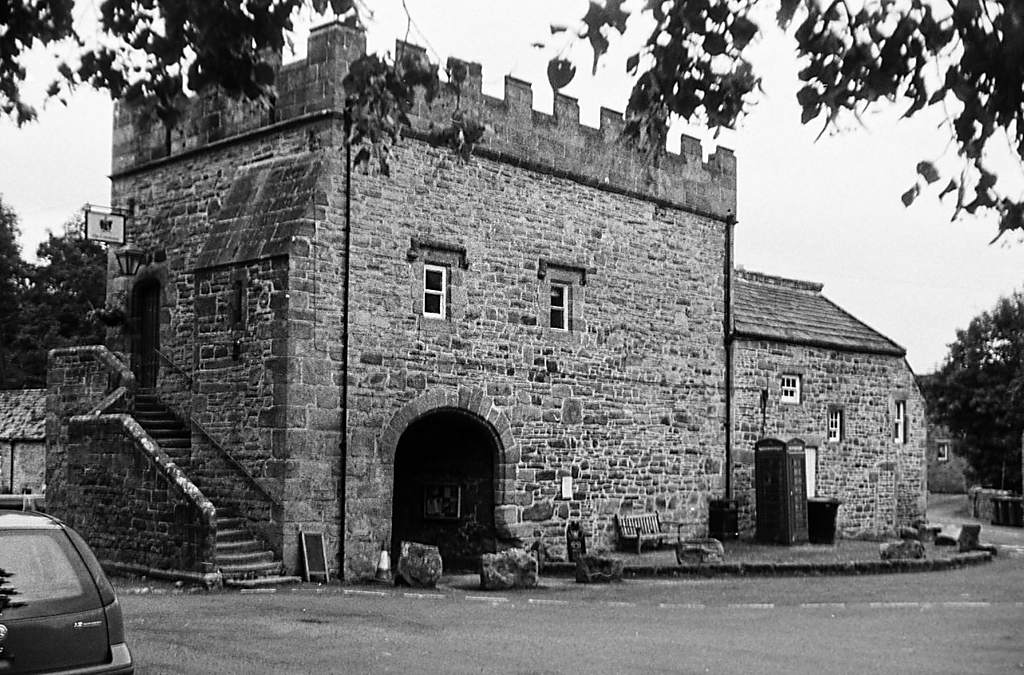
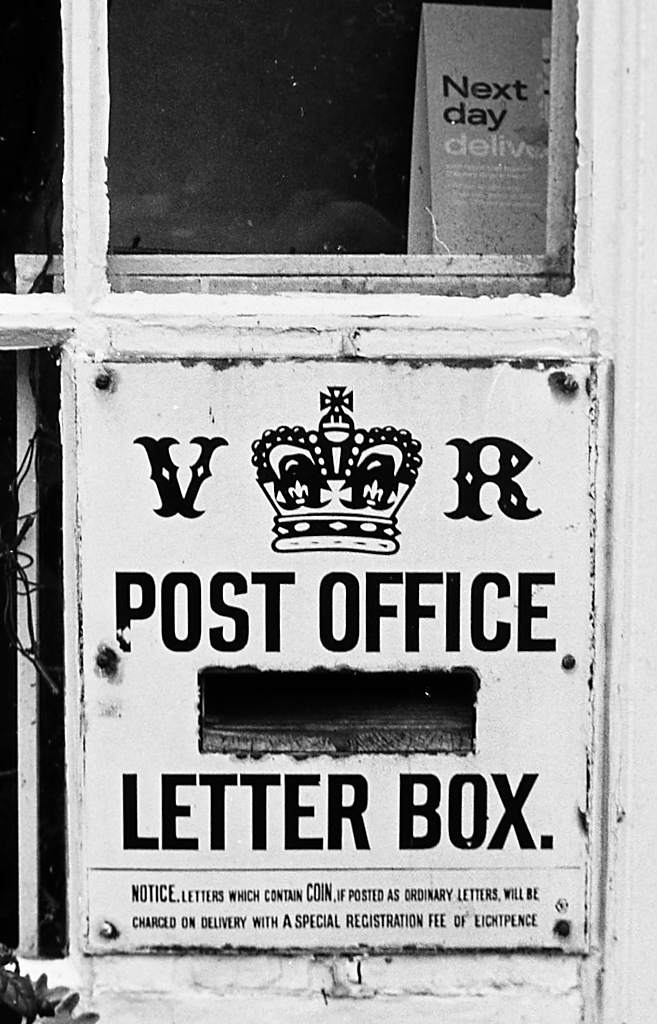
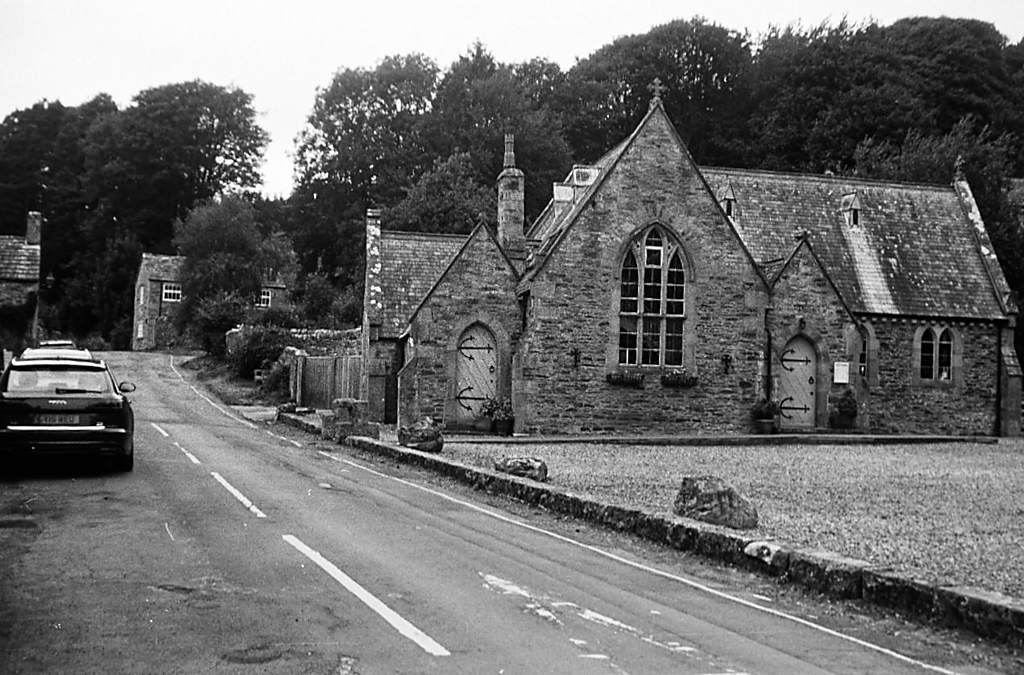
Everything Hamish said about the camera is correct (not that I would expect anything else) though like at least one other person on the forum, I ended up more positive about it. It is a camera that pushes you towards treating it as shutter priority, though as there is such a limited choice of shutter speeds, that hardly seems an issue. What I like most is the viewfinder display, showing both focus distance and exposure extremely clearly. The main frustration is having to turn the focus wheel to extend the lens, especially given that there is a bit of play in the mechanism (maybe that is what the repairer could not fix). There is also the need to remember to delay winding on until you are ready to take the picture, because winding on turns on the meter (if there is a battery installed). But the camera is small and I enjoyed using it. On getting home I installed a zinc-air battery and the meter seemed to tally with what a Weston meter said, which was a bonus.
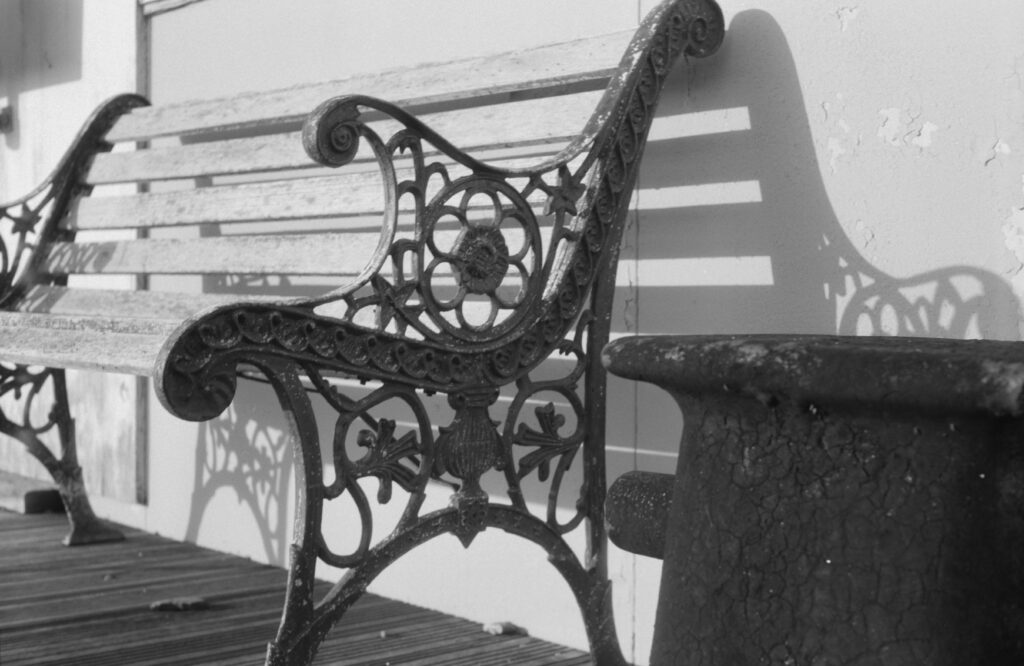
My reactions to the Fomapan are mixed. Not wanting to waste time or money on something that might not work at all, I cut off half the film and developed in Rodinal 1:50. Given the dull light and drizzle, I am impressed with the contrast and the tones, though the grain is a bit obstrusive for my taste, especially in plain areas. But perhaps that is the result of pixel-peeping 42 megapixel scans done with a Sony A7R3. It makes me look forward to seeing how similar shots taken on the same day with the OM4Ti on Pan F look. It is possible that results would be better with a tripod, as there could be a trace of camera shake, though the grain makes it hard to tell.
I enjoyed using the camera and intend to use it again, next time using its own meter, though my rational self says it would be much better to use my OM4Ti, which is easier to focus, has better metering, and allows me to use a focal length other than 40mm, or even a rangefinder with interchangeable lenses (such as a Leica IIIf, despite its inferior viewfinder).
Share this post:

Comments
Geoff Chaplin on Petri Color 35 D & Foma 100 – A twin test
Comment posted: 23/09/2026
The camera perfirmed well so a good buy, and some excellent images from a photogenic setting.