Filmomat PhotoPlug

By Roger

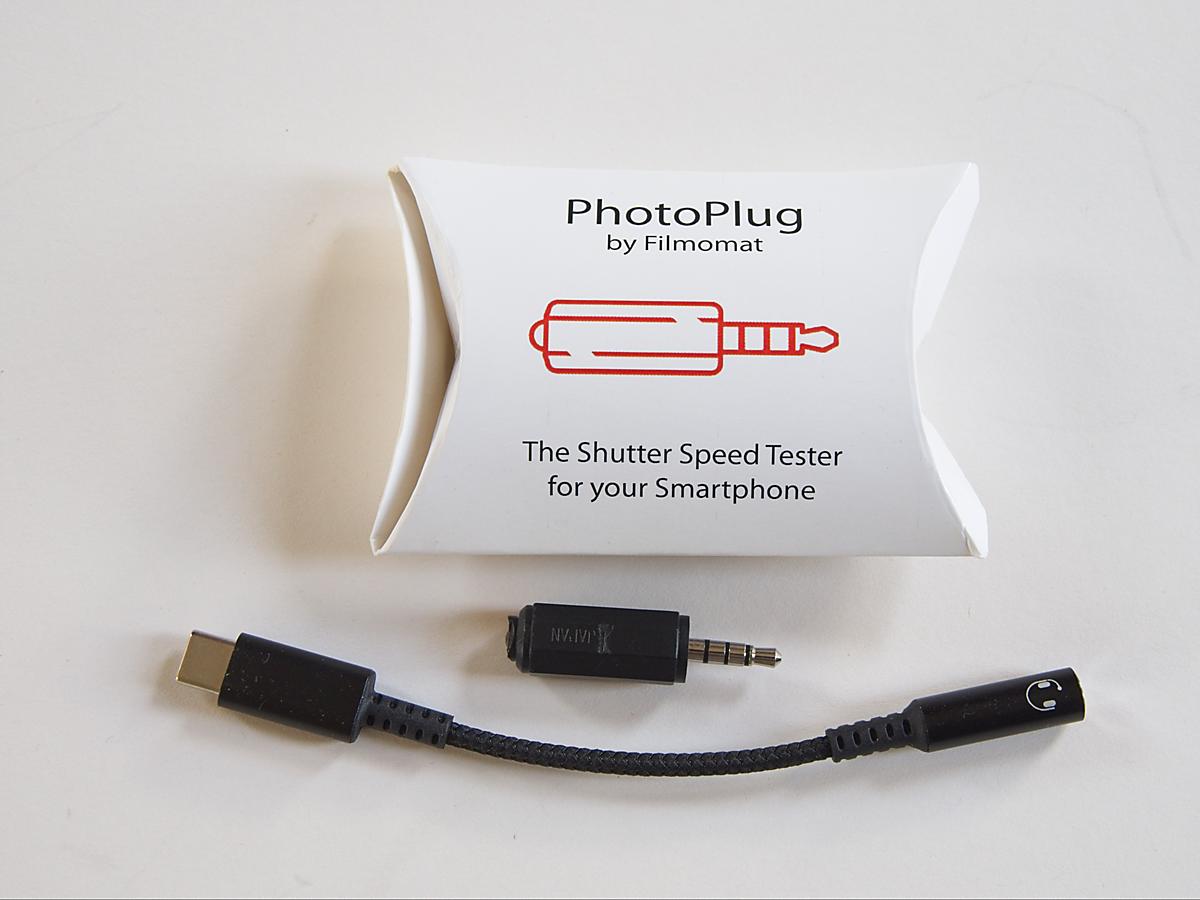
As someone who has more film cameras than I need, I decided it would be interesting to know how accurate their shutters are. Obviously, you can tell the difference between 1 second and 1/500 but when there is also a mirror making a noise, I cannot tell the difference between 1/125 and 1/500 second. So on impulse I invested in a Photoplug. I can’t find a review on this forum so here is a quick one.

It is a simple plug that goes into the microphone socket of a phone, or if you have no microphone socket, into an adapter. I bought the adapter too, thinking I would use if on my regular phone but, so that I could loan it to a friend, I retrieved an old Android phone from the pile of stuff to go to Oxfam (they recycle old phones) and set that up to use it. It works by using a light sensor to send a signal into the headphone socket and then into an app that analyses it. You can use the app without the plug, but it would rely on sound, which given the noise of an SLR mirror means it is unlikely to be accurate.

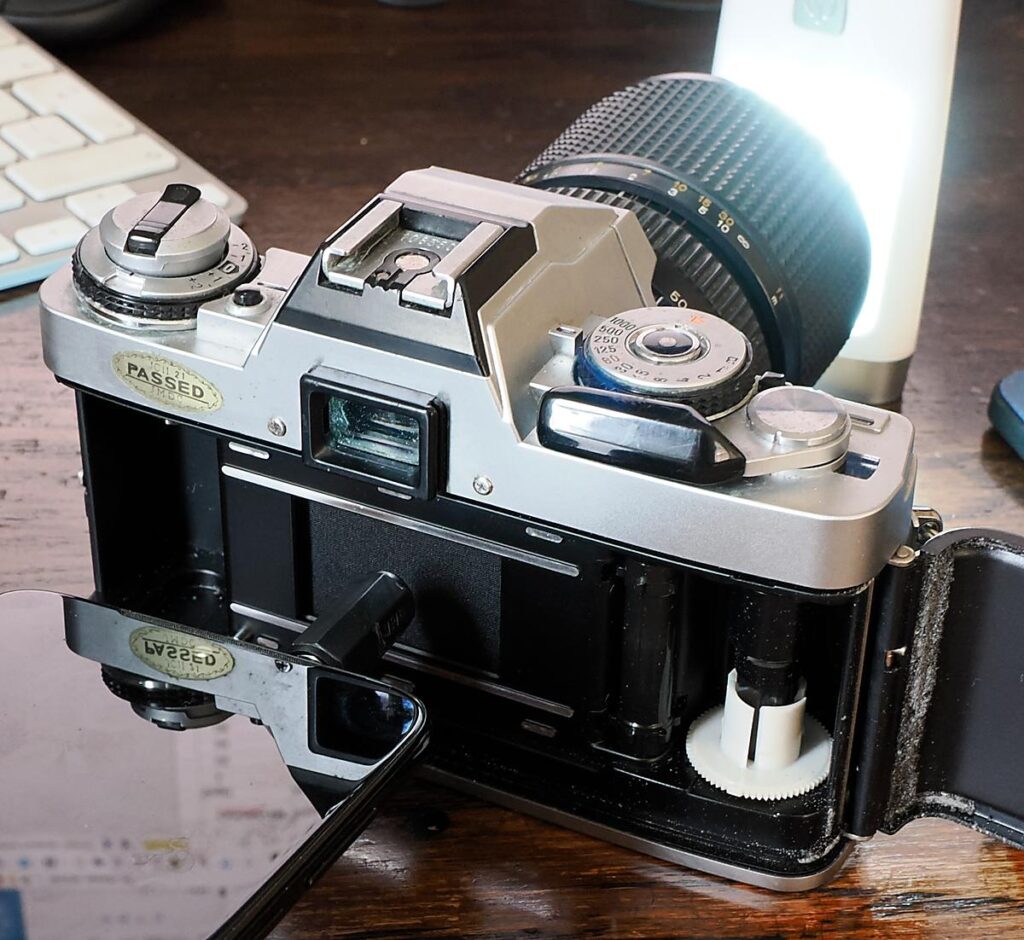
It is simple to set up. After downloading the app, plug it into the headphone/microphone socket, open the back of the camera, put a bright light in front of the lens (and I use the widest aperture) and position the plug behind the shutter.
Then open the app, when you see a screen like this:
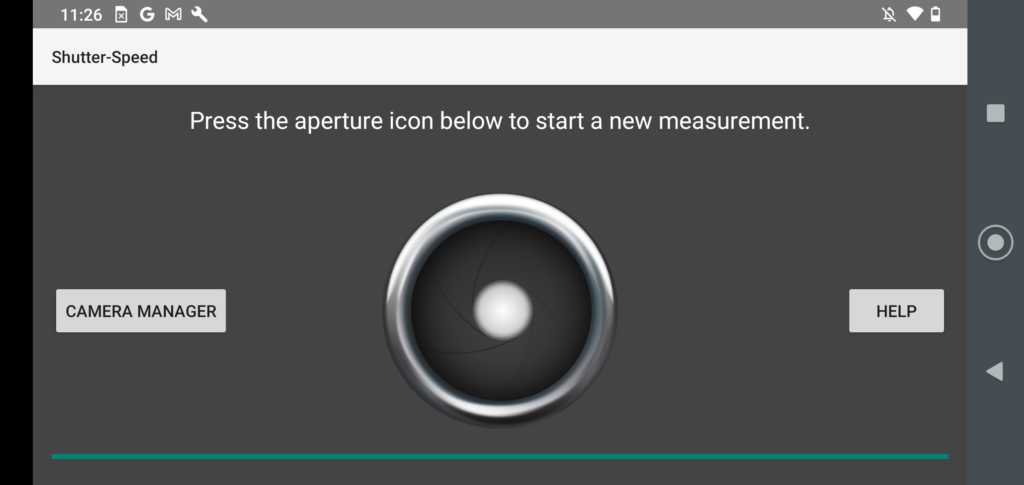
Go into camera manager and create an entry for the camera, then, with the camera in place, press the big button in the middle, which gives you a three second window during which you have to fire the shutter. Left hand holding the phone and right hand on the shutter works for me. You then see a screen like this.
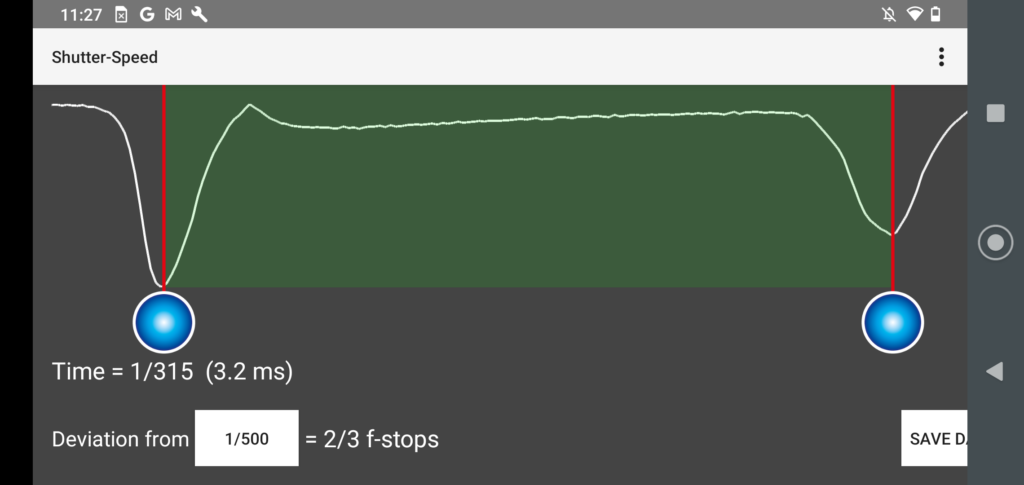
The Android app defaults to 1 sec, so you have to select the correct target shutter speed. Then do the obvious: save, select the camera, answer yes, and click the back arrow twice to test the next speed. Going back into the camera manager, you end up with a screen like this:
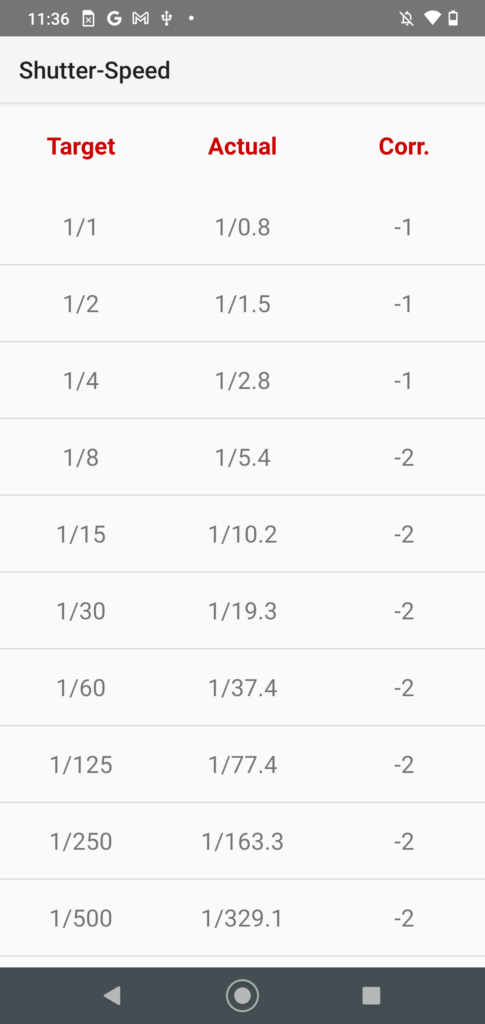
When I have done a batch of testing, I then do screenshots which I copy to a computer, run OCR and copy and paste into the spreadsheet that contains details. The corrections are errors, measured in ⅓ stops.

It seems to work nicely. There are times when it does not work, no doubt due to user error such as not holding the sensor square to the camera, or not near the middle of the opening, and occasionally I have to repeat because the app did not give me the full 3 seconds. What persuaded me it was working was testing two cameras I expected to be accurate and were. A Minolta 700si (the newest film camera I own) was perfect, and an Olympus OM4Ti had two speeds out by ⅓ stop (1/35 instead of 1/30, and 1/17.4 instead of 1/15) – nothing to worry about. Clearly, the Minolta XG-M shown in the pictures is not so good, but this is useful information because it suggests it should be perfectly usable if I bump up the ISO by half a stop. (Of course, B&W film has more latitude than that, so it is probably usable without this so long as I avoid colour transparency film.) It revealed that some cameras have shutters that are less reliable than my ear told me.

A limitation is that you cannot test cameras where the back cannot be opened like this to reveal the film chamber, or where the shutter cannot be fired with the back open and without film. That rules out testing a Voigtlander Vito B or similar, or an old Leica rangefinder. Another is that you cannot test faster than 1/500. Well you can, but I assume they know what they are doing when they give that limit – it is probably not accurate enough. And the iPhone app shows the name of the camera on the results screen, whereas the Android version doesn’t.

Was it worth buying? Given my usage, if I am realistic, probably not, though it is interesting to be able to check cameras before wasting film, so I don’t regret it. For example, a Lubitel turned in results of 1/13.2, 1/27.6, 1/53.7, 1/121.8 and 1/270.6 which isn’t bad for such a simple and inexpensive camera. It also told me not to waste film in testing another TLR (I’ll keep silent about the brand, though I guess it has just had a hard life and needs a service), so I may have saved a bit of the cost there.

Share this post:

Find more similar content on 35mmc

Use the tags below to search for more posts on related topics:

Donate to the upkeep, or contribute to 35mmc for an ad-free experience.

There are two ways to contribute to 35mmc and experience it without the adverts:

Paid Subscription – £3.99 per month and you’ll never see an advert again! (Free 3-day trial).

Subscribe here.

Content contributor – become a part of the world’s biggest film and alternative photography community blog. All our Contributors have an ad-free experience for life.

Sign up here.

Make a donation – If you would simply like to support Hamish Gill and 35mmc financially, you can also do so via ko-fi

Donate to 35mmc here.

Comments

Phil Harrison on Filmomat PhotoPlug

Comment posted: 29/08/2026

I too have one of these. I discovered that it does not work accurately with horizontal cloth shutters of the sort that you find in the Leica M film cameras or Zenith slrs and early rangefinders, above a speed of 1/60. Below 1/60 it's accurate. I found it useful testing Nikon slrs from the 70's, the cameras showed similar results and were accurate at most speeds except the top three, being -1/3 stop out, pretty good for cameras around 50 years old.
Reply

Leave a Reply

Your email address will not be published. Required fields are marked *

Roger replied:

Comment posted: 29/08/2026

Interesting. I am curious as to whether, with the horizontal cloth shutters, you got results that were wildly out and obviously wrong, or whether you used some other measuring device to show that the error was due to the Photoplug and not the camera. I occasionally get a reading that surprises me but get a different result when I do it a second time. When that happens I test a third or even fourth time to decide between the two results. Sometimes I assume the first reading was wrong because of user error, such as holding the sensor in the wrong place or the light source not being bright enough relative to the ambient light.

Reply

Leave a Reply

Your email address will not be published. Required fields are marked *

Bob Janes on Filmomat PhotoPlug

Comment posted: 29/08/2026

Interesting. Many (many) years ago as a post 16 student I tried along with another guy, to measure the accuracy of the focal plane shutters in our cameras using the most sophisticated scaler equipment available in our school labs. It was relatively easy to do speeds up to twice synch speed - 1/125 for his Pentax KX and 1/250 for my Konica T3, but the photosensors had problems dealing with a thinner slit.. which may be the limitation that restricts to 1/500 for this app.
I'd be curious to know if it made any difference whether you had a lens on the camera or not. I'd also be interested to know if there was a difference depending on how far behind the shutter the sensor was (2mm, 5mm, 10mm, 15mm...). I suspect that no lens and a laser light source (as in a laser pointer) might give the most accurate results, but of course you would need to be sure of your aim onto the sensor, and touching the phone attached to the sensor might muck that up.
I must confess I'm a bit sceptical about getting hung up about accuracy of shutter speeds, as the key thing (from my perspective), is well and consistantly exposed negatives (what use is a shutter that is accurate in the middle, but caps at the end?)
Reply

Leave a Reply

Your email address will not be published. Required fields are marked *

Roger replied:

Comment posted: 29/08/2026

I have not tried without a lens, but just used the maximum aperture. It is not clear why this should make a difference so long as the light is bright enough. I hold the sensor as close as I could to the shutter because, though I have not done a test that would pass muster as a scientific experiment, I think that it works better if there are no distracting bright lights around, and the closer it is to the shutter, the less change of stray light interfering. But I will try with and without a lens some time. Your question about how close to the shutter to hold it relates to another issue. If I use the USB-C adapter, I need three hands: one to hold the sensor in place, one to handle the phone and a third to fire the shutter. However, it it is in the microphone socket, as in the image above, one hand is enough for both of those tasks. You are right on all that matters being correctly exposed negatives - with B&W film I could use the Minolta XG-M as is, without any correction and there are other variables that are probably as significant as the shutter speed: measuring exposure and developing technique for a start. It would matter more if I still did colour transparencies but I don’t. But as I said in the post, I think this has saved me the trouble of film-testing one TLR. I purchased it as much out of curiosity as for any other reason, thinking it was not very expensive.

Reply

Leave a Reply

Your email address will not be published. Required fields are marked *

Bob Janes replied:

Comment posted: 29/08/2026

Back in the lab, we used retort stands to hold the emitter and the receiving cell - effectively, as long as you have something to hold the sensor in one place the fact that the phone is not rigidly connected to it might take away some variance.

Reply

Leave a Reply

Your email address will not be published. Required fields are marked *

Gary Smith on Filmomat PhotoPlug

Comment posted: 29/08/2026

Interesting? I suppose. Worthwhile? Not for me. What do you do with the information? Adjust exposure in post I suppose.
I trust the decibel meter on my phone to get me in the ballpark. I trust the light meter on my phone for a second opinion.

Anyway, thanks for the write-up Roger!
Reply

Leave a Reply

Your email address will not be published. Required fields are marked *

Roger replied:

Comment posted: 29/08/2026

Well, the information stopped me from wasting film on one recently acquired camera, which saved me a few pounds, and there was another that was significantly wrong until the shutter had been given a bit more exercise. But I agree with you that the information is not very useful for normal use, at least if you use negative film with plenty of exposure latitude. (I leave it to users of transparency film to say whether slight over-exposure matters.) As for sound, if you don’t use a PhotoPlug, the Filmomat app will detect speeds using sound, but my experience is that it’s not very reliable. With SLR cameras, the mirror noise often drowns out any sound from the shutter. Some cameras have mirror lock-up, which should solve that problem, but others don’t. On a Bronica ETRSi I tested recently the mirror is very noisy and the shutter in the lens is almost silent. Incidentally, that is another one that was measured as completely accurate.

Reply

Leave a Reply

Your email address will not be published. Required fields are marked *

Max Tiraquon on Filmomat PhotoPlug

Comment posted: 29/08/2026

The picture on there website show them testing without a lens, this is what the Fast Box shutter speed tester also recommended. As for whether this makes much of a difference who knows I've never bothered to test if there is any difference myself with my Fast Box. As for horizontal shutters I have found that it maybe best to get some extra readings not just from the middle but also the left and right for faster shutter speeds due to capping that you cannot see with your eyes. Either way these little testers are great in my opinion they give you a pretty good ball park shutter speed for better negatives.
Reply

Leave a Reply

Your email address will not be published. Required fields are marked *

Roger replied:

Comment posted: 29/08/2026

Thanks for the idea. I should try that one day, though without knowing whether a shutter is capping, it might be difficult to tell whether that or user-error is causing inconsistent results. Of course, if the lens should be taken off, it would make it difficult to use the device with fixed-lens cameras. As the picture shows, I just use a very bright LED light in front of the lens and draw the curtains to keep off any direct sunlight.

Reply

Leave a Reply

Your email address will not be published. Required fields are marked *

Chris Giles on Filmomat PhotoPlug

Comment posted: 29/08/2026

I also use this app, although I made up my own hardware. I find it reasonably accurate for most shutter types, and does not seem to matter if the lens is attached or not. Because I repair old cameras I find it very useful, firstly to check how bad the shutter speeds are and then to see if my ministrations have made a significant difference. With older horizontal plane SLRs the higher speeds are often slow. This app gives you an indication of how much they are out, sometimes it is not worth a full strip down and CLA when it may only be one speed that is out, usually the highest. It is simpler to note the variation and allow for it when shooting.
Reply

Leave a Reply

Your email address will not be published. Required fields are marked *

Roger replied:

Comment posted: 29/08/2026

In making the hardware you have electronics skills that, I assume, most of us don’t have. Perhaps your experience would say whether the 1/500 limit is caused by hardware or software.

Reply

Leave a Reply

Your email address will not be published. Required fields are marked *

Chris Giles replied:

Comment posted: 29/08/2026

The system will measure beyond 1/500, I have used it up to 1/2000. The software does display the result, but you can not record it beyond 1/500. Maybe this is because at those speeds even a small variance in milliseconds is significant in terms of a stop, so perhaps there is less confidence in the result. I'm not really sure about the reason, but either way I find it useful to know if the camera is close, or well out, for the speed being tested. In that regard it is a useful bit of kit that I use frequently.

Reply

Leave a Reply

Your email address will not be published. Required fields are marked *

Roger replied:

Comment posted: 29/08/2026

It is encouraging to know you think it works at even 1/2000 s. I have used it for faster shutter speeds a couple of times, but I assumed I should not believe the results because they would probably not be very accurate. It sounds as though I should be more confident.

Reply

Leave a Reply

Your email address will not be published. Required fields are marked *

Tony Warren on Filmomat PhotoPlug

Comment posted: 29/08/2026

What an ingenious device. Will have to investigate. By the way you can fire a Vito without film. You simply turn the toothed wheel above the film gate (B-type) or the toothed rod at the right of the film gate (II-type). A bit hard on the fingers sometimes, the B is pretty stiff and keeps trying to spring back.
Reply

Leave a Reply

Your email address will not be published. Required fields are marked *

Roger replied:

Comment posted: 29/08/2026

Thanks for the advice. I think I tried this once, but was unsuccessful. If my memory is right, you are correct in saying it is hard on the fingers!

Reply

Leave a Reply

Your email address will not be published. Required fields are marked *

Martin replied:

Comment posted: 29/08/2026

It is hard on the fingers and it's difficult to do it in one go the throw is too long and if you let go the wheel tends to rotate back. As much as I love my Voigtländers this is what I hate about them.

Reply

Leave a Reply

Your email address will not be published. Required fields are marked *

Leave a Comment

Leave a Reply

Your email address will not be published. Required fields are marked *