

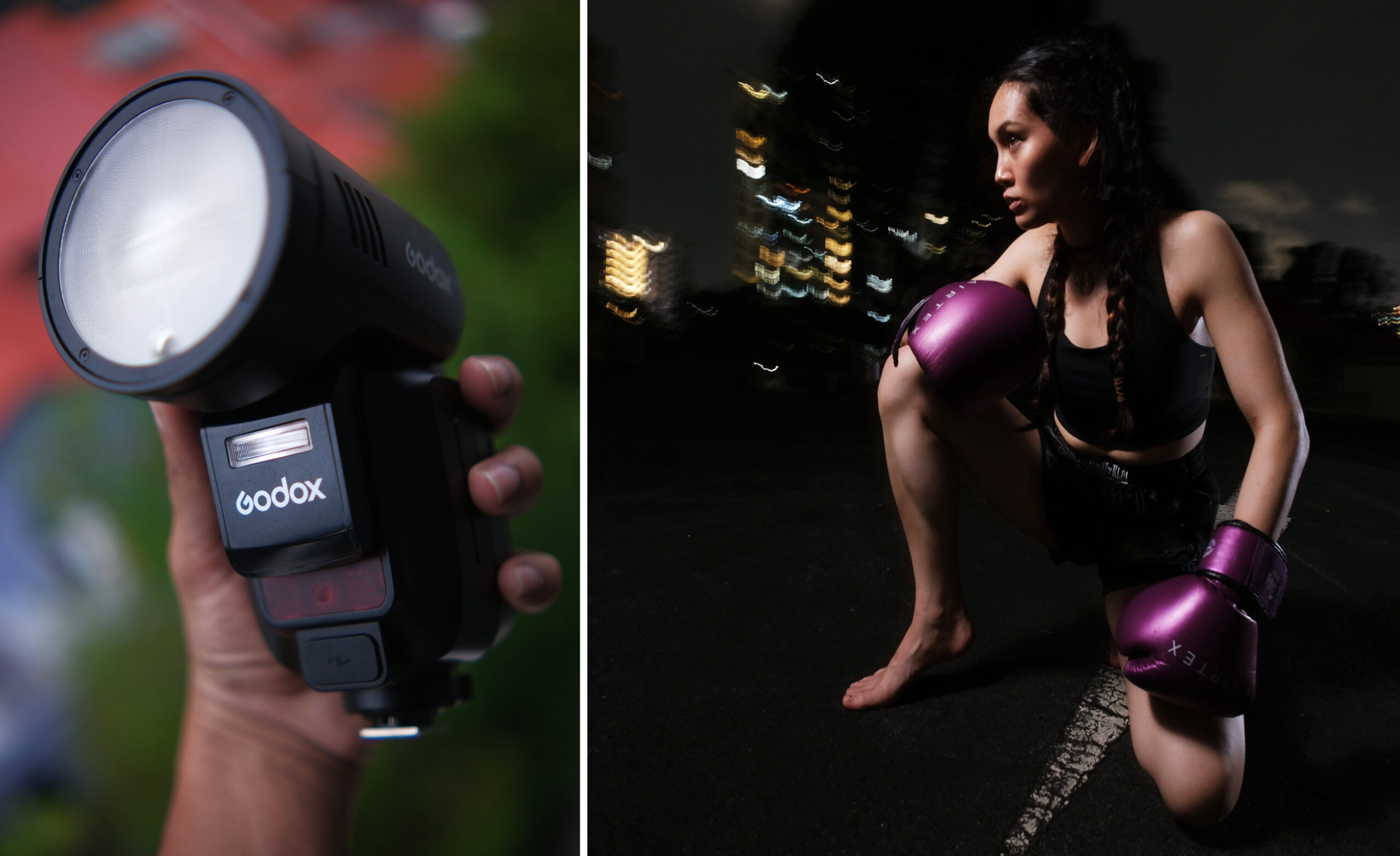
I don’t know if you are keeping up with the world of flash photography – 35mmc is after all a largely analogue-focused website, and many film photographers prefer available light – but the range of products on offer at this moment in time is just incredible.
Just from Godox alone, being the brand I’m most familiar with, there are tiny, retro-cool flashes like the Lux Cadet, absolute units like the AD1200 Pro, and almost every conceivable configuration in between. This article is about one of those in-betweens: the Godox V100. It’s a camera flash (i.e. one which can be mounted in the hotshoe) but it packs as much power as an entry-level strobe (which are more powerful units designed to be used off-camera).
The Godox V100 is somewhat similar to an older model – the V1 which was released in 2019. Wes Perry described the V1 as a flash which “took the world by storm and dominated the flash market for years”. The V100 was launched in December 2024. It features several upgrades, but I’d say the most notable ones are:
-
- 100Ws of power, which at the time of launch was unprecedented for an on-camera flash (the V1 maxes out at 76 Ws);
- a full-colour touchscreen interface; and
- a detachable sub-flash for fill-light and other creative effects.
In this review, I’ll cover these and other features, alongside lots of sample images from 1.5 years of using the flash in a variety of situations, with both digital and film cameras.
Review notes
Godox sent us the V100 for review, but I was not paid for this review, nor do we have affiliate links. I always try to review gear in an honest and objective way.
The photos in this article were shot with a Fuji X-E5 camera and various lenses (if you want more details about gear, just ask me in comments). When used off-camera, the V100 was triggered with a Godox X3 wireless flash trigger. In the photo below, my friend Fede is holding the Fuji X-E5 and Godox V100.
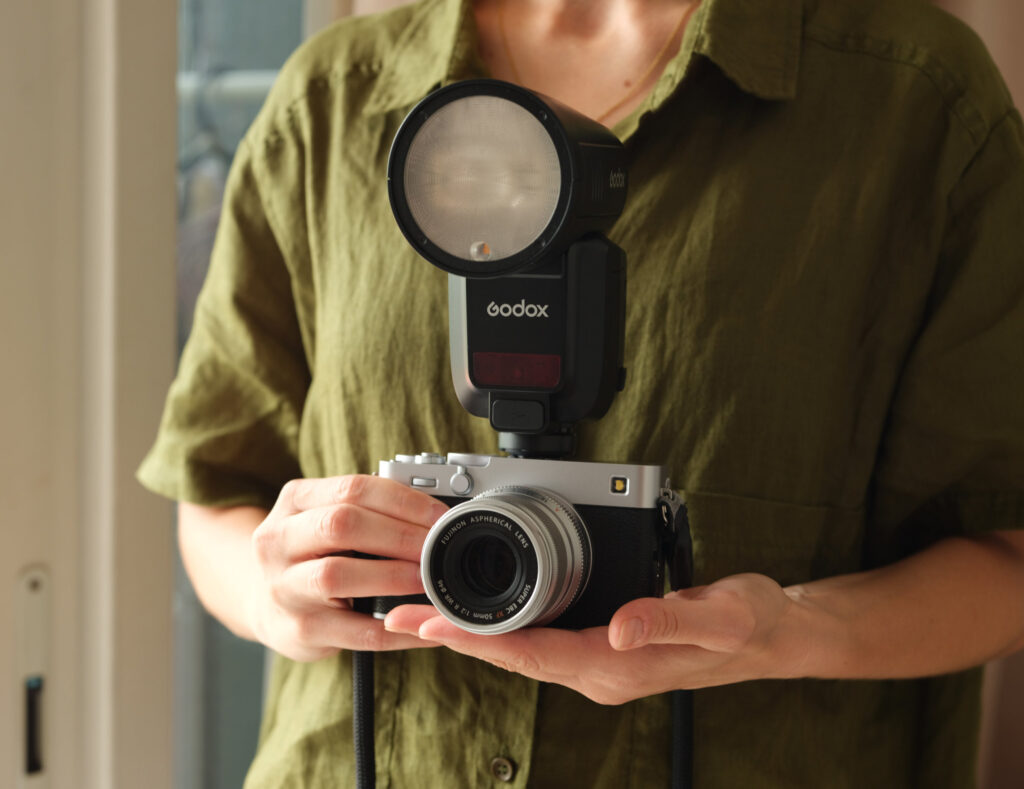
I have the Godox V100-F (the F signifies that it’s the Fuji-compatible model). There are variants for Nikon, Canon, Sony and Olympus cameras. The models are generally interchangeable – e.g. you can use the V100-F on a Canon, or the V100-C on a Nikon. The only catch is that if you use the “wrong” model for your camera, you will lose out on a few specific features like through-the-lens metering (TTL) and high-speed sync (HSS). But that’s only if you mount it on your hot-shoe. If you use the correct wireless trigger for your camera (e.g. X3-C for Canon), you can still use the “wrong” flash off-camera, with no compromise and all features enabled.
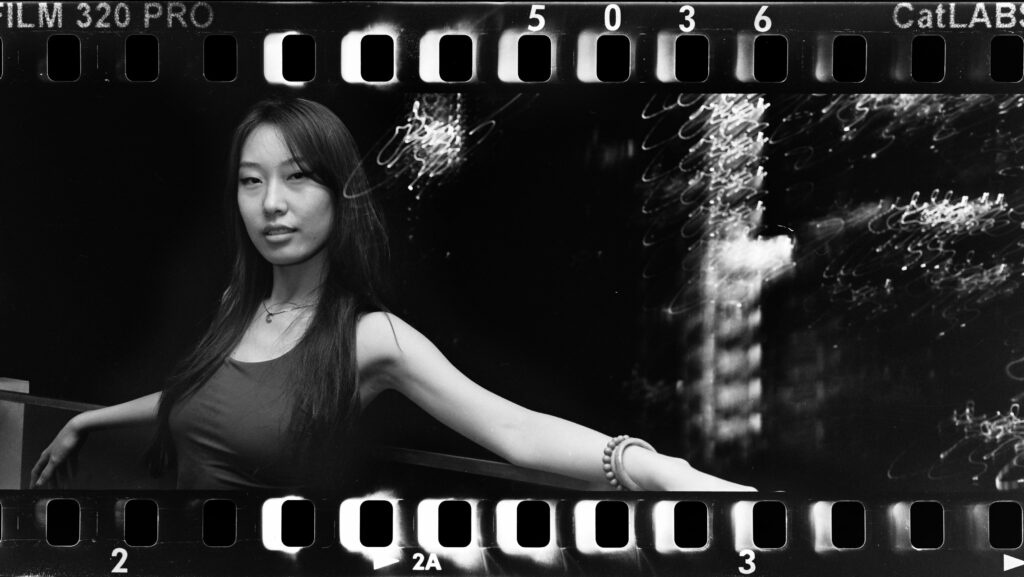
Since this is 35mmc, I should note that the V100 will work on film cameras too, although you’ll have to make do without TTL and HSS. Here’s a photo that I shot with a Hassebland XPan. The V100 was mounted on-camera and bounced off the ceiling.
The flash even has a 2.5mm sync port for a wired connection, e.g. for vintage cameras which have a PC sync port for flash connections, but no hotshoe. You’ll have to buy the PC Sync to 2.5mm cable separately, but those cables cost just a few dollars.
What’s in the Box
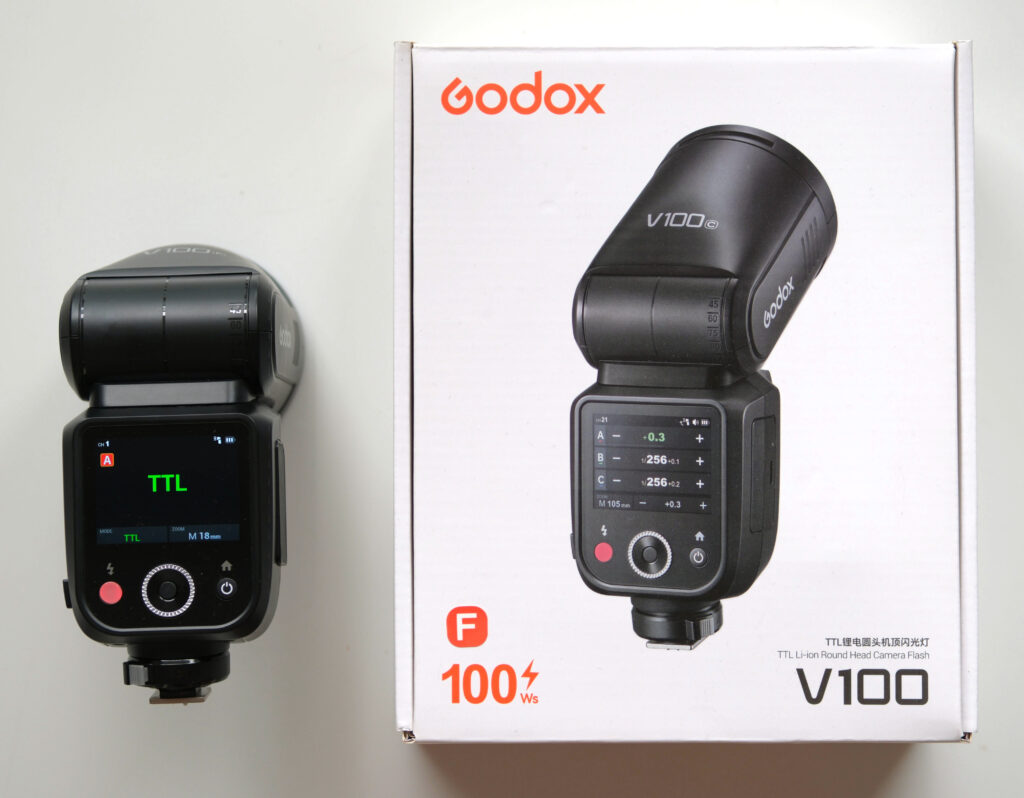
The Godox V100 comes with a protective pouch, VB30 rechargeable lithium-ion battery, USB-C charging cable, power adapter, cold-shoe foot, instruction manual and SU-1 Detachable Sub-Flash (more on this later).
The VB30 battery has an integrated USB-C port, so it can be charged by directly plugging in the supplied cable. This is a very convenient upgrade over the old VB26 battery that came with the Godox V1. The VB26 had a separate dock-style charger (VC26). The charger was small and light, but still an additional device you had to carry around.
If you already own a Godox flash which uses the VB26 and you want to upgrade your battery, the VB30 can also be purchased separately. Note that the VB30 is backwards compatible with older flashes like the original V1, but the VB26 does not work on the V100.
Build quality and handling
The V1Pro is relatively big and heavy for an on-camera flash. It weighs in at 616g including the battery – slightly heavier than the Godox V1, which is itself heavier than the average speedlight. But that is only to be expected for such a powerful and sophisticated unit. If you want something lighter and don’t need the extra power, Godox (as well as other manufacturers) have various other models which should fit the bill.
On my Fuji X-E5, as you can see from the earlier photo, the flash is rather top heavy. But on some of the larger full-frame mirrorless and DSLR cameras – or the Fuji GFX medium-format camera (shown below) – it feels like a better fit.
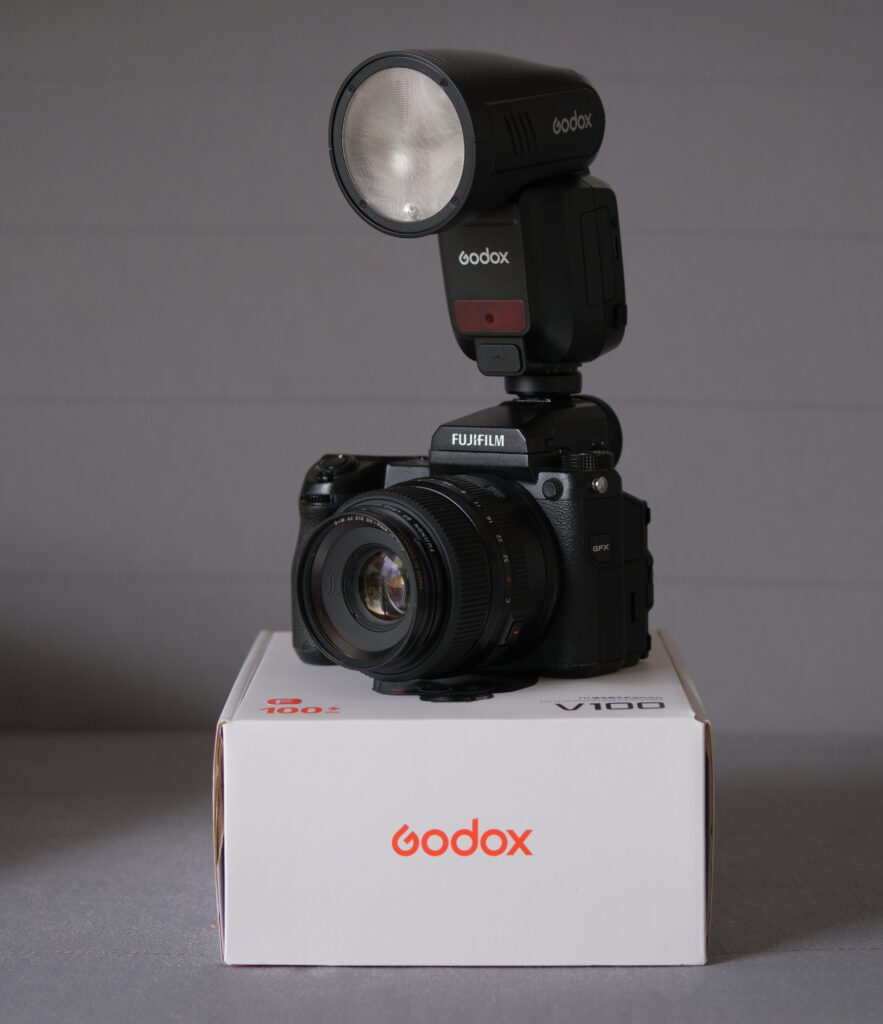
The flash body is made of high-grade plastic and seems very sturdy. One time I was doing an outdoor shoot with the flash on a light-stand. The whole thing got knocked over by the wind, but there was no damage to the flash.
The head swivels smoothly both sideways and up, and slightly (105°) to the back. The hotshoe feels robust, and the hotshoe-lock clicks reassuringly into place. I do recommend locking it, because otherwise if you tilt your camera up, the weight of the flash means there is a risk of it sliding out. Wes Perry did a teardown, taking apart the flash and even trying to scratch the touchscreen with a penknife (!), if you’re interested in that sort of thing.
Touchscreen controls
Unlike its predecessors which had buttons and an old-school display, the Godox V100 has an full-colour touchscreen interface. In the pic below, you can see it side by side with a Godox V1 Pro which I also own.
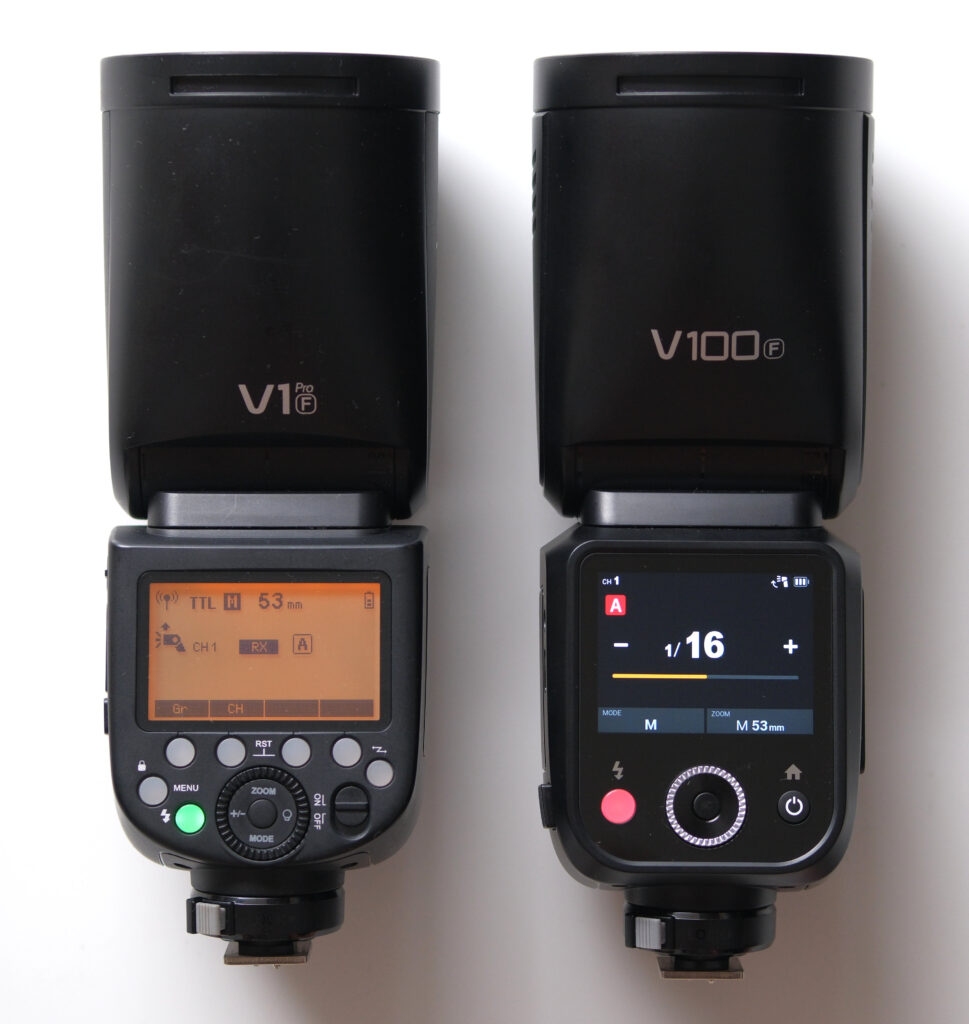
The V1 Pro, as you can see, has a whole array of buttons. Some photographers do prefer physical buttons, especially if shooting in the rain or wearing gloves. But with the V1 Pro, if I’m using it after a few months’ hiatus, I often need to take some time to refresh my memory about certain operations because the controls are rather complicated. The V100’s touchscreen, by contrast, feels faster and more intuitive.
The V100 does have some physical controls, e.g. the silver ring with a push-button at its centre. For certain things – e.g. adjusting the flash power – you can either use the ring, or slide your finger left or right on the touchscreen.
The touchscreen is bright, and I had no difficulty reading it even in direct sunlight. It’s also easy to read from all angles, which is great because if you’re checking your settings mid-shoot, you don’t want to have to take your eye too far from the viewfinder.
The Godox V100 is jam-packed with features. I won’t go through all of them, but I will mention that it can be used not just on-camera, but also off-camera using a wireless trigger. In the photo below, the flash is in Receiver mode, which means it’s ready to be fired off-camera. Off-camera flash is a real game-changer when it comes to creating naturalistic lighting and a host of other effects, because you have precise control over the angle of light and can also use modifiers like softboxes, beauty dishes and so forth.
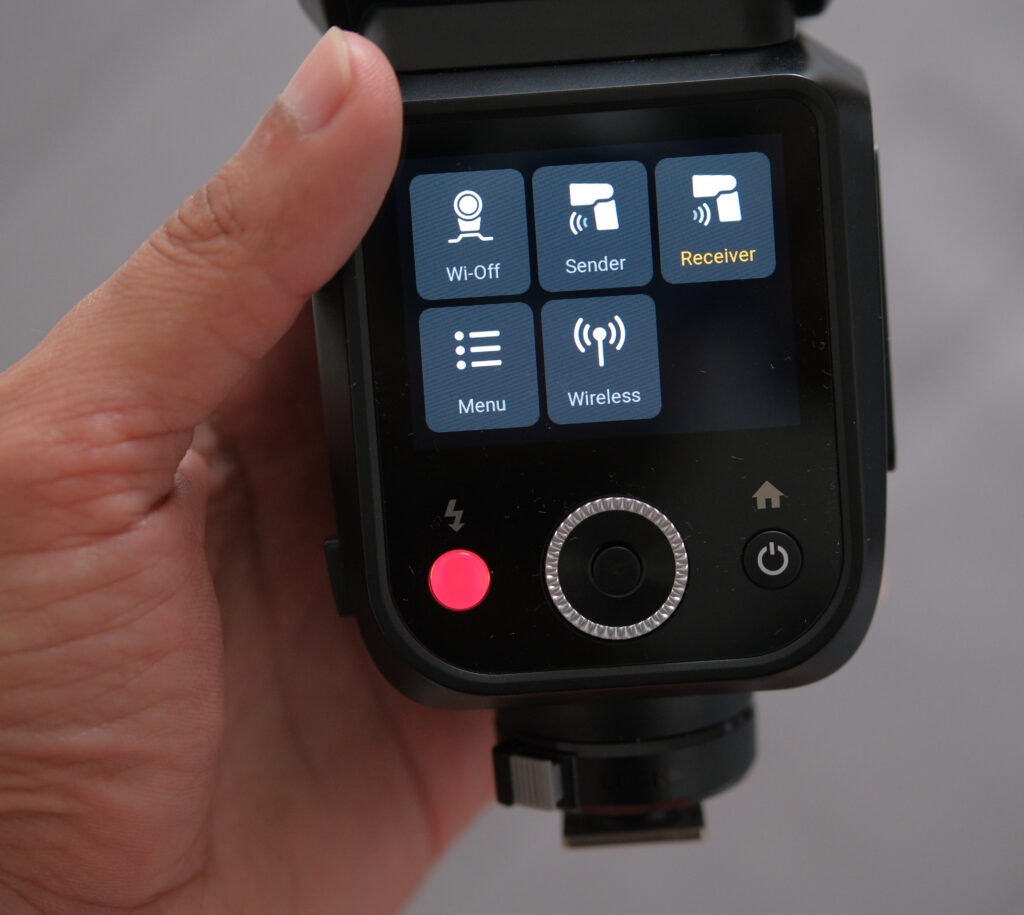
The V100 can also function as a Sender, where the flash is mounted on-camera but also remotely fires another off-camera flash. This is useful if, say, you want to bounce the V100 off the ceiling as a fill light, while simultaneously firing another off-camera flash as the key light.
The touchscreen interface looks and feels quite similar to the Godox X3 wireless trigger which I also own and love:
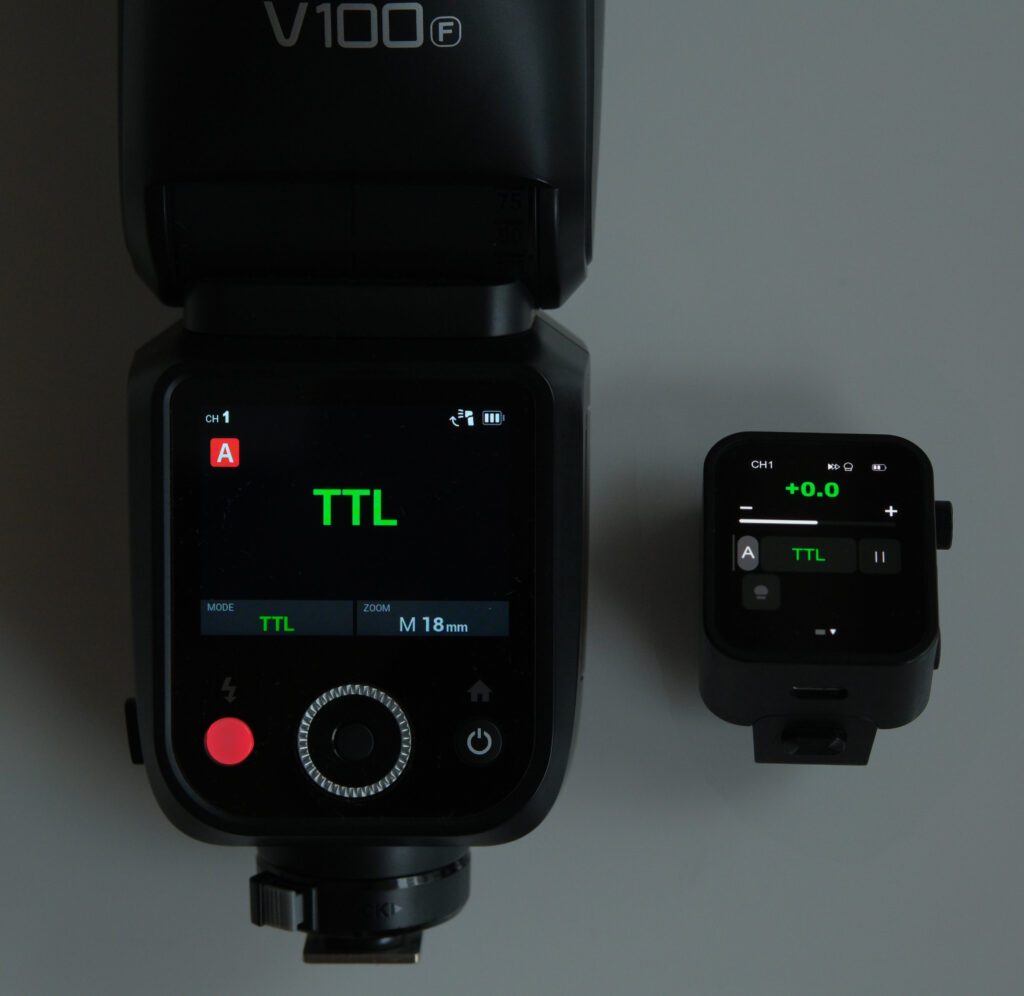
Speaking of triggers, the Godox X3 trigger has a Wireless Sync feature which I found very useful. With one tap, you can instantly pair it to the flash, automatically syncing the channel, group and ID. Old-school manual sync is also possible by setting these three parameters individually.
Sample shots: Off-camera flash
Since we’re on the topic remote triggering and off-camera use, I’ll share some sample images from actual photoshoots.
The photos below are for a campaign which was part of Singapore’s National Day Celebrations, where influencers posed with cutouts of avatars designed to resemble them. The green background was replaced in post with official branding.

My lighting setup was something like this:
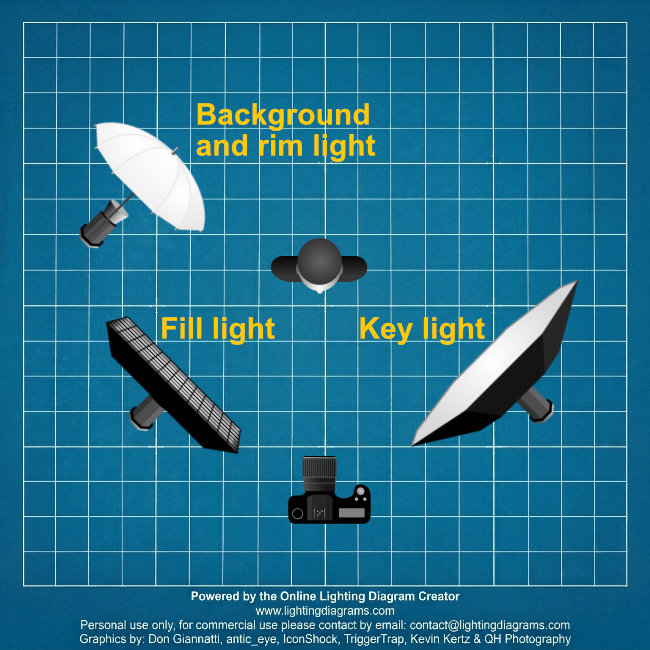
I had a key light on camera-right in an octabox, and a fill-light on camera left in a gridded strip softbox. Both these lights, if memory serves, were Godox AD200 strobes supplied by the studio.
At the back, I had my Godox V100, modified by a shoot-through umbrella. It helped light the background more evenly, and also doubled up as a rim-light. Here’s a BTS pic taken from the back of the studio, showing all three lights:
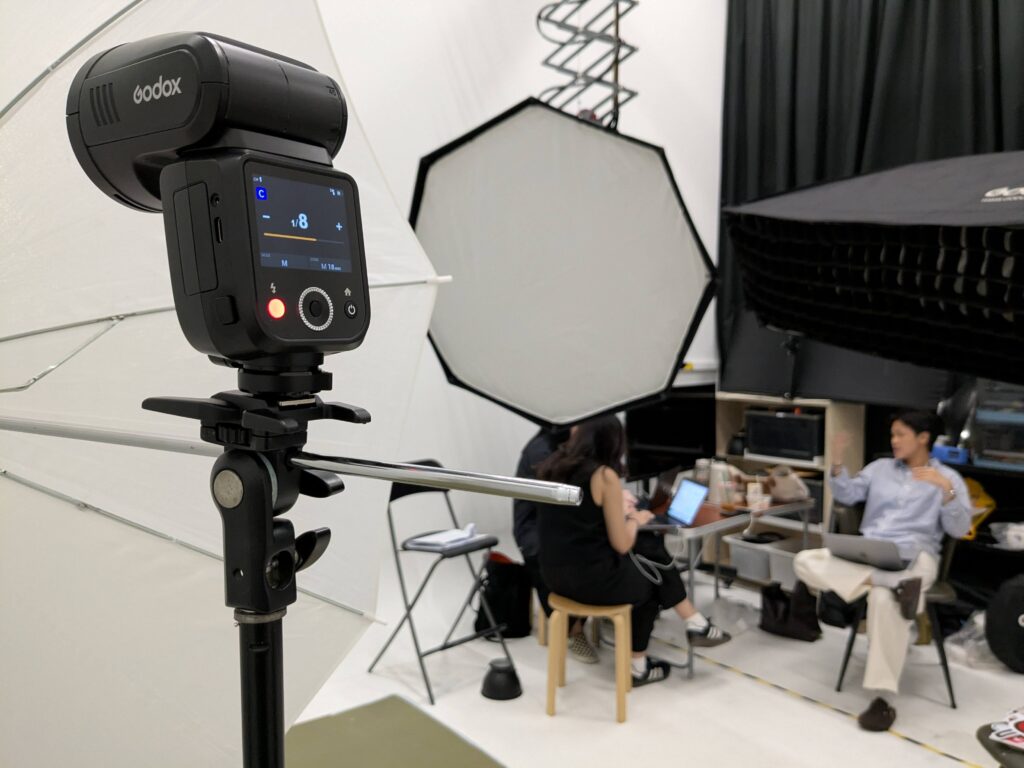
These three off-camera lights were controlled by the Godox X3 wireless trigger, mounted on my camera hotshoe. I had the three lights on separate groups so that I could adjust their power individually. The flashes all worked seamlessly and in sync, even with quickfire shooting.
The two test shots below, which are straight out of camera, show the effect of the Godox V100, which was my background and rim-light.
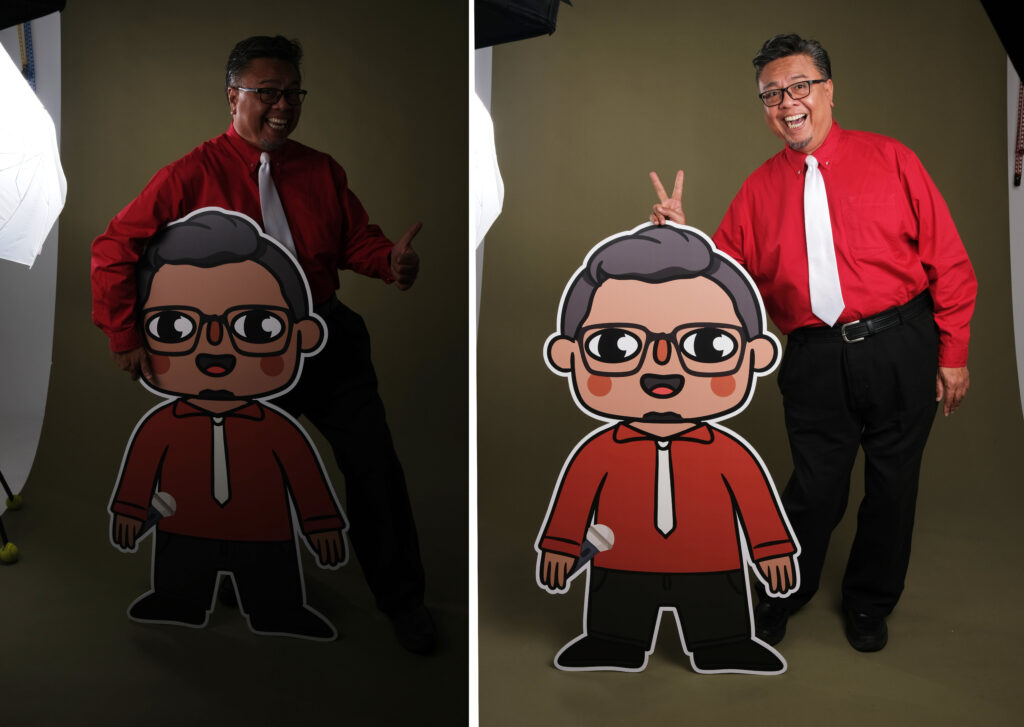
In the first photo, I fired the V100 alone, so you can see how rim-light outlines the model’s cheek and jaw. In the second, I also fired the key and fill lights. In fact, you can see the shoot-through umbrella in the frame, but of course we removed it in post.
The next few photos are from a photoshoot with my friend Anais, who is a Muay Thai fighter and coach. We did the shoot in an empty parking lot. Anais’ mom, Kazuyo – who is also into Muay Thai – helped out with lighting.
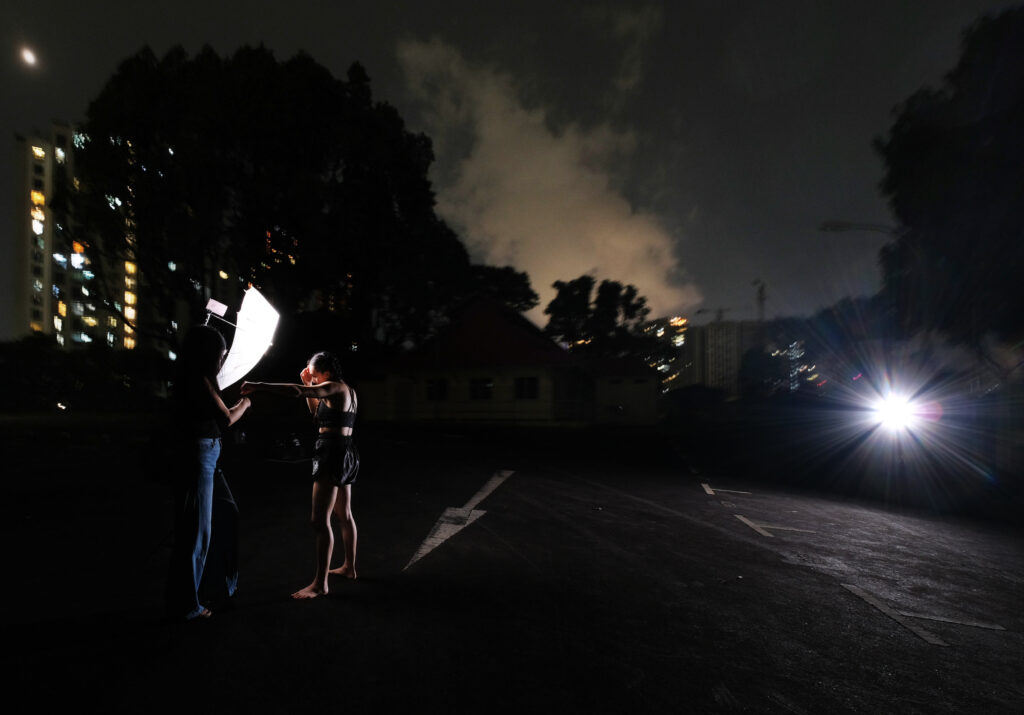
In the BTS pic above, Kazuyo is holding a Godox AD100 strobe, modified by a shoot-through umbrella. On camera-right, some distance back, I had my Godox V100 as a rim-light. It was on a light-stand with no modifiers – bare-bulb, as it’s called in lighting parlance.
The shots below show the effect of the key light alone (left) and the rim light alone (right).
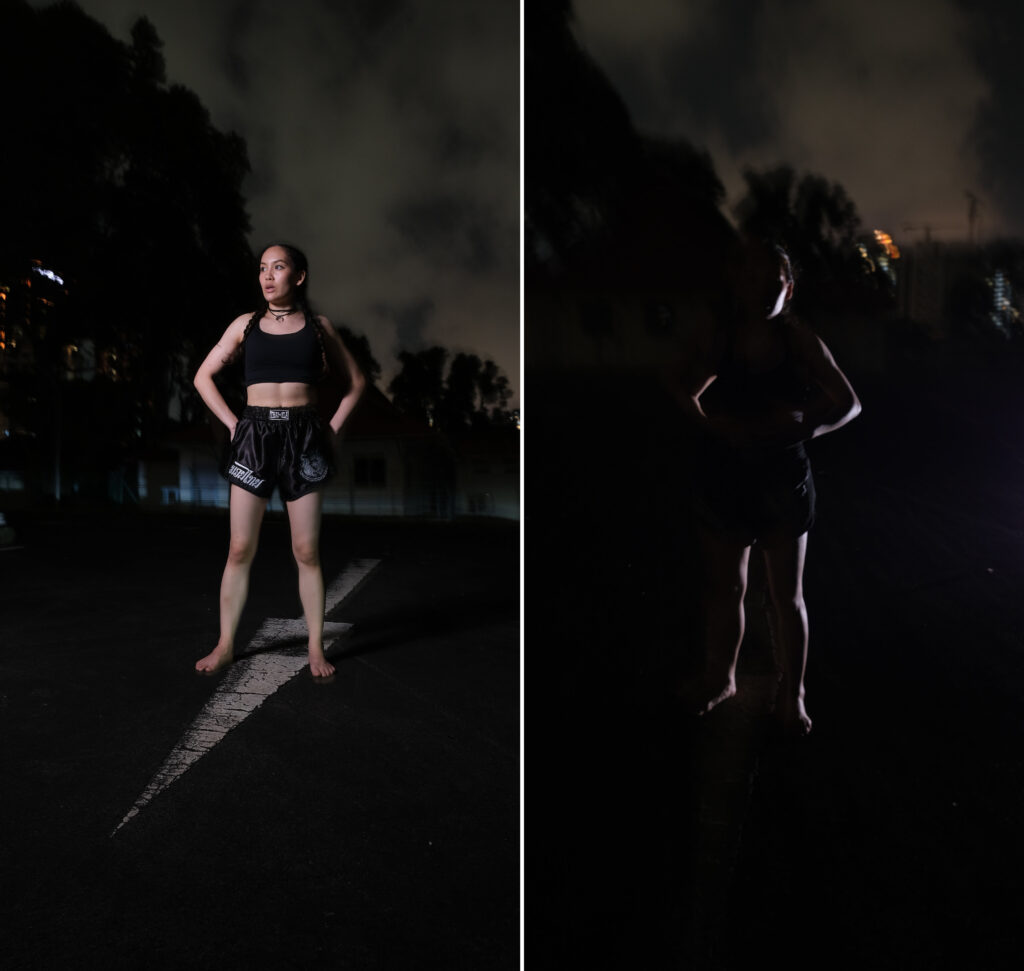
The key light is softened by the umbrella, while the bare-bulb rim-light creates a hard outline that felt well-suited to action photos like these.
When you combine the two lights, use a slow shutter-speed and deliberately shake the camera, you get shots like this:
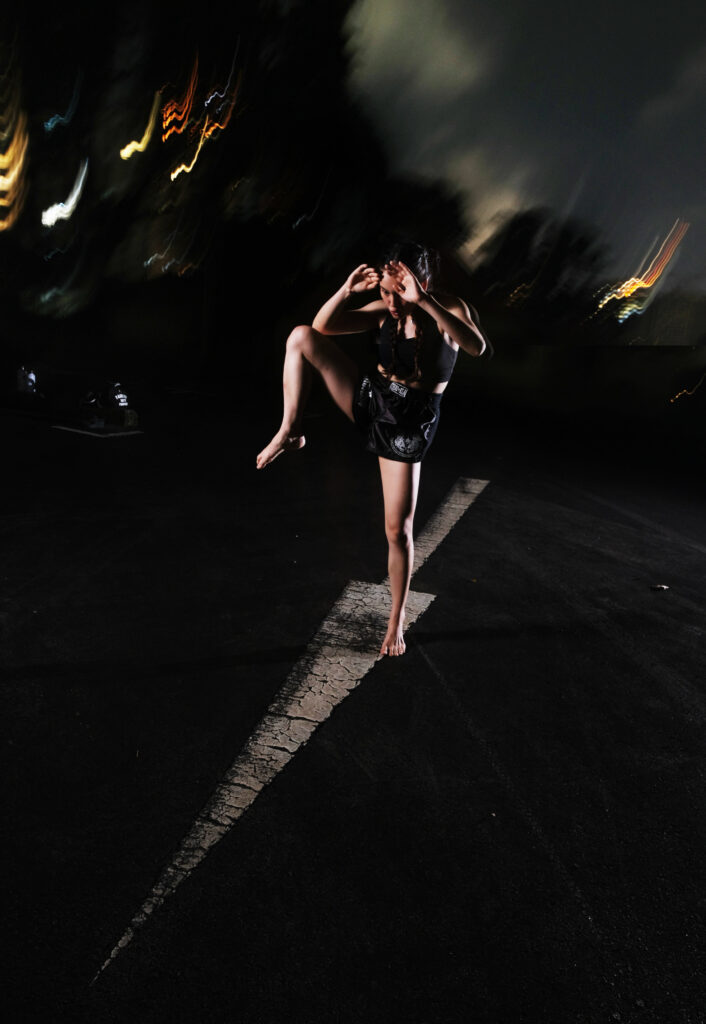
This technique is known as dragging the shutter. The long shutter-speed and camera-shake creates a blurry background and squiggly lines, while the flash freezes and clearly defines the main subject.
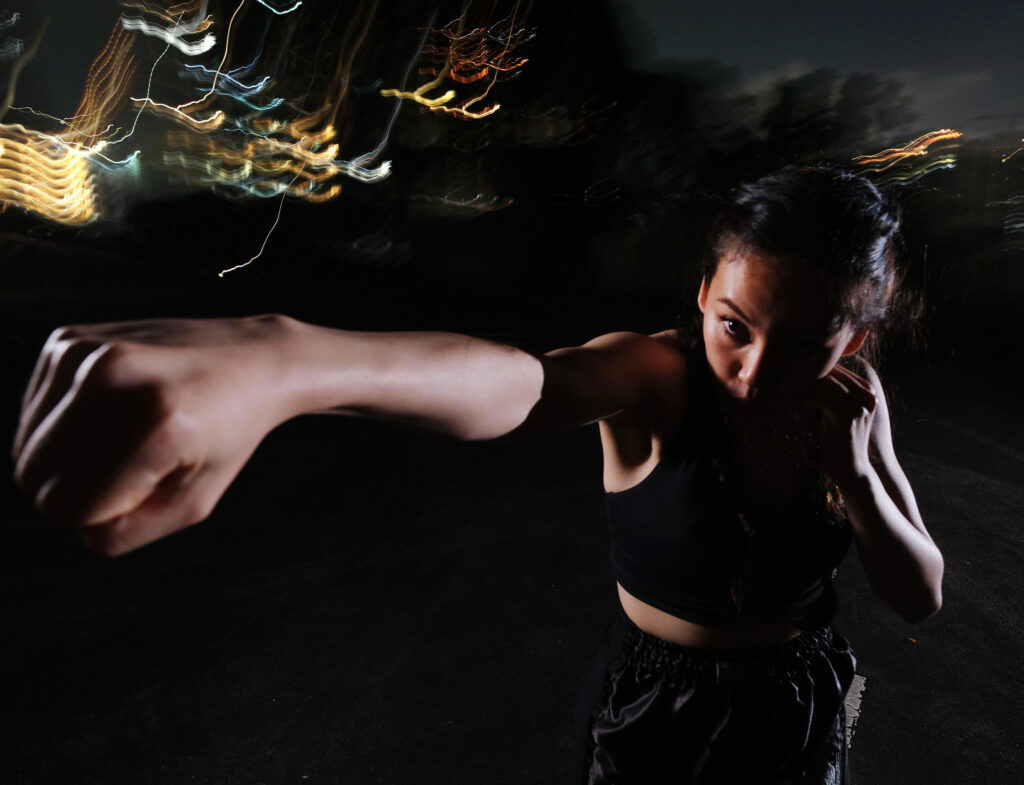
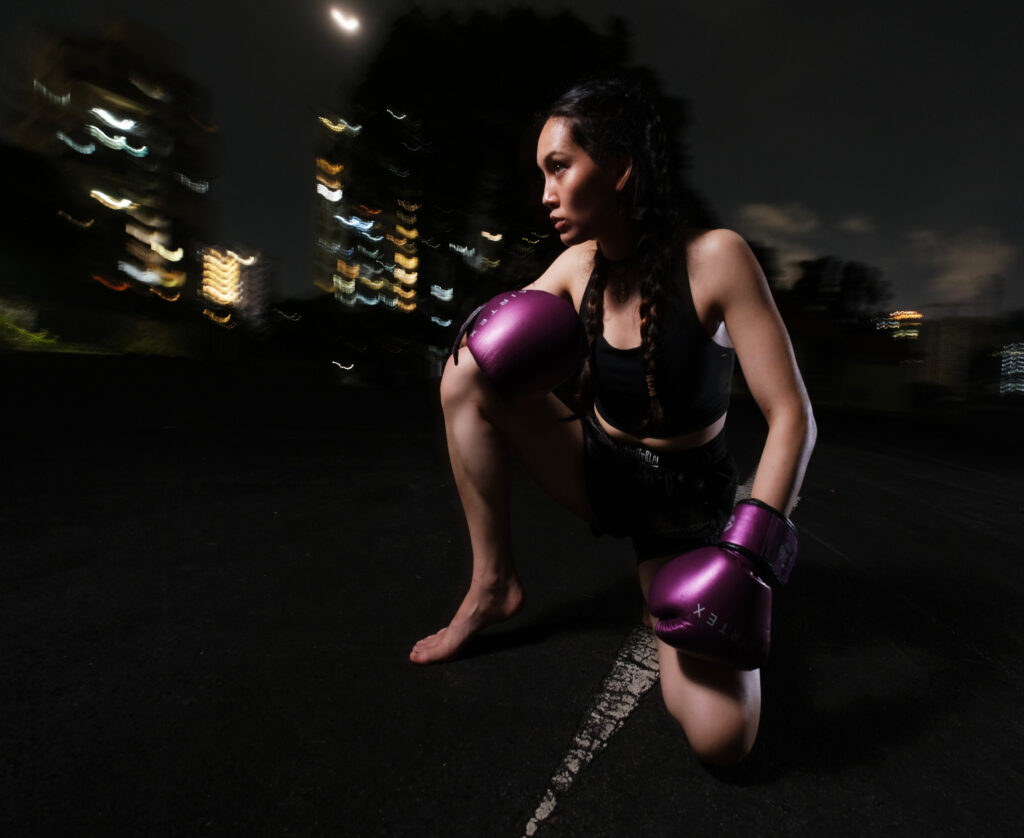
Two more photos from the same shoot. The shutter-speed in both cases was 1 second.
Sample shots: On-camera flash
On-camera flash is where the flash is mounted in the camera’s hot-shoe (or cold-shoe, for older cameras). The upside is that you don’t need other accessories like wireless triggers and light stands. The downside is that the angle of light is relatively limited.
There are three main ways to use on-camera flash: (a) direct flash, where the flash is pointed straight at the subject with no modifiers, (b) bounced flash, where it’s reflected off a wall, ceiling or other surface, and (c) modified, where you use an accessory like a diffuser or snoot. Next up, I’ll show some examples of each.
This is a pure ambient-light photo (no flash):

…while this photo was taken just a few minutes later:

In the second photo I lowered the shutter-speed (from 1/160 to 1/30) to get some motion blur, but stopped down (from f/1.4 to f/8) to underexpose the ambient. And of course, I used the flash – direct, on-camera – to light the subject.
The next photo was also lit with direct on-camera flash, for a high-contrast “snapshot” aesthetic.

…while for the one below, I also had the flash on camera, but pointed up to bounce off the ceiling, producing a much softer light:
 A minimal adjustment, producing two very different looks. Which do you prefer?
Now for a couple of modified-flash examples:
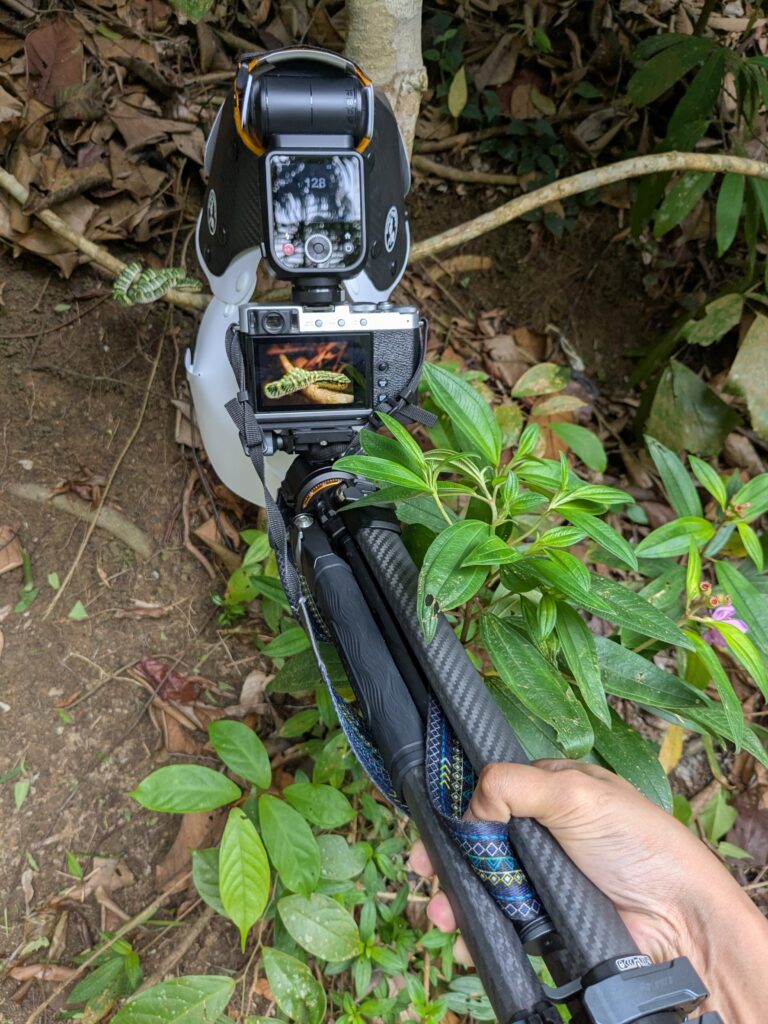
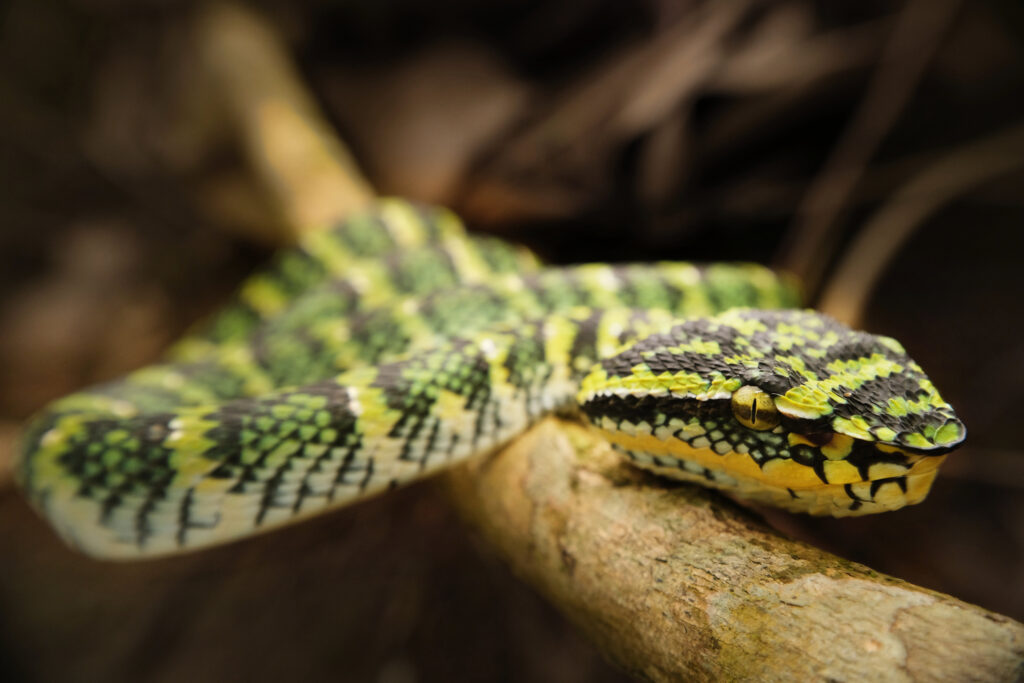
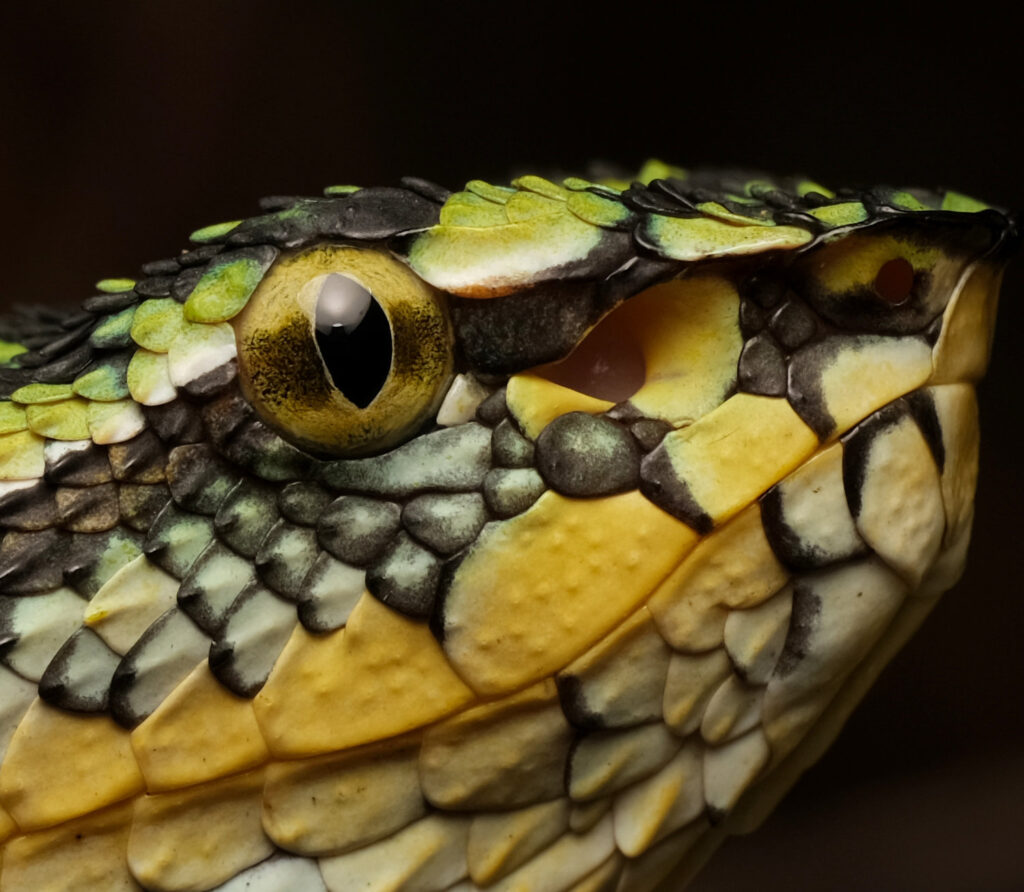
In the BTS photo above, the Godox V100 is mounted on-camera, along with a Guage macro diffuser. My subject is a Wagler’s pit viper, which I spotted on a forest trail, coiled up in ambush position. The snake is venomous, which is why I’m using my tripod to shoot from a safe distance.
Here are two of the resulting images:
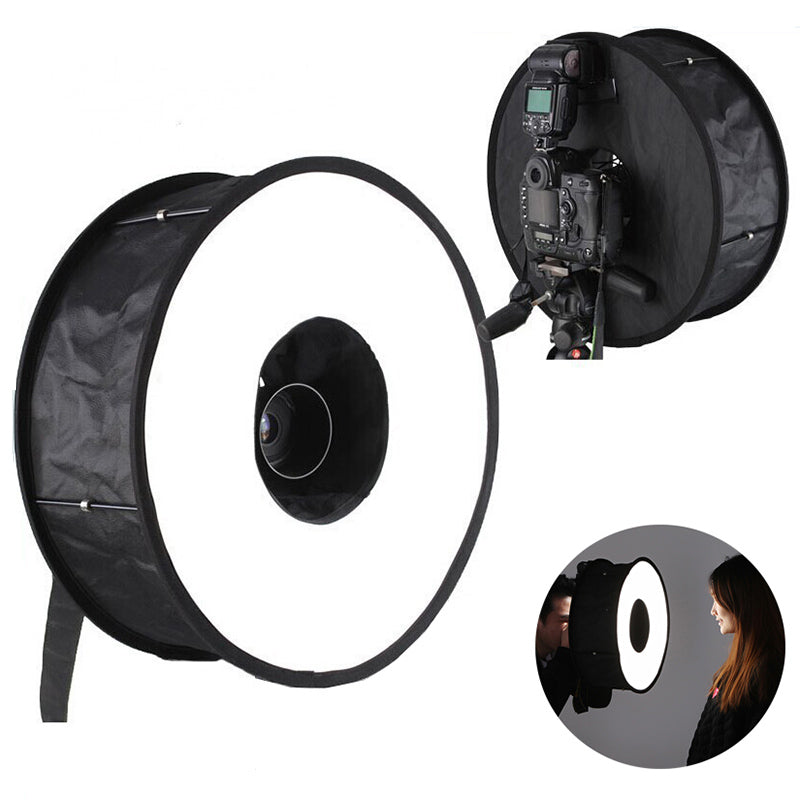
 I’ve also used the V100 with a ring softbox. I don’t have a true ring flash (which is smaller but also much more expensive). Instead I use a ring-shaped diffuser – a folding accessory which modifies a normal flash.

This photo of Anais was shot on a subway train, also using the shutter-drag technique (1/4 sec exposure). It was late at night – the last train, in fact, and therefore mostly empty. Which was good, because otherwise I would have felt self-conscious whipping out the big softbox and firing off a bright flash.
You can see the tell-tale ring-shaped reflection in her eyes, and also in the glass panel behind her. I set the camera white balance to match the flash, which produces natural skin tones and nice tonal contrast with the greenish cast of the ambient light.
Flash power, TTL and HSS
You can adjust the Godox V100’s flash power from 1/256 to 1/1 (full power) in 0.1 stop increments. At full output, it produces 100Ws of power, which at the time of its launch was unprecedented for an on-camera flash (it has since been matched by the Neewer Z3). This is a ridiculous amount of power for an on-camera flash, on par with entry-level strobes like the Godox AD100.
The photos below were shot from my bedroom window, and are unedited straight from camera.
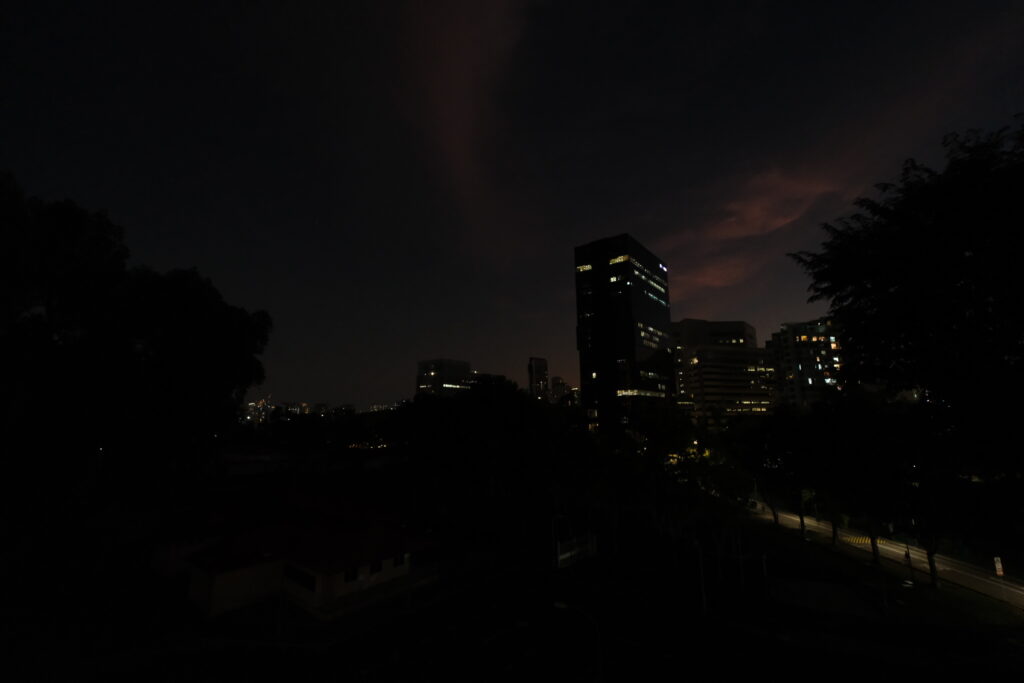
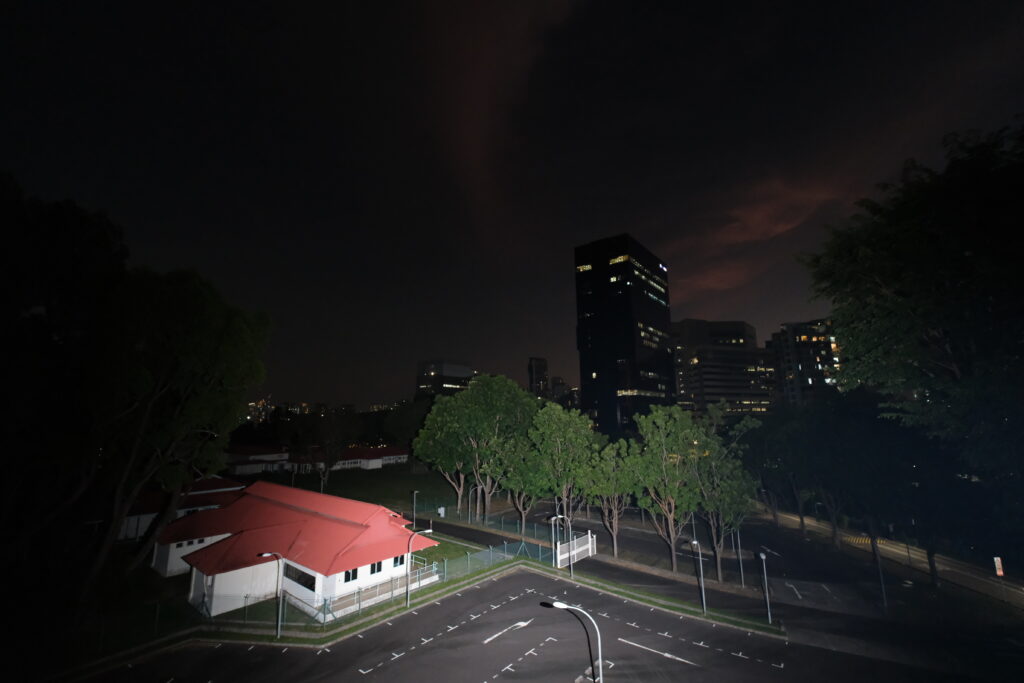
Left: without flash. Right: with the Godox V100 at full power. All other camera settings were the same. As you can see, it lit up the entire parking lot as well as the buildings, all the way from my fifth-floor window.
More power also means faster recycling, reducing the waiting-time between consecutive flashes. The V100’s full-power recycling time is only 1.7 seconds. At 50mm zoom, it can fire 80 consecutive full-power flashes (and significantly more at lower power levels) before overheat protection kicks in.
The flash sync speed on my Fuji X-E5 is 1/180 sec. Ordinarily, that’s the fastest shutter-speed you can use without producing banding. But sometimes you want a shutter-speed that’s faster than your sync speed, e.g. when shooting in bright daylight. So higher-end flashes including the Godox V100 have a high-speed sync mode, where you can use faster shutter-speeds and still get flash sync, albeit at the cost of slightly reduced power.
The Godox V100 features HSS up to1/8000 sec (1/80000s with Sony global shutter cameras), as well as first-curtain and second-curtain sync.
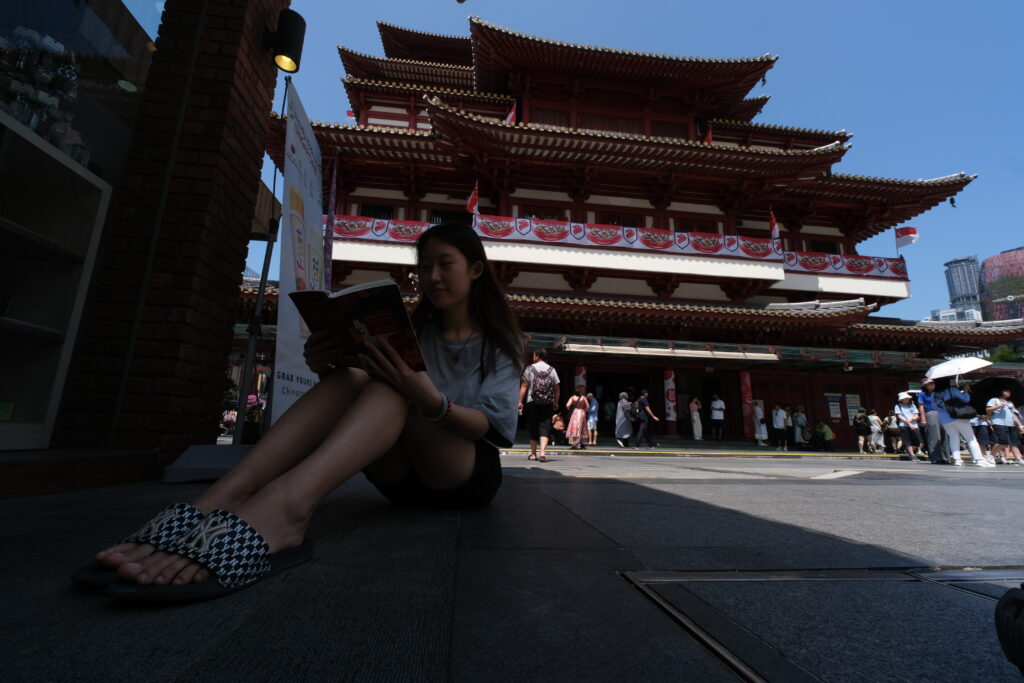
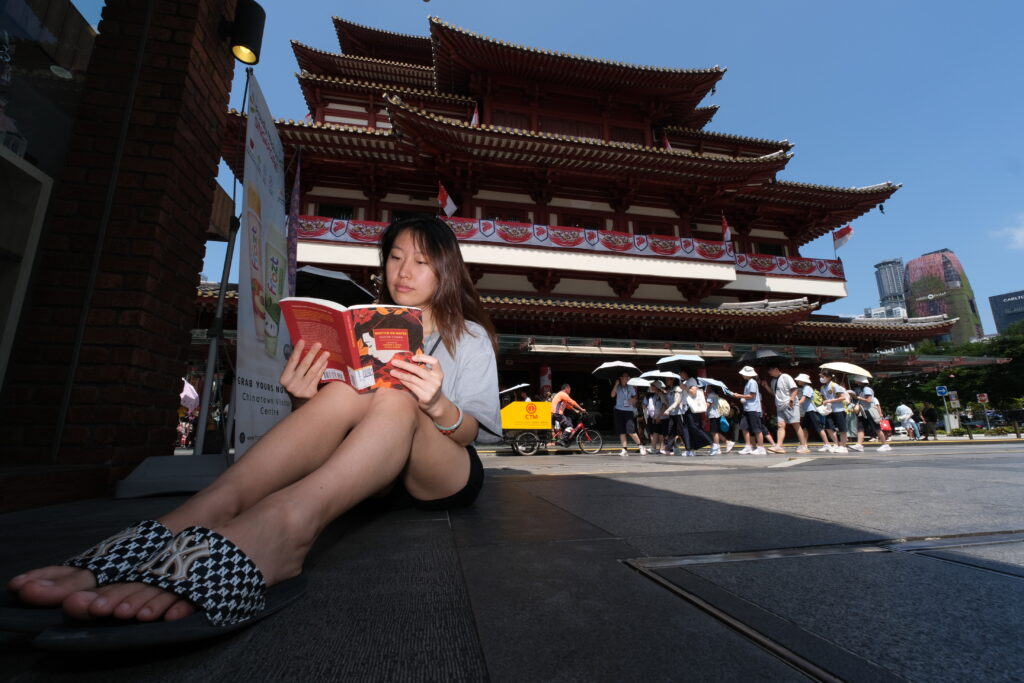
The photos above (unedited, straight from camera) were shot in bright noonday sun, without and with flash. As before, all other camera settings were the same. To prevent the background from blowing out, I used a shutter speed faster than my sync speed, and the flash in HSS mode. Not only did the flash compete with sunlight, but to my amazement, I didn’t even have to use it at full power – I dialled it down to about 1/4 if memory serves. At full power, the flash was actually blowing out my subject:
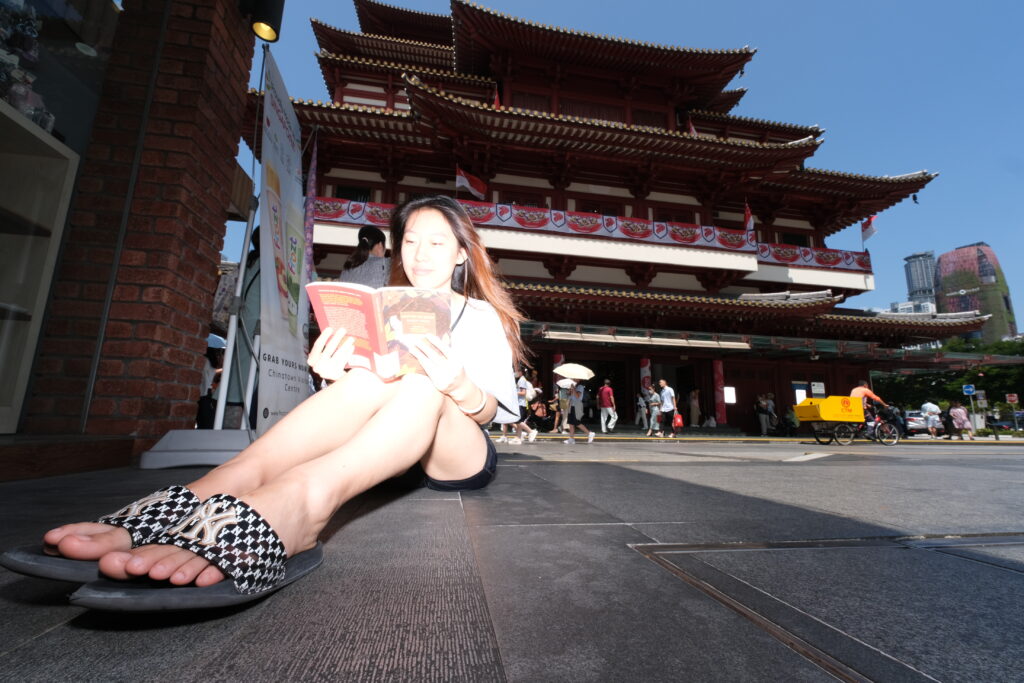
I don’t know who needs this kind of power from an on-camera flash, but it’s nice that we have it!
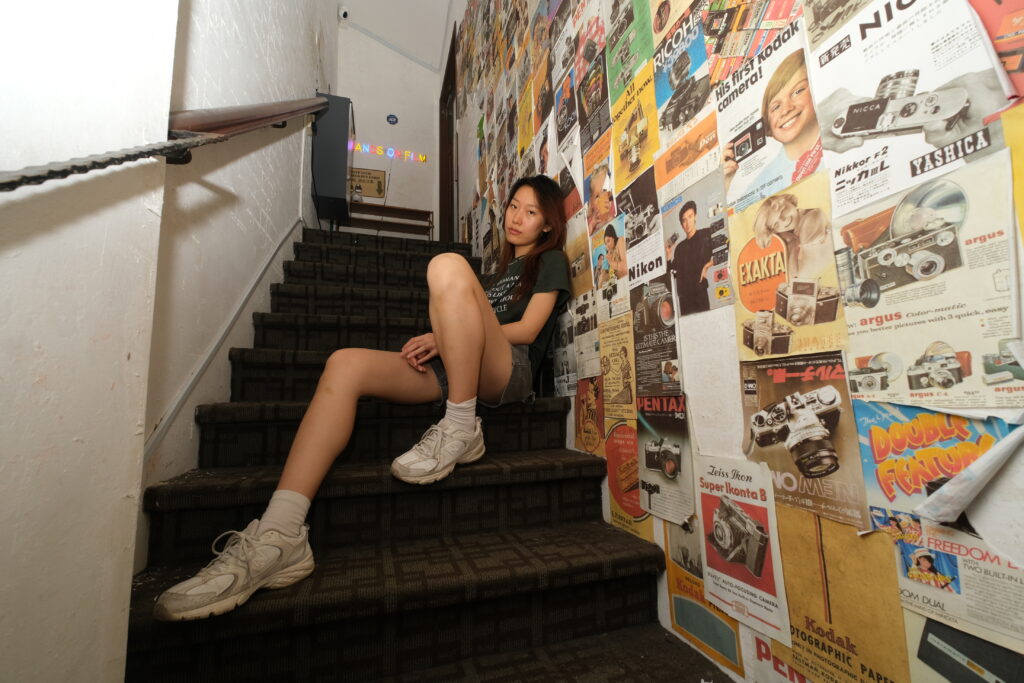
In addition to Manual mode where you set the flash power yourself, the Godox V100 also has TTL (through-the-lens) mode, where it calculates the appropriate flash power and adjusts automatically. TTL works whether you are using direct, bounced or modified flash.
I almost always use the flash in Manual mode, but I tried TTL for the photo below, just for this review, bouncing the flash off the wall on camera-left. The stairway – at Hands On Film lab in Singapore – was quite dark, but the photo came out perfectly exposed.
Light quality and colour temperature
The Godox V100 has a round Fresnel head which supposedly produces a more natural fall-off than rectangular heads which are more common on speedlights. In practical use, I have to say I haven’t noticed much difference between round and rectangular heads. But I do like the round heads because they are natively compatible with Godox’s very handy series of accessories.
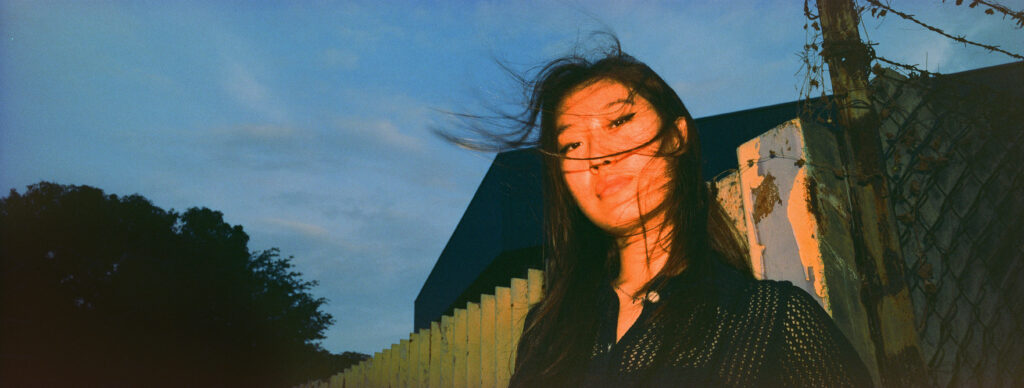
In the photo below, shot with a Hasselblad XPan on Cinestill 800T film, I used direct flash modified by an orange filter for dramatic effect.
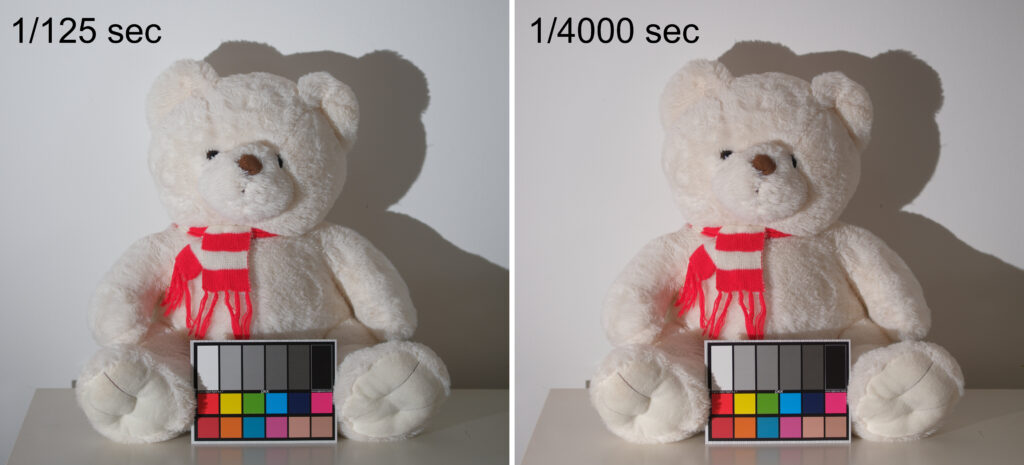
In my tests I noticed slight colour shift in the flash output, varying with the power level. This is most obvious when you compare normal sync (below left) against HSS (below right), with the latter being a shade warmer. But this shift is really slight – essentially unnoticeable – and easily fixed in post. I don’t see it being a problem unless you are doing extremely colour-critical work. Wes Perry has a more detailed analysis of colour shift across various Godox models, if you’re interested.
Sub-flash and modelling light
The Godox V100 comes with the detachable SU-1 sub-flash – a little gadget which clips onto the front of the V1 and fires in sync with the main unit.
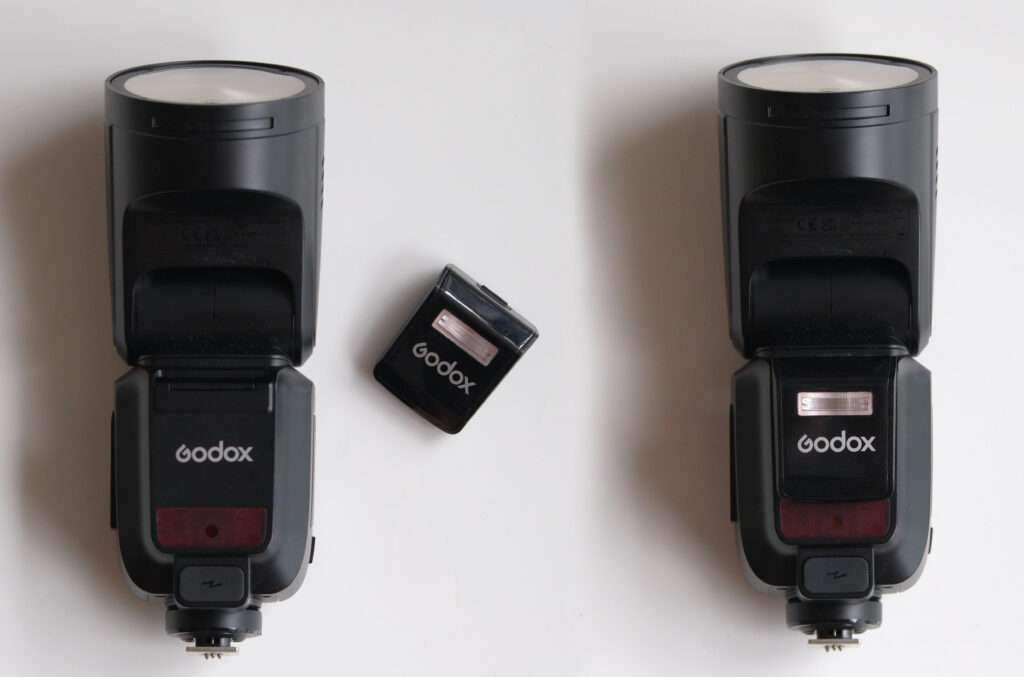
If the main flash is being bounced off another surface, the sub-flash can act as a fill-light.


In the photos above, you can see how the main flash bounced off the ceiling (left) creates more pronounced shadows under my friend’s eyes and cheekbones. When I add the sub-flash (right), it fills those shadows, and also adds a catchlight in her eyes.
Many photographers use a bounce card for this purpose, like the one which comes with the Godox AK-R1 accessory kit (or with rectangular-head flashes, is often built in). The advantage of the sub-flash is that it’s stronger, being a light source in its own right (as opposed to reflecting and redirecting some of the light from the main unit). Moreover, the sub-flash power is adjustable – 1/128 to 1/1, in 0.3 stop increments – which gives you more control.
I should note that the sub-flash only works when the flash is on camera, not off-camera. But I don’t think that’s an issue, because all the potential uses I can think of for the sub-flash are as a supplement to on-camera flash.
In practice, I rarely use the sub-flash – in fact I usually leave it at home. But of course, your mileage may vary. If you’re an experienced flash user, you probably already have a sense of whether the sub-flash might be a useful addition to your kit.
The Godox V100 also has a modelling light, which is a constant light (unlike flash, which is instantaneous). It’s much less powerful than the main flash, but can be helpful to previsualize the direction and spread of light, and also for focusing in dark conditions.
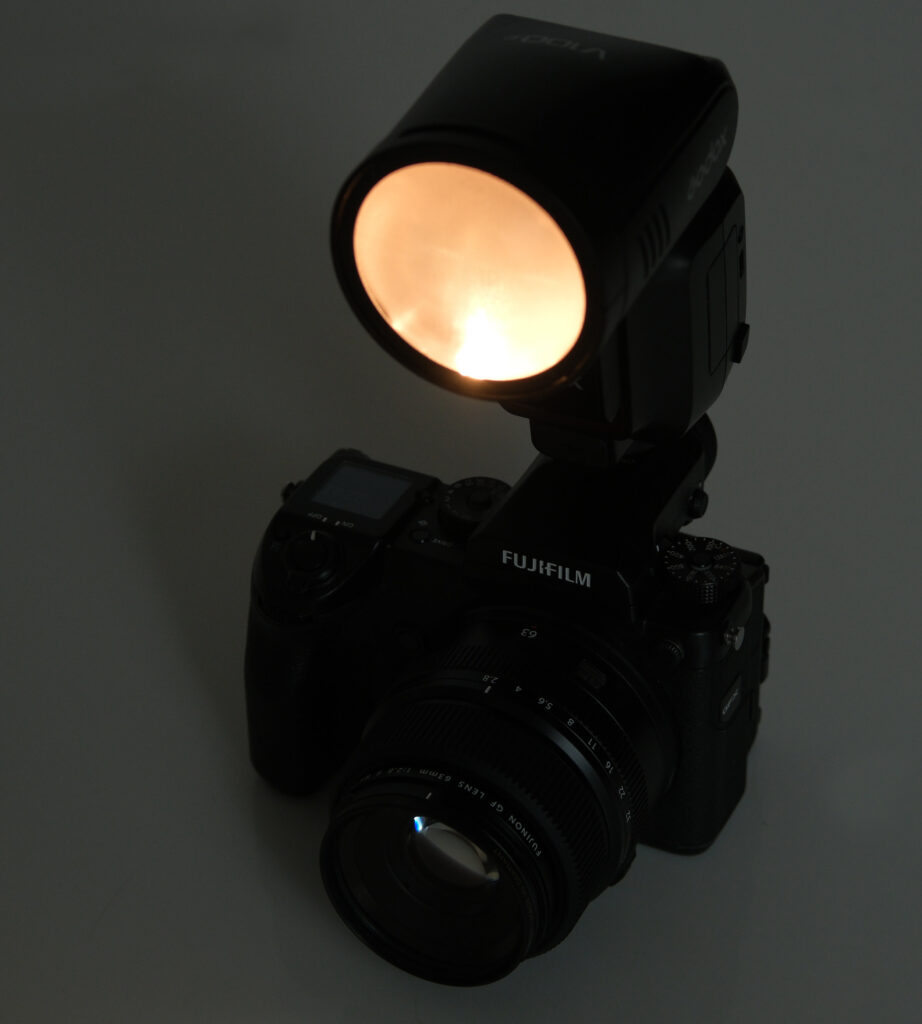
The modelling light is noticeably warmer than the main flash, but this is something I have noticed with a lot of flashes. I’m not sure why manufacturers don’t try to match the colour temperature more closely, or if there is some engineering constraint.
I like to go for night walks in forests, to photograph snakes and spiders. For lighting, I generally use on-camera flash with a macro diffuser – the same setup I used for the viper photo earlier in this article.
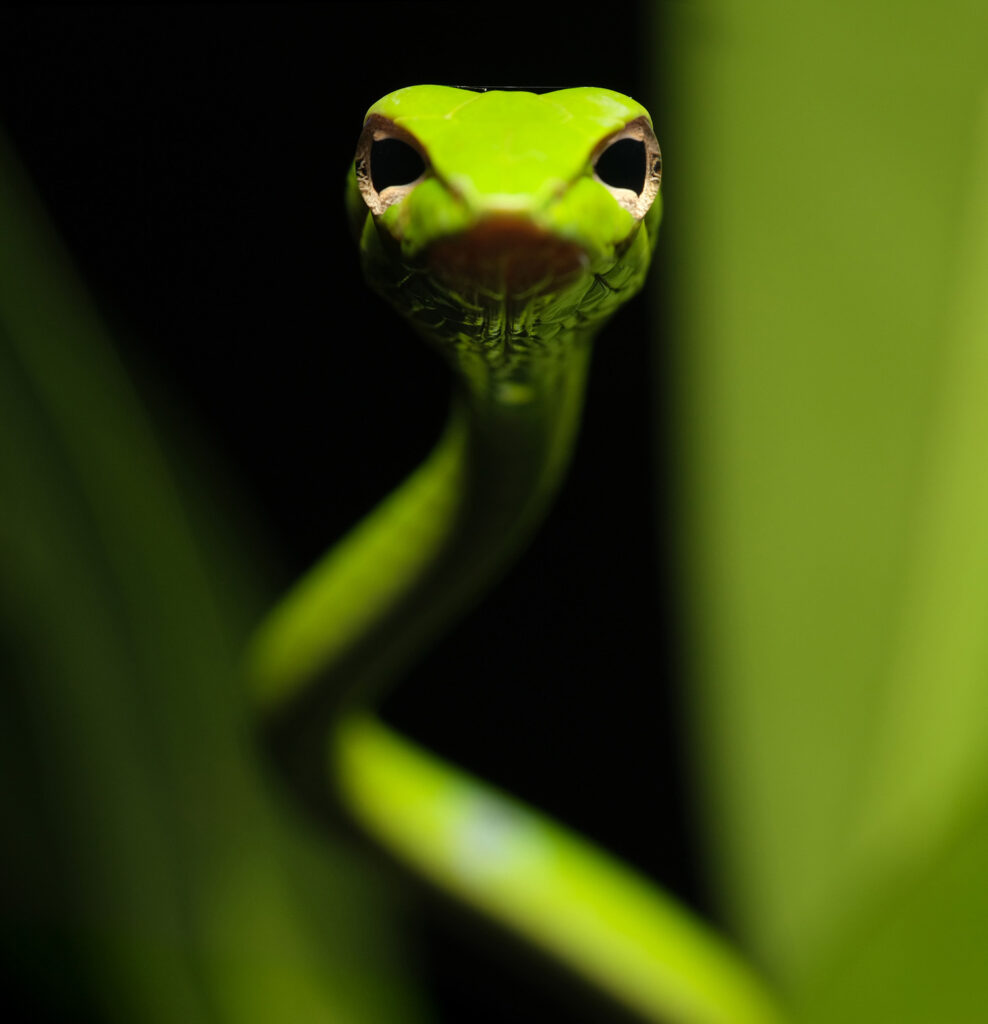

My macro lens – Laowa 65mm f/2.8 for Fuji X-mount – is manual-focus. Nailing focus at such close range is tricky at the best of times, and even more so at night, with erratically moving animals. Some macro diffusers have a constant LED light, but mine doesn’t, so the V100’s modelling light is super helpful for focusing in the dark.
Price, alternatives, and final thoughts
I’ve had my flash for a year and a half, and as you can see from the sample photos, I’ve used it in a variety of shooting scenarios – outdoors, in a professional studio, for portraits, wildlife, action and product photography. Its build quality has held up, and the flash fires reliably every time, both on-camera and off.
In terms of what you can expect from a speedlight in 2026, the Godox V100 has pretty much every feature known to man: a head which swivels both sideways and upwards (and even a bit to the back), adjustable power and zoom, TTL with exposure compensation, high-speed sync, rear-curtain sync, stroboscopic flash, modeling lamp… you name it. It not only has a built-in receiver (which means it can be fired off-camera using, say, a wireless trigger) but it can also act as a transmitter, which is to say, it can sit on top of your camera and fire other off-camera flashes. And of course, you can use it on-camera – pointing directly at your subject, or bouncing off the walls or ceiling.
Of course, all these features and flash power come at a cost, and the retail price of the Godox V100 is in the AD200 territory. The latter is twice as powerful – but it’s a strobe for off-camera use, not an on-camera flash.
Ultimately the question boils down to: do you need 100Ws of power and a cutting-edge feature-set in a speedlight (i.e. a flash which can be mounted on-camera)?
If you need that power and feature-set but not necessarily on-camera, a strobe might be the way to go. Or if you don’t need that much power, you might want to get a smaller and lighter speedlight, and save some money in the process. But if you want both power and on-camera flexibility, the Godox V100 is virtually unmatched.
Thanks for reading. If you want to see more of my work, with and without flash – or simply chat about photography – I’m also on Instagram.
Share this post:

Comments
Gary Smith on Godox V100 Flash – Long-Term Review
Comment posted: 07/08/2026
I don't pay much attention to flash development. When I started shooting 50+ years ago I only relied on pushing Tri-X from 400 to 800 to get more low light capability. I purchased Sony's best flash when I initially picked up the a65 years ago. That flash (HVL-F58AM) works great on my a7R3 so when I want/need flash, that's the camera that I grab. I also have a flash trigger for off-camera flash but I haven't shot any off-camera flash shots in quite a while.
Thanks for your article!
Comment posted: 07/08/2026
Jeffery Luhn on Godox V100 Flash – Long-Term Review
Comment posted: 07/08/2026
Thanks for the well-written review on the Godox V100. I've shot with several Godox products and I can vouch for their performance and reliability.
I have boxes of battery powered speed lights and even more studio strobes. There are a few reasons why I will probably buy a Godox or Neewer speed light, even though I have tons of older flashes.
1- Old flashes, like the Vivitar 283, Nikon SB 700/800, Canon 580, Sunpak, etc, can all do fine within the limits of their design, but they have drawbacks.
2- The Vivitar 283 was a breakthrough speed light in 1970, with the detachable sensor to aid in using the auto exposure setting in off-camera situations. Great thyristor circuitry for accurate output and extending battery life. I have 10 of them! I bought them to tape up on gymnasium walls to shoot 'freeze-shots' of college basketball games. My tutorial on this may still be available on The Strobist site. The issue with this old unit is the high voltage that goes through the synch cord to fire the flash. It can fry modern digital camera electronics! There are accessories for hot shoe mounting that prevent this. But...this workhorse has passed it's prime.
3- The Nikon SB 700/800 has some good built in slave capabilities, but I found all four of the ones I have to have complicated menus that reset for no reason. Unreliable. Ditto with the Canon 580 speed light series. Not worth the trouble and the expense.
4- Yongnuo brand is the newest batch of speed lights I've purchased. I bought 6 of them with radio remotes for the college photo classes I teach. Reasonably reliable, cheap, but not compatible with all digital cameras. Troublesome with Sony and Olympus.
4- Because of improved high ISO quality on digital cameras, I see no reason to buy AC powered studio strobes. We don't need 800 ws! Also, studio models have long burn times, like 1/800sec unlike small speed lights that can get as fast as 1/80,000sec when used on 1/16 power. If you have moving subjects, big AC powered strobes don't stop the action.
In closing: If I wasn't so cheap, I'd probably give away my boxes of strobes and buy two or three Godox speed lights. Updated menus and features, improved power management for longer battery life, and better TTL performance. You get what you pay for. Unless you're a vintage buff looking to fiddle with old stuff, I'd recommend buying Godox. If you want to save money, research Neewer. Their stuff is not as robust, but for casual use and learning, they will be okay. Check out the Strobist website for loads of tutorials and gear reviews.
Thanks again for the great review.
Jeffery
Comment posted: 07/08/2026
Comment posted: 07/08/2026