

One true joy of travel is the chance it offers to stumble onto real mysteries of nature. It doesn’t happen often, but Kate and I have experienced it three times. The most recent occurred during a 2018 tour of Newfoundland.
“Plantimals”?
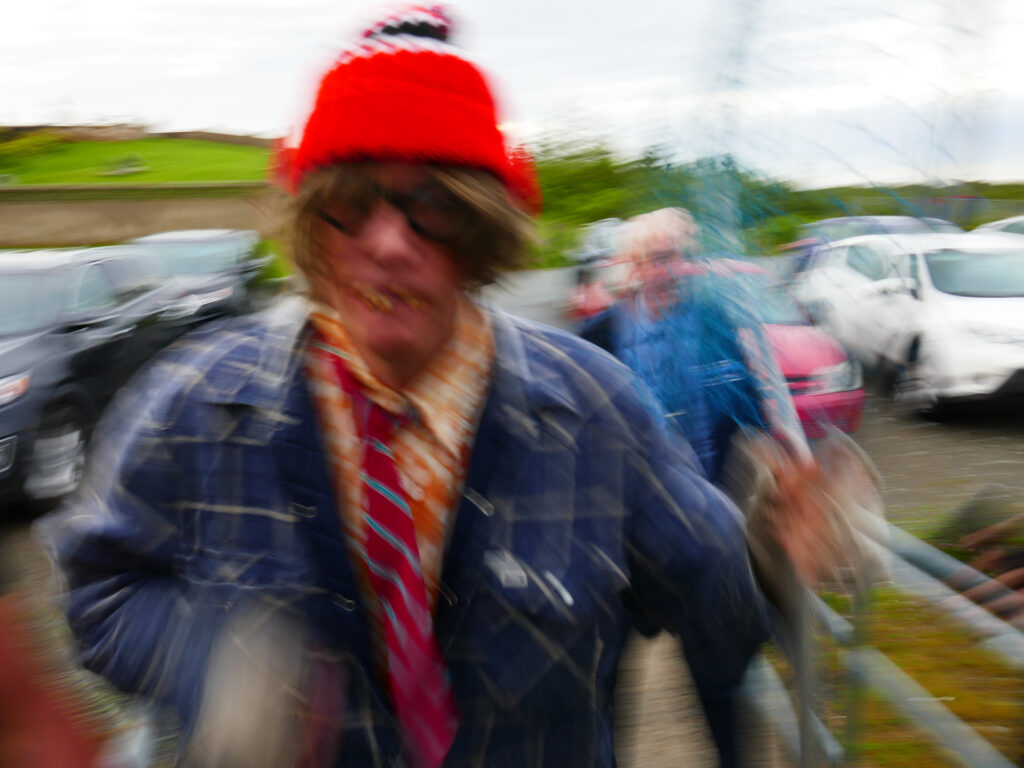
This 35mmc article describes a wild ceremony that the tiny town of Port Union threw for our tour group in its function hall. Everyone in town brought home cooking for a communal dinner. And after meeting and eating, the fun leveled up quite a few notches when a Master of Ceremonies dashed in out of the rain to turn us into Honorary Newfoundlanders:
 A Secret Mission Overheard
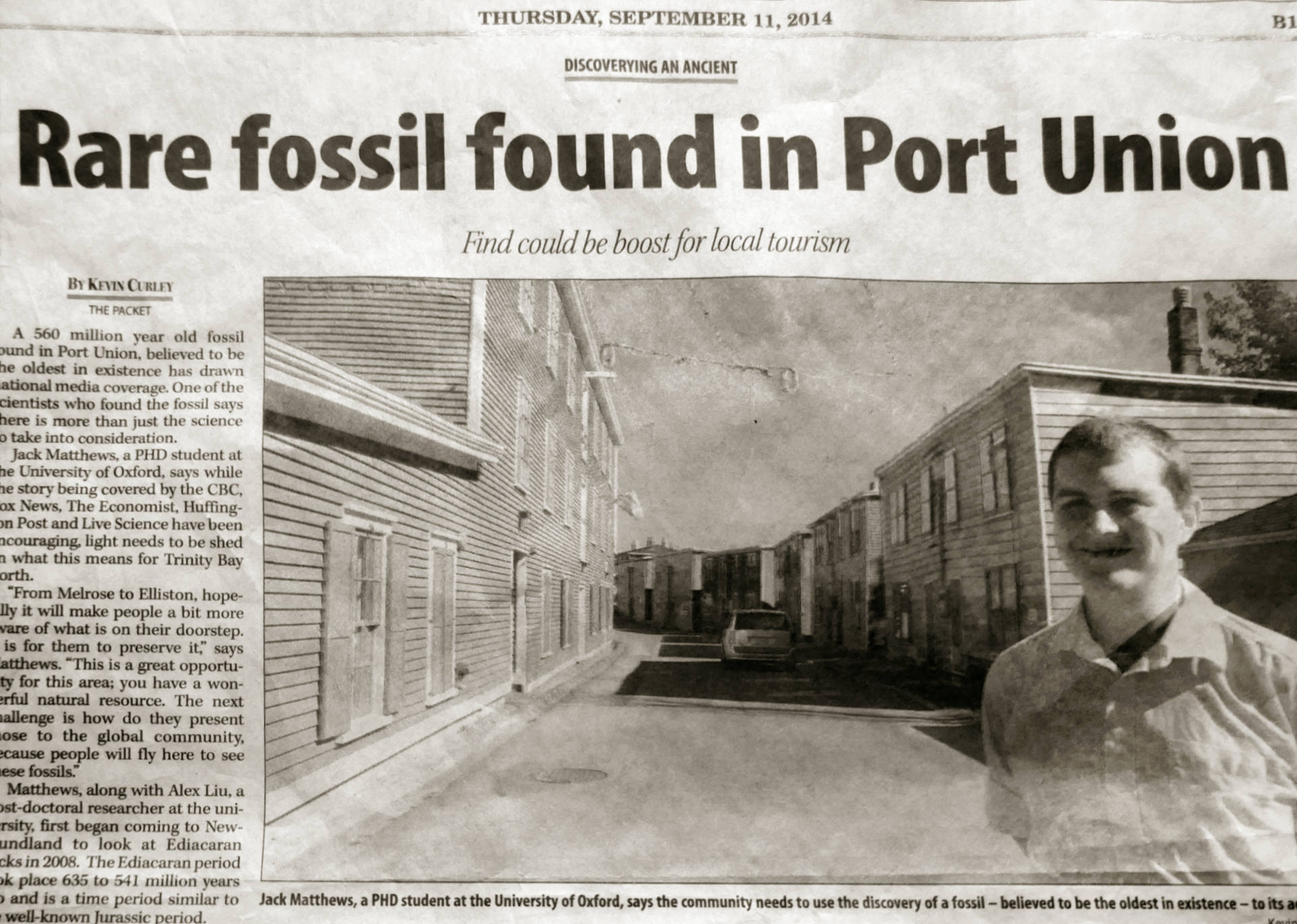
Also invited were some Oxford paleontology students, who were in town on a “somewhat secret mission.” For several years, they and their professors had quietly returned to the area to research (and try to preserve) some extremely weird fossils found in nearby coastal rocks. The plant-like marine creature lived an astonishing 560 million years ago, and may have been an ancestor of today’s jellyfish, anemonies and corals.
But what the students and their professors also discovered about it “shocked the pants” off of both botanists and paleontologists. Close examination revealed that it appeared to be a plant with animal-like muscles! Or more precisely, as Science News explained, it was “the oldest evidence of muscle tissue – the bundles of cells that make movement in animals possible.”
A “plantimal” if you will.
Named Haootia quadriformis, its muscle fibers formed a “four-fold symmetrical structure” that looked like a wine glass with tentacles (like this artist’s conception in Port Union’s town newspaper):
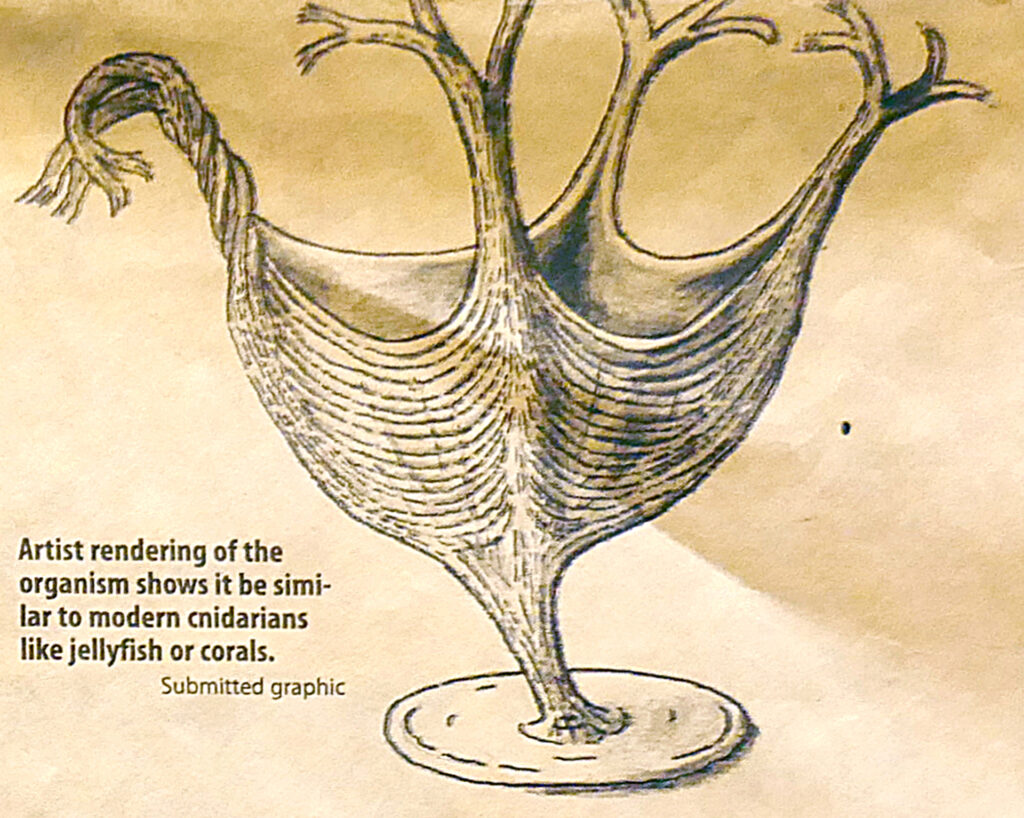
The “base” of the wine glass was a foot that anchored it to hard surfaces. And it is thought that its muscular arms may be the first in evolutionary history that could actively react to external events.
So many unusual, super-ancient fossils were found on the seashore near Port Union that the area is now UNESCO’s Mistaken Point Ecological Reserve World Heritage Site. And while paleontologists wanted to extract the fossils to save them from wave erosion, Newfoundland law prohibited it. So plaster casts were made of the best specimens. Here are a couple (shot with my Panasonic ZS100 point-and-shoot):
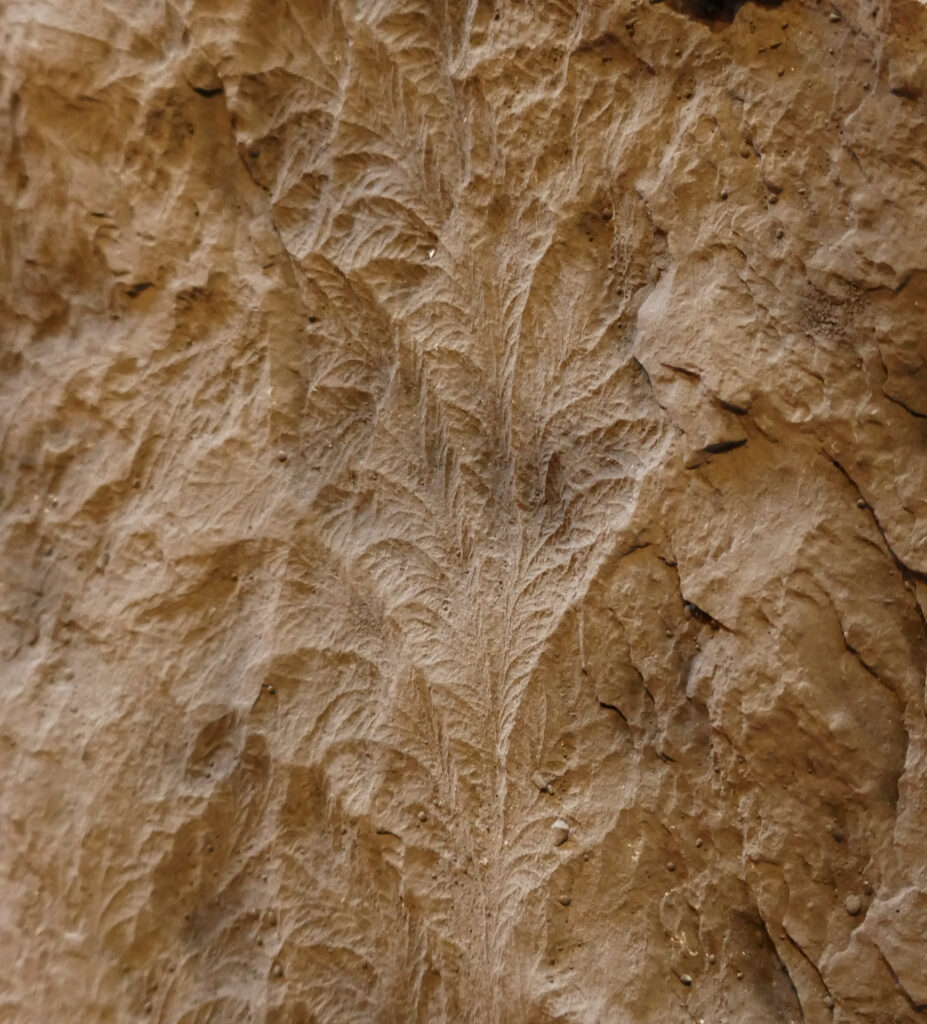
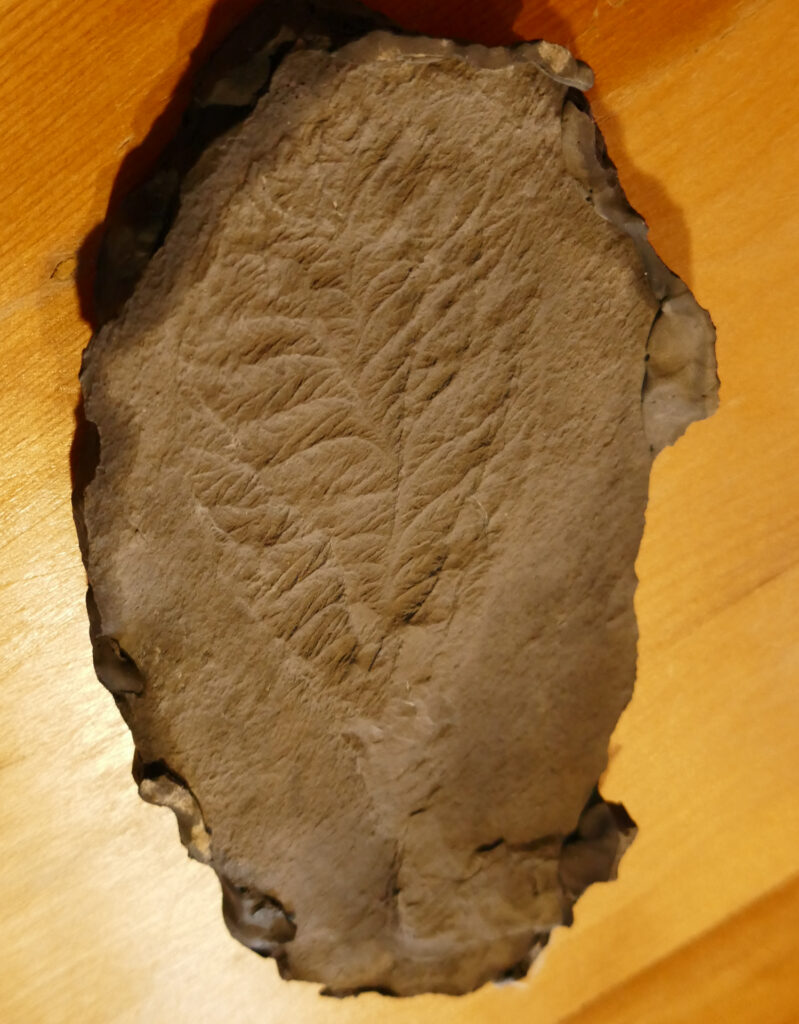 The second shot shows the “wine glass foot” rather nicely!
Tourists can visit these casts in The Rooms museum in St. John’s. (And if you’re lucky and well-behaved, a friendly docent might even chat you up with a tray of appetizers and drinks!)
And Fossilized Forests?
But Newfoundland isn’t the first place in the North Atlantic where Kate and I “discovered” very strange fossils in our travels. In the mid-1980s, we did a self-guided auto tour of western Nova Scotia. One evening, in a bar on Mahone Bay, we heard about a little-known local cove where one could walk right up to an entire fossilized forest!
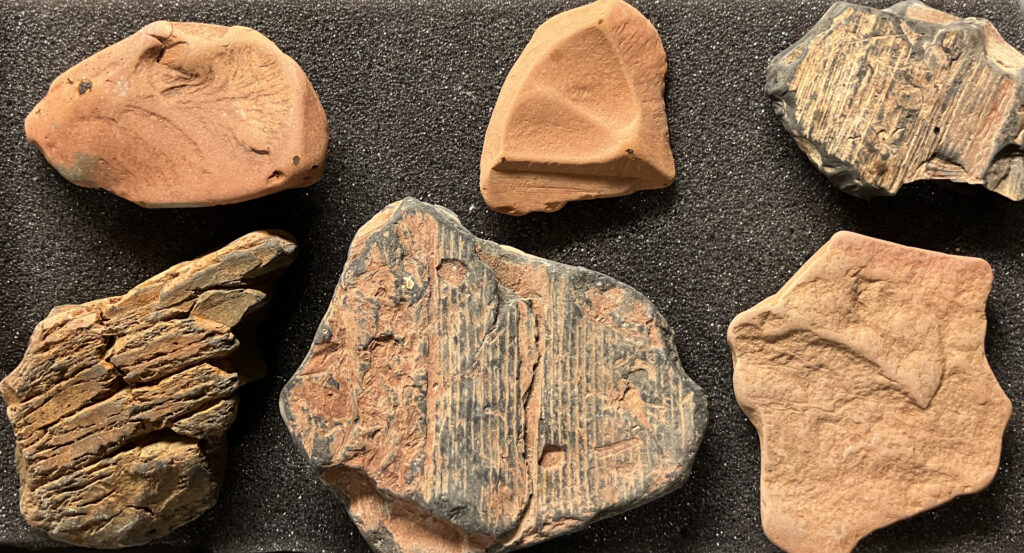
Yep, it was indeed a standing forest of what looked like palm trees. Encased in stone. They towered over us in red sandstone cliffs at sunset. We could touch their grooved, patterned trunks while pieces of stone bark and leafs literally rained down on us.
A quick Google search tried to tell me that the place is now the popular Joggins Fossil Cliffs tourist site. But we were never near it. Some diligent prodding of Google AI finally elicited that there are indeed rarely visited areas on Mahone Bay where other people have reported fossilized forests of whole standing trees (as opposed to pieces of trunks embedded in rock). The most likely locations AI suggested are now called Green Point and Blue Rocks, which are both near Lunenburg (where we had stayed).
If that’s true, then what we saw weren’t palm trees at all, but dense groves of ancient bamboo-like Lepidodendron plants that grew up to 120 feet tall. Darwin actually mentioned these mysterious stone forests in “The Origin of Species,” but he and many other scientists also wondered (as we did):
What Force Could Fossilize Forests?
According to Wikipedia, it probably occurred at a time when the Earth was emerging from a major Ice Age, seas were rising, and landmasses were assembling into a supercontinent called “Pannotia.” (Unlike the later and more well-known supercontinent “Pangaea,” Pannotia was relatively short-lived, had a V or C shape, and was mostly clustered around the then South Pole.)
Scientists think fossilization occurred when a sudden jump in sea level (possibly due to a tsunami) coincided with subsidence of the entire region due to heavy subsurface flows of rock salt. Over the course of a few decades, the standing plants would have been entombed in deep sand and mud, and the salt would have helped to preserve and fossilize them.
We still have small samples of the leaves and bark scales that rained down on us. Here are some of them (shot with my iPhone):
But that was a while ago. If you visit Joggins Fossil Cliffs, Green Point, Blue Rocks, Mistaken Point or any other Canadian fossil field today, they’ll no doubt frown upon similar sample collecting.
And a Third Story to Come!
My fascination with fossils actually began even earlier. It was around 1963, when I was 15 and my family “rediscovered” a once-famous central-Ohio fossil site that had been lost for 160 years! We didn’t have to travel far either… it was within walking distance, right down the road from our house.
For fossil-loving kids (and their mother), It was a true Indiana-Jones adventure that (along with the above experiences) proved real adventures– NOT pre-packaged amusement-park thrills– are still out there. Still waiting to be discovered. In Part 2, I’ll share that story.
–Dave Powell is a Westford, Mass., writer and avid amateur photographer.
Share this post:






Comments
Ibraar Hussain on Real Adventures are Still Out There! (Part 1)
Comment posted: 28/05/2026
Comment posted: 28/05/2026
Jeffery Luhn on Real Adventures are Still Out There! (Part 1)
Comment posted: 28/05/2026
A very good read!! Thanx!
Comment posted: 28/05/2026