

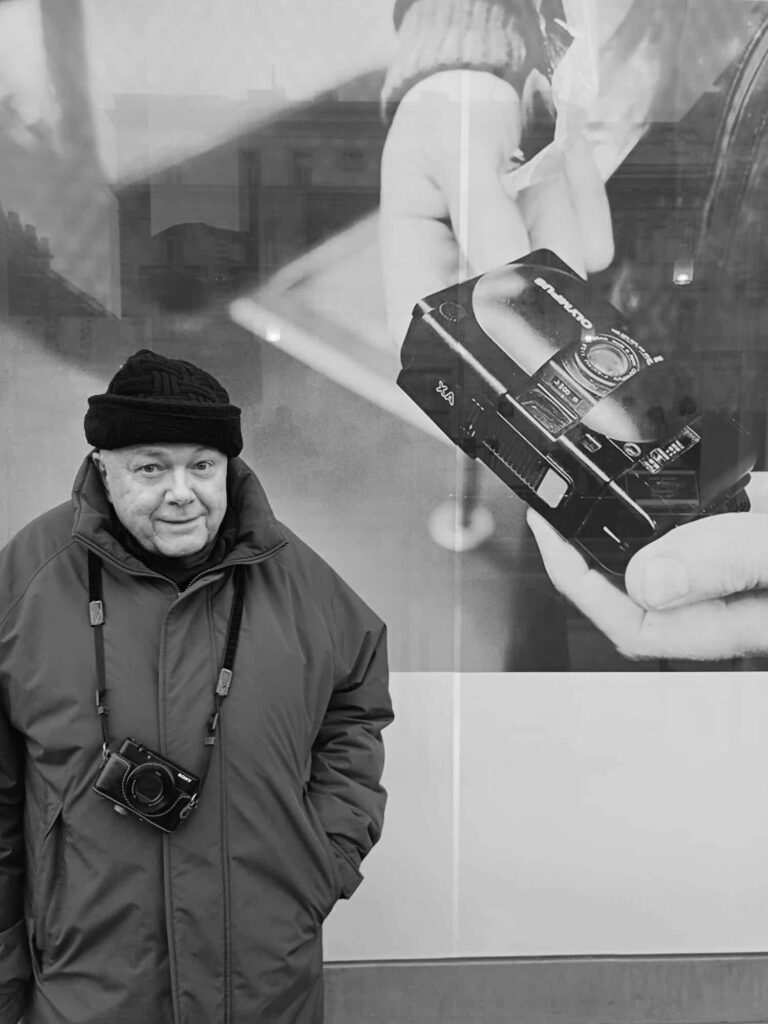
I have known Phil Maxwell for about sixteen years. For a period, we both had studios in Spitalfields, in that strange zone where the East End was still recognisably itself but was also being remade, priced up, polished, and thinned out.
Phil had already lived through several versions of that neighbourhood by then. He had photographed Brick Lane, Whitechapel, Bethnal Green Road and the surrounding streets for decades. Bishopsgate Institute describes him as the “pre-eminent photographer of Brick Lane” and holds his archive of around 10,000 digital photographs and negatives covering the East End, Liverpool street life, Labour politics and personal work from 1975 to 2013.
Spitalfields Life calls him “the photographer of Brick Lane”, noting that no one had taken more pictures there over the previous thirty years.
That is the public version of Phil Maxwell – the chronicler of Brick Lane, the man whose photographs form part of the visual memory of the East End. But when I spoke to him recently, I wanted to talk about something smaller, more pocketable, and perhaps more revealing – the Olympus XA2.
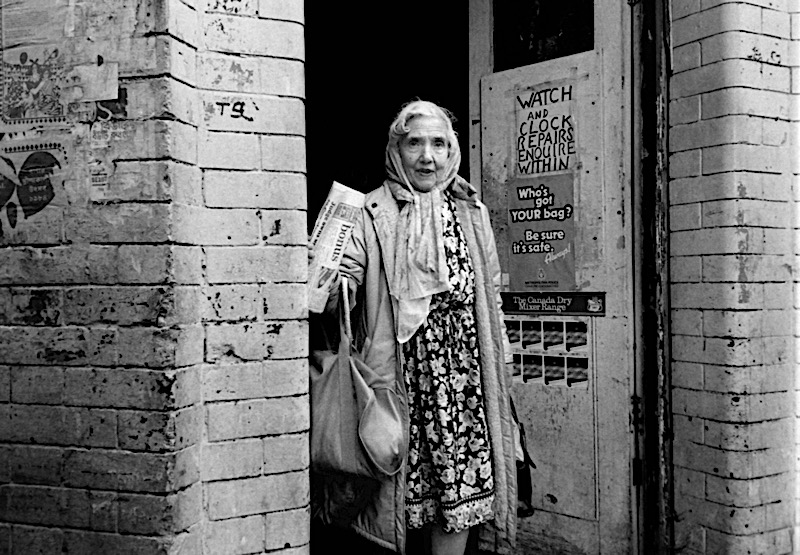
The XA2 is not a grand camera. It does not announce itself as serious. It is not a Leica, nor even the more cultish Olympus XA with its rangefinder focusing. It is a small zone-focus compact with a sliding clamshell cover, automatic exposure, and a lens that has probably done far more good work than its modest status suggests. For Phil, it became something like a notebook.
He remembers seeing it advertised in photographic magazines and thinking immediately that it looked interesting because he could simply put it in his pocket. Before that, he had used heavier, more conspicuous cameras. He started, as many of us did, with second-hand equipment. One of his early cameras was an old Russian Zenit – heavy, tank-like, cheap, and fitted with a lens he still remembers fondly.
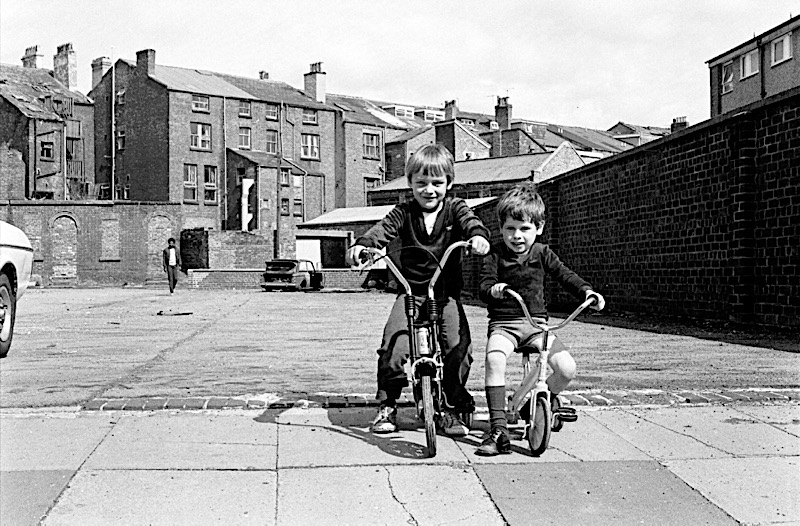
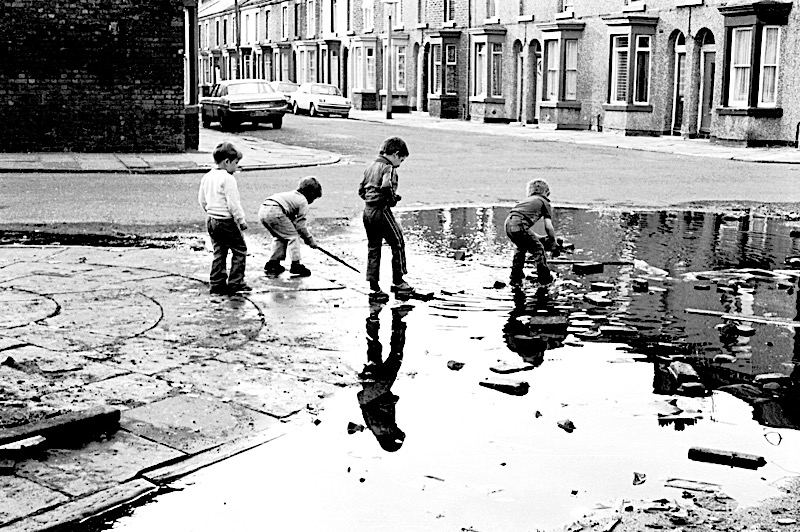
In the late 1970s, when he was living in Toxteth, Liverpool Eight, he would cycle around with an SLR hanging from his neck. Children would stop him and ask him to take their picture. That detail matters, because it belongs to another photographic world, one in which a camera in the street was still unusual enough to invite curiosity rather than suspicion.
One of those children contacted him around forty years later after seeing a photograph online. It was, the man told Phil, the only photograph he had of his childhood. Another family contacted him after recognising a paper seller at Aldgate East as their grandfather. They had no picture of him either. Phil sent them a print. These are not sentimental anecdotes. They point to something important about street photography at its best. It is not merely the theft of a passing image. Sometimes it becomes, decades later, a family archive where no family archive existed.
This is where the XA2 enters the story. Phil bought his new Olympus XA2 for around £80, which was not insignificant money at the time. But it changed the way he worked. He could load it with Ilford HP5, put it in his pocket, and walk. The camera did not hang from his neck. It did not turn him into an event. It allowed him to be present without becoming the centre of the scene.
That is one of the great virtues of the XA2. It removes ceremony. Slide open the clamshell, estimate the distance, raise it, press the shutter. In Phil’s words, the camera was “like a notebook”. He carried it everywhere. The design still delights him. Holding it again during our conversation, he described the sliding cover and the way the lens appears as something almost futuristic —”I remember thinking it’s like a gadget from space, like something from Star Trek. It’s such a beautiful design.”
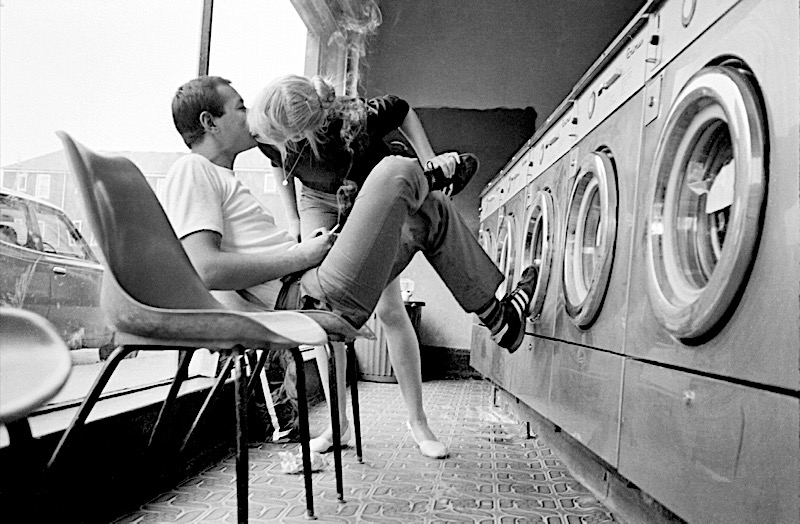
The most famous photograph he took with the XA2 came from the Brick Lane Laundrette in the early 1980s. Phil lived nearby and, like many people then, did not have a washing machine. He was sitting in the laundrette with his camera in his pocket. A young couple nearby were arguing, kissing, arguing again. The woman eventually walked off, leaving the man alone with the washing. Phil took a sequence of frames. Years later, when he revisited them, he realised they formed a small drama: a kiss, a row, abandonment.
The story did not end with the photograph. The woman in the picture later moved into the top of the block where Phil lived. The image was published as a postcard for a Bangladesh-related fundraiser. Later still, the daughter of the couple — the daughter of the man and woman in the laundrette — contacted Phil because she wanted to buy them a print. The photograph had become part of their family story too.
This is the kind of thing that makes Phil’s work different from the more aggressive tradition of street photography. We spoke about photographers such as Bruce Gilden and Tatsuo Suzuki, whose work can feel confrontational, even invasive. Phil’s answer was not that street photography is ethically pure. Quite the opposite. He is clear that the street photographer has an ethical responsibility. But for him, the ethics do not begin and end at the moment the shutter is pressed. They continue afterwards, in the editing, in the decision about whether an image should be shown at all.
“If that image is demeaning of that person or makes them look stupid,” he said, he would generally not use it. That distinction is crucial. The camera may be quick, but the judgement must not be.
Phil also places the anxiety about street photography within a wider surveillance culture. We live in cities where our images are recorded constantly by CCTV, phones, police technologies and databases. The lone photographer with a small camera is not the only person making images of us; in many ways, he is the least powerful image-maker in the street. But that does not absolve him. It simply changes the frame. A street photograph made by a human being, with human judgement, may still carry a different kind of social meaning from the automated harvesting of faces by surveillance systems.
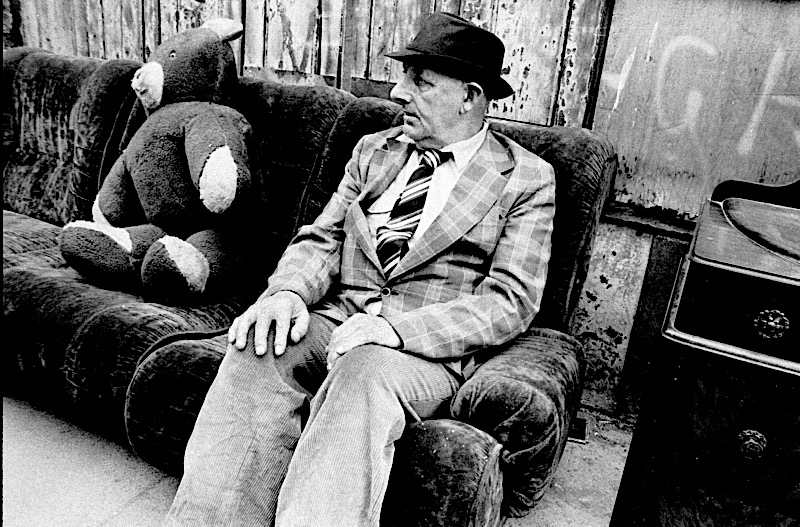
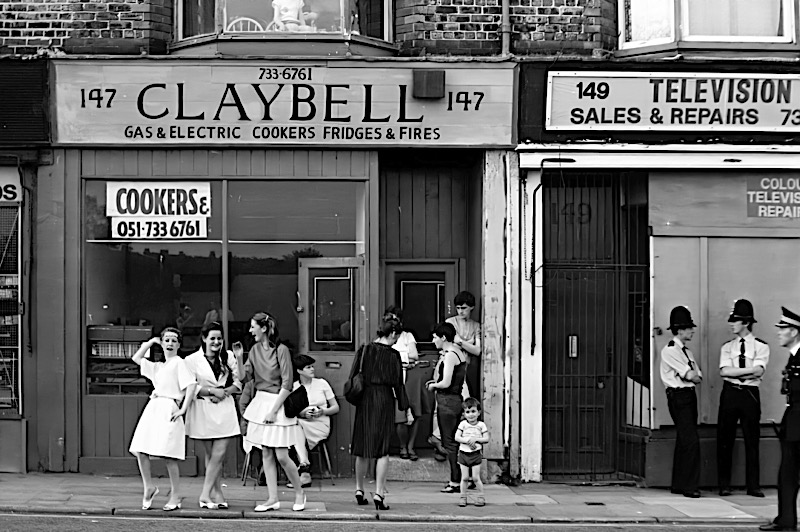
For Phil, the street is not just a backdrop. It is a theatre. It is where society reveals itself. It is where you “take the temperature” of a place. This is where his work moves beyond camera talk and into sociology. The East End he photographed was not simply picturesque poverty or urban grit. It was a place of dense social life: children playing outside, pubs as mixed social spaces, laundrettes as stages for domestic drama, Brick Lane as a living street rather than a heritage brand.
He is alert to what has been lost. Gentrification pushed him and his filmmaker partner, Hazuan Hashim, away from Spitalfields. They moved to Liverpool, where they now have more space, studios, a garden, and a different kind of community. He describes parts of Wavertree as having echoes of what Hackney Road or Bethnal Green Road once felt like – bohemian in places, working class in others, still sociable, still legible. After ten years there, people know him. They know he takes photographs. He has, in effect, re-established the conditions of intimacy that made his East End work possible.
This is also why he is sceptical of much contemporary street photography. I mentioned the kind of image one now sees constantly online – a figure with a long shadow, a person with an umbrella, a graphic arrangement of shape and light. Phil agreed. Such images can be elegant, but often they feel emptied of society. They are street photographs without the street as a social organism. They produce style, but not necessarily memory.
The film stocks matter here too. Phil’s early work was largely on HP5. He bought film in bulk and loaded it into cassettes himself. This was partly economics, partly practice. Bulk loading could produce scratches; some might call that damage, others authenticity. He developed and printed his own work, often in makeshift conditions, sometimes with expired photographic paper bought cheaply. The darkroom was not a pristine temple. It was a place of improvisation, mistakes, salvage and discovery. A long phone call while a film was in the tank could produce strange overdeveloped negatives. But sometimes those “wrong” negatives yielded astonishing images.
Later, he used Ilford XP2. His reason was practical – he was busy. He was doing activism, taking photographs, working on NUJ day rates for magazines and local government publications, and he did not always have time to process film himself. XP2 could be dropped at a lab on Whitechapel Road. Its C-41 processing made it convenient, and its latitude made it forgiving. It also allowed him, later, to get scans or CDs alongside prints.
But Phil is not romantic about every aspect of the material. Looking back, he recognises a difference between his silver HP5 negatives and XP2. The XP2 images, he says, can feel blander by comparison. That does not mean they are useless. Digital adjustment can recover contrast, tone and drama. But HP5 has a different bite, a different density, and a different historical presence. Black and white, for Phil, has its own language. Colour dates itself quickly. Black and white, he suggests, can become a “great leveller” of the human condition.
This is a familiar argument, but in Phil’s case it does not come from purism. He was a late convert to digital, but once he moved into Photoshop and digital printing, he did not treat it as a betrayal. The skills of the darkroom transferred. Dodging, burning, contrast control, experimentation: these continued by other means. His later work includes digital montage, mixed media, prints he draws and paints on. The analogue and digital are not enemies in his practice. They are stages in the same long argument with images.
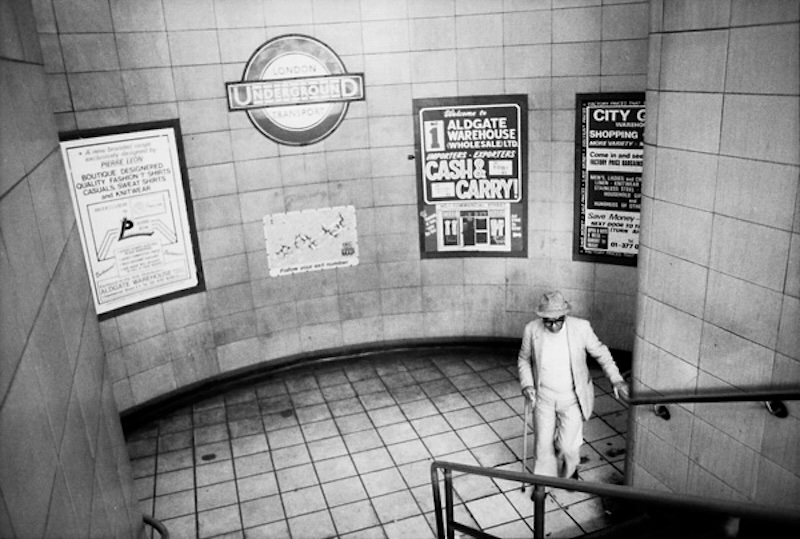
There is a striking irony in his career. The paid work – politicians, local government assignments, magazine jobs, even half a dozen prime ministers – often mattered less to him than the photographs made on the way home. He might photograph Tony Blair at the House of Commons, then take pictures of people on the Tube, then walk through Whitechapel and Brick Lane with the camera. The commissioned image paid the bill; the unpaid image carried the life.
He photographed an ACT UP demonstration fighting for gay law reform in Shaftesbury Avenue, including the arrest of Derek Jarman, almost incidentally, while moving through the city. Those photographs, unpublished at the time, later became more meaningful to him than the official work.
This is perhaps the real lesson of the XA2. Its value was not in technical superiority. It was in availability. It allowed Phil to have a camera when life presented itself. The XA2 is the kind of camera that collapses the distance between seeing and photographing. It is not fast in the modern autofocus sense, nor luxurious, nor especially celebrated. But it is democratic in the practical sense – small enough to carry and good enough to trust.
At the end of our conversation, I asked Phil what he hoped someone might see in his archive a hundred years from now. A young researcher, perhaps, walking into Bishopsgate Institute and looking through his negatives. What should those pictures communicate about London’s working class?
His first answer was “resilience”. Then he expanded it: the ability to embrace life despite difficulty. That is what the photographs preserve – not misery, not nostalgia, but human presence under pressure. He worries that the street as theatre is being closed down by the digital world. In the 1980s East End, overcrowded homes pushed life outdoors. The street was an extension of the house. People met there, argued there, flirted there, performed there, belonged there. Now, he fears, social life is increasingly mediated by machines, screens and artificial forms of companionship.
That may sound bleak, but it also clarifies the importance of his work. Phil Maxwell’s photographs are not simply records of Brick Lane before the coffee shops, galleries and speculative developments. They are records of a kind of public life. The Olympus XA2, loaded with HP5 or XP2 and carried in a pocket, was one of the instruments that allowed him to catch it.
The camera was only a tool, as Phil insists. But some tools are well matched to a way of being in the world. The XA2 suited Phil because it was modest, observant, unshowy and always there. Much like the best of his photographs, it did not shout for attention. It simply stayed close enough to notice what mattered.
Follow Phil Maxwell’s photography blog here: Free to subscribe.
You can also support his new documentary, Terrorists, here.
Share this post:


Comments
Chuck Young on Phil Maxwell, the Olympus XA2, and the Street as Theatre
Comment posted: 26/06/2026
Comment posted: 26/06/2026
Richard Alton on Phil Maxwell, the Olympus XA2, and the Street as Theatre
Comment posted: 26/06/2026
Comment posted: 26/06/2026
Walter Reumkens on Phil Maxwell, the Olympus XA2, and the Street as Theatre
Comment posted: 26/06/2026
“Anyone who can see can take photographs, but learning to see can take time.”
(Advertisement, Leica AG)
Thank you for the article and the brilliant photos. I hadn’t heard of Phill Maxwell before.
.
Comment posted: 26/06/2026
Comment posted: 26/06/2026
Dave on Phil Maxwell, the Olympus XA2, and the Street as Theatre
Comment posted: 26/06/2026
"One of those children contacted him around forty years later after seeing a photograph online. It was, the man told Phil, the only photograph he had of his childhood."
As good as the photos are, that quote may have been the most effective thing about this post.
I'm spoiled by the photos my Dad took -- on Kodachrome, no less. It's nearly a shock to find other children didn't have any photos taken during their childhood. Thankfully, there were some by Phil.
Comment posted: 26/06/2026
Andrew L on Phil Maxwell, the Olympus XA2, and the Street as Theatre
Comment posted: 27/06/2026
Comment posted: 27/06/2026
Danilo Leonardi on Phil Maxwell, the Olympus XA2, and the Street as Theatre
Comment posted: 29/06/2026
What the article makes clear is that the XA2 became his street camera simply because he used it to take wonderful photographs on the street. Its simplicity and quality suited the way he worked. Reading this also made me think about how much of today’s photography conversation can become centred on the experience of owning and operating particular cameras: the styling, the dials, the LUTs and endless equipment discussions. There’s nothing wrong with enjoying well-designed cameras, but perhaps there’s a very human temptation to feel that buying the object, particularly a well-hyped one, somehow brings us a little closer to an artist’s way of seeing, or even to the persona we associate with their work. What comes through is that the XA2 didn’t create the photographs; it simply served the photographer who did. The artistry was in Maxwell’s patience, observation and ability to recognise that something meaningful was unfolding in front of him.
Comment posted: 29/06/2026
Ibraar Hussain on Phil Maxwell, the Olympus XA2, and the Street as Theatre
Comment posted: 29/06/2026
Comment posted: 29/06/2026
Jeffery Luhn on Phil Maxwell, the Olympus XA2, and the Street as Theatre
Comment posted: 13/07/2026
In 1971 I was working for UPI on an assignment to photograph 'the hippie invasion of Europe.' My task, along with many others, was to record young people doing interesting and sometimes outrageous things in order to sell the photos to newspapers and magazines. While on Mykonos I shot about 20 rolls of 36x Tri-X because I'd run out of slide film. I never sent the rolls into UPI because I didn't think they would have been interesting to readers. I didn't look at those negatives for nearly 50 years. My wife and I were planning a vacation to Greece in 2017, so I printed all of the negatives with recognizable faces of Greek locals. About 200 4x5 inch prints. I contacted the mayors office on Mykonos and said I'd be delivering the prints and asked if they could arrange a place for me to pin them up. All the prints would be free to anyone that wanted them. The day my wife and I pinned them up, there were about 20 people there. The next day 50. The next day over 100. So many people had no photos of their long deceased relatives! We left Mykonos on day 4, but could have stayed for weeks because of so many invitations for lodging and dinners. That remains one of my most memorable uses of a camera.
The work of Phil Maxwell, and any serious photographer of people doing daily living, is important. But the photos are meaningless unless they are shared. All of us can learn from stories like Maxwell and mine. Taking the photo is just the first step. There's joy to be had in giving those images away!
Comment posted: 13/07/2026