

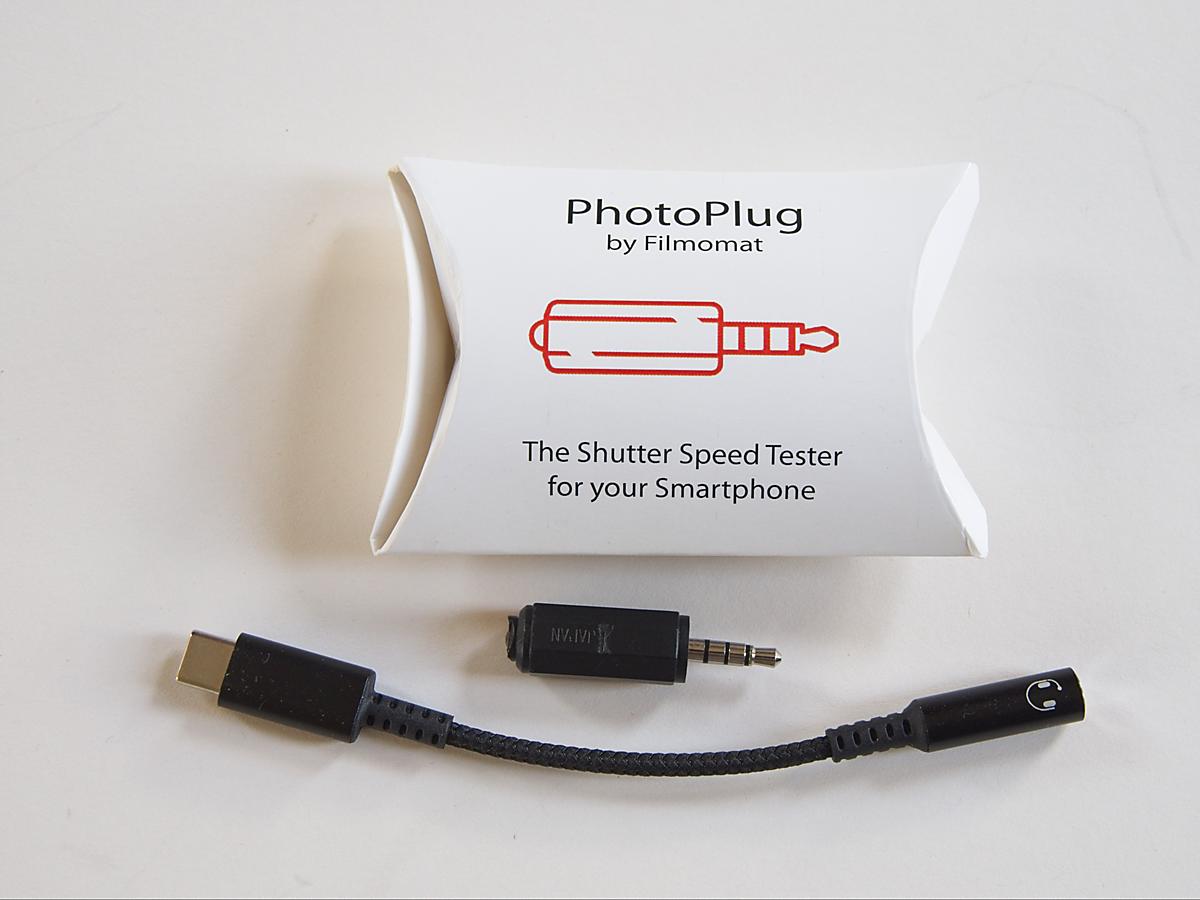
As someone who has more film cameras than I need, I decided it would be interesting to know how accurate their shutters are. Obviously, you can tell the difference between 1 second and 1/500 but when there is also a mirror making a noise, I cannot tell the difference between 1/125 and 1/500 second. So on impulse I invested in a Photoplug. I can’t find a review on this forum so here is a quick one.
It is a simple plug that goes into the microphone socket of a phone, or if you have no microphone socket, into an adapter. I bought the adapter too, thinking I would use if on my regular phone but, so that I could loan it to a friend, I retrieved an old Android phone from the pile of stuff to go to Oxfam (they recycle old phones) and set that up to use it. It works by using a light sensor to send a signal into the headphone socket and then into an app that analyses it. You can use the app without the plug, but it would rely on sound, which given the noise of an SLR mirror means it is unlikely to be accurate.
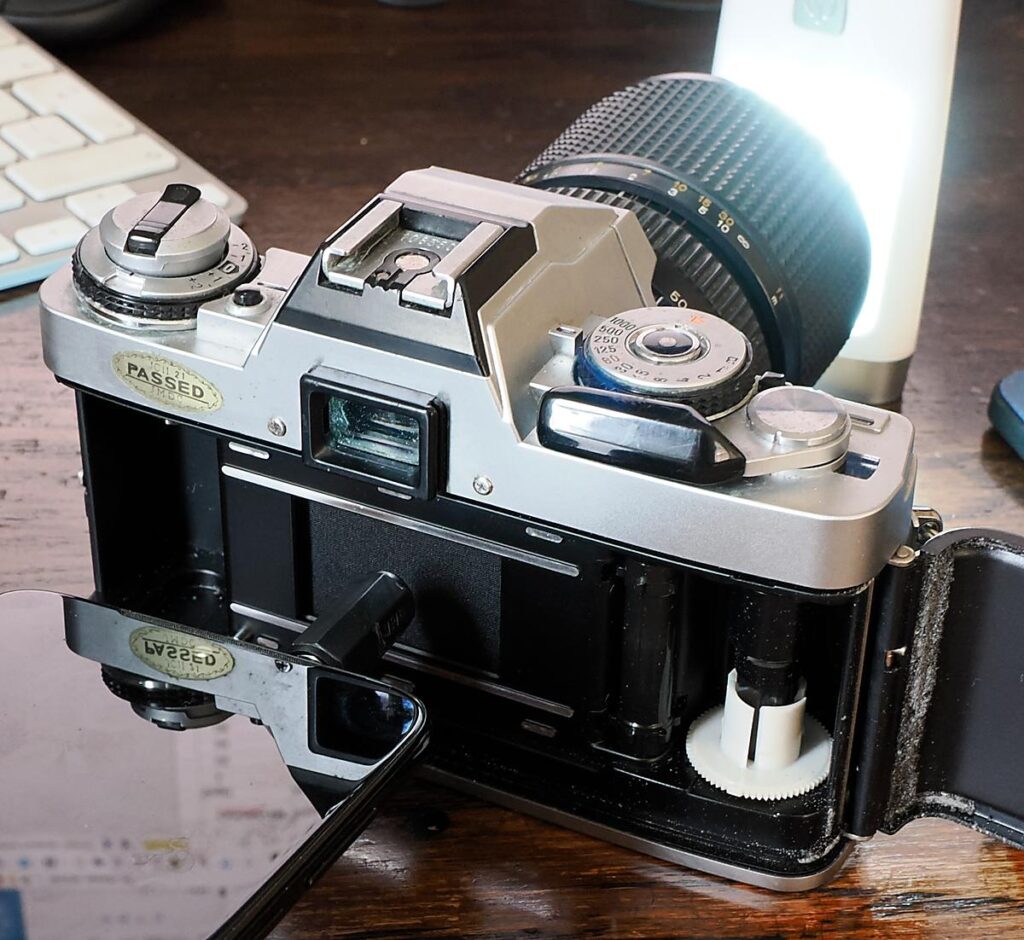
It is simple to set up. After downloading the app, plug it into the headphone/microphone socket, open the back of the camera, put a bright light in front of the lens (and I use the widest aperture) and position the plug behind the shutter.
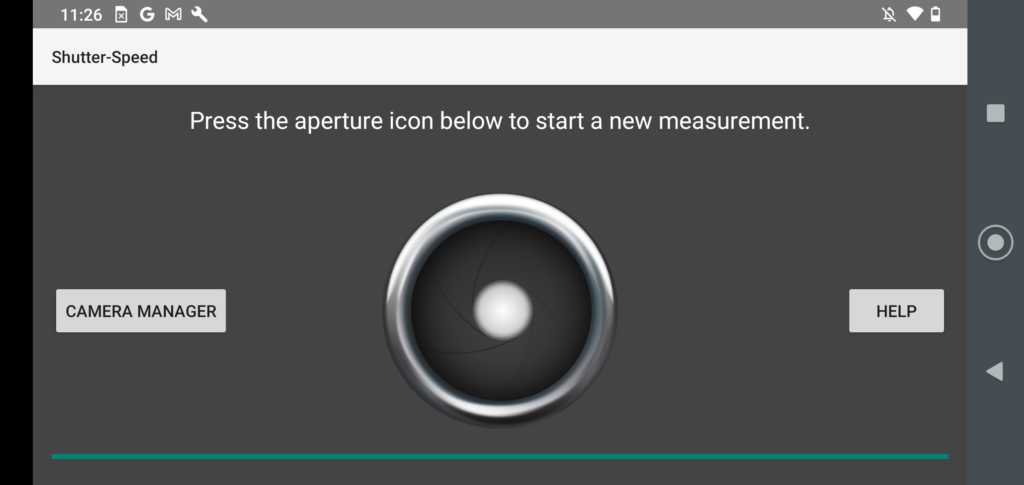
Then open the app, when you see a screen like this:
Go into camera manager and create an entry for the camera, then, with the camera in place, press the big button in the middle, which gives you a three second window during which you have to fire the shutter. Left hand holding the phone and right hand on the shutter works for me. You then see a screen like this.
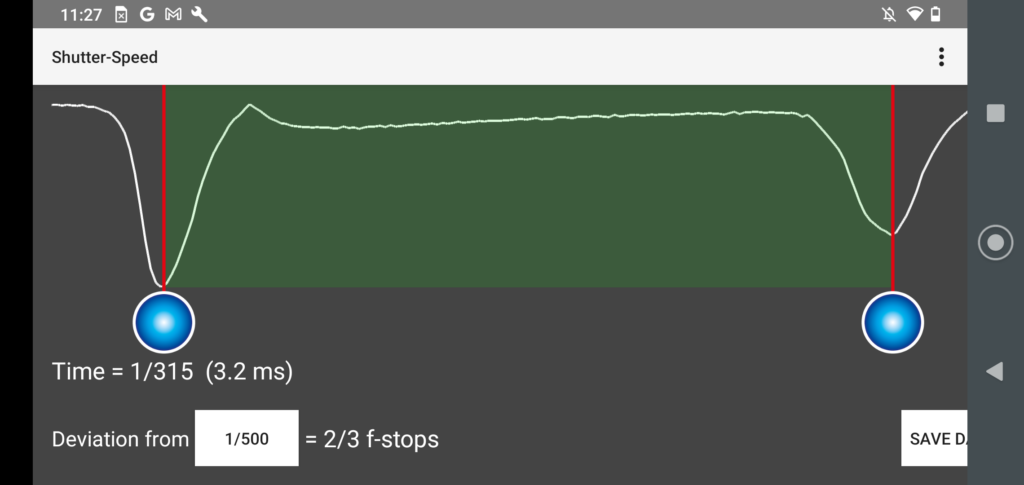
The Android app defaults to 1 sec, so you have to select the correct target shutter speed. Then do the obvious: save, select the camera, answer yes, and click the back arrow twice to test the next speed. Going back into the camera manager, you end up with a screen like this:
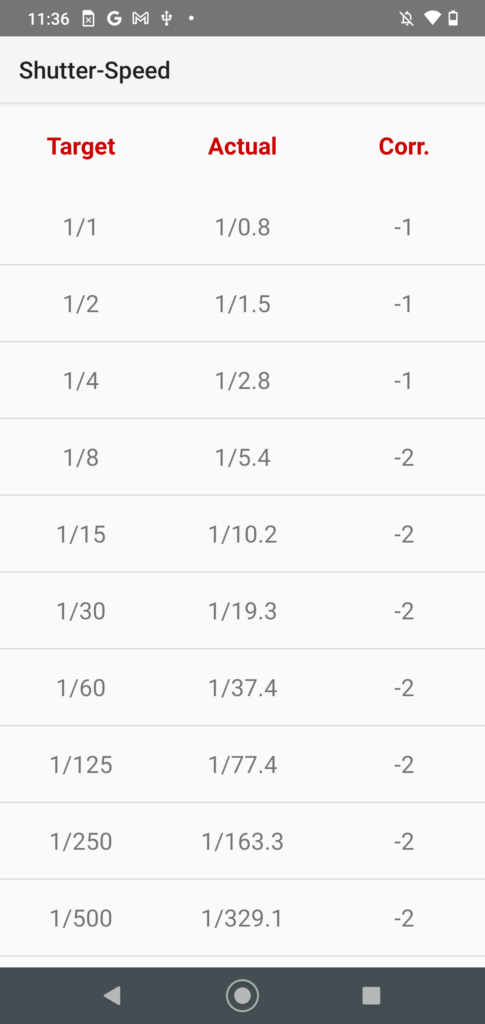
When I have done a batch of testing, I then do screenshots which I copy to a computer, run OCR and copy and paste into the spreadsheet that contains details. The corrections are errors, measured in ⅓ stops.
It seems to work nicely. There are times when it does not work, no doubt due to user error such as not holding the sensor square to the camera, or not near the middle of the opening, and occasionally I have to repeat because the app did not give me the full 3 seconds. What persuaded me it was working was testing two cameras I expected to be accurate and were. A Minolta 700si (the newest film camera I own) was perfect, and an Olympus OM4Ti had two speeds out by ⅓ stop (1/35 instead of 1/30, and 1/17.4 instead of 1/15) – nothing to worry about. Clearly, the Minolta XG-M shown in the pictures is not so good, but this is useful information because it suggests it should be perfectly usable if I bump up the ISO by half a stop. (Of course, B&W film has more latitude than that, so it is probably usable without this so long as I avoid colour transparency film.) It revealed that some cameras have shutters that are less reliable than my ear told me.
A limitation is that you cannot test cameras where the back cannot be opened like this to reveal the film chamber, or where the shutter cannot be fired with the back open and without film. That rules out testing a Voigtlander Vito B or similar, or an old Leica rangefinder. Another is that you cannot test faster than 1/500. Well you can, but I assume they know what they are doing when they give that limit – it is probably not accurate enough. And the iPhone app shows the name of the camera on the results screen, whereas the Android version doesn’t.
Was it worth buying? Given my usage, if I am realistic, probably not, though it is interesting to be able to check cameras before wasting film, so I don’t regret it. For example, a Lubitel turned in results of 1/13.2, 1/27.6, 1/53.7, 1/121.8 and 1/270.6 which isn’t bad for such a simple and inexpensive camera. It also told me not to waste film in testing another TLR (I’ll keep silent about the brand, though I guess it has just had a hard life and needs a service), so I may have saved a bit of the cost there.
Share this post:



Comments
Phil Harrison on Filmomat PhotoPlug
Comment posted: 29/08/2026
Comment posted: 29/08/2026
Bob Janes on Filmomat PhotoPlug
Comment posted: 29/08/2026
I'd be curious to know if it made any difference whether you had a lens on the camera or not. I'd also be interested to know if there was a difference depending on how far behind the shutter the sensor was (2mm, 5mm, 10mm, 15mm...). I suspect that no lens and a laser light source (as in a laser pointer) might give the most accurate results, but of course you would need to be sure of your aim onto the sensor, and touching the phone attached to the sensor might muck that up.
I must confess I'm a bit sceptical about getting hung up about accuracy of shutter speeds, as the key thing (from my perspective), is well and consistantly exposed negatives (what use is a shutter that is accurate in the middle, but caps at the end?)
Comment posted: 29/08/2026
Comment posted: 29/08/2026
Gary Smith on Filmomat PhotoPlug
Comment posted: 29/08/2026
I trust the decibel meter on my phone to get me in the ballpark. I trust the light meter on my phone for a second opinion.
Anyway, thanks for the write-up Roger!
Comment posted: 29/08/2026
Max Tiraquon on Filmomat PhotoPlug
Comment posted: 29/08/2026
Comment posted: 29/08/2026
Chris Giles on Filmomat PhotoPlug
Comment posted: 29/08/2026
Comment posted: 29/08/2026
Comment posted: 29/08/2026
Comment posted: 29/08/2026
Tony Warren on Filmomat PhotoPlug
Comment posted: 29/08/2026
Comment posted: 29/08/2026
Comment posted: 29/08/2026