

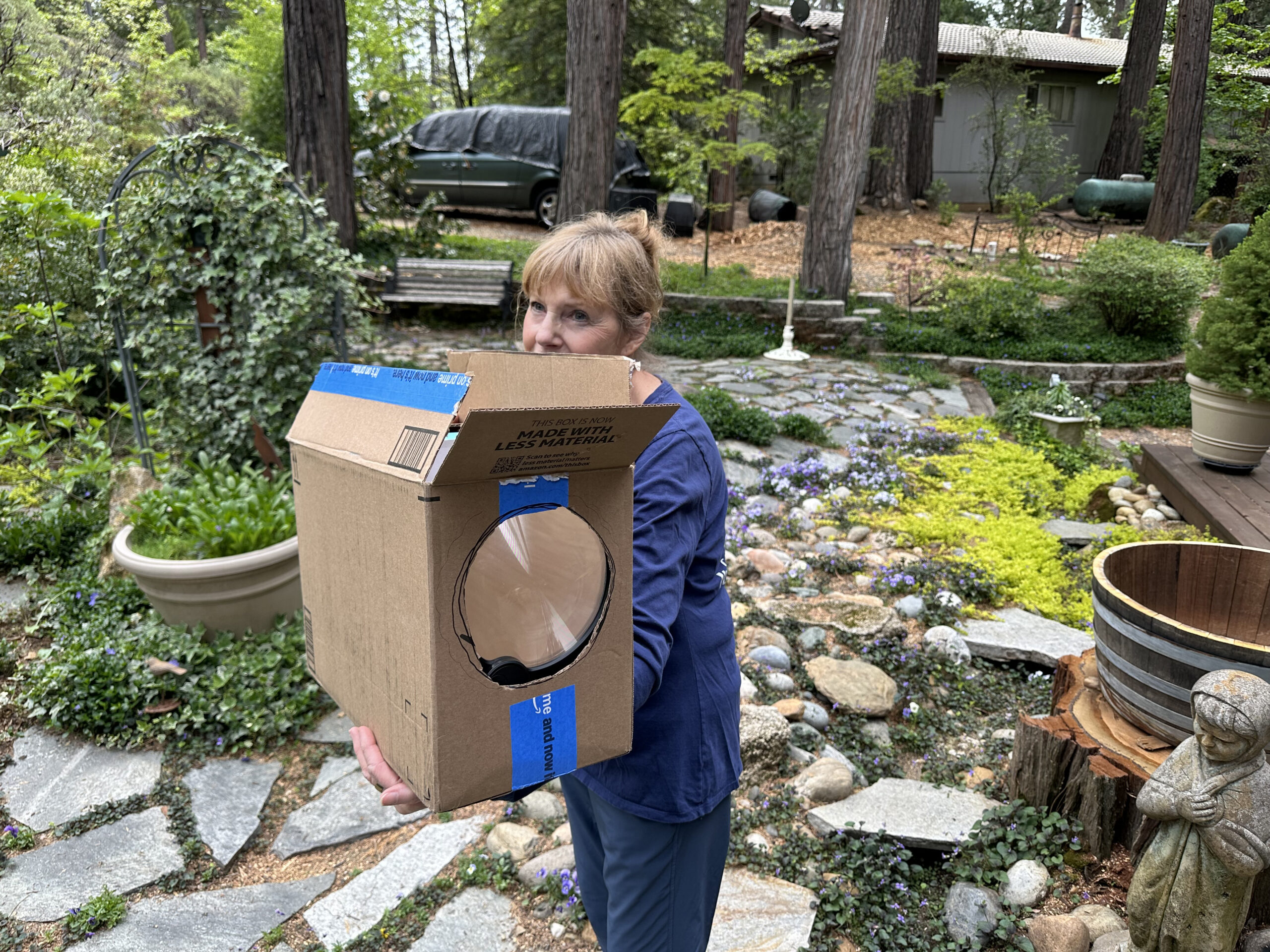
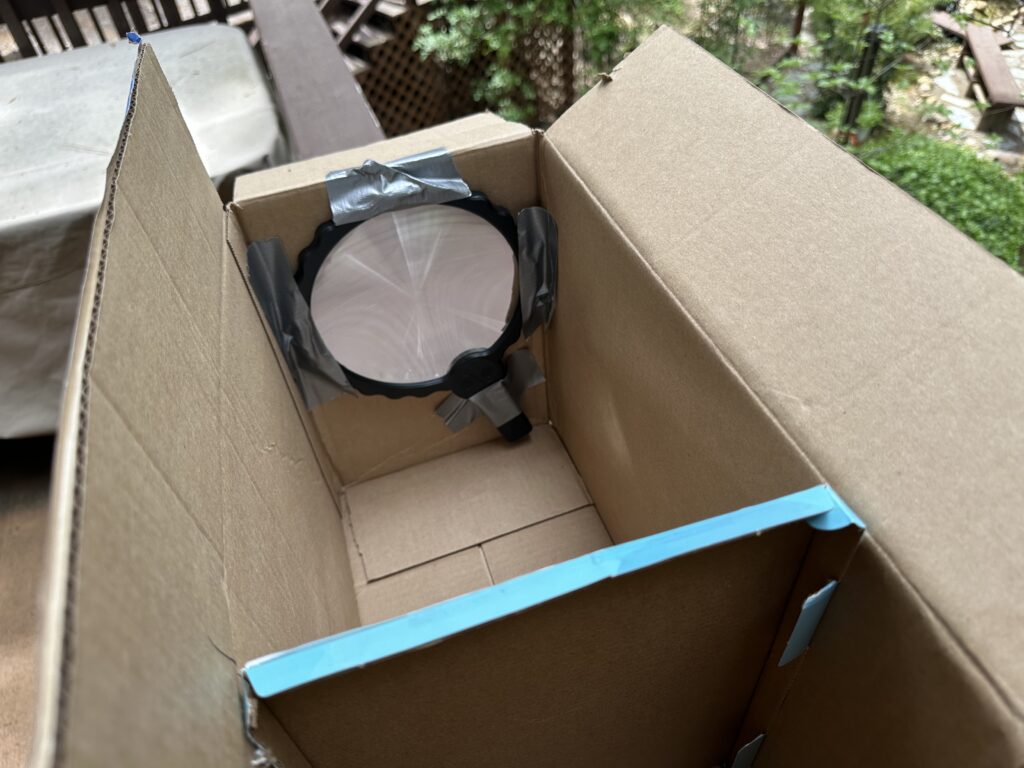
I signed up to teach a photography event to 8-year-olds at a summer activity event. It was scheduled to take place on my college campus in late June, 2025. The ‘class’ was comprised of two 1-hour sessions. My first thought – we could get sheets of blueprint paper and make prints using a crude cardboard box camera with a magnifying glass for a lens. Then we’d process the paper with ammonia fumes in a darkened room. I called around and with a stroke of luck, found an architect’s office with 500 sheets of unused 24×30 inch diazo blueprint paper. I made an 8×10 camera in ten minutes. It’s a cardboard box with a piece of stiff cardboard jammed inside to hold the light sensitive material. The ‘film plane’ can be slid in the box to achieve focus. The lens is a rather large Fresnel magnifier costing $10. Where a pinhole is usually about f/200, a big magnifying lens is like f/1. Bright image, but very narrow depth of field.
I did some tests and was disappointed to find that household ammonia cleanser was not strong enough to develop any images made in bright sunlight, even though the exposures were for 5 minutes. Maybe the paper is out of date? Maybe I need pure liquid ammonia? Using pure ammonia in a closed room with kids sounds punishing, and probably dangerous. Then I bought ‘Sun Paper’, which is a more sensitive diazo paper with a layer of dry developer activated by water. This paper works great in bright sunlight at 8000 foot candles, but it took a one-hour exposure in my box camera. I decided diazo paper was not going to work in a camera, so we just did the activity by making photograms in direct sunlight.

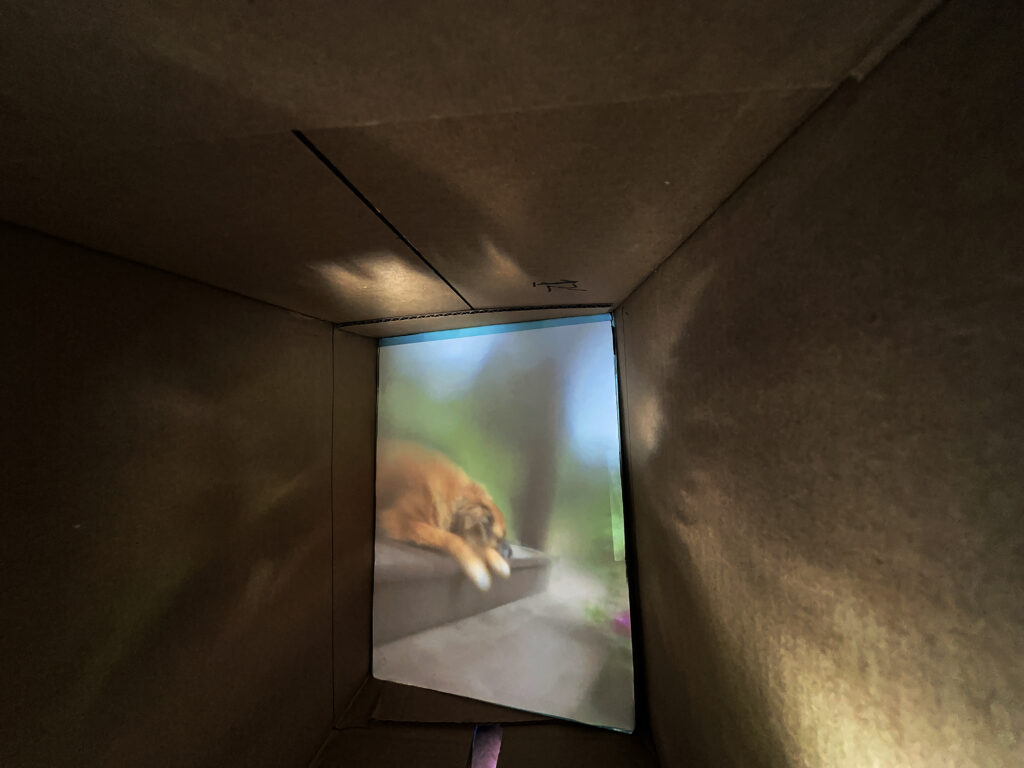
The ‘true photography’ activity for young kids didn’t work out as originally planned, but before throwing the box camera away, I decided to play with it. I tried exposing RC enlarging paper with it, and did make one image that I contact printed. Interesting. But the projected image in the box was more compelling, so I set up a cell phone in the box to capture it. The cell phone was set on a 10-second delay to allow me to close the box.
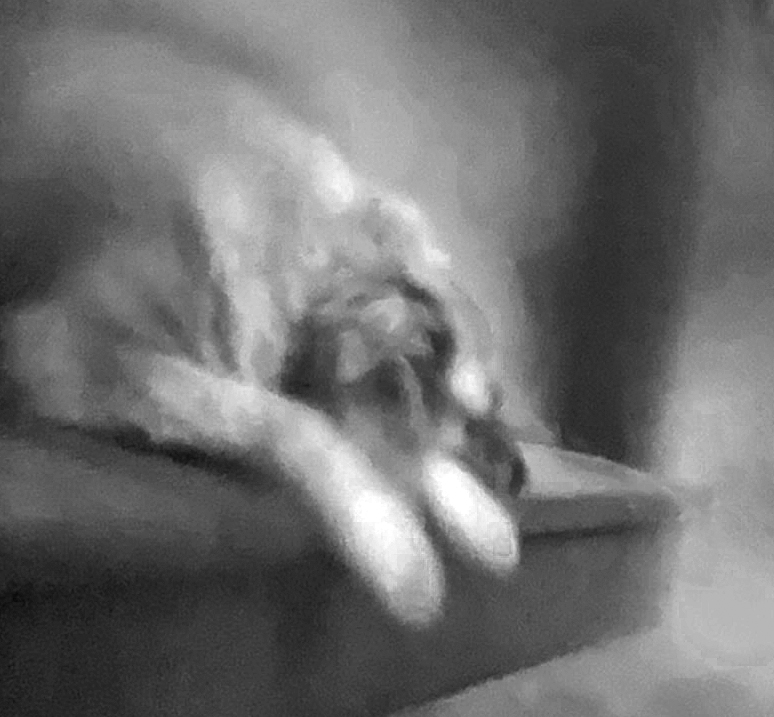
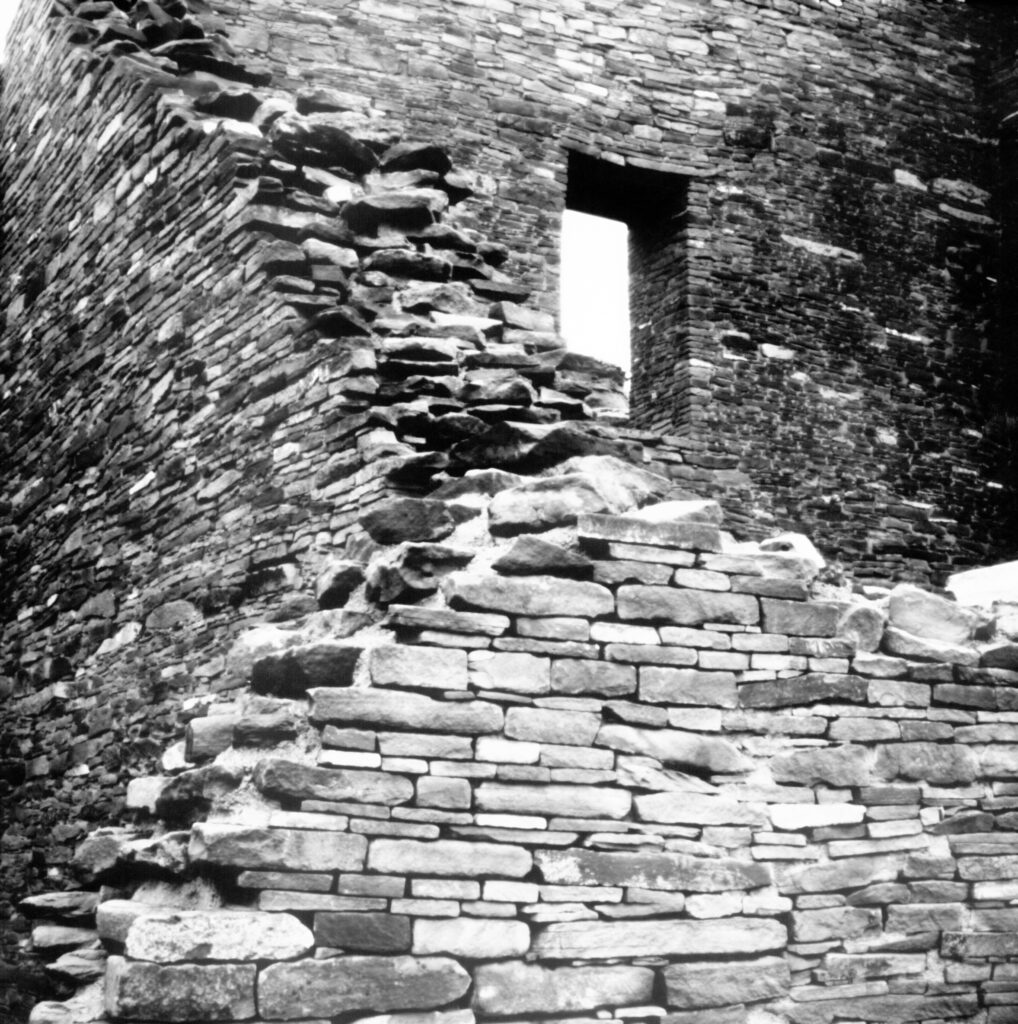
Here’s a photo made by exposing enlarging paper in the box, processing it, and using it as a paper negative for a contact print. This was one of last photos I took of Sherlock. She passed away at age 12 in early July, 2025. She was, by all accounts, the world’s best dog.
Share this post:

Comments
Greg Hammond on 8×10 camera for $10 in ten minutes
Comment posted: 21/11/2025
Comment posted: 21/11/2025
Gary Smith on 8×10 camera for $10 in ten minutes
Comment posted: 21/11/2025
Very cool Jeffery!
Comment posted: 21/11/2025
Charles Young on 8×10 camera for $10 in ten minutes
Comment posted: 21/11/2025
https://cyanotypes.org/how-to-make-cyanotypes/
HOW TO MAKE CYANOTYPES
by Lisa Shea
I adore making cyanotypes. Their blue color is stunningly beautiful. Did you know this original form of photography from the 1800s is the basis of blueprints?
Here is how to make cyanotypes of your very own!
First, you need the starting chemicals. These are potassium ferricyanide and ferric ammonium citrate. You can buy them from Amazon or many other art stores*. Just look for ‘cyanotype chemicals’ to find them. In most cases they are sold as overpriced solutions, but the better value is in dry, bulk form. You then add water to get them into liquid form. RECIPE: Mix 10g of the potassium ferricyanide with 100ml of water. Put it into a dark container. SEPARATELY mix 25g of the ferric ammonium citrate with 100ml of water. Put it into its own separate dark container.
( 1 part by weight potassium ferricyanide to 2.5 parts by weight ferric ammonium citrate. It may be smart to find the “teaspoon/volume equivalents to not have to get the scales off the shelf every time to make new liquid chemicals.)
___________________________________________
I (CTY) scale this quantity down to two containers of about 50 ml of water. This makes enough fluid for at least a dozen 8 x 10 inch prints. While I have the scales ofF the shelf I weigh and store enough dry chemicals for several more batches. I use either watercolor or card stock paper. The sensitized paper does not store well. It tends to darken with age. So, just make as much paper as you expect to use soon.
I darken the new cyanotype (while it is in the tray) with a small amount of hydrogen peroxide. About $1 at WalMart for about 16 oz.
__________________________________________
* URLs for cyanotype chemicals
Jacquard Potassium Ferricyanide
4oz $10.26 https://www.officesupply.com
Also Amazon:
Ferric Ammonium Citrate (Green),for Cyanotype(250g/8.8oz)
Visit the EASTCHEM Store
$39.99
1 part by weight needed
Amazon:
Jacquard Ferric Ammonium Citrate 8oz
2.5 parts by weight needed.$18
Comment posted: 21/11/2025
Bob Janes on 8×10 camera for $10 in ten minutes
Comment posted: 22/11/2025
Comment posted: 22/11/2025
Geoff Chaplin on 8×10 camera for $10 in ten minutes
Comment posted: 22/11/2025
A friend of mine takes cyanotype negs in a lens camera - several hours exposure but decent images. Your experiennce reminds me of some of my diy photography exploits. Fun. I hope the kids all enjoyed it and learned something.
Comment posted: 22/11/2025
Joe Van Cleave on 8×10 camera for $10 in ten minutes
Comment posted: 24/11/2025
Comment posted: 24/11/2025
Michael Jardine on 8×10 camera for $10 in ten minutes
Comment posted: 24/11/2025
I also really love the idea of using a cheap fresnel magnifier to wreak open-aperture chaos in opposition to the scalpel sharpness of a pinhole.
Comment posted: 24/11/2025
Charles Young on 8×10 camera for $10 in ten minutes
Comment posted: 14/01/2026
I suggest that you look up "camera obscura". Put a clear plastic window on the box camera, put "onion skin" paper on that and trace the image. Also I found that I could make an image with an overhead projector ... same idea.
I think cyanotypes with found objects is a perfect opportunity for kids.
Chuck