

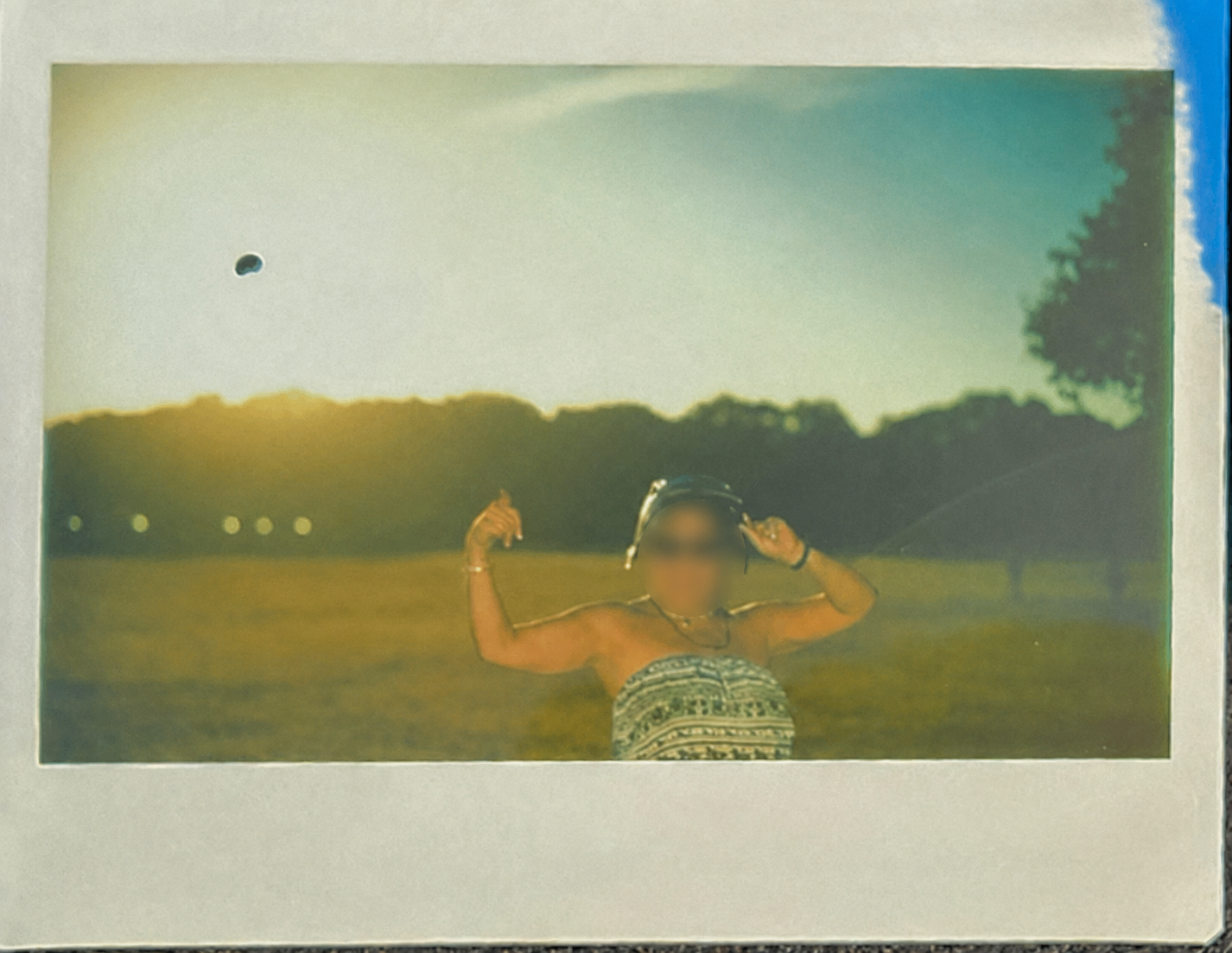
Above: A portrait beneath the black-eyed sun of the 2026 eclipse, made on Instax Wide film with a modified Polaroid 180 Land Camera. The original was given to the sitter; this is a smartphone record.
She told me she would keep the photograph into her eighties so she could remember the day. The woman who said this was a little close to tears. Only a few minutes earlier, she had been standing in the eclipsing light at Albury Heath in Surrey, both arms raised, smiling as if dancing beneath the eclipse. She looked joyful, energetic and exuberant. Her daughter, who loved astronomy, could not be there. She had told me how much she wished they were sharing the event and how excited she was to take the photograph home to show her.
I had photographed the Instax print with my smartphone before handing it over. My phone now holds the record; she holds the photograph. That distinction became the root of the most important thing I relearned that evening.
A plan in two parts
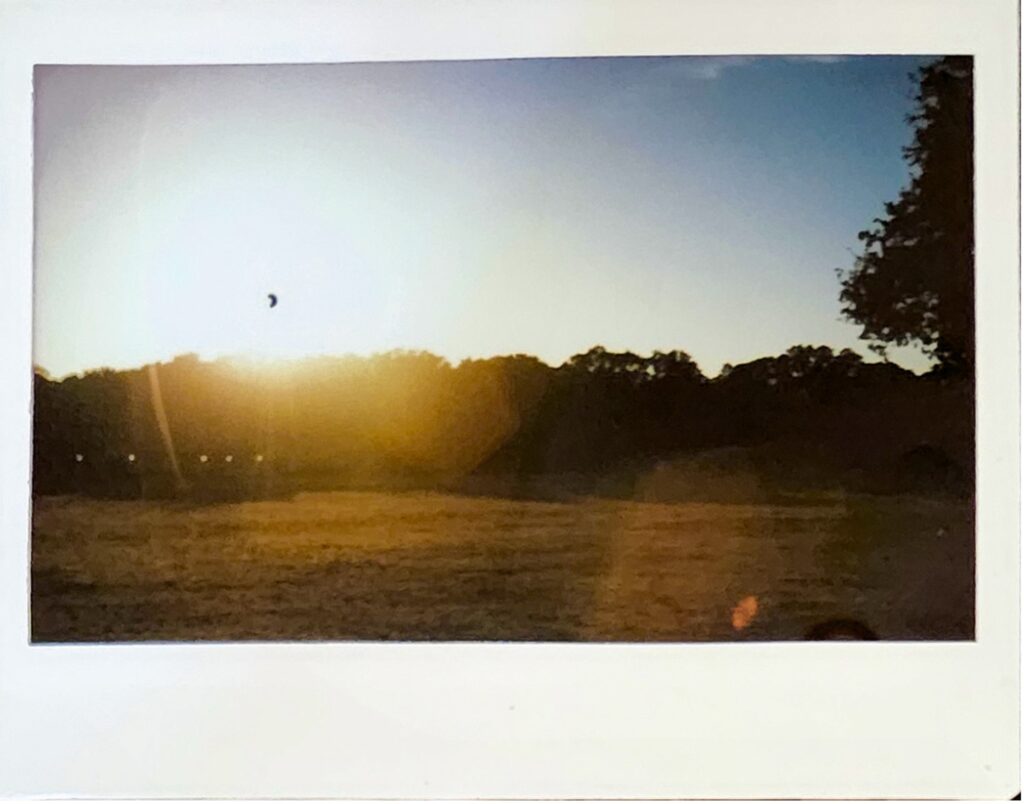
I went to Albury Heath for the partial solar eclipse on 12 August 2026 with two deliberate photographic aims. The first was precise, almost scientific: I wanted a tightly framed record of the changing crescent, made with a digital Hasselblad 907X/CFV 100C and a vintage Canon FD 500mm Reflex f/8 lens. The second was more experimental. I wanted to place the eclipse within the landscape and use extreme overexposure to reverse the brightest area of the Instax image in tone. Instead of a white sun, I hoped to make a black one.
For the instant photographs, I used a Polaroid 180 Land Camera converted by Analogue Studio to accept a removable Lomography Lomograflok back and Instax Wide colour film. The conversion allows the classic camera, its Tominon 114mm f/4.5 lens and its manual controls to continue working with a modern instant-film back. I metered with the Film Photography Viewfinder app and worked at small apertures and relatively slow shutter speeds, from about 1/8 to 1/60 second, while experimenting with exposure.
The Hasselblad photographs were made at ISO 64 through the fixed-aperture Canon mirror lens, with stacked ND8 and ND2 filters. The files record shutter speeds between 1/6000 and 1/10000 second. On the Polaroid, I used an old Polaroid UV filter and a four-stop ND filter. Between exposures, I covered both cameras rather than leaving them aimed at the sun. I should stress that these were not proper solar-viewing filters; I return to that in the safety note below.
The black-eyed sun
The Instax experiment worked. Extreme overexposure caused the sun to reverse colour, producing a dark crescent against the pale sky: an eclipse rendered not as a brilliant astronomical object isolated against blackness but as a strange presence within an ordinary Surrey landscape. The tree line, sun bleached grass and low evening light remain recognisable. Above them floated what looked like a black eye.
That was the picture I had imagined. Yet almost as soon as I set up the old folding Polaroid, another subject appeared: the people around me.
A camera people notice
People came over to ask about the camera and what I was doing. That happens far less often with a modern digital camera. A modified Polaroid 180 is visibly mechanical and slightly improbable. It invites questions before the shutter is released. The Lomograflok back makes the camera stranger still: familiar enough to be recognised as a Polaroid, but altered enough to demand an explanation.
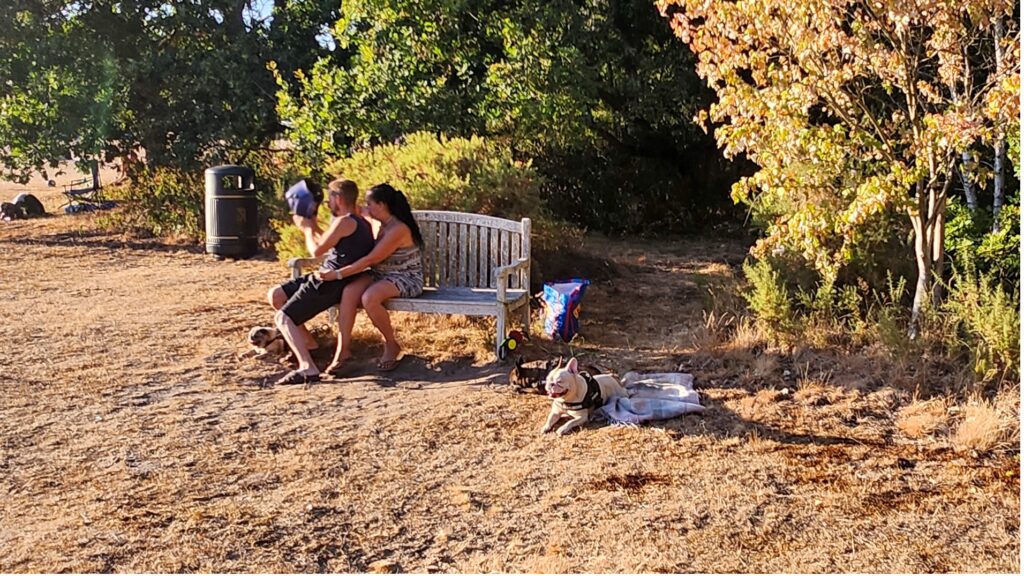
I first made photographs of myself and my friend. Then someone shared their eclipse glasses with us. To thank them, I offered to make a portrait. The exchange was beautifully simple: they had helped us see the eclipse safely, and I could give them something to remember it by.
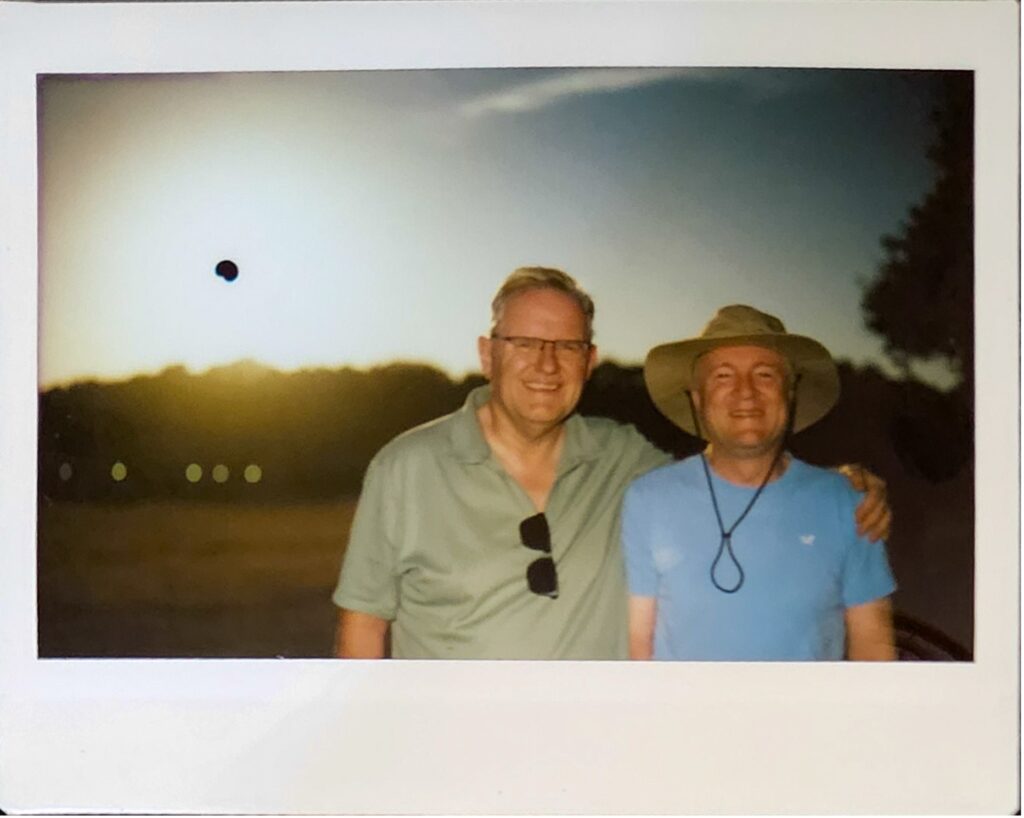
One portrait led to another. Over the course of the event, I made and gave away several instant photographs—to individuals, couples and families. The eclipse gathering had made the heath feel communal. The Polaroid gave us a reason to speak; the emerging Instax image gave us something to watch; and the finished print turned a brief conversation between strangers into an exchange.
A smartphone’s speed or convenience could not quite reproduce that. A phone can display or send an image instantly, but it does not create a singular physical object that passes from one person’s hands to another’s. The Instax did. It could cross the space between us and belong entirely to somebody else. Of course, being a “Polaroid”, it is also impossible to reproduce an identical copy because of the chemical processes involved. Thus it is a unique piece of art.
The portrait that changed the evening
The woman whose portrait opens this article had been at Albury Heath when we arrived. Before I photographed her, she had told me about her daughter and how much she wished she were there. The eclipse clearly mattered to her, and the pleasure of seeing it was sharpened by the absence of the person with whom she most wanted to share it.
Then she stepped into the frame and raised her hands. The portrait is not melancholy. Quite the opposite: she appears playful, celebratory and powerful. The blackened sun sits above her, while the softness and warm colour of the Instax keep the scene intimate. The photograph holds joy and absence at the same time.
When I gave her the original, she was close to tears. She said she would keep it into her eighties to remember the day and looked forward to showing it to her daughter. The photograph connected more than photographer and subject; it also reached towards somebody who had not been present. A piece of instant film became a message carried home.
Edwin Land and the human picture
As the evening unfolded, I found myself thinking about Edwin Land. In my previous 35mmc article, “Instant Fine Art,” I wrote about instant film as a serious creative medium: immediate yet analogue, tactile, unique, and capable of far more than the fuzzy party snapshot to which it is often reduced. At Albury Heath, those qualities became social rather than merely aesthetic.
Land’s work on colour was rooted in questions of human perception. His Retinex theory explored how perceived colour depends upon relationships across a visual scene, rather than simply upon the light reaching the eye from a single point. His philosophy of invention was similarly human-centred: begin with a “deep human need” and develop the science necessary to meet it. In a 1970 film, he imagined photography becoming “part of the human being, an adjunct to your memory.”
It is tempting to hear those words as a prediction of the smartphone, and in one sense they were. We now carry cameras everywhere and make photographs continuously. Yet the response to the Instax prints suggested to me that Land’s deeper idea still has a particular force in instant film. The people I photographed did not value the prints because they were technologically immediate; their phones could record and display an image faster. They valued them because they were singular, tactile and freely given.
Giving away the originals
I almost never give away an original instant photograph, and I am reluctant to do so. Its uniqueness is part of what attracts me to the medium. Once the object has gone, it cannot be replaced. A scan or smartphone photograph can preserve its image, but not its physical presence, its texture or its history of being handled.
That evening, however, the reluctance fell away. There was a warmth at Albury Heath, a shared sense of wonder at the eclipse. Giving the photographs away felt less like losing them than allowing them to complete their purpose.
I had set out to invert the sun. Instead, the eclipse inverted my normal relationship with photographs. I arrived intending to make objects I would keep; I left most satisfied by the ones I no longer possessed.
Precision and presence
The two camera systems produced radically different accounts of the same event. The Hasselblad and 500mm mirror lens gave me the precise crescent I had planned: clean, enlarged and isolated against a black field. It records the eclipse as an astronomical event. The Instax photographs are softer, less controlled and, in several cases, visibly imperfect. Yet they contain the field, the lowering sun, my friend, the strangers and the exchanges between us. They show what it felt like to be there.
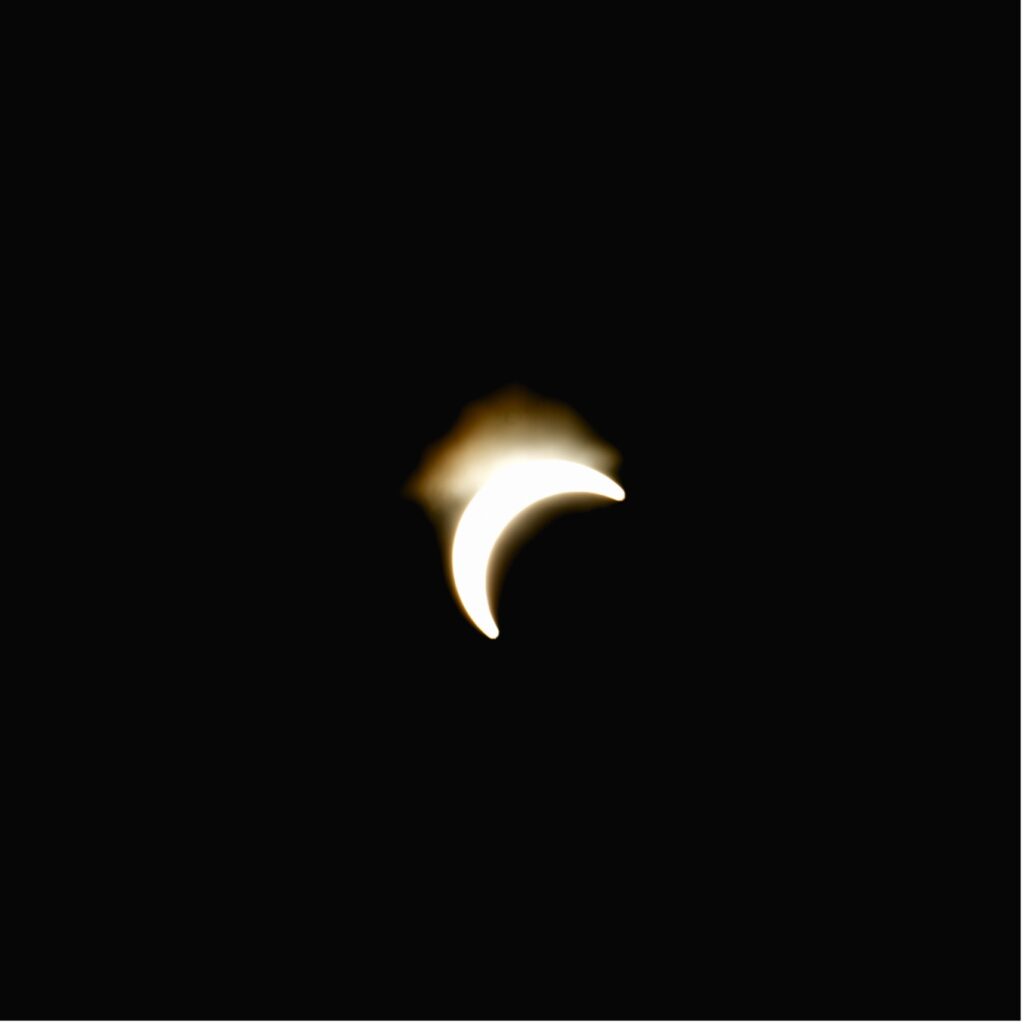
This is not an argument against digital photography. My smartphone copies allow me to write this article and show photographs whose originals are now in other homes. The Hasselblad image provides a record the instant camera could not. Each medium did something valuable. But of the tools I had with me, only the instant camera produced a unique object that I could hand over there and then, while the emotion of the eclipse was still present.
A necessary safety note
I must be candid about safety. I did not use appropriate solar-viewing protection when briefly composing through the Polaroid’s separate optical rangefinder/viewfinder. That was unsafe, and I would neither repeat nor recommend it.
Ordinary sunglasses and photographic ND filters are not safe substitutes for purpose-made solar filters. During the partial phase of an eclipse, an optical device used to look towards the sun must itself be properly filtered; a filter on the Polaroid’s taking lens does not protect an eye looking through its separate viewfinder.
The Hasselblad was composed using its electronic screen rather than an optical finder, but a suitable, securely front-mounted solar filter remains the responsible way to protect the camera when photographing the sun.
Happiness is other people
My earlier article was a love letter to instant photography as an artistic medium. This experience added another chapter. At Albury Heath, instant photography created a kind of encounter that felt especially valuable in a world where so many photographic experiences now take place on screens.
The power isn’t just that the picture appears quickly. It is that people gather to watch it appear. They ask questions. They share stories. The photographer can give away not a file or a link, but the photograph itself. For a few minutes, process, object and human interaction become inseparable.
Somewhere, the original portrait now belongs to a woman who intends to keep it into her eighties. Perhaps she has already shown it to the daughter she wished had been there. I retained only a smartphone copy and, unusually for me, I am content with that. The photograph completed its purpose when it left my hands.
I went to Albury Heath looking for a black-eyed sun. What I discovered was other people. And happiness, on that evening at least, was in other people.
Sources and links
Michael McGrath, “Instant Fine Art,” 35mmc.
American Chemical Society, “Edwin Land and Polaroid Photography.”
National Academies, “Edwin Herbert Land.”
Christopher Bonanos, Edwin Land’s 1970 film The Long Walk.
Analogue Studio, Polaroid Land x Lomograflok conversion.
Lomography Lomograflok Instax Wide Back
B&H Guide to safe solar photography
Share this post:


Comments
Erik Brammer on Giving Away the Eclipse – The human power of instant photography beneath a black-eyed sun
Comment posted: 16/09/2026