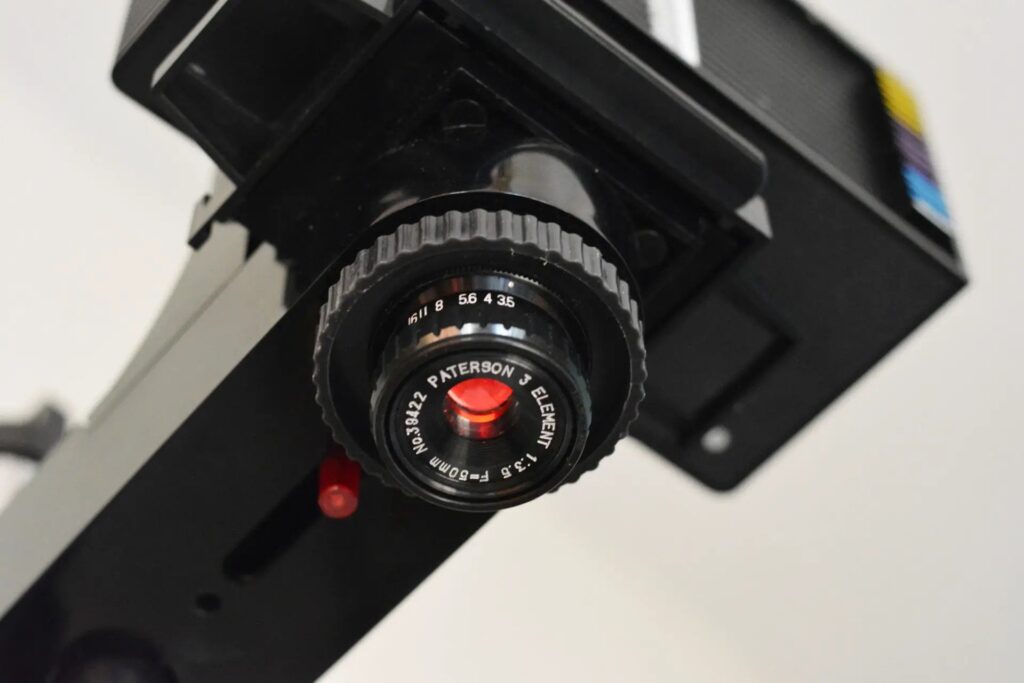
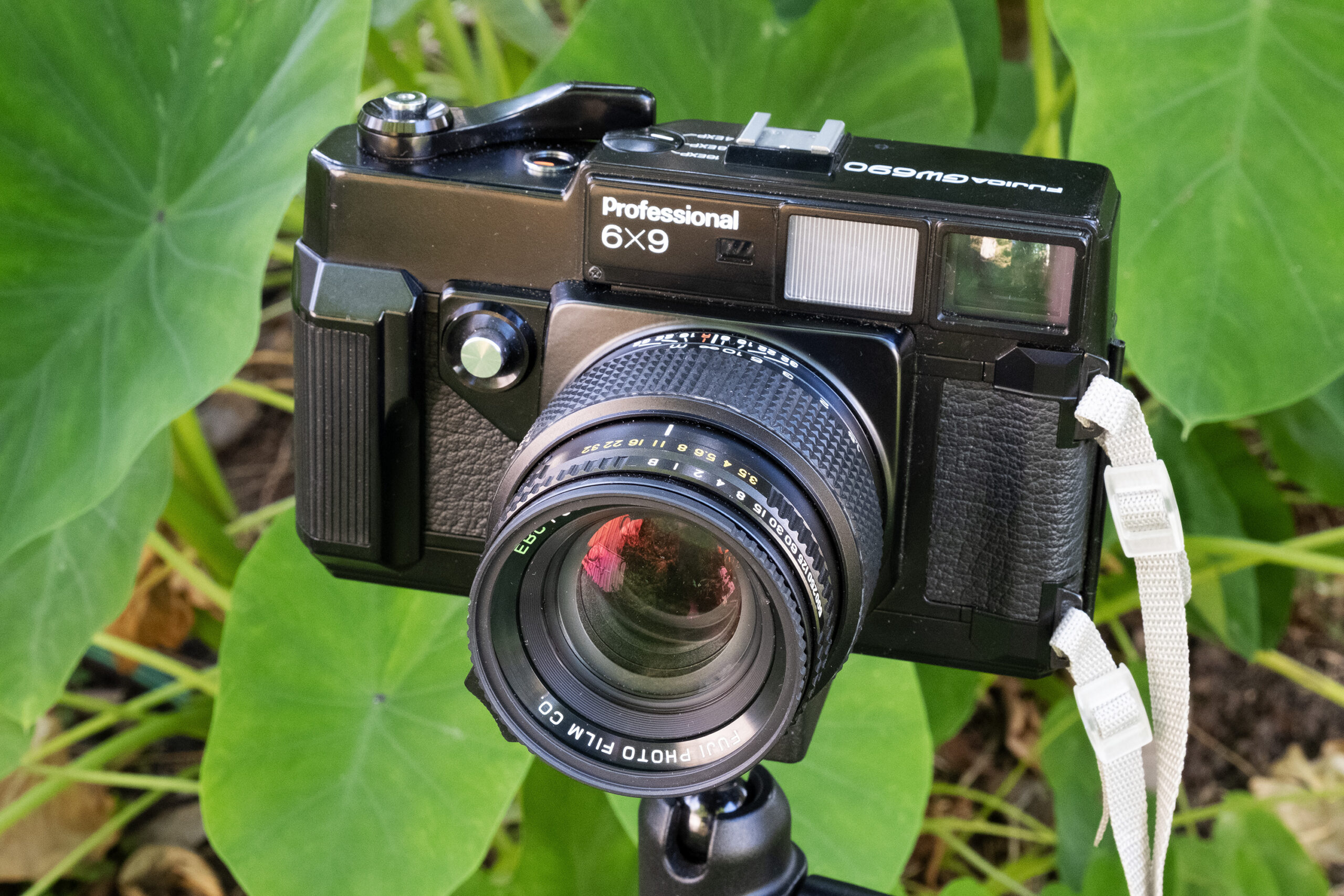
Fujica GW690 with B setting

Fujica GW690 with Bulb Setting – Mini Review

By Simon Foale

I spotted this camera online while looking for something else and, after double checking that it really was a Fujica GW690 with an actual B setting on the shutter speed ring, I snapped it up. It was in good nick and reasonably priced. I had already read about the quite unpopular T setting that most of these cameras have instead of B, and even though I already have the older Fujica GL690 system with interchangeable lenses (all of which have B settings on the shutter speed ring), I couldn’t resist this one. The GW690 cameras with their fixed 90mm F3.5 lens are significantly lighter and slightly smaller than the G690 and GL690 models with their standard 100mm lens attached. At least this is what I told myself by way of managing my GAS guilt. I was also quite curious to see for myself how the five-element multi-coated ‘EBC’ 90mm F3.5 lens on the GW690 cameras performs relative to the ‘single coated’ 100mm F3.5 four-element Tessar used with the older Fujica 690s.

I found a couple of mentions of the Fujica GW690 with a B setting online here and here, but there doesn’t appear to be much information available about them. Anyway I’ll spare you too much talk and let’s have a look at some images. The pictures here were made on Bindal, Wulgurukaba and Warrgamaygan country. I processed all film at home in a small tank and scanned negs and transparencies on a Nikon LS9000 ED scanner using Vuescan.
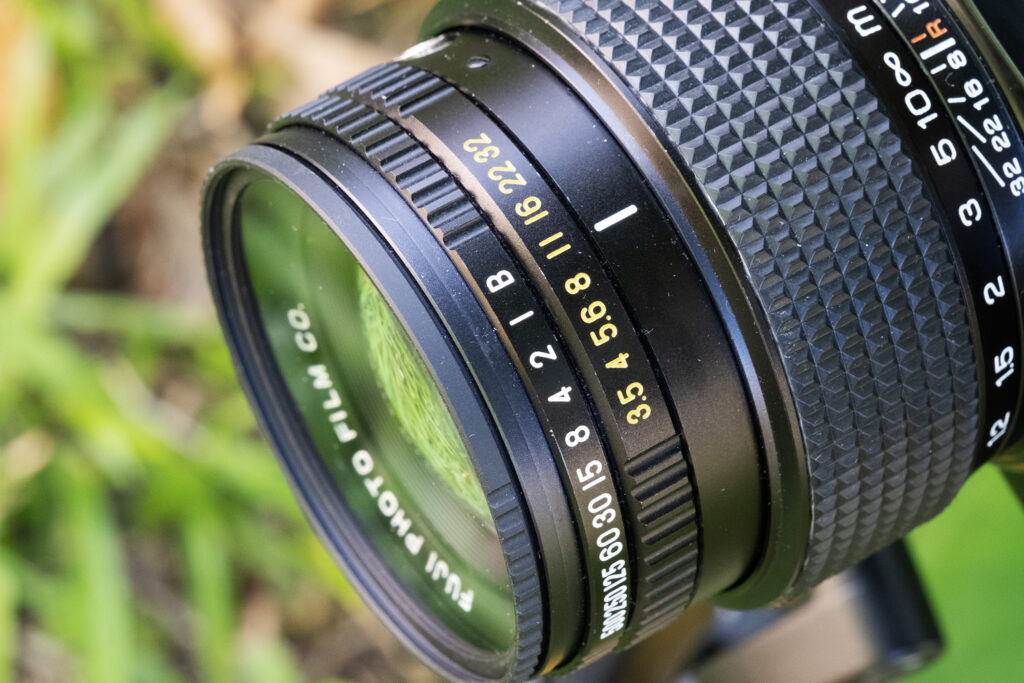
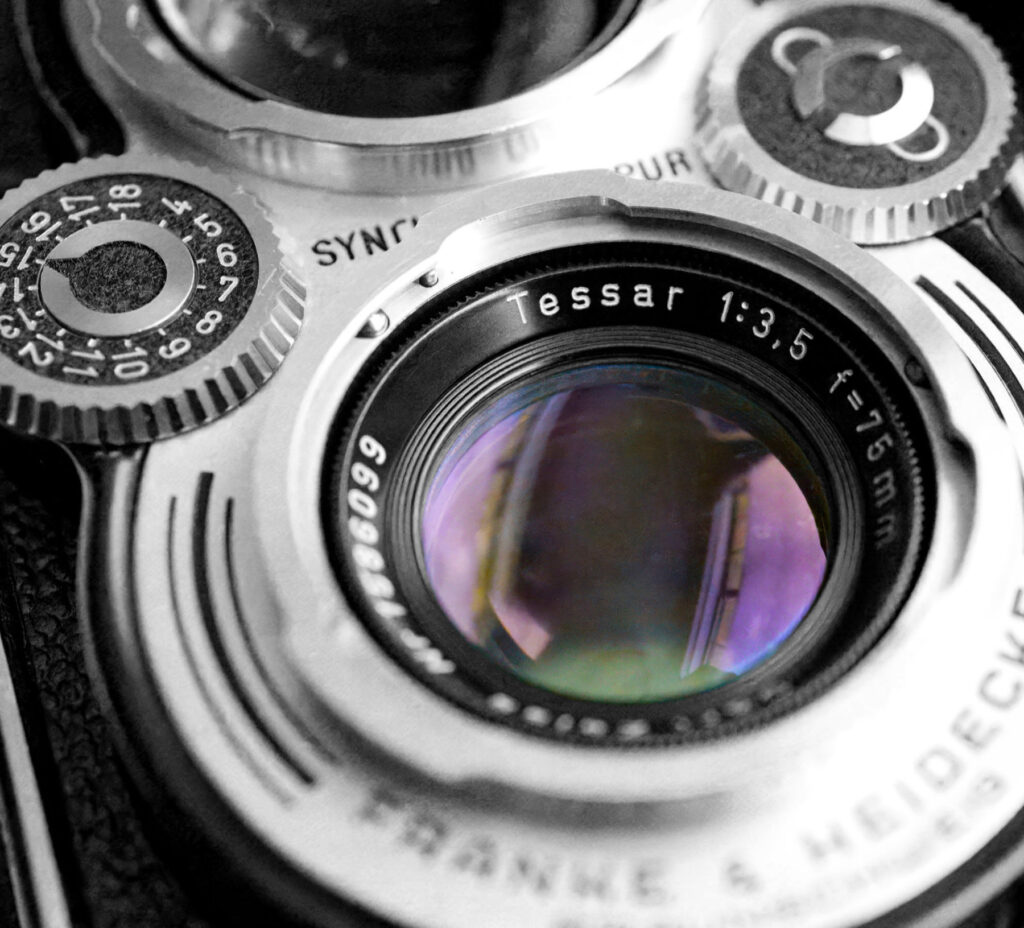
Close up of top of lens of GW690 with B
A close-up of the top of the lens, showing that there really is a ‘B’ on this one.

First, Black Weir on the Ross River, at the height of the wet season in early 2025. Fuji Acros II. This and the next frame are both two-second exposures using the B setting, at F16. Exposures between two and say, eight seconds are likely to be the trickiest to manage with the T setting on standard GW690s, because you can’t close the shutter again with the shutter release button (or cable release). So you have to find a way to end the exposure without causing the camera to move (replace lens cap, or put a black cloth or a hat over the lens) before making the shutter close by either winding on the film or moving the shutter speed dial to another setting.
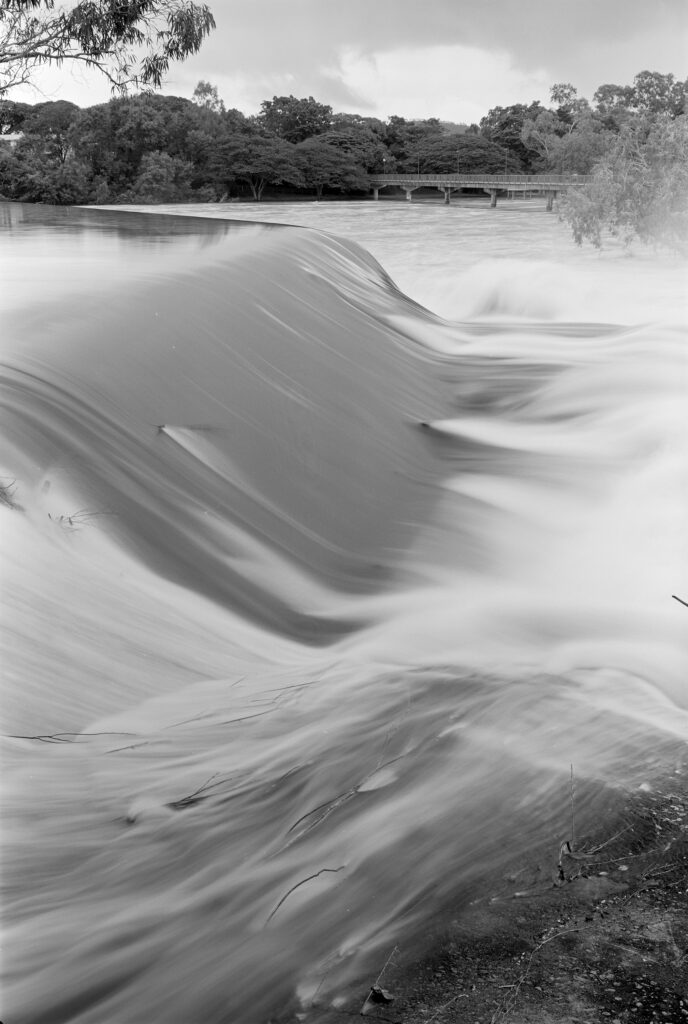
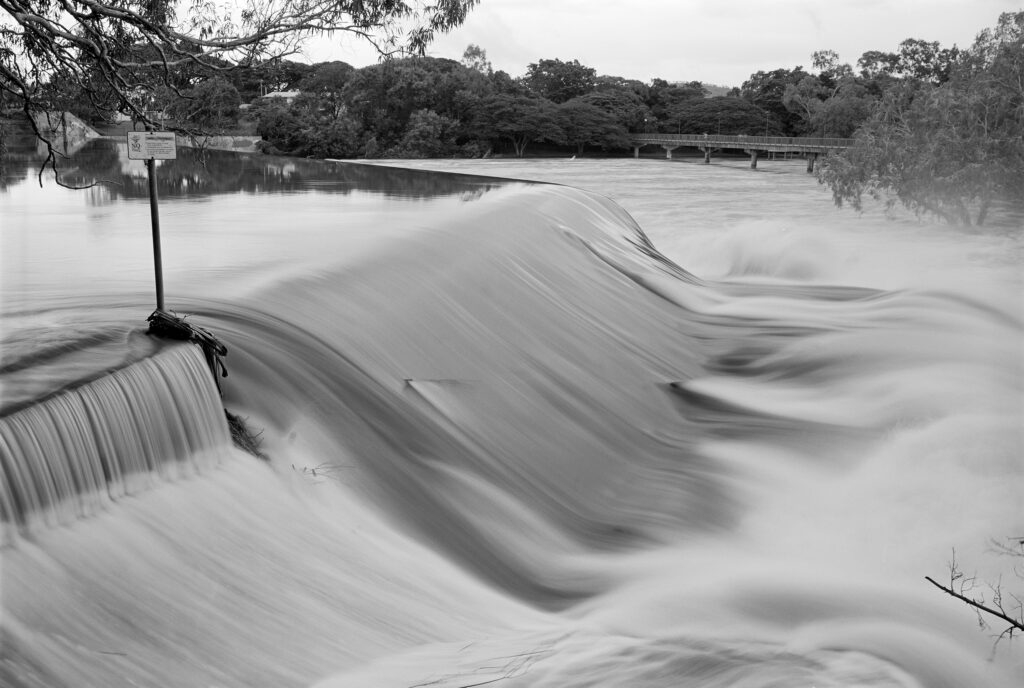
Black Weir in flood, vertical
Black Weir in flood, horizontal
Horizontal view of the Black Weir during heavy flow. Same film and settings as above.
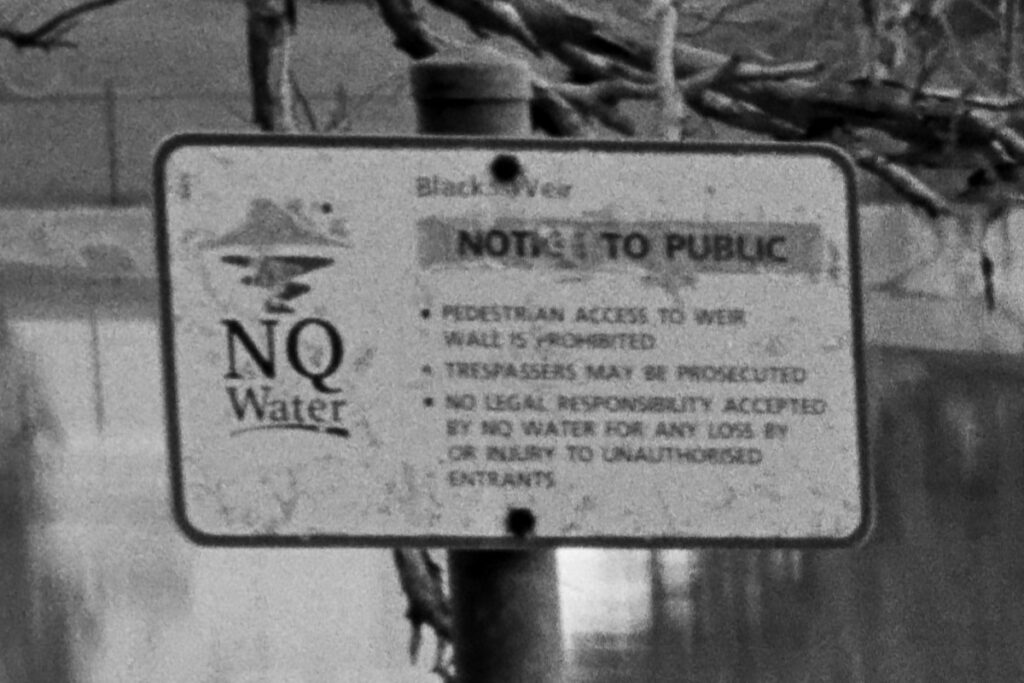
crop of sign at Black Weir
1500 x 1500 pixel crop of the sign at the top left of the frame in the above image, to give an idea of image quality.

Moving on to Aplin’s Weir, also on the Ross River, at a different time of year, quite late in the day. Fuji Acros II. This is a 60 second exposure. The veiling flare you can see at the top left of the image is from street lights on the foot bridge I was standing on to make the image. Should have attached a hood.
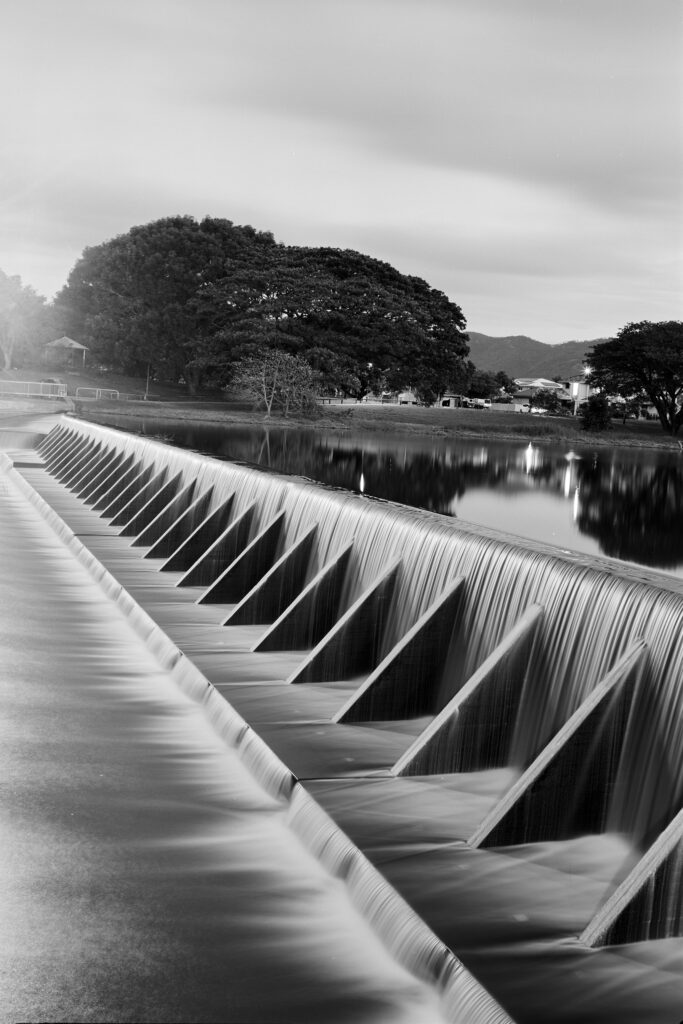
Aplin's Weir 1
Fuji Acros II, 60 second exposure

Aplin’s Weir, looking up-river, same time as previous image. Fuji Acros II, 60 second exposure. As with the previous image, the water flowing over the weir is lit by street lights on the foot bridge I was standing on.
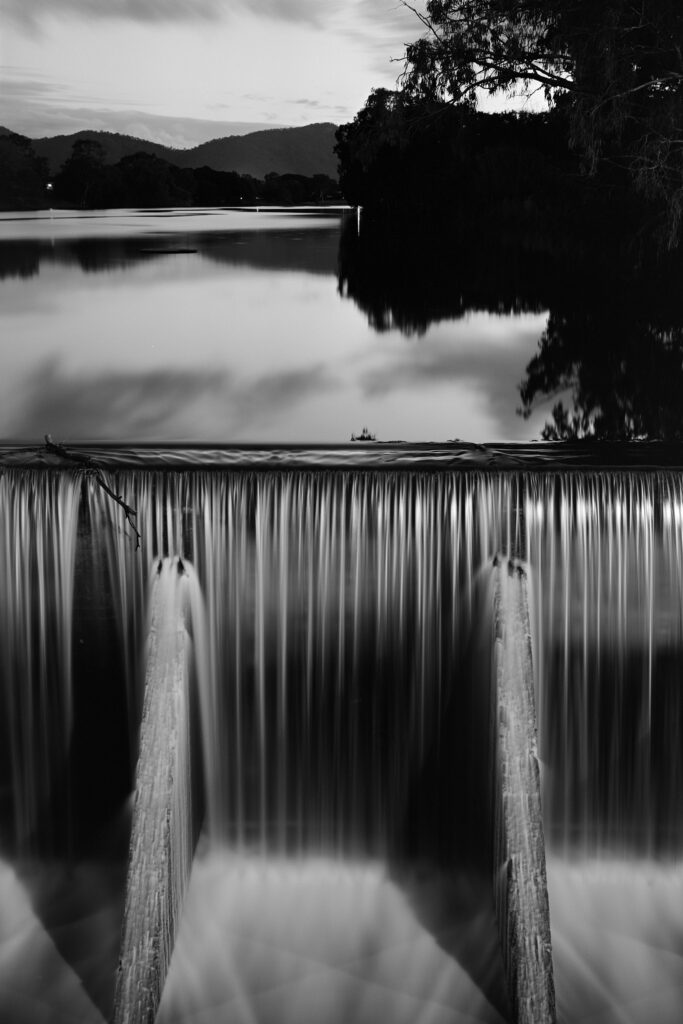
Aplin's Weir 2
Fuji Acros II, 60 second exposure

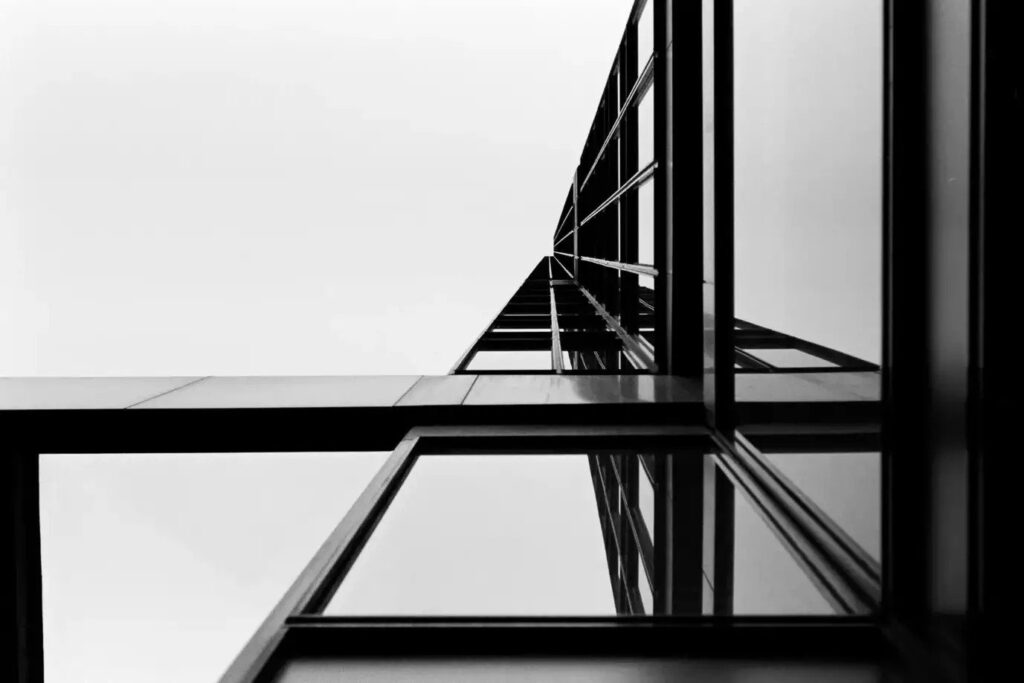
Next, the former Townsville General Hospital (now flats).  I was interested in the performance of this camera’s lens at the frame edge at wider apertures, compared to the 100mm Tessar that I use on my Fujica GL690. The edges of this frame are impressively sharp at F5.6 ½. I would say that the 90mm is perhaps very slightly better at the wider apertures than the Tessar but there is really not much in it.
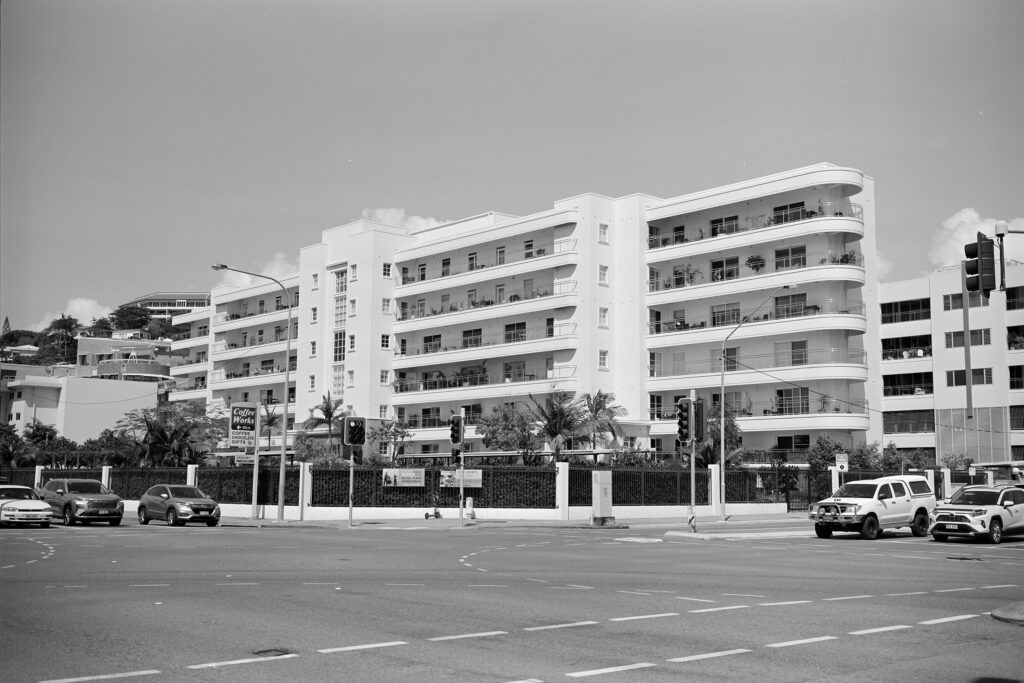
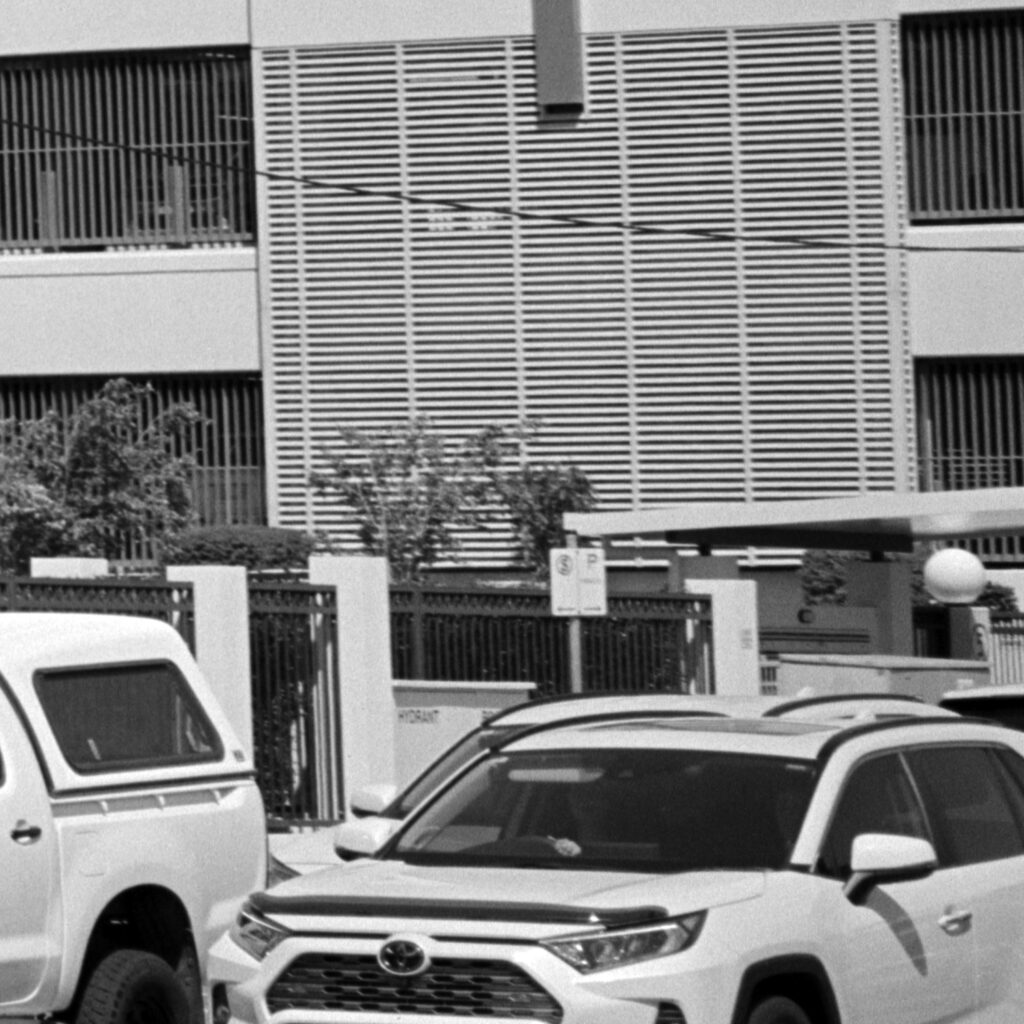
Old Townsville Hospital building
Agfa APX25. 1/125 at F5.6 ½.


Crop from hospital shot
1500 x 1500 crop from the above image.

Alocasia macrorrhizos (I think) at Townsville Palmetum.
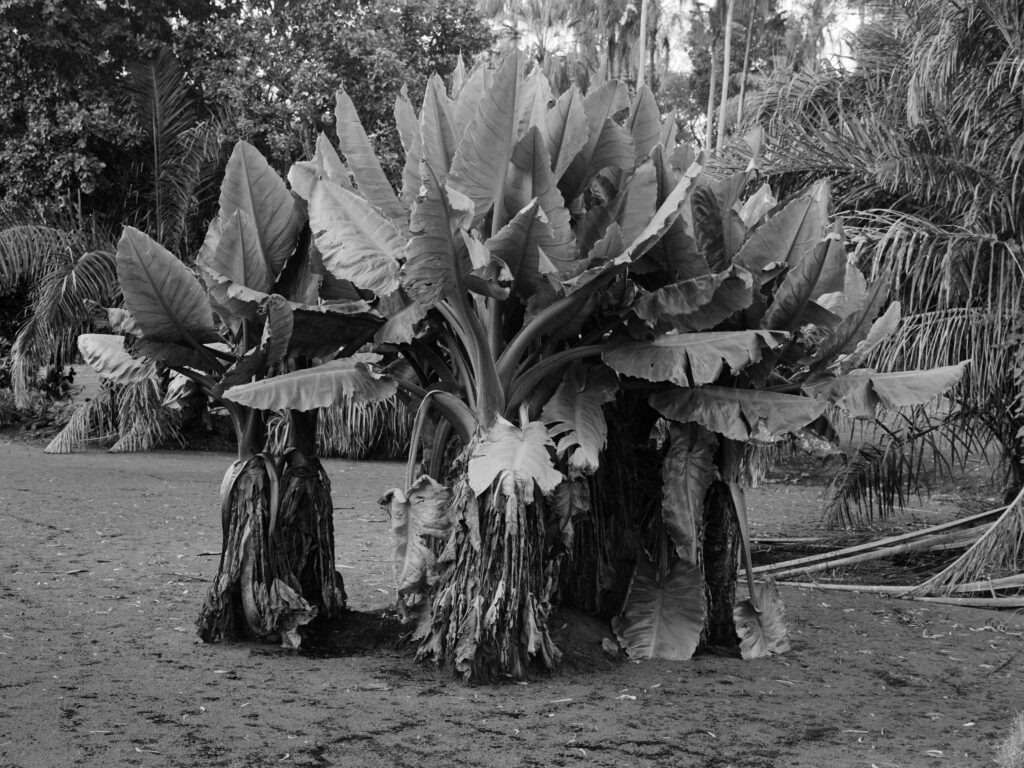
Alocasia macrorrhizos
Agfa APX25. F8, 1 sec.

Wallaman Falls. One unexpected upside with this particular subject is that the 90mm lens can fit some sky into the frame along with the whole length of the waterfall, which is not possible with the 100mm lens of the GL690 from the same viewing position (and there aren’t any easily accessible alternative spots that I’m aware of).
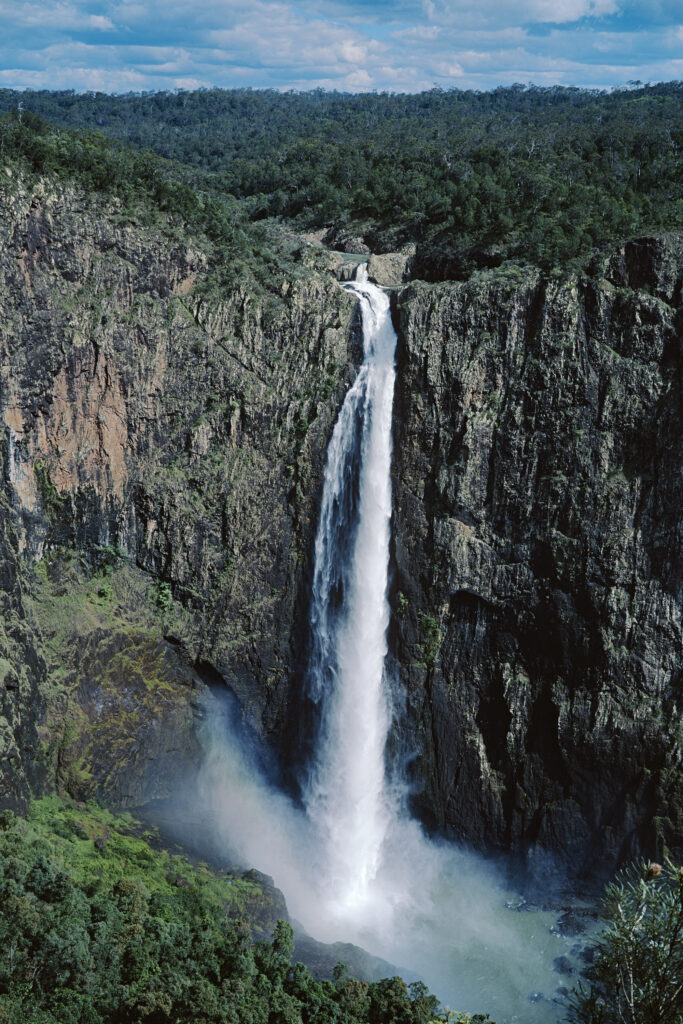
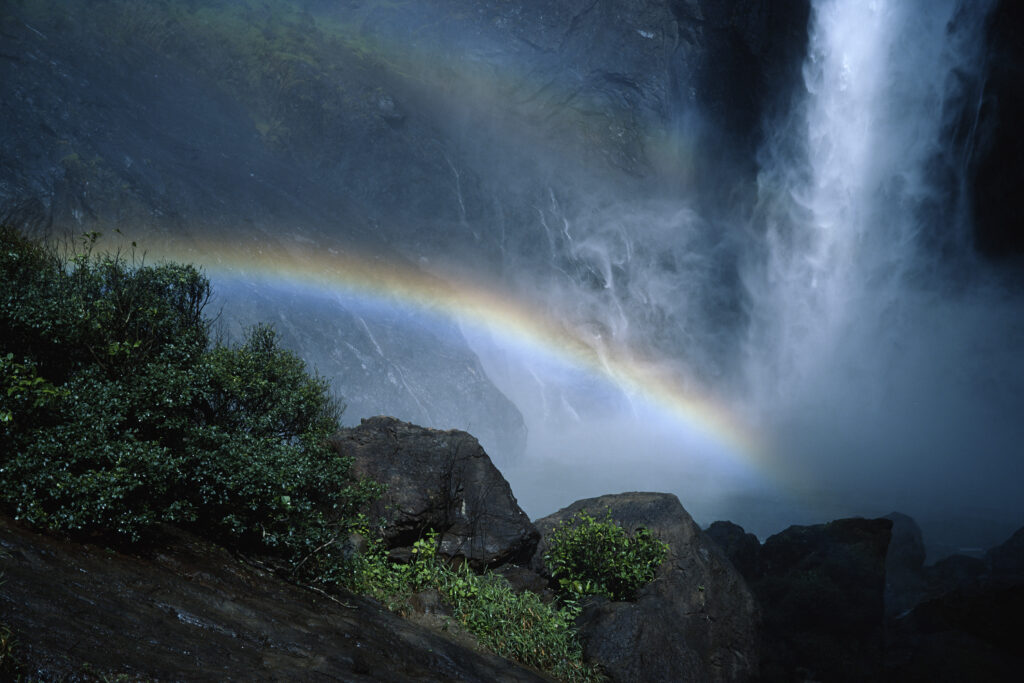
Wallaman Falls
Kodak E100 slide film. F11, 1/250. 
Wallaman Falls base
Wallaman Falls base. Kodak E100. F11, 1/250.

Castle Hill from Queens Gardens, Townsville.
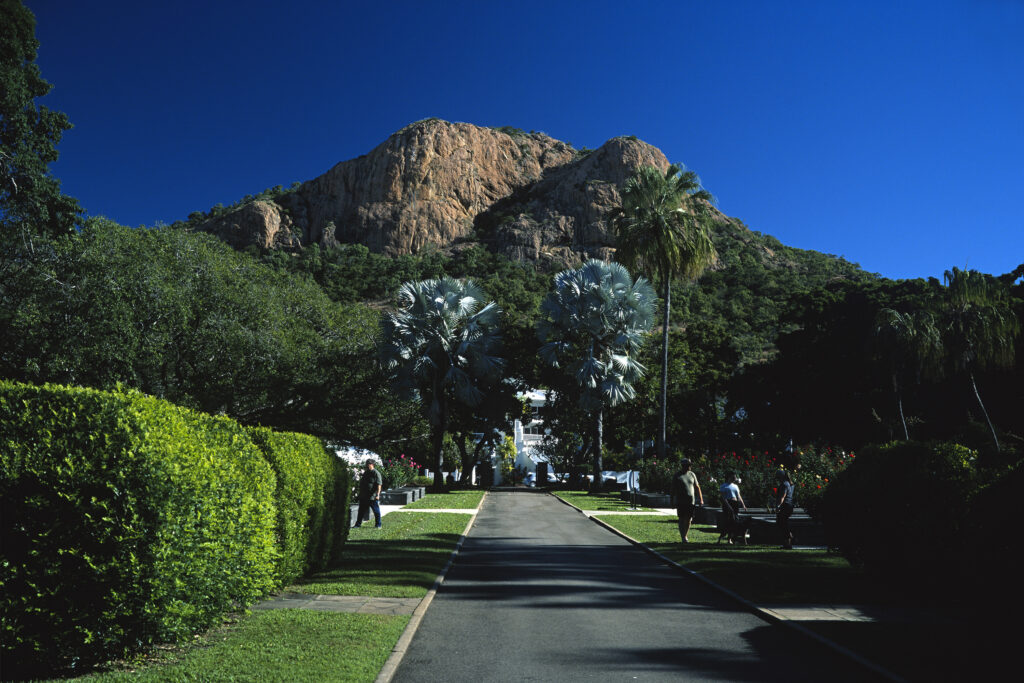
Castle Hill
Kodak E100. F11, 1/60. Polarising filter.

Sanchezia sp. foliage and park bench. I wanted to do a ‘bokeh’ shot, as I had read mixed reports about how this camera’s lens performs. This looks OK to me, but there aren’t any super bright highlights in the background.
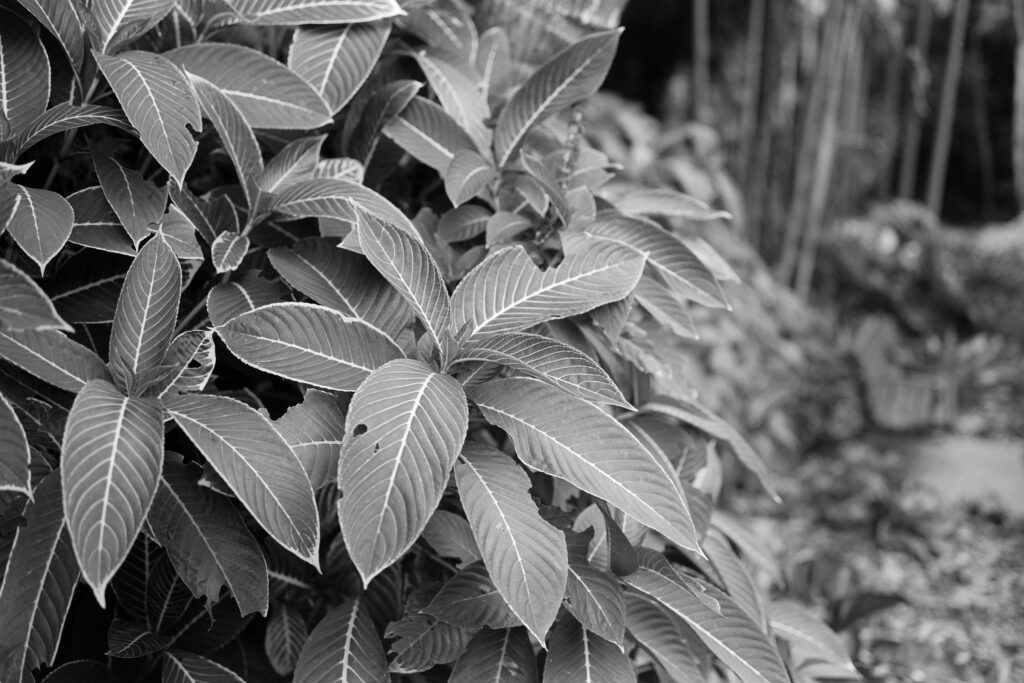
Sanchezia (GW690)
Kodak T-max 100. F4, 1/250.

The same scene but vertical orientation and made with the GL690 and 100mm Tessar lens. The film was Kodak E100 which I converted to black and white in post. Also shot at F4. Not sure I can see any big difference between this and the GW690 image.
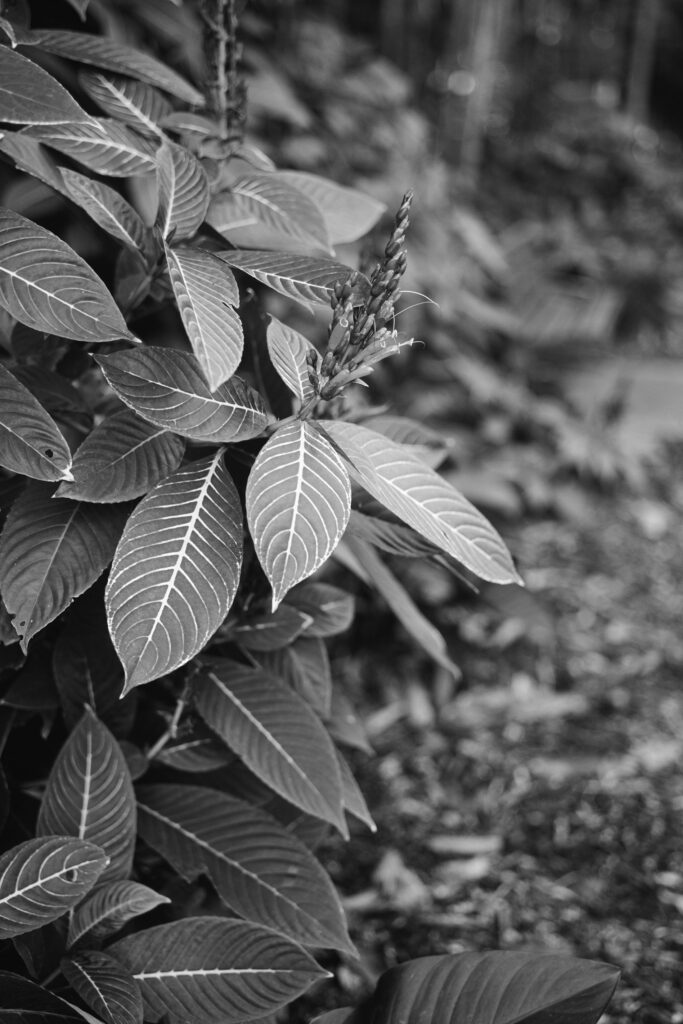
Sanchezia (GL690)

That’s my quick and dirty review of the Fujica GW690 with Bulb shutter capability. I like the camera and will continue to use it, along with my GL690 system, which, aside from its greater weight, is definitely no less impressive in terms of the image quality it delivers, and can of course use several different lenses. If anyone knows any historical details about why Fuji made some of the GW690s with a B setting, and how many might be out there, I would be interested to hear from you.

My Flickr site.

Share this post:

About The Author

By Simon Foale
Repairing and trying out my late grandfather's 1914 No.1 Autographic Kodak Junior initially led me down the film rabbit hole but now that I'm here I might stay for a bit. I am currently based in North Queensland, Australia. I used film for over 20 years before digital but these days I'm keen to indulge my curiosity about some film types I never tried back in the day, including some of the so-called 'document' films. I also like sharing stuff from my film archive.
Read More Articles From Simon Foale

Find more similar content on 35mmc

Use the tags below to search for more posts on related topics:

Donate to the upkeep, or contribute to 35mmc for an ad-free experience.

There are two ways to contribute to 35mmc and experience it without the adverts:

Paid Subscription – £3.99 per month and you’ll never see an advert again! (Free 3-day trial).

Subscribe here.

Content contributor – become a part of the world’s biggest film and alternative photography community blog. All our Contributors have an ad-free experience for life.

Sign up here.

Make a donation – If you would simply like to support Hamish Gill and 35mmc financially, you can also do so via ko-fi

Donate to 35mmc here.

Comments

Christian on Fujica GW690 with Bulb Setting – Mini Review

Comment posted: 20/05/2026

Interesting finds... I also have a "special" one. Mine is a GSW (read super wide angle) but has also the more narrow 90mm lens.
It seems, although being "fixed lens", maybe a technician could interchange the lenses, as my camera basically "was" a GSW with 65mm lens,
but now is a 90mm. I never used the T or B mode, I will have a look at mine when I come home... I think it also was only T-mode.
Great shots you did with your cam in B-mode!
Reply

Leave a Reply

Your email address will not be published. Required fields are marked *

Simon Foale replied:

Comment posted: 20/05/2026

Thanks for this Christian. That is definitely an interesting species of camera! All the old Fujis seem to have excellent glass so as long as you enjoy using it, that's the main thing!

Reply

Leave a Reply

Your email address will not be published. Required fields are marked *

Erik Brammer on Fujica GW690 with Bulb Setting – Mini Review

Comment posted: 20/05/2026

Hi Simon, thanks a lot for sharing your experiences with the camera and the great photographs to document it. Really really nice. I had almost gotten past my lust for this camera, and now this. :-) I must resist, I must resist...
Reply

Leave a Reply

Your email address will not be published. Required fields are marked *

Simon Foale replied:

Comment posted: 20/05/2026

Thanks Erik. Resistance is futile!

Reply

Leave a Reply

Your email address will not be published. Required fields are marked *

Bruce Parker on Fujica GW690 with Bulb Setting – Mini Review

Comment posted: 20/05/2026

Thanks for the well done article! Nice pictures.
I do want to point out (nit picker that I am) that a number of times you describe the B setting as residing on the aperture ring. I bring this up so that those less experienced and/or unfamiliar with the camera don't become confused. Thanks.
Reply

Leave a Reply

Your email address will not be published. Required fields are marked *

Simon Foale replied:

Comment posted: 20/05/2026

Thank you Bruce! That's a genuine 'doh' moment! I've fixed that now :)

Reply

Leave a Reply

Your email address will not be published. Required fields are marked *

Jeffery Luhn on Fujica GW690 with Bulb Setting – Mini Review

Comment posted: 20/05/2026

Simon,
The first photo is my favorite, but all the long exposures are great. I like the 6x9 format, but don't have a Fuji camera. Mine is a Zeiss Ikonta and a Horseman. It makes for nice enlargements. Keep shooting! I enjoy your postings!
Reply

Leave a Reply

Your email address will not be published. Required fields are marked *

Simon Foale replied:

Comment posted: 20/05/2026

Thanks Jeffery. I've read about both the Zeiss Ikonta and Horseman cameras. I have a soft spot for folders but opted instead for the smaller 6x6 Mamiya-6 Automat, which has been fun for me. I also like the Horseman setup with its movements - that would be pretty handy for landscape work. All the best with your photography. I've enjoyed your posts too.

Reply

Leave a Reply

Your email address will not be published. Required fields are marked *

David Hume on Fujica GW690 with Bulb Setting – Mini Review

Comment posted: 20/05/2026

Cheers Simon - as well as the camera, I'm interested in your E100 shots. They look nice and saturated, and a bit blue as I'd expect. Did you match the scans to the transparencies by eye, or is that just how they came out of the software? (I've only used Vuescan a few times) I know one guy who processes E6 sheet film at home; do you find that processing tricky? An article on that would be interesting...
Reply

Leave a Reply

Your email address will not be published. Required fields are marked *

Simon Foale replied:

Comment posted: 20/05/2026

Gday David - no I didn't exactly try to match the originals to the scans by eye, but I do try to tweak the scans in Photoshop to something that looks reasonably natural, which typically doesn't involve a lot in the way of adjustments with E100. I mean, being slide film it's typically massively contrasty, as you would expect, and there's often not a huge amount you can do about that. But I tried to pull the shadows up a bit with curves for the shot of the base of the waterfall, which I think improved it a bit. And you can see that the shadows in the Castle Hill shot are pretty dense, without much detail to retrieve at all. However I don't have a standardised (or sophisticated) regime for tweaking scans. Just muddle through some adjustments with curves and sometimes the colour sliders till I get something that I'm happy with.

Reply

Leave a Reply

Your email address will not be published. Required fields are marked *

Simon Foale replied:

Comment posted: 20/05/2026

Forgot to reply re processing slide film at home. As long as you have a sous vide (i found a nice one online for like $60) you can run a controlled temperature water bath in any old tub pretty easily. You have three lots of chemicals to use - First Developer, Colour Developer, and Blix, with an initial pre-soak and water rinses after each. Then a 'stabiliser' rinse before hanging the film up to dry. So it's just a bit longer then for C41, but pretty simple. E100 comes out of the final stabiliser rinse looking a bit foggy, but turns clear as it dries. The Fuji slide films are clear as soon as you pull them out of the rinse. No idea why. I use my phone as a timer and I have a cheap digital food thermometer to check temps. I have more notes re storage of the concentrates - yeah perhaps I should share this stuff in a longer form post! I've thought about posting about chemical storage as it's really mostly about reducing oxygen exposure. Mylar bags are great but you need to be careful with E6 chems, esp the Colour Developer, which is quite caustic.

Reply

Leave a Reply

Your email address will not be published. Required fields are marked *

Gary Smith on Fujica GW690 with Bulb Setting – Mini Review

Comment posted: 21/05/2026

Great shots Simon! Back in my early days I shot some high-contrast copy film outside. Developed it in D76 as with my other b&w. Turned out great!
Reply

Leave a Reply

Your email address will not be published. Required fields are marked *

Simon Foale replied:

Comment posted: 21/05/2026

Thanks for this Gary. Interesting that you got good results with D76. I haven't actually tried that with copy films. I think if you are careful with dilution and agitation you can get OK results from a few developers. I didn't actually use any copy films for this particular story though.

Reply

Leave a Reply

Your email address will not be published. Required fields are marked *

Gary Smith replied:

Comment posted: 21/05/2026

It was years ago and it was a lark suggested by the teacher of the photography class I was taking in high school in 1972.

Reply

Leave a Reply

Your email address will not be published. Required fields are marked *

Leave a Comment

Leave a Reply

Your email address will not be published. Required fields are marked *