


No, I’m not a flower photographer, and this isn’t a review, merely my thoughts after a few hours playing with two second-hand lenses costing about ₤40/€45/$50 each. Specifically a Russian Jupiter 8 50mm f2 Sonnar design lens, bought “new old stock” and in mint condition, and a Tamron 500mm f8 SP lens, mechanically mint but with internal fungus on the optical components.
I used the lenses on my wife’s Sony A7Rii, and I’ll have a whinge about that later. If using IS remember to set the focal length of the lens manually in the IS settings. Images shown are in-camera jpgs on standard setting.
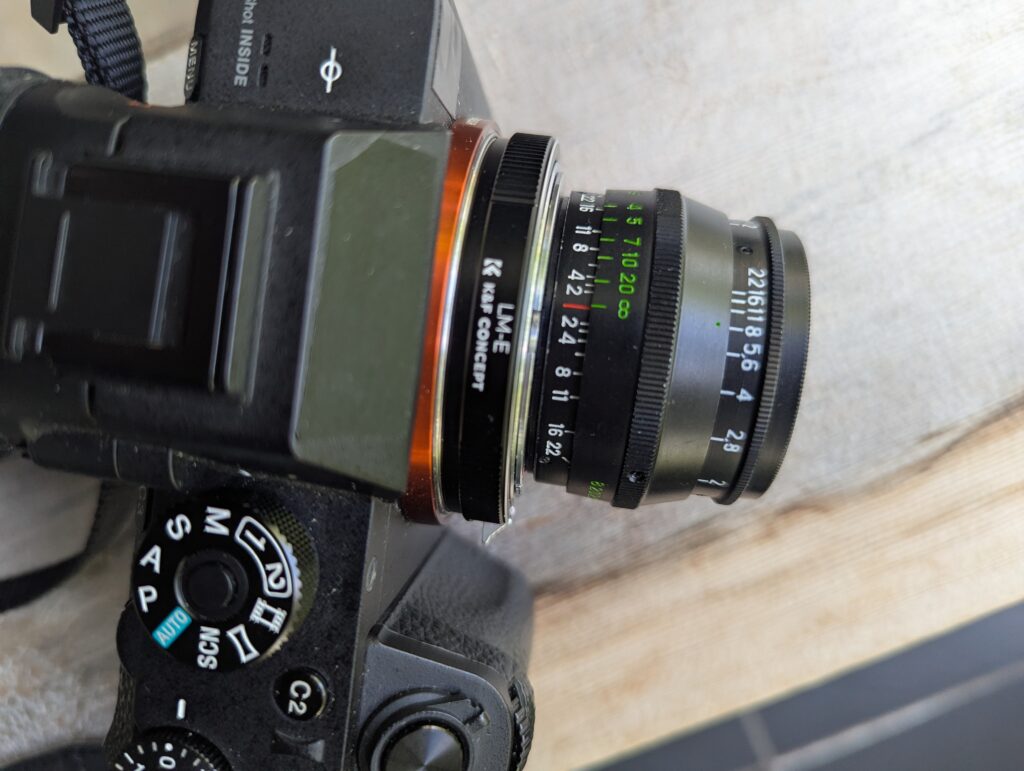
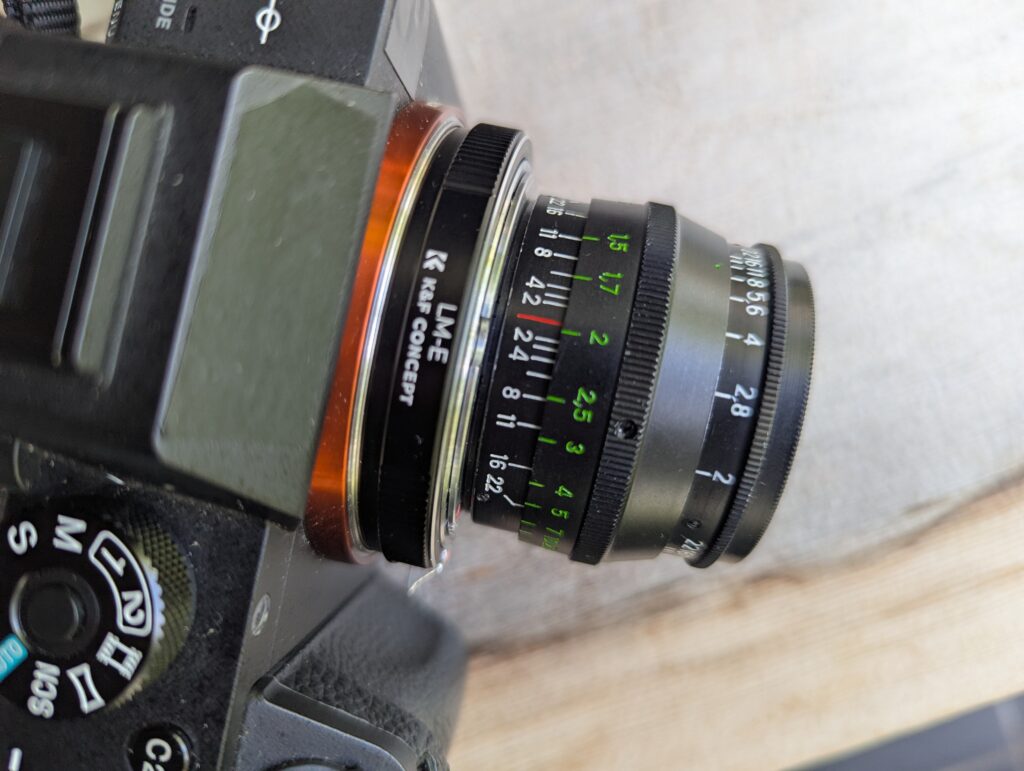
Jupiter 8
I know this lens is slightly soft and less contrasty (even at f8) compared to my Zeiss Sonnar but for the price there is no other Sonnar design lens in the lineup. There are many excellent reviews and articles about this lens on 35mmc and elsewhere, in particular Simon King’s comparison with the Zeiss Planar. (Editor’s note: and in my/Hamish’s Sonnar series here)
I shall restrict my comments to gripes about the ergonomics. (1) The aperture ring has no click stops, (2) it can be easily nudged to a different setting by mistake, (3) the marker against which to align the aperture desired is a tiny green dot, hard to see in many situations, (4) the aperture ring rotates with the focus setting potentially taking it to the side of the lens where it is not immediately visible, and (5) finally the aperture ring is very slim making difficult to find and hard to use if you are wearing gloves. However the lens is very light and compact, so 5/10 for ergonomics – bad enough for me to use the lens rarely
I use 50mm lenses 95% of the time for my photography and my preference is for contrasty images so poor ergonomics and low contrast means this lens doesn’t get used often. Unless you are wedded to the Sonnar design there are so many better alternatives in 50mm focal length – second hand kit lenses from the 70s onwards – offering better ergonomics and optics at normal apertures. No doubt many of you will jump to defend the lens against my fussy old man’s criticisms – go ahead!
Some images: all shots taken at f8. Taken on a shopping trip to Asahikawa





Tamron 500 SP
This is a mirror lens of fixed f8 aperture based on a Maksutov telescope design with what is I assume is a field flattening lens at the camera end. Tamron lenses can be adapted to 35mm camera bodies from the main manufacturers with the appropriate Tamron adapter. Because of the catadioptric design the lens is very compact and light. With 5 stops of in-camera IS hand-held exposures at 1/30th of a second should generally be possible.
There are several excellent articles on 500mm lenses of this design on 35mmc.
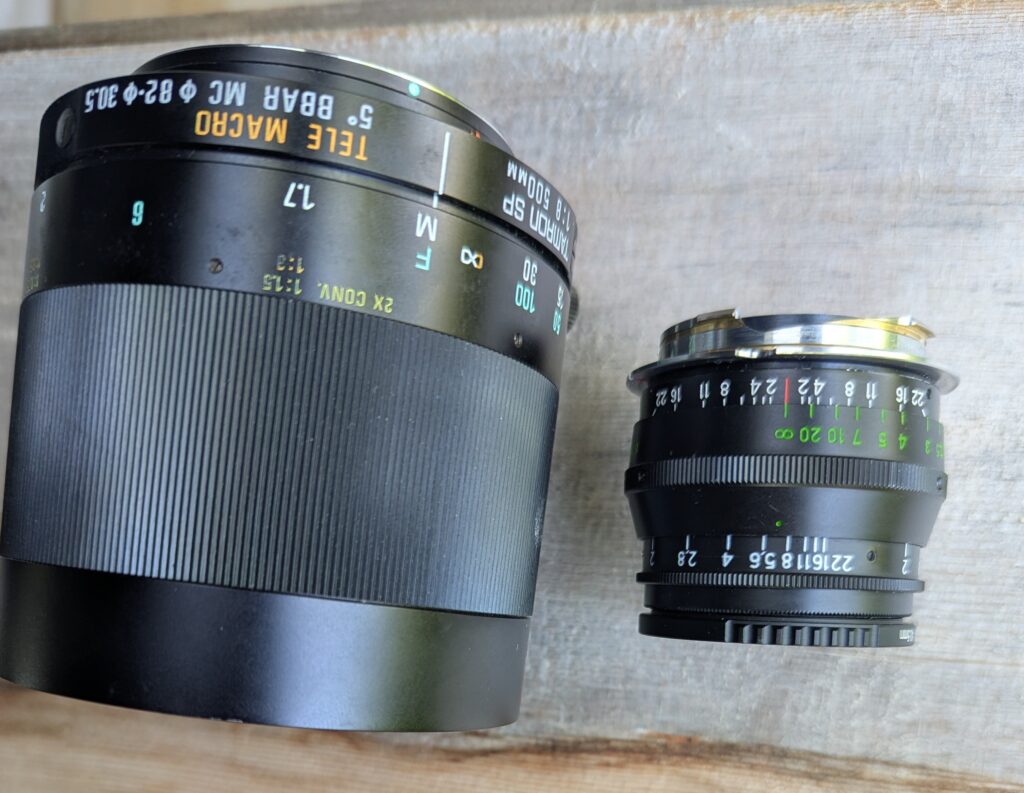
Unavoidably the biggest problem with the lens is the manual focus making stationary subjects much easier though Bob Janes illustrates some stunning results by pre-focusing and waiting for the subject to come into the field of view. Even with stationary subjects focusing hand-held is not easy because of the 10x magnified wobble caused by your shaky hands.
So why use a 500mm lens? Apart from obvious situations (sport, wildlife etc.) using such an unusual focal length makes you look at the world differently. How often have you looked at your images and spotted as small area of the image which makes for a much more interesting picture? Well for me, many times. For the price of a decent bottle of wine the lens can take you out of your comfort zone, open up new ways of looking at the world and relight your imagination.
Images: the featured image and the following, all shot at f8 (ha!), all hand held and slightly out of focus




A final whine about digital cameras
In bright light I find the viewfinders (and more so, screens) dim or invisible, even with brightness set to maximum. In strong light nothing beats rangefinders or optical reflex viewers. On top of that digital is just not a PROCESS I enjoy. Maybe the camera is more clever than me and takes away much of the thought – but where is the fun in that? Whine over.
Share this post:



Comments
Ed on Jupiter 8 and Tamron 500 SP – Two cheap lenses
Comment posted: 28/07/2026
Best wishes. Ed