

The song by Joni Mitchell contains the much quoted line “you don’t know what you’ve got till it’s gone”.
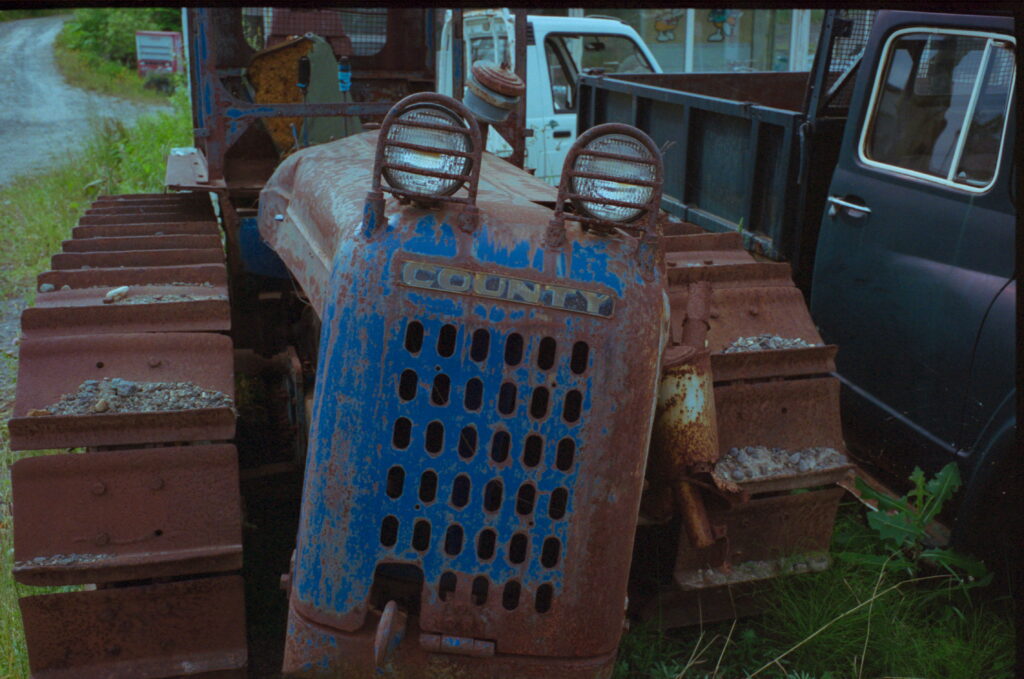
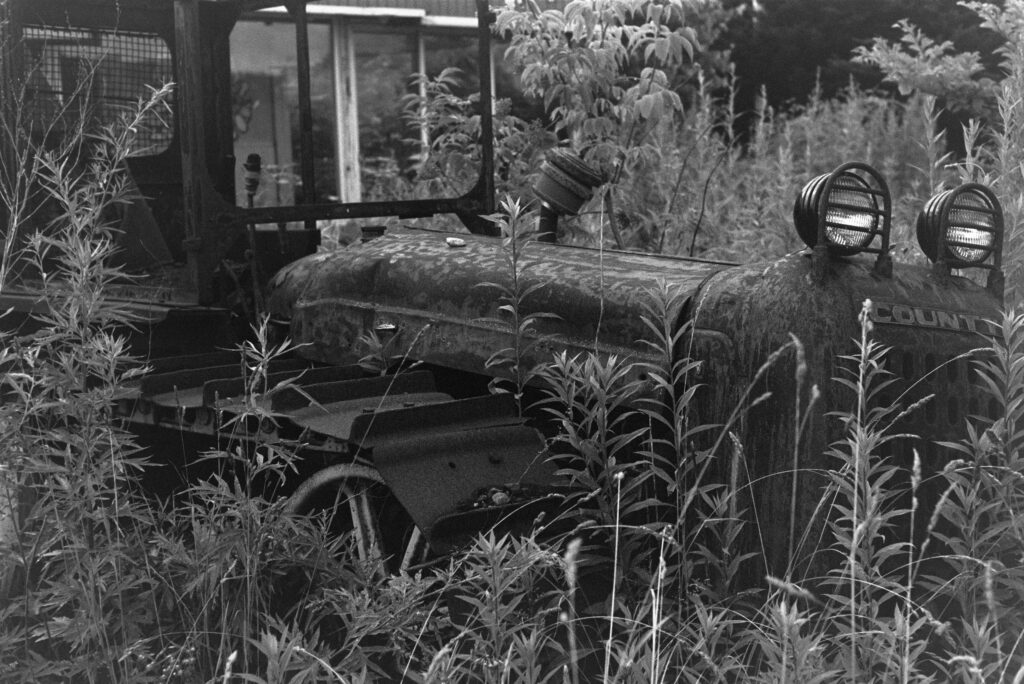
Every time I came back from town I passed within a couple of metres of “County”, a small, old and battered, tracked bulldozer / tractor. For many years she has been there gradually deteriorating in summer sun, rain and winter snow. When I met Fukuhara-san, the owner, he said proudly that the engine still fired up and ran.
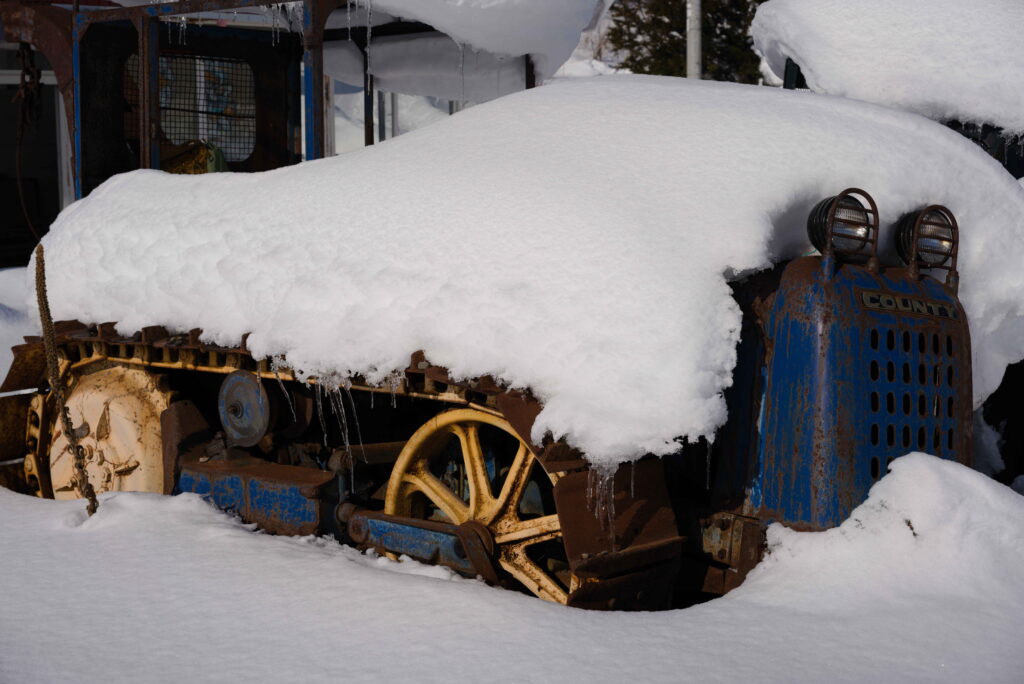
Then one day a couple of weeks ago she was gone.
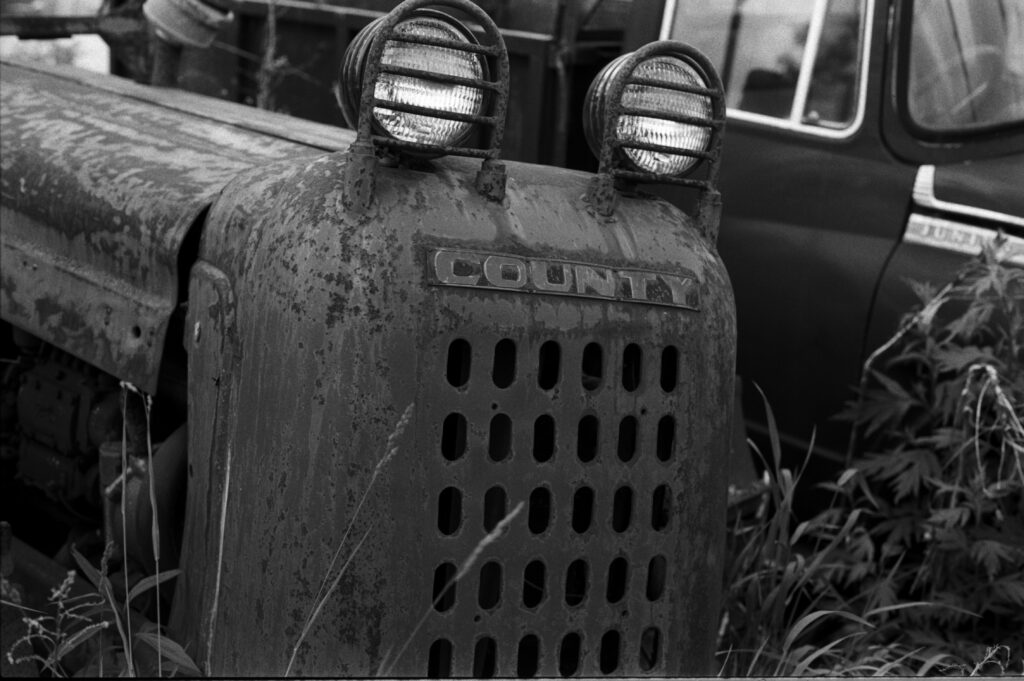
Of course I miss her. I have been photographing her for years watching the paint gradually peel and rust expand, admiring her quiet strength and resilience, watching the weeds grow and engulf her more each year. But fortunately I have memories of her on film and in data files. The last photo I took of her was only a few weeks ago when I was testing my ME Supers, unfortunately only B&W and on film I don’t particularly like but at least I have her final farewell.
So what’s my point?
Exactly what Joni sang: there may be a particular object, building or even person we pass or see regularly, something just a little beyond the ordinary that attracts our attention, one day it’ll be gone and it will be too late to make a record. If something gets your attention regularly, record it, record how it relates to the environment around it, find out why it attracts your attention. This is something I failed to do – “County” attracted my attention enough to use it as a test subject when I was trying out different films, cameras or lenses, but I failed to find out something about its history, why it was there and how or why it related to the other objects around it. If something is worth photographing, a photograph may be worth a thousand words but it doesn’t tell the complete story. This is something I am very bad at, often I’m just collecting an image, and I suspect many other photographers are like me. In many cases that is sufficient, but not all. We deserve to give the unusual, anything that is unusual enough to grab our attention or become part of our daily lives, not just a photograph but a story. Fill in the ‘how’, ‘why’, ‘when’ etc., and make a documentary about the object, then something meaningful will remain when the object has gone. I’ll try to listen to my own advice in future!
Share this post:



Comments
Ken Davis on “Big Yellow Taxi”
Comment posted: 03/09/2026
Comment posted: 03/09/2026
Comment posted: 03/09/2026
Bill Brown on “Big Yellow Taxi”
Comment posted: 03/09/2026
Comment posted: 03/09/2026
Gary Smith on “Big Yellow Taxi”
Comment posted: 03/09/2026
Comment posted: 03/09/2026
Jeffery Luhn on “Big Yellow Taxi”
Comment posted: 03/09/2026
As you point out, along with Joni, we fail to appreciate the scenes and sometimes people, we see all the time. Joni is a genius. In that tune she points out several critically important aspects of destructive behavior and then ties it up with her man leaving her...acknowledging that she, too, has a blind spot. I'm so glad I got to see her in person with different ensembles.
Back to the tractor: It was not in an advantageous place to be photographed, so you shouldn't be tough on yourself. In my part of the country there are thousands of abandoned pieces of mining and farm machinery. Endless hulks rusting in weedy lots, pastures, roadsides, aside houses, etc. It's a blight on the landscape here. If you ever come this way in Northern California, I'll take you on a tour. You'll get your fill in ten minutes! See this link for a look at just one of hundreds of sites. https://www.youtube.com/watch?v=UuXU85bCs7M
Comment posted: 03/09/2026
David Pauley on “Big Yellow Taxi”
Comment posted: 03/09/2026
Comment posted: 03/09/2026
Walter Reumkens on “Big Yellow Taxi”
Comment posted: 03/09/2026
Comment posted: 03/09/2026
Dan on “Big Yellow Taxi”
Comment posted: 03/09/2026
Comment posted: 03/09/2026
Erik Brammer on “Big Yellow Taxi”
Comment posted: 04/09/2026
My wish is to photograph an old papermill in my village, established around 1750, still in operation today, producing specialty papers for industrial use. The good thing is that it is listed as a protected landmark, so it won't go away and can only change to a certain extent. Unfortunately, management of the corporation that owns it now said no to my enquiry. But I have a friend working there, so there is still a slim chance that we can sneak in on a weekend but I don't see myself schlepping the 4x5 into that place, and I certainly don't want to get my friend into trouble...
Comment posted: 04/09/2026
JA on “Big Yellow Taxi”
Comment posted: 04/09/2026
AKA a heavily modified Fordson.
Comment posted: 04/09/2026
Comment posted: 04/09/2026
Comment posted: 04/09/2026
Comment posted: 04/09/2026
Comment posted: 04/09/2026
Omar Tibi on “Big Yellow Taxi”
Comment posted: 07/09/2026
To your point, in Boston we have a gigantic CITGO sign, first lit in 1940, as part of the skyline. It's been on top of the same building since at least 1983 I believe. Just recently they took it down in order to build a new superstructure to hold it, as the sign was at risk of being blocked by new hi-rise development. Looking my through folders, I only have a couple of photos with it in the original location, which is an interesting feeling; sure, it'll be coming back soon, but not in the exact same way it was before.
Thanks again for the great read Geoff, and wishing you a great start to the week.
Comment posted: 07/09/2026