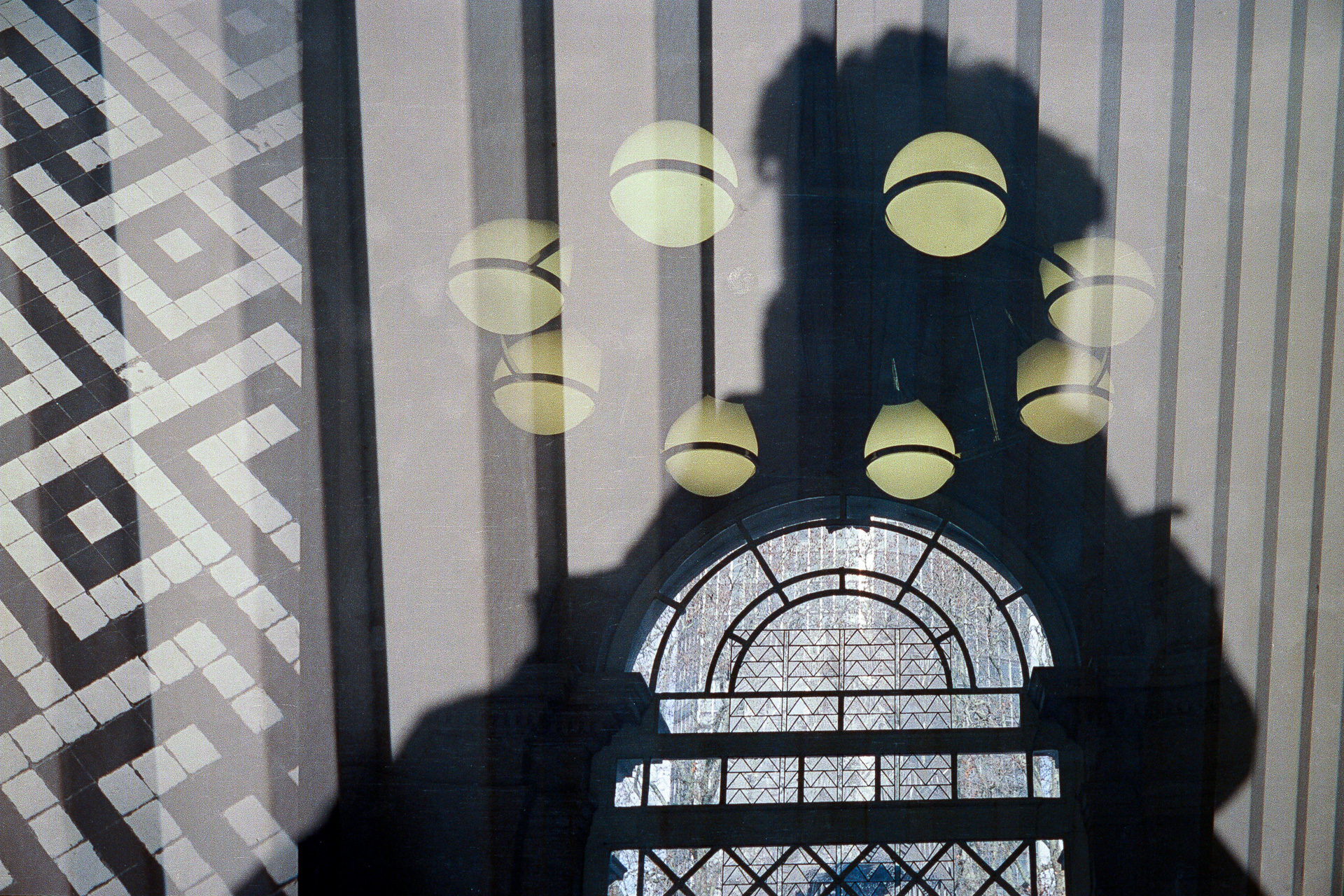
A double exposure featuring a shadow selfie and art deco light fitting and decorative window.

Double Exposures with a Rollei 35B

By Paula Smith

New Year comes and goes. By February, I’m feeling the creative doldrums—that post-holiday flatness where nothing seems to spark. So I decide to shake things up and try something I’ve never done before.

I load my Rollei 35B with a roll of Kodak Vision 3 500T, but with a twist. My plan is to shoot all 36 frames, rewind the film, reload the same roll, and shoot over it again. Same camera, different day, different location, different light. Photographic roulette.

Double exposure photography has always felt like a kind of magic to me—that beautiful unpredictability, the way two unrelated moments conspire to create something neither could have achieved alone. I’ve done the occasional film swap with other photographers (check out this with Peggy), and I’ve taken plenty of intentional double exposures with my Holga, Bronica, and various old box cameras where you can easily cock the shutter without advancing the film. But this? Running an entire roll through a compact 35mm and overlaying it weeks later under completely different conditions? This was new territory.

The results surprised me. Despite carefully noting where I loaded the leader, the frames didn’t line up perfectly—the registration was off just enough to make things interesting. Sometimes frustrating, but other times exactly what made these images sing.

Take this shadow selfie: there’s no universe where I could have planned for that massive Art Deco light fixture in the Tate Britain lobby to crown my shadow like a halo. The first exposure captured my silhouette on a sunny afternoon. The second, shot days later in that grand museum entrance, dropped the chandelier and window right into place. Pure serendipity.
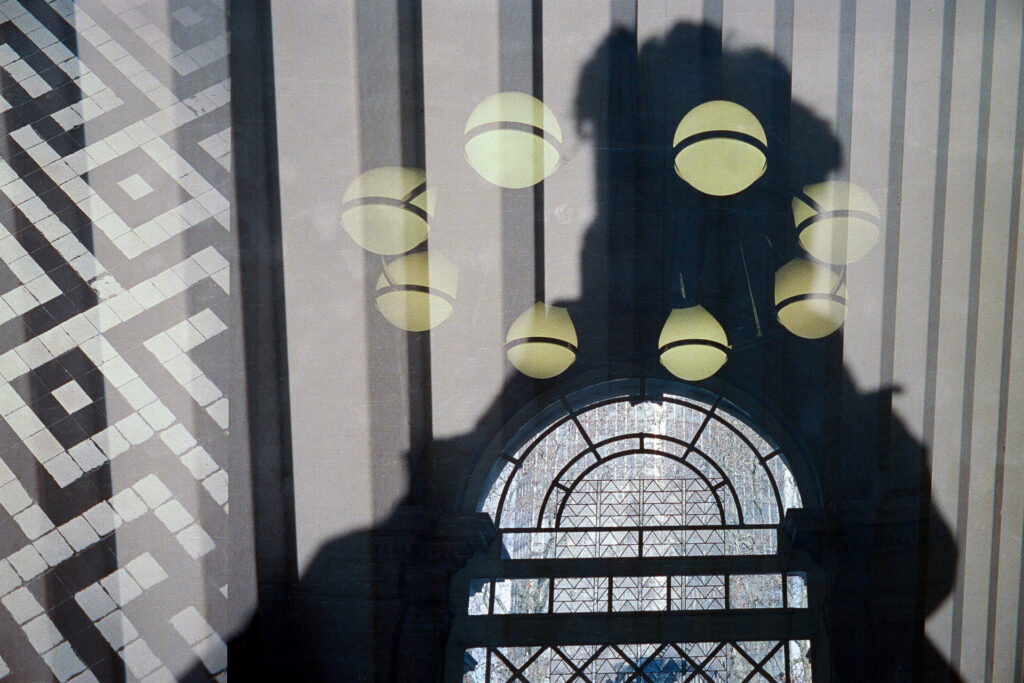
A double exposure featuring a shadow selfie and art deco light fitting and decorative window.

The Process

Here’s what I learned: most compact cameras auto-rewind completely, pulling the leader back into the canister. The Rollei 35B, being fully manual, lets me rewind the film and stop just before the leader disappears—which makes reloading far easier. That was one of the reasons I chose this camera; no faffing around fishing the leader back out with a retriever tool.

Reloading, I tried to position the film back exactly where it started. You can mark the film advance position with a Sharpie in advance, or line up the first sprocket hole with the first tooth on the advance winder. In retrospect, I think this is where I went wrong not noting the position of the take-up spool before winding film on.

But that misalignment became a feature rather than a bug—it created interesting overlaps where one image bleeds into the next.
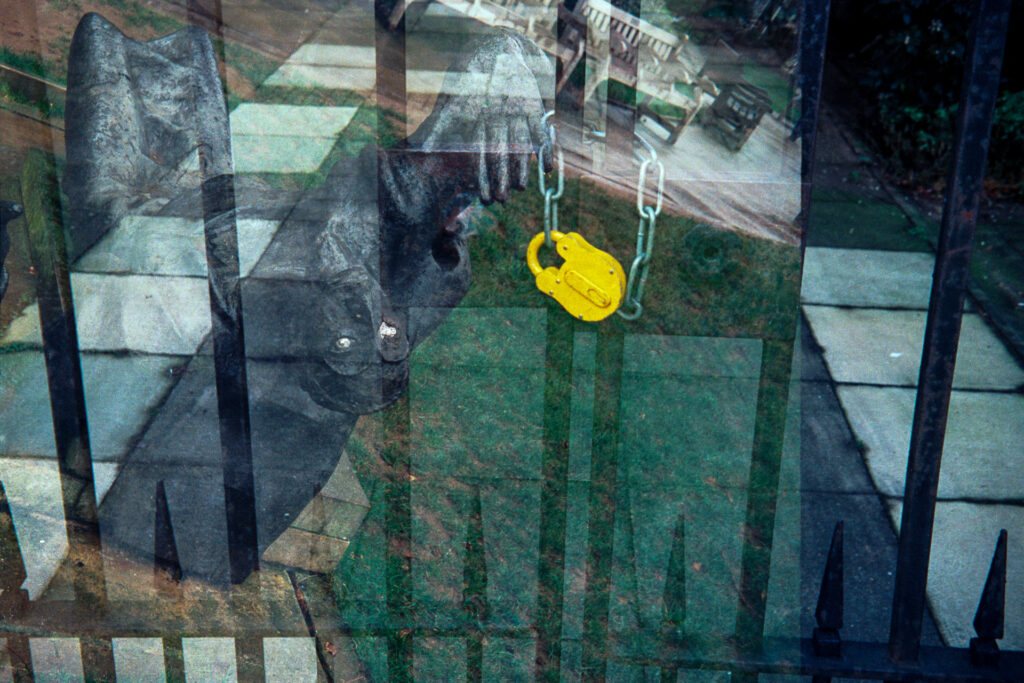
Double exposure on 35mm film featuring a yellow padlock and railings and the sculpture of Becket in the grounds of St Paul's Cathedral.

Exposure Considerations

Double exposures mean double the light hitting the film, so technically you should underexpose each pass by one stop to compensate. Did I do this? Not really. My first pass was shot either inside a dimly lit gallery or outside on a grey, dank February day. I set the camera to ISO 400 and aimed for the fastest shutter speed and aperture combination I could manage—in a couple of cases that meant shooting wide open at 1/30th and f3.5, where camera shake was a bigger concern than exposure.

When the light did improve—yes, I actually caught some sun—I leaned on Vision 3 500T’s generous latitude and didn’t worry too much about my sloppy technique. It rewarded me with rich, saturated colours even when I overexposed by two or three stops.
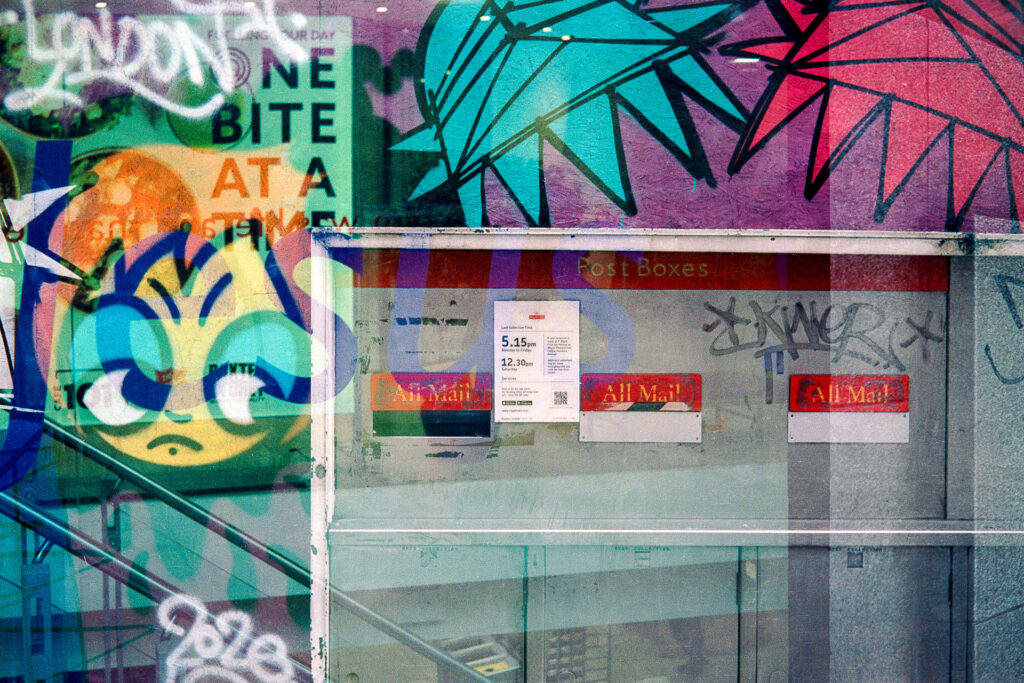
Double exposure featuring Royal Mail postboxes and graffitied walls.

What I Learned

The misaligned frames created something I never anticipated: continuity across the roll. Because each exposure bled slightly into the next, the entire roll became one long, interconnected visual story rather than 36 discrete double exposures. This made deciding where to cut the negatives genuinely challenging. A portion of a building from one part of London reaches into a walkway beside the Thames in another part of the city. Two people on the tube, heads down in their phones, merge with joggers running along Bankside under the Millennium Bridge.

This taught me something about control—or rather, about letting go of it. We spend so much time in photography trying to nail the perfect exposure, the perfect composition, the decisive moment. Double exposures on a compact camera strip all that away. You shoot the first roll with only a vague memory of what you captured weeks ago, with no way to see through the viewfinder how the images will layer. You’re flying blind, trusting the process. And yet some of my favourite images of the year so far have come from this roll.
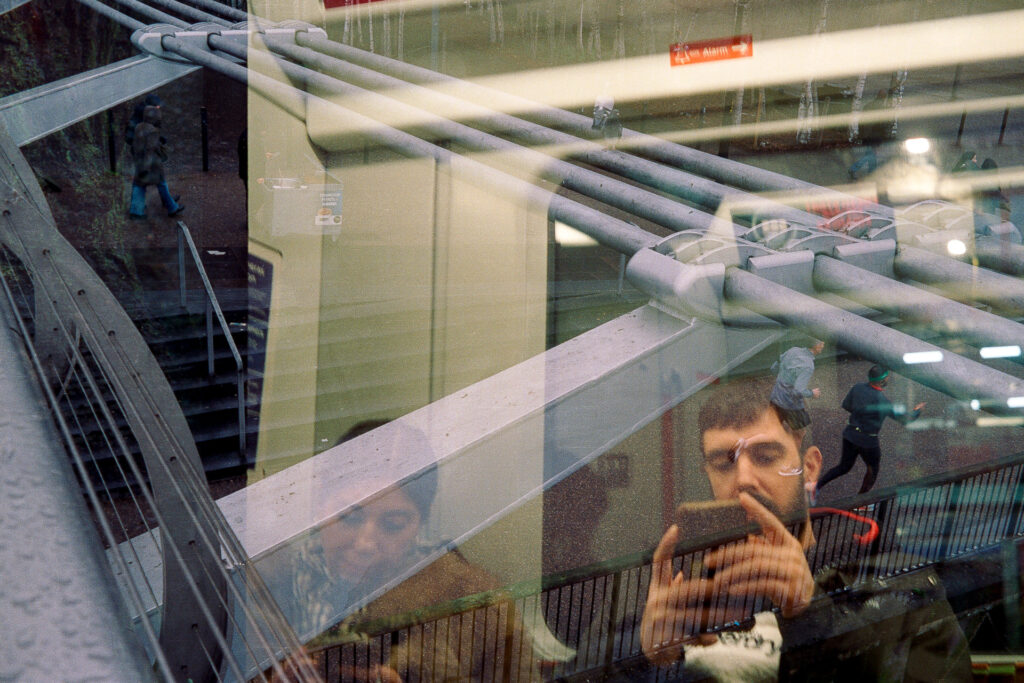
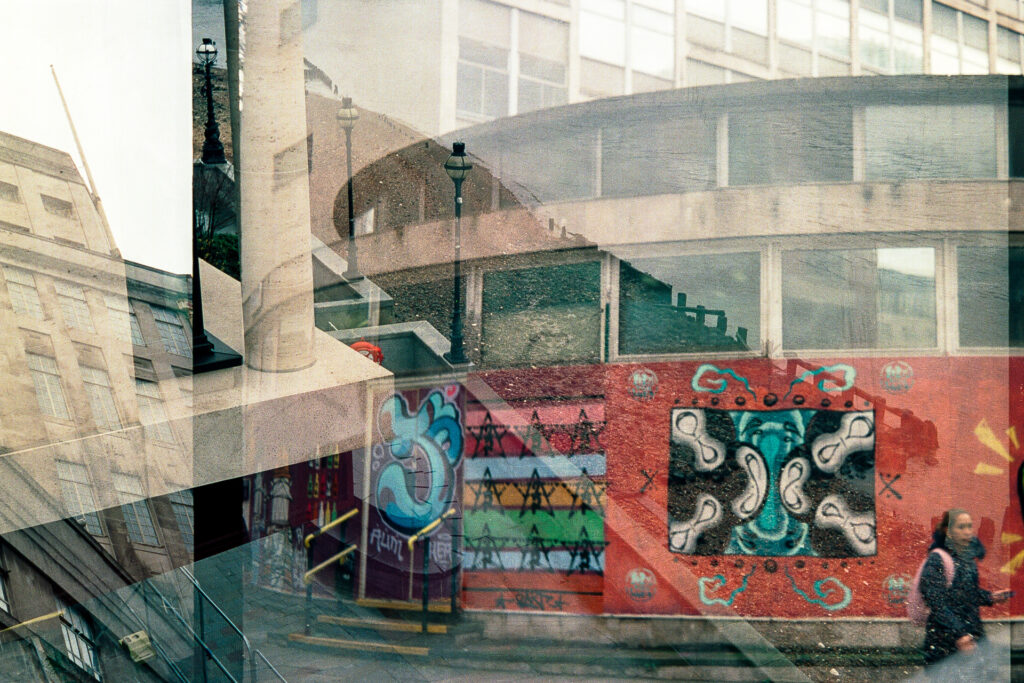
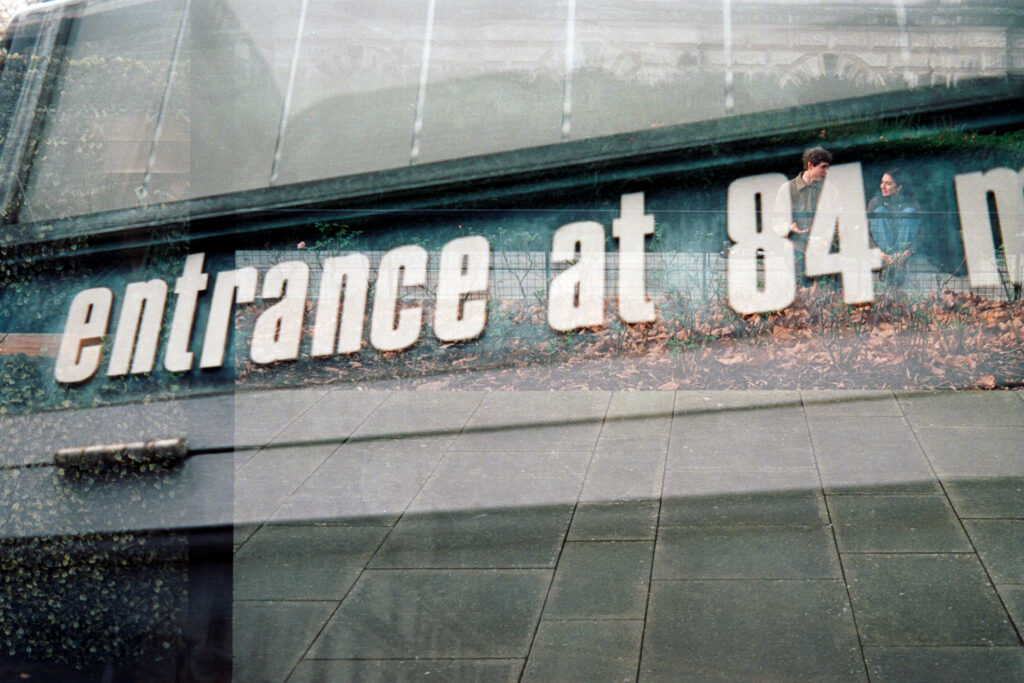
Double exposure featuring two people sitting on a train looking at their phones while runners are jogging over them along viewed from the Millennium Bridge.Double exposure featuring a Royal Mail building in Pimlico and view down to the Thames foreshore at low tide. Double exposure on 35mm film featuring a building sign entrance at 84 with a couple sitting in a garden talking.

Practical Tips

If you want to try this:

Choose contrasting light conditions for each pass. Bold shapes and silhouettes layer beautifully over soft, diffused backgrounds, so consider pairing a high-contrast pass with a softer one.
Keep notes—or don’t. I didn’t, and it worked out fine, but if you want to be more deliberate, jot down what you shot on each frame. “Frame 8: bare tree branches against sky.” That way, on the second pass, you’ll have some idea of what you’re layering over.
Embrace failure. About a third of this roll isn’t great—muddy, soft, or compositionally messy. That’s the deal. The wins more than make up for the losses.
Try themed passes. One pass could be all nature, the second all urban architecture. Portraits over landscapes. Give yourself a conceptual thread to follow, even a loose one.
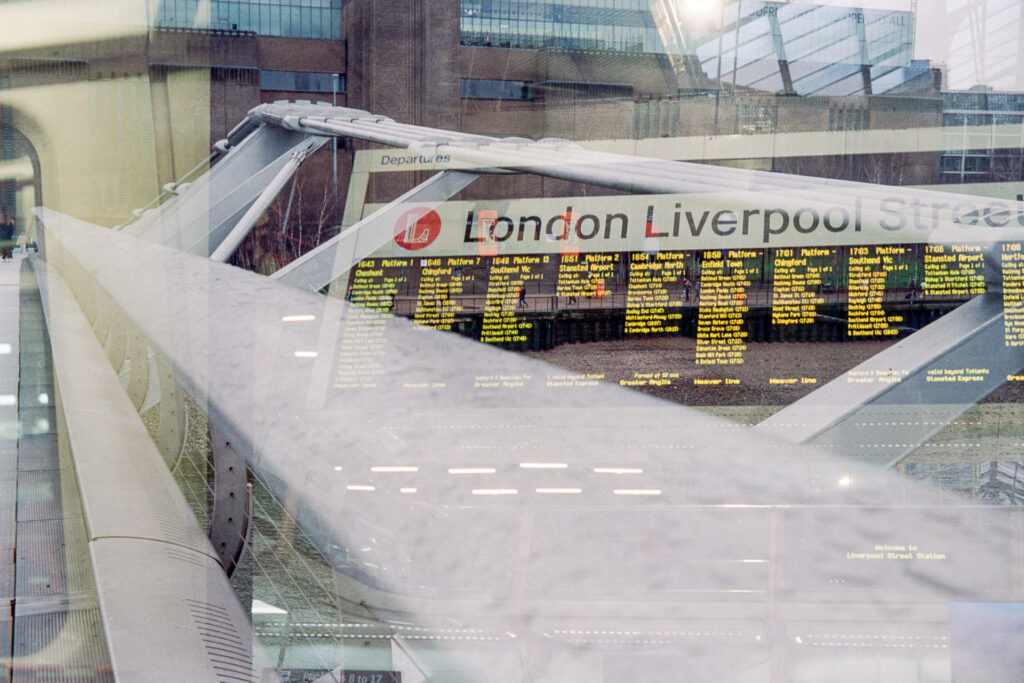
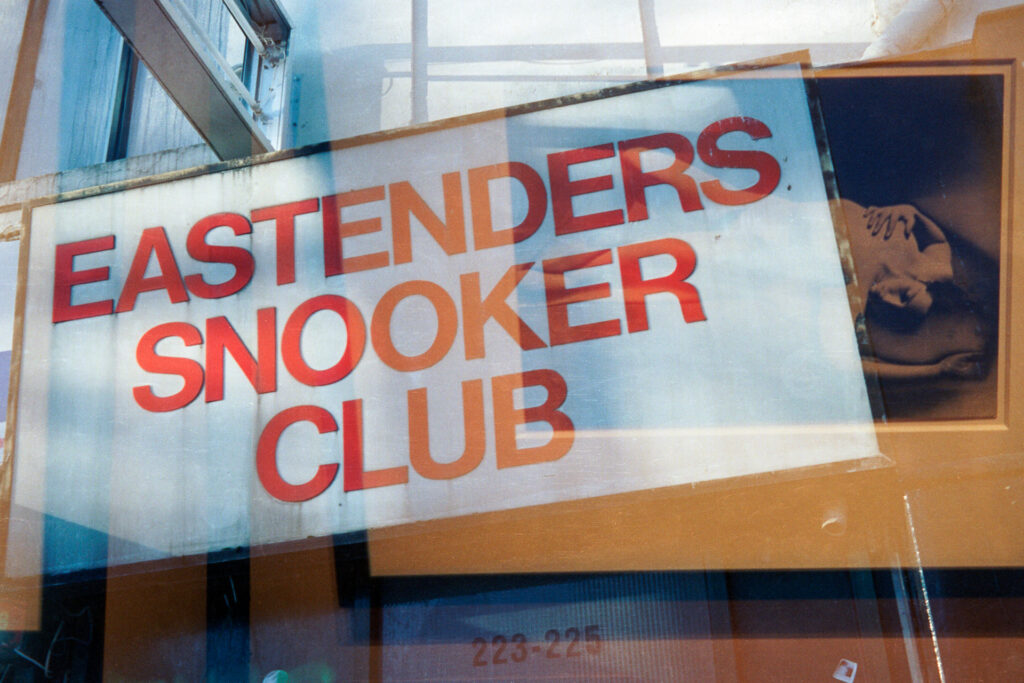
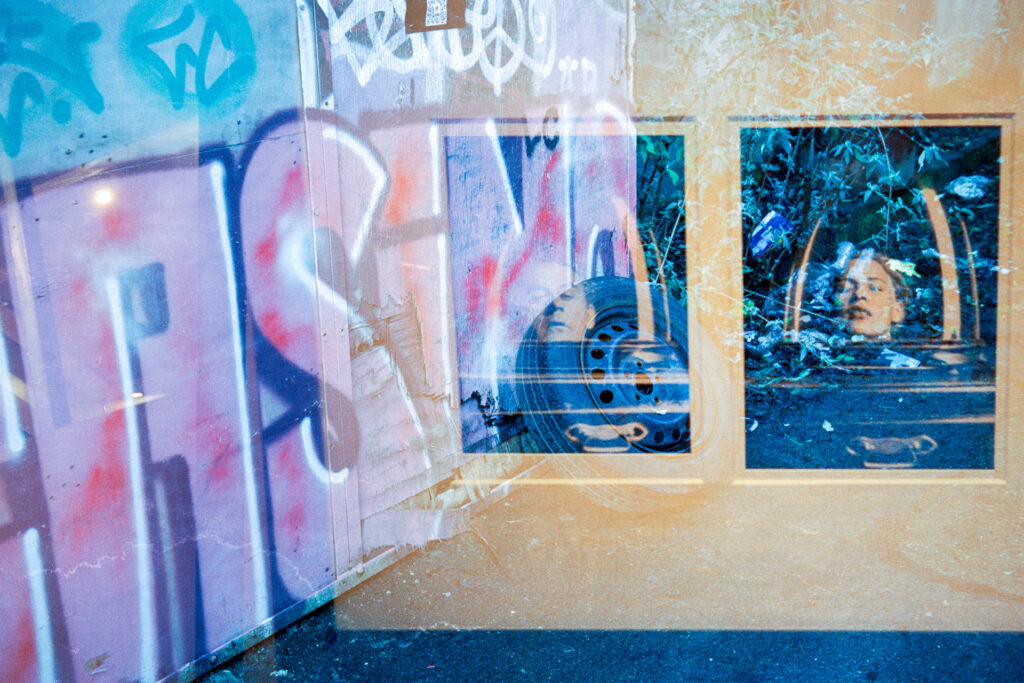
Double exposure featuring Millennium Bridge and the train board at Liverpool Street Station. Double exposure featuring Eastenders Snooker Club signage merged with a gallery image from the recent Lee Miller Exhibition at Tate Britain. Double exposure on 35mm film featuring a graffitied wall and dumped car tire over layered with a gallery wall framed photo of Man Ray and Lee Miller from the Lee Miller Exhibition at Tate Britain.

Closing Reflection

That February creative slump? Completely cured. There’s something about a genuine photographic experiment that wakes the eyes and resets everything.

I’m already planning my next double exposure roll—maybe with faster film, maybe with a camera that has even less precise film registration, maybe shooting the same locations on both passes to see how the frames overlap with themselves.

The Rollei 35B, that perfect little pocket camera designed for precise, considered single exposures, became a chaos engine. And I couldn’t be happier about it.
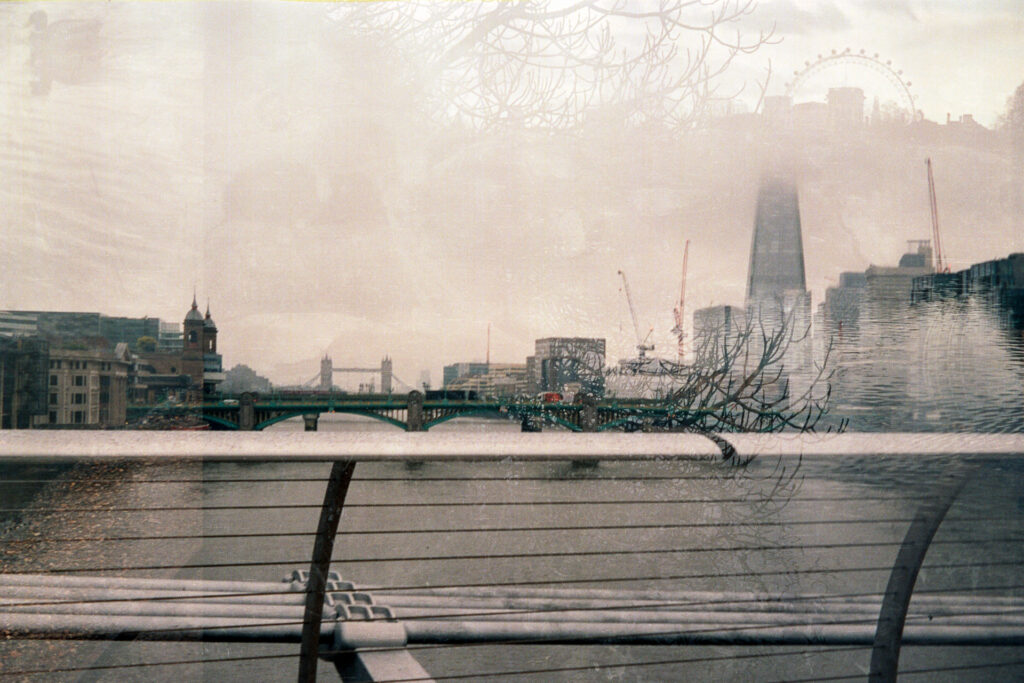
Double exposure on 35mm film featuring view from Millennium Bridge towards the east. Overlayed is a view from St James park of ducks in the lake and the London Eye.

Share this post:

About The Author

By Paula Smith
Paula Smith | London-based freelance photographer capturing life's fleeting moments. Devoted to the art of film photography and the charm of vintage cameras.
Read More Articles From Paula Smith

Find more similar content on 35mmc

Use the tags below to search for more posts on related topics:

Donate to the upkeep, or contribute to 35mmc for an ad-free experience.

There are two ways to contribute to 35mmc and experience it without the adverts:

Paid Subscription – £3.99 per month and you’ll never see an advert again! (Free 3-day trial).

Subscribe here.

Content contributor – become a part of the world’s biggest film and alternative photography community blog. All our Contributors have an ad-free experience for life.

Sign up here.

Make a donation – If you would simply like to support Hamish Gill and 35mmc financially, you can also do so via ko-fi

Donate to 35mmc here.

Comments

David Pauley on Double Exposures with a Rollei 35B

Comment posted: 28/03/2026

An excellent article, Paula, with beautiful images! Your prose brings us into the playfulness of this double exposure experiment, and the results speak for themselves. I especially like the frames that bookend the "what I learned" section: the punchy colors and graphic pop of the first, and the weird spatial distortion of the bridge structure (or whatever it is) pressing against an ordinary shot of a guy (perhaps I should call him a bloke, but in my American accent that would sound ridiculous) riding on the tube. Actually there is a woman seated next to him as well though she's a bit less present in the frame given the superimposed bridge structure. Above all your piece reminds me that making photos ought to be fun, something I sometimes forget in my effort to (as you point out) control everything.
Reply

Leave a Reply

Your email address will not be published. Required fields are marked *


Paula Smith replied:

Comment posted: 28/03/2026

Thanks so much or your comments David. Really appreciate it. It's interesting isn't it that often the more you search within a double exposure the more you see that you didn't at first glance. I do enjoy that aspect of double exposure photography.

Reply

Leave a Reply

Your email address will not be published. Required fields are marked *


Brashtown Czar on Double Exposures with a Rollei 35B

Comment posted: 28/03/2026

Super fun! For even more "giving up control," another idea is you can shoot the roll and then give it to a friend to shoot over it the second time. I think people variously call this names like "blind film swap" or so on. The results will be even more of a surprise!
Reply

Leave a Reply

Your email address will not be published. Required fields are marked *


Paula Smith replied:

Comment posted: 28/03/2026

Definitely agree there Brashtown Czar! So much fun when you swap with someone else. You'll have no idea what's on the film even more magic to hopefully happen. :-)

Reply

Leave a Reply

Your email address will not be published. Required fields are marked *


Walter Reumkens on Double Exposures with a Rollei 35B

Comment posted: 28/03/2026

The idea, the description, the photos – everything’s absolutely brilliant! Thanks for sharing, Paula.
Reply

Leave a Reply

Your email address will not be published. Required fields are marked *


Paula Smith replied:

Comment posted: 28/03/2026

Thanks so much Walter, I'm very glad to share.

Reply

Leave a Reply

Your email address will not be published. Required fields are marked *


Martin Siegel on Double Exposures with a Rollei 35B

Comment posted: 28/03/2026

Great article, Paula. Great to read and fine pics even if I'm not a great fan of double exposures.
Take care and best wishes from Austria!
Reply

Leave a Reply

Your email address will not be published. Required fields are marked *


Paula Smith replied:

Comment posted: 28/03/2026

Thanks Martin! Thanks for reading and commenting. I wouldn't want all my photographs to be double exposures but they are fun, and when they work, wow they make me happy.

Reply

Leave a Reply

Your email address will not be published. Required fields are marked *


Gary Smith on Double Exposures with a Rollei 35B

Comment posted: 28/03/2026

It would seem to be the best way to shoot double exposure, rather than making the decision frame by frame.

Great article Paula and an interesting set of results.
Reply

Leave a Reply

Your email address will not be published. Required fields are marked *


Paula Smith replied:

Comment posted: 28/03/2026

Thanks so much Gary. Yeah when I've been more 'considered' on the framing the results haven't necessarily been as pleasing. Probably because I've got more of a fixed idea on what it should look like. I've enjoyed just letting go of that and seeing what serendipity will bring me.

Reply

Leave a Reply

Your email address will not be published. Required fields are marked *


Russ Rosener on Double Exposures with a Rollei 35B

Comment posted: 28/03/2026

I really enjoyed your post and the technical notes on using the Rollei 35B for this experimentation. It's true there is a kismet which occurs in some double exposures. It's an experiment and can really free up a creative block. When I was in graduate school this method of rewinding the film at the end of the roll was something he often recommended. My fave "doubles" are when I have put a roll of film in a camera and shot a few frames and then decide to pull it out and load a different emulsion. I often forget to mark how many shots I took, and load the same roll months or years late into another camera. Those doubles somehow are the most poignant and surreal.
Reply

Leave a Reply

Your email address will not be published. Required fields are marked *


Paula Smith replied:

Comment posted: 28/03/2026

That's brilliant Russ! I've had that experience too. Years ago when I was travelling with just one film camera I'd often swap out say a black and white film for colour. Then not label in the moment (Oh I'll remember... Ha, I never do!). I must dig out those doubles out again and see what I got. Thanks so much for reading and commenting back.

Reply

Leave a Reply

Your email address will not be published. Required fields are marked *


Erik Brammer on Double Exposures with a Rollei 35B

Comment posted: 28/03/2026

Thank you for sharing this experience and the results with us, Paula! Many of these images look so collage-like to me, translucent though - of course.
If you’re looking for a faster film, there are the usual suspects with ISO 800. What you might want to give a try is Kodak Ultramax 400 exposed at EI 1600 and push developed 2 stops. Very nice and bold colours with a decent amount of contrast. And who cares about a bit of colour shift when you are creating translucent collages…
Reply

Leave a Reply

Your email address will not be published. Required fields are marked *


Paula Smith replied:

Comment posted: 28/03/2026

Hi Erik, thanks so much for commenting. I love the sound of pushing Ultramax 400. Thanks for the suggestion! I'll give that a try sometime for sure. I've not done too much of that with colour films. I use to get quite hung up on correct colour but now embracing more of the 'artistic' side I just go for it.

Reply

Leave a Reply

Your email address will not be published. Required fields are marked *


David Hume on Double Exposures with a Rollei 35B

Comment posted: 28/03/2026

Thanks for the lovely article and photographs Paula. What I like most about the series is the sense of a journey unfolding… Reading your text. I'm not sure that I can see this as a deliberate goal, but the street scenes, the people sitting on trains, the reflections in windows all seem to add up - to my eye anyway - to journeys layered upon one another. In this way, I feel a sense of movement and time that we don't normally get out of photography. Cheers!
Reply

Leave a Reply

Your email address will not be published. Required fields are marked *


Paula Smith replied:

Comment posted: 28/03/2026

Thanks so much for your thoughtful words David! It's a really good point, much of my photography lately has been about journeys. Journeys to appointments, to work, running errands... I have a camera in my pocket and I'll grab a picture here and there without much thought. So when it does form more of a narrative it's a delight.

Reply

Leave a Reply

Your email address will not be published. Required fields are marked *


Michael Jardine on Double Exposures with a Rollei 35B

Comment posted: 28/03/2026

Love this! So timely- my son asked me today what happens if you shoot a roll of film and then shoot it again (poor lad's had a hopeless film-fiddling parent for his whole life). I don't think I've ever intentionally done this, and it's kind of pure surrealist praxis which makes it *very* appealing.
Reply

Leave a Reply

Your email address will not be published. Required fields are marked *


Paula Smith replied:

Comment posted: 28/03/2026

Thanks so much Michael! Brilliant - you and your son should do a film swap. Let the surrealist joy happen.

Reply

Leave a Reply

Your email address will not be published. Required fields are marked *


Jeffery Luhn on Double Exposures with a Rollei 35B

Comment posted: 29/03/2026

Paula,
I really enjoyed your article! The photos make me imagine that I've seen something that defies time. A 'decisive moment' overlayed on another 'decisive moment.' Brilliant. I've tried double exposures, but always been too restrictive. I'm going to try this. Thank you for the great text and pix!
Jeffery
Reply

Leave a Reply

Your email address will not be published. Required fields are marked *


Paula Smith replied:

Comment posted: 29/03/2026

Hi Jeffery, Thanks so much for your kind words. I am learning, the more I do it, that being less restrictive can yield some really interesting results. Go for it and I hope it works well for you.

Reply

Leave a Reply

Your email address will not be published. Required fields are marked *


Ibraar Hussain on Double Exposures with a Rollei 35B

Comment posted: 29/03/2026

Good
Enjoyable motivation inspirational stuff with some really good photos
Reply

Leave a Reply

Your email address will not be published. Required fields are marked *


Paula Smith replied:

Comment posted: 29/03/2026

Thanks so much Ibraar. Much appreciated.

Reply

Leave a Reply

Your email address will not be published. Required fields are marked *


David Mackay on Double Exposures with a Rollei 35B

Comment posted: 30/03/2026

I love when I come across an article that gets me inspired to try something new. Thanks Paula, these images came out fantastic.
Reply

Leave a Reply

Your email address will not be published. Required fields are marked *


Paula Smith replied:

Comment posted: 30/03/2026

Thanks David! That's great to know. Good luck, hope you get some wonderful results.

Reply

Leave a Reply

Your email address will not be published. Required fields are marked *


Leave a Comment

Leave a Reply

Your email address will not be published. Required fields are marked *