First attempts at Bird Photography (beginner’s luck) – One Shot Story

By Hamish Gill

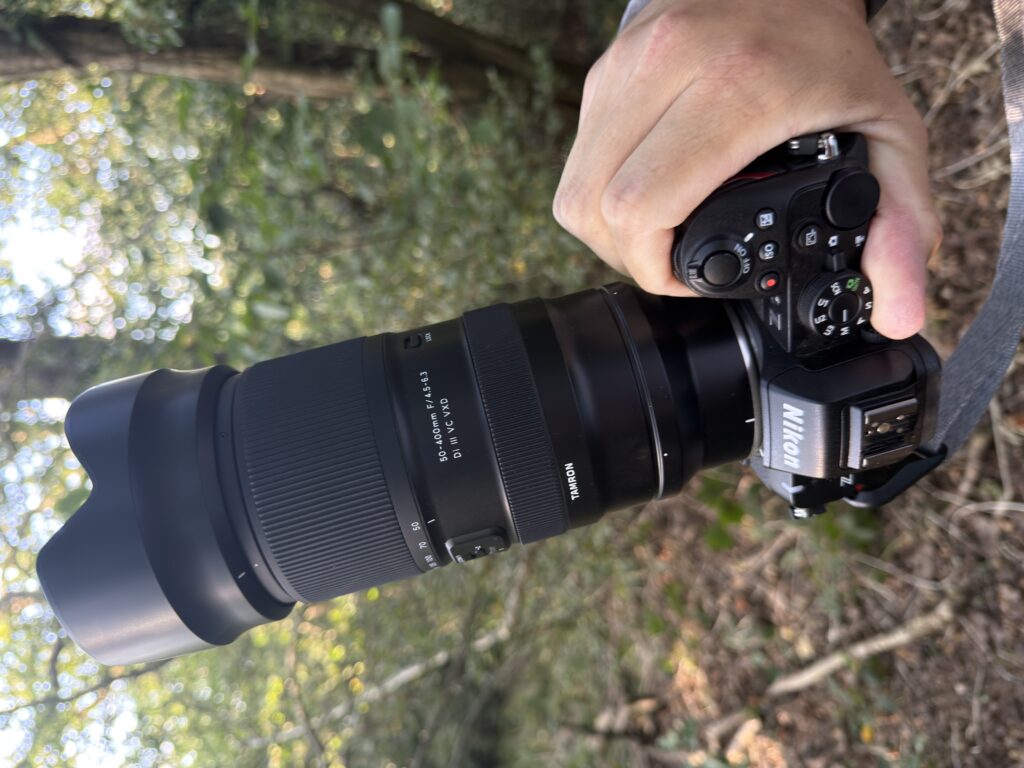
I’ve borrowed a Tamron 50-400mm lens to review over the summer. I have a few plans for it, one of which, as I have recently decided, is to try my hand at taking photos of wildlife.

We’ve recently won a contract at work with Worcestershire Wildlife Trust – albeit a video/documentary contract, but I have found myself a little inspired. I’m always taking photos when I’m out and about in the countryside anyway, but they’re usually more landscape or flora-based rather than fauna-based. The contract is video, as I said, but during the process with WWT I happened to mention that I’d be happy to throw some of my stills photography skills into the mix too. This started a conversation with one of the team there, Wendy, who as it turns out is quite an accomplished wildlife photographer.

By the time I’d had this conversation with Wendy, I’d already arranged to arrange to borrow this Tamron lens. It’s a story for another day really, but I’ve set it up with the local Women’s Football team for me and Connie to go and take some photos at one of their first fixtures of the season, so the lens loan timing was quite specific, and at the time, a month or so away. So when Wendy showed me her photos, something clicked in my head. I was 100% inspired by her shots, but knowing I had this lens on the way to me over the summer meant I felt like I could turn that inspiration into the actual practice of trying to take some photos. So, as soon as it landed with me, that’s pretty much exactly what I set out to do.

To be fair, the first outing with the lens was with the full frame Nikon Zf hanging off the back of it. But, that first trial done, I was more keen to try it on the Z50ii where the 1.5x crop factor would give me a 75-600mm equivalent, i.e. a touch more reach for snapping birds and the like.
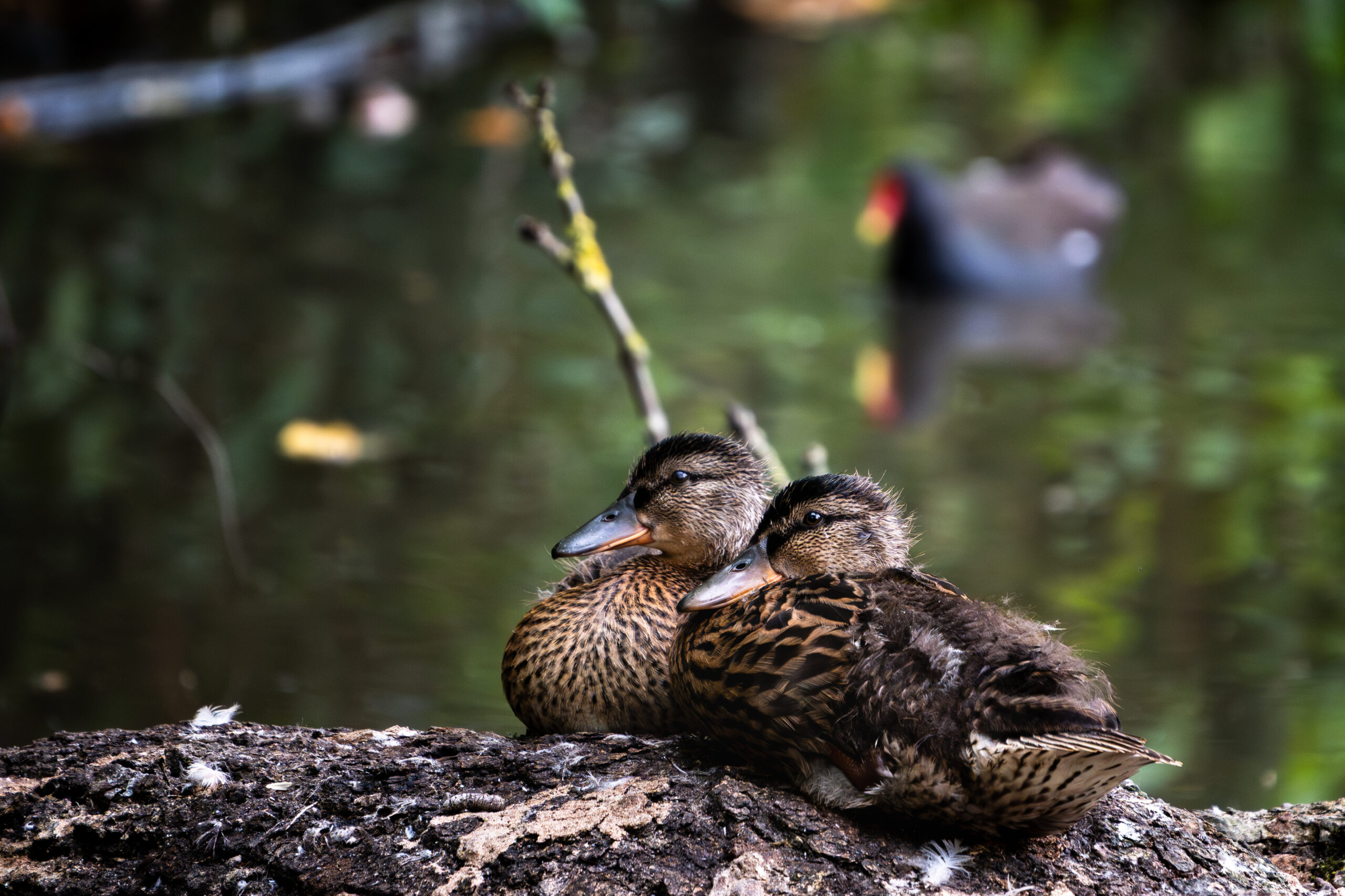
My first outing was a bit of a bust. I got a pretty crappy photo of a pigeon from a crap angle that was too far away, and that’s was about the lot. The second outing worked out better though. I was pleased with the first shot of another pigeon on top of a grave stone, but still hoped to do better. We were on a dog walk in Inkberrow, and found ourselves wondering around the Millennium Green where there’s a bit of a duck pond. I had a few failed attempts at duck photos at the beginning of the walk, then got a few shots of some butterflies that were ok, though not amazing. Then, just as we were making our way back to the car, Hannah spotted these two young ducks on a log. I got my shot lined up, and after few initial snaps the Moorhen appeared in the background completing the composition.

It feels like a bit of beginner’s luck, to be honest, and I certainly wouldn’t have got the shot without Hannah noticing the ducks on the log, but I’m pretty pleased with it nonetheless! The biggest issue that’s I can already see coming down the tracks here is that I’m going to start enjoying this sort of photography more than I expected. Walking around in the countryside quietly trying to spot a squirrel, bird, or little bug of some sort was really quite compelling an experience. This Tamron lens is already shaping up to be the perfect choice for someone of my skill level and creative desires too!

Share this post:

About The Author

By Hamish Gill
I started taking photos at the age of 9. Since then I've taken photos for a hobby, sold cameras for a living, and for nearly two decades now I've been a professional photographer and, of course, regular contributor to and founder of 35mmc.
Read More Articles From Hamish Gill

Find more similar content on 35mmc

Use the tags below to search for more posts on related topics:

Donate to the upkeep, or contribute to 35mmc for an ad-free experience.

There are two ways to contribute to 35mmc and experience it without the adverts:

Paid Subscription – £3.99 per month and you’ll never see an advert again! (Free 3-day trial).

Subscribe here.

Content contributor – become a part of the world’s biggest film and alternative photography community blog. All our Contributors have an ad-free experience for life.

Sign up here.

Make a donation – If you would simply like to support Hamish Gill and 35mmc financially, you can also do so via ko-fi

Donate to 35mmc here.

Comments

Cosme Lapena on First attempts at Bird Photography (beginner’s luck) – One Shot Story

Comment posted: 10/08/2026

I've got zero experience with wildlife photography myself, but I really admire the patience it takes, and how much you and other bird photographers seem to know about the animals you're shooting. I don't think I'd have that kind of patience, or the desire to walk for hours lugging a telephoto that heavy!

I'm more of a street/urban photographer myself, but I have a lot of respect for a genre so different from mine. Quick question — how are you finding the Tamron 50-400mm so far? Curious if it feels versatile enough as a walk-around lens, or if it's strictly a wildlife tool for you.

That said, that shot of the two ducklings is gorgeous. Congrats — really nice work.
Reply

Leave a Reply

Your email address will not be published. Required fields are marked *

Hamish Gill replied:

Comment posted: 10/08/2026

It's very versatile! I suspect the Nikon 28-400 would be the ultimate, but I like the quality and AF speed this lens brings. I often shoot longer than 50mm too, so to me, it has all the range I am usually at, and the crazy reach of 400mm. It is a touch heavy though - I was out with it for 4 hours in the heat today, and it did start to feel heavy... I got some lovely shots though!!

Reply

Leave a Reply

Your email address will not be published. Required fields are marked *

Ed on First attempts at Bird Photography (beginner’s luck) – One Shot Story

Comment posted: 10/08/2026

Hi Hamish - you've definitely entered long lens territory here. I think optical image stabilisation and high ISO digital cameras must help with wildlife photography. Goodness knows how photographers managed it in the good old days of 35mm film, non-stabilised gear and a tripod. I've tried a bit with 200mm lenses (plus a bit on smaller sensors) but I've come to the conclusion that at least 400mm full frame focal length is needed. I think Olympus 4/3rds gear is popular with wildlife photographers because it gives more reach. Good luck with the project. Ed
Reply

Leave a Reply

Your email address will not be published. Required fields are marked *

Hamish Gill replied:

Comment posted: 10/08/2026

Yeah, for sure, modern tech definitely makes this sort of thing a lot easier! I did some sports photography yesterday at a footbal match and even with this kit I struggled for the first 20 mins. How folks did that back in the day is beyond me and my skills for sure! Cheers!!

Reply

Leave a Reply

Your email address will not be published. Required fields are marked *

Jeffery Luhn on First attempts at Bird Photography (beginner’s luck) – One Shot Story

Comment posted: 10/08/2026

Nice shot of ducklings!
I'm always puzzled by people saying a long lens on a crop sensor gives you more 'reach.' It doesn't. It just crops the image. The lens is delivering a specific magnification and that doesn't change with the sensor size. Think of it like this:
You have a projector sending out a cone of light that fills the screen. You replace the normal screen with a smaller one. Same size image, but cropped. The original image is unchanged, but a lot of it is spilling out over the edges of the screen. It looks 'zoomed in' but it's the same size on a smaller screen.
To test this description, shoot the same scene with the same lens on full and crop sensor cameras. Review the images on screen. When you tell the computer to 'fill the frame', the smaller sensor image looks like it's more magnified. But when you tell it to show 'actual size' you'll see that the small sensor image is just a cropped version of the full frame one.
This isn't to say that folks should stop enjoying what they think is more reach. But just realize that the same lens on a full frame camera gives you the same magnification with the advantage of being able to have more real estate to work with.
Reply

Leave a Reply

Your email address will not be published. Required fields are marked *

Hamish Gill replied:

Comment posted: 10/08/2026

Absolutely, "more reach" in my world is just shorthand for the fact that I'm getting more pixels really. If I shoot on my Zf in crop mode (which I do, often) I get 12mp (I think, maybe 10) - whereas on the Z50ii, I get the full resolution with the same crop factor, which then in turn means I can crop even more in Lightroom (which I did here)... ie, more reach. I get the technical reasons why it's not like shooting a 600mm on full frame, but the difference to me is negligible. In fact, I probably prefer the increased DoF on the crop camera with this lens.

Reply

Leave a Reply

Your email address will not be published. Required fields are marked *

Roger replied:

Comment posted: 10/08/2026

This is my view entirely, as someone who uses OM cameras a lot for birds and bugs. The way I put it is that what matters is pixels per bird, and for most bird shots (typically the birds are either not as close as one would like or they are very small or, very often, both) a 20mp MFT sensor does better than cropping even a 42mp FF sensor. I also endorse your remark about depth of field; you often want to take pictures at max aperture to get the shutter speed, but you want to get the whole creature in focus. Beginner's luck? But surely it just shows that as a professional photographer you know what you are doing. The coot makes the photo in my view.

Reply

Leave a Reply

Your email address will not be published. Required fields are marked *

Hamish Gill replied:

Comment posted: 10/08/2026

That's it exactly - right kit for the right job. There has been such a push toward bigger is better with sensors, that in many circles it's been forgotten that smaller sensors have their advantages too - especially modern ones! I suppose you're right - all this build up of photography expertise helps... though it doesn't help where the animals are, or me finding them... I guess/hope that will come with time...

Reply

Leave a Reply

Your email address will not be published. Required fields are marked *

Gary Smith on First attempts at Bird Photography (beginner’s luck) – One Shot Story

Comment posted: 10/08/2026

For a while I had bird feeders in the back yard, but the seed waste attracted rats and mice. I now travel to a nearby (45-minute drive) wildlife refuge to shoot birds. What is there varies by season, so I usually make the trek 4x per year.

Your ducks look great.
Reply

Leave a Reply

Your email address will not be published. Required fields are marked *

Geoff Chaplin on First attempts at Bird Photography (beginner’s luck) – One Shot Story

Comment posted: 11/08/2026

Better than I've ever managed - but that's not saying much. Were you were tempted to digitally remove the 'telegraph pole' coming out of one of the ducklings heads?
Reply

Leave a Reply

Your email address will not be published. Required fields are marked *

Leave a Comment

Leave a Reply

Your email address will not be published. Required fields are marked *