

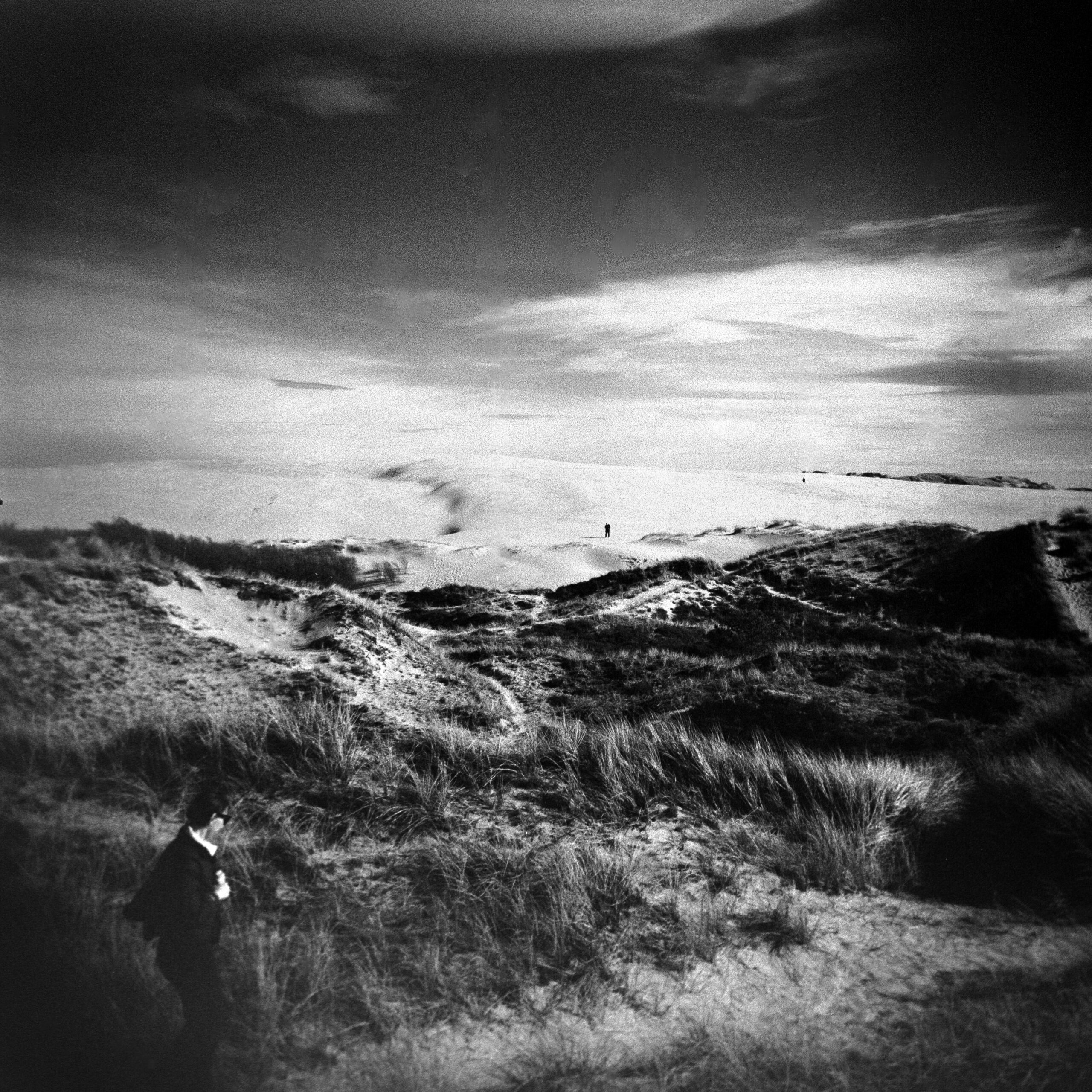
I spent three months working in North Jutland this spring, and it became a bit of a ritual: whenever friends came to visit, I’d take them out hiking either along the coast, through woodlands or the dunes. As most of them weren’t photographers, they came for the walks, the wind, and the company, and I didn’t want to be the one holding everyone up while the group drifted ahead. For this reason, I’d grab my easy-going Holga 120GN instead. It’s a plastic medium-format camera that weighs almost nothing and costs about as much as a couple of rolls of film, and there’s a particular freedom in carrying a camera you wouldn’t mind losing. I could grab a frame in the time it took the others to get a few steps down the path, then catch up. No fuss, no apologies, just a quiet souvenir of where we’d been. But could a toy camera really be a serious travelling companion? Here are five frames that made the case.
The Holga isn’t a camera for making records; it’s a camera for making memories.
My Holga 120GN Set-Up
If you haven’t met one, the Holga is gloriously simple. It shoots 120 film in 6×6 (or 6×4.5 with the supplied mask), has a single shutter speed of roughly 1/100s, a zone-focus scale of four little icons, and two aperture symbols (sun and cloud) that in practice barely differ. The “GN” means it has the glass lens, in my opinion, a touch sharper than the plastic version. However, you still get the soft corners, heavy vignetting, and unpredictable character that the camera is loved/hated for. By any technical measure, it’s a bad camera, and that’s exactly why I wanted it here: light enough to forget on a long walk, cheap enough that sand, salt spray, and a knock on the rocks didn’t worry me, and limited enough that I stopped fussing and just looked at the landscape.
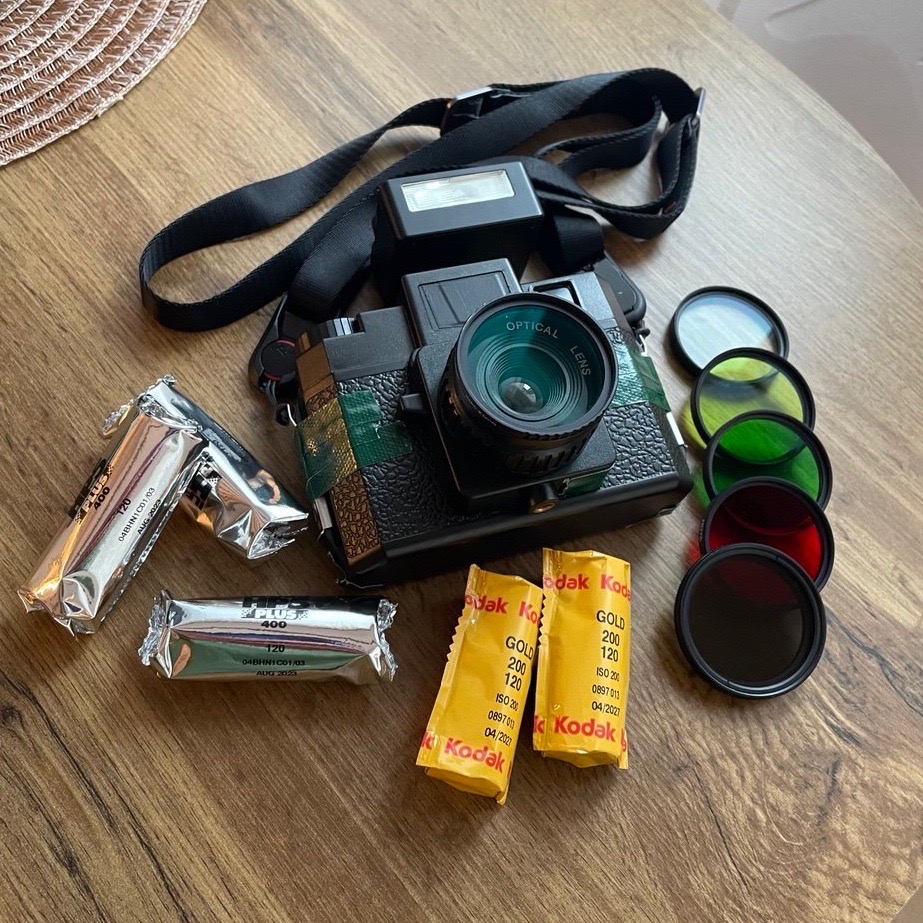
As an artistic and practical choice, I loaded the Holga with Kentmere 400, rated at 1600, which I developed later in Rodinal (1:60, semi-stand for 1h). I wanted the hard, contrasty, grainy rendering that push-processing and Rodinal give you. In my opinion, this look works really well with the soft rendering of the Holga lens. Of course, a 1600-speed film in a camera with one shutter speed and one aperture is wildly overexposed in daylight, so the filters did the work the camera couldn’t: coloured filters (orange and red) to cut light and darken those skies, and an additional variable ND filter to claw back the excess light. On a Holga, the filter ring is the only exposure control you’ve got (and even this one you have to install by yourself). Keeping things simple, I applied the “sunny-16-rule” for metering (aka reducing my ISO number), which works suprisingly well. But what about my results?
5 selected frames from my walks:
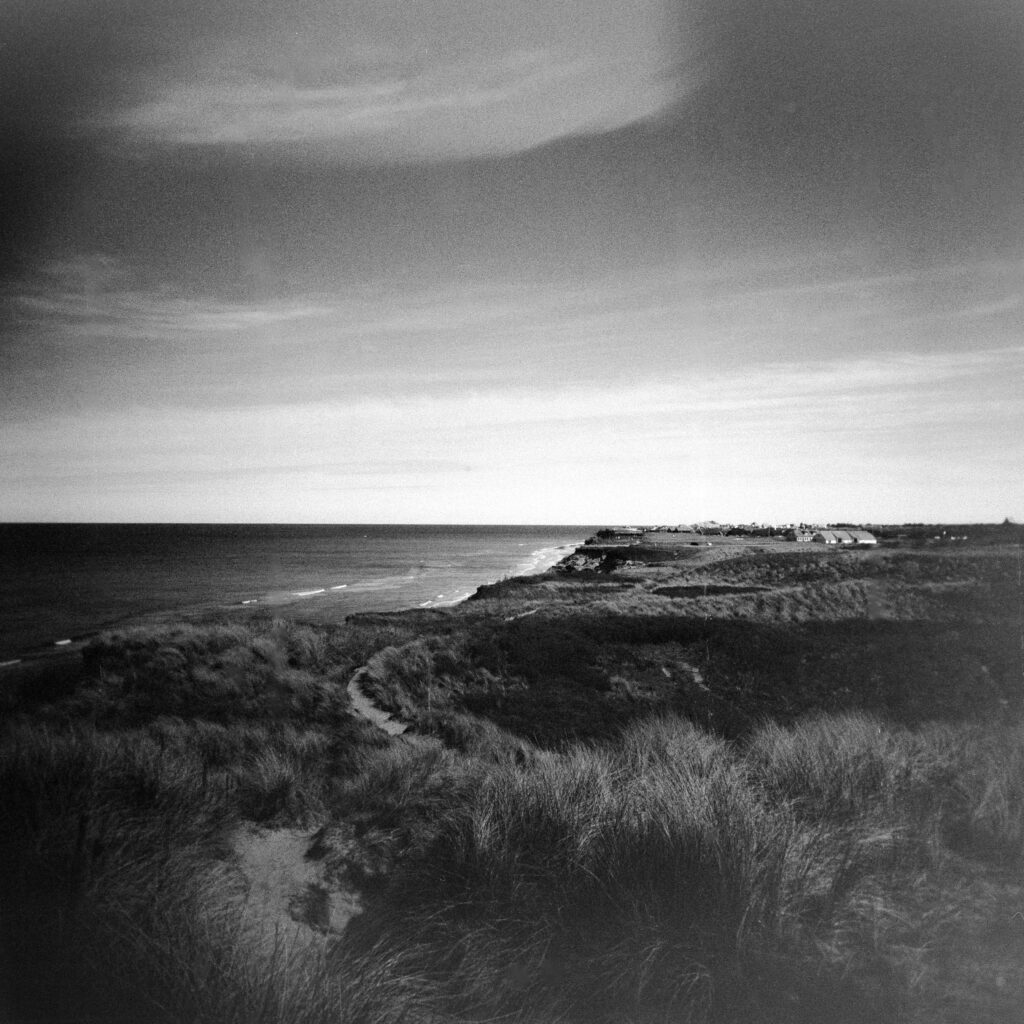
My favourite thing about hiking in North Jutland is the network of coastal paths that wind through the dunes, the “klitter”, as they’re called here. These are great drifts of pale sand, anchored by tough marram grass and shaped endlessly by the wind off the North Sea, so the landscape is never quite the same twice. The trails rise and dip over the dune ridges, opening now and then onto the sea, and there’s a wonderful sense of space to them: wide and often empty for as far as you can walk. Stripped down to sand, grass, sky, and sea, this landscape leaves nothing to distract from light and form. Isn’t that what all photographers are chasing? In my opinion, my first frame shows that really well.
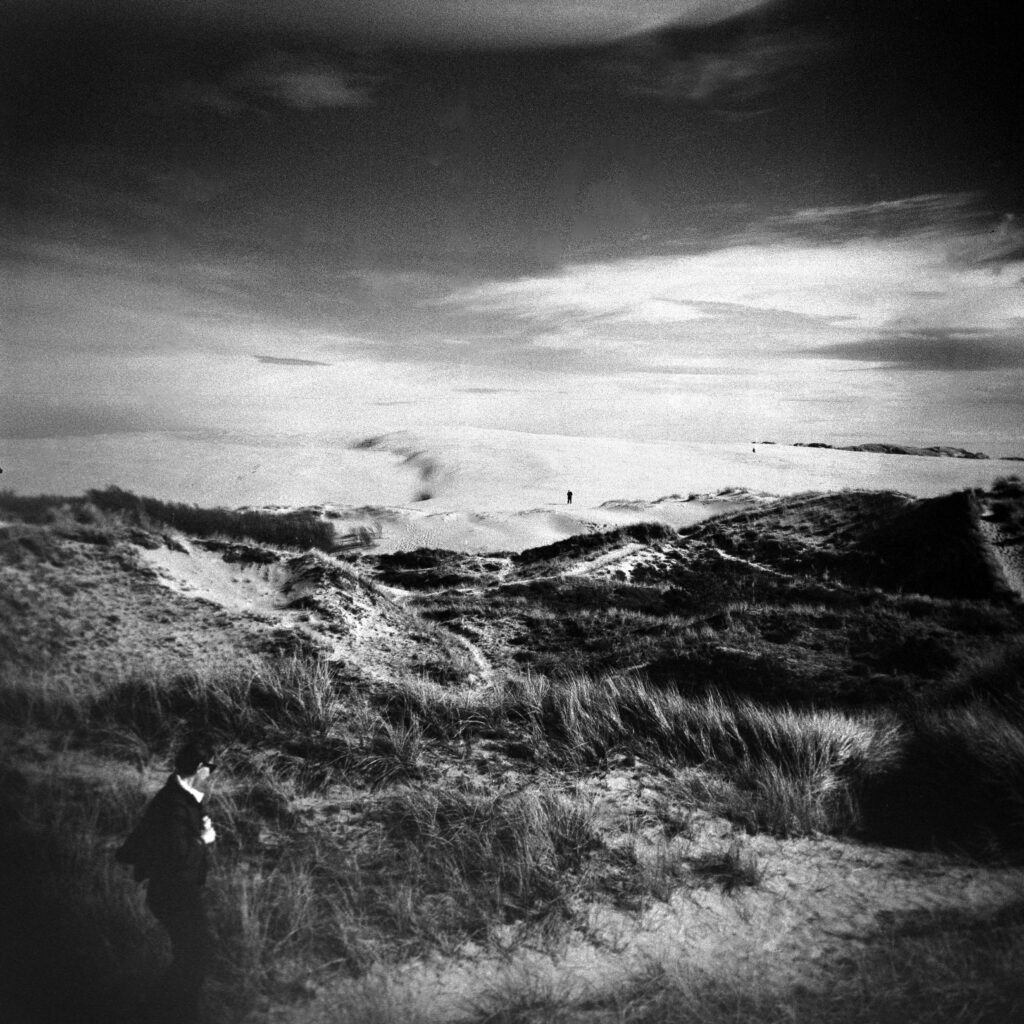
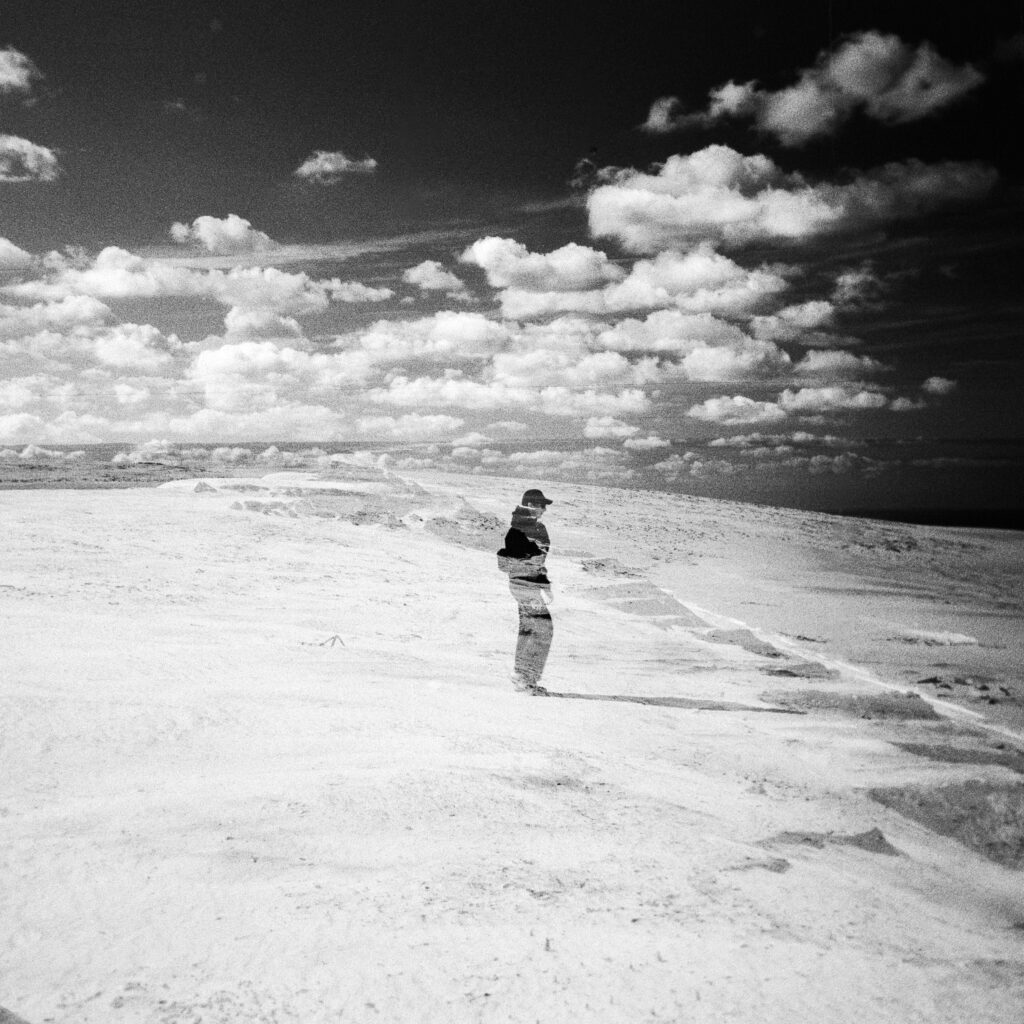
One of my favorite shots from this series was captured in Råbjerg Mile, which is the largest migrating dune in Northern Europe. Some four square kilometres of sand that the wind pushes steadily inland at around 15 metres a year, swallowing whatever lies in its path and uncovering it again on the far side. Standing in the middle of it, you lose all sense of scale, and the frame above works by giving you that scale back through its layers. Here, the Holga’s heavy signature vignette does its magic, while the orange filter presses the sky into something dark and brooding above. I love how the contrast between the bright sand, shadowed grass, and heavy sky makes my eye travel through all three people in the photograph, acting as anchor points and scale.
A Holga classic is the double exposure (yikes! I hate them). Overlapping frames usually feel like a gimmick to me, a busy mess seldom ending up as something useful, and the Holga’s lack of double-exposure prevention means you get them whether you want to or not. Here, near Skagen, Denmarks northmost city, I forgot to wind on, and the camera happily stacked two pictures on top of each other. But every so often, the chaos lands, and I end up with a double exposure I adore. That’s the strange gift of a camera this crude: it makes mistakes you’d never make on purpose, and now and then one of them turns out better than anything you intended.
For all that North Jutland is defined by its coast, it was the Danish woodlands that caught me off guard. One of my favorie places was inland and is called Rebild Bakker, Denmark’s oldest national park located south of its main city Aalborg. It’s a rolling landscape of heath and old beech forest, where I stumbled across something gentler than the windswept dunes: A lonely great beech in full early-season leaf, glowing almost white against a darkened sky, with the trail running right up to its feet as if it had been placed there to be photographed. The red filter pulled the sky down and let the foliage shine, while the vapour trails crossing overhead gave the whole scene an unexpected geometry and some nice leading lines. What you can see in the image is the Holga at its best: the falloff into the dark corners, the gentle unsharpness, the way the cheap glass lens turns fresh spring foliage into something that glows rather than merely records (also shout-out to the Rodinal glow #freerodinal), flaws on paper that here add up to a kind of quiet magic.

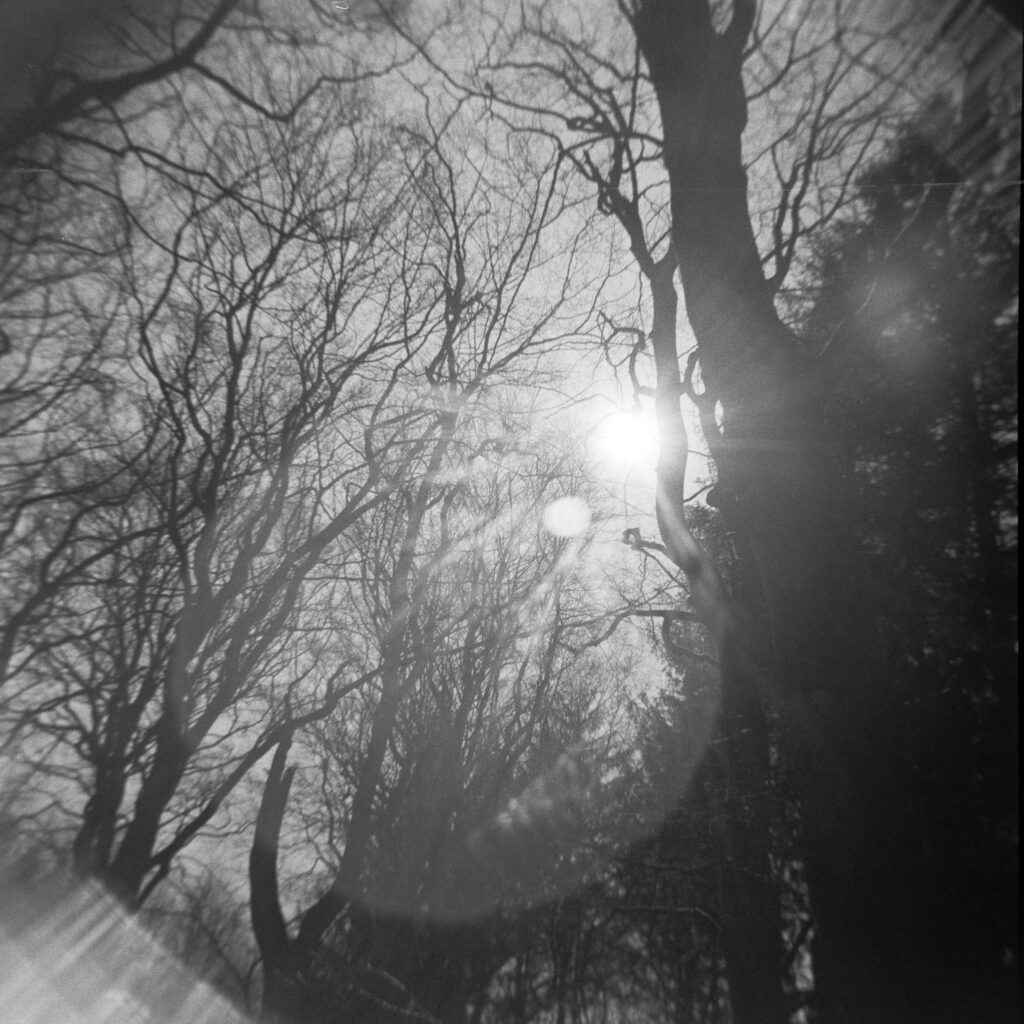
I’ll end in Rold Skov, one of Denmark’s largest forests, where I pointed the Holga straight up into the sun. Everything a “serious” lens is built to prevent happened at once: flare blooming across the frame, a round ghost of light hovering among the branches, the whole image dissolving into haze at the edges. And yet it’s the frame I come back to most. The bare canopy reaching up, the sun caught flaring through it, the soft imperfection of it all. Somehow, it holds a moment that mattered to me in a way a cleaner, more technically correct photograph never could have. Some pictures are good because they’re sharp; this one is good because it feels like the day felt.
Closing remark:
Looking back over these five frames, there isn’t much to speak of in terms of technical quality or artistic value. Are those among my best photographs? Surely not, but they hold the feeling of being there. They’re soft, flared, vignetted, blurry, and occasionally doubled over themselves by accident. To me they resemble memories: a little dreamlike, a little uncertain at the edges, the way the recollection of a good day actually feels when you reach for it months later. Sure, my legendary Rolleiflex gave me a more faithful record of North Jutland and some of the best darkroom prints I’ve made so far. But the Holga gave me something closer to how I remember it. And I really appreciate that.
Maybe that’s the point that some of us hating on the Holga are missing: the Holga isn’t a camera for making records; it’s a camera for making memories. Farvel Nordjylland! – I’ll be back soon.
Share this post:

Comments
Ken Tuomi on 5 Frames with a Holga 120GN and Kentmere 400 in North Jutland
Comment posted: 21/07/2026
Comment posted: 21/07/2026
Bob Janes on 5 Frames with a Holga 120GN and Kentmere 400 in North Jutland
Comment posted: 21/07/2026
Comment posted: 21/07/2026
Gary Smith on 5 Frames with a Holga 120GN and Kentmere 400 in North Jutland
Comment posted: 21/07/2026
Thanks for sharing!
Comment posted: 21/07/2026
Comment posted: 21/07/2026
David Dutchison on 5 Frames with a Holga 120GN and Kentmere 400 in North Jutland
Comment posted: 21/07/2026
Comment posted: 21/07/2026
Chuck on 5 Frames with a Holga 120GN and Kentmere 400 in North Jutland
Comment posted: 21/07/2026
ASA film and use a red filter to darken the sky.
Chuck
Comment posted: 21/07/2026
brad s sprinkle on 5 Frames with a Holga 120GN and Kentmere 400 in North Jutland
Comment posted: 22/07/2026
Everytime I read an article about how my Anscoflex II is a piece of junk, or my Kodak Bull's-eye is crap. Everytime someone post that my Argus-75 is not worth purchasing it makes me smile and shake my head because I know better.
Your Holga is a fantastic camera and your lead photo is stunning. Maybe get rid of that crappy glass lens and upgrade to the plastic one :)
Cheers,
Comment posted: 22/07/2026
Geoff Chaplin on 5 Frames with a Holga 120GN and Kentmere 400 in North Jutland
Comment posted: 22/07/2026
Comment posted: 22/07/2026
Comment posted: 22/07/2026
Art Meripol on 5 Frames with a Holga 120GN and Kentmere 400 in North Jutland
Comment posted: 22/07/2026
Comment posted: 22/07/2026
Omar Tibi on 5 Frames with a Holga 120GN and Kentmere 400 in North Jutland
Comment posted: 22/07/2026
Comment posted: 22/07/2026
Erik Brammer on 5 Frames with a Holga 120GN and Kentmere 400 in North Jutland
Comment posted: 22/07/2026
And yes, Kentmere 400 exposed at EI 1600 is magic to me as well. An orange filter brings it back to ISO 400. I have developed this in HC-110-B so far. It’s probably time to try Rodinal semi stand. You chose 1:60 instead of the usual suspect of 1:100. Was there a particular reason for you to use the higher concentration?
Comment posted: 22/07/2026
Simon Atkins on 5 Frames with a Holga 120GN and Kentmere 400 in North Jutland
Comment posted: 25/07/2026
Comment posted: 25/07/2026
Daniel Ivan on 5 Frames with a Holga 120GN and Kentmere 400 in North Jutland
Comment posted: 02/08/2026
Comment posted: 02/08/2026
David Pauley on 5 Frames with a Holga 120GN and Kentmere 400 in North Jutland
Comment posted: 05/08/2026
Comment posted: 05/08/2026