Painted houses of Little Venice in Mykonos seen from the water, late afternoon light

5 Frames With a 1935 Leica II and Candido 400 in Mykonos

By Francesco Mocellin

I live in northern Italy. Only recently, after many years away, have I gone back to shooting film – mostly black and white – and developing and printing at home when I can. This is a short account of my first roll of Candido 400. I’d already used the Leica II on a previous trip, in Morocco, with a Kodak Gold. This time I wanted to try the Candido because it’s a Kodak Vision3 250D motion picture stock with the remjet removed, and I was curious to see how it would look.

The camera

My Leica II came to me secondhand, of course: it left Wetzlar in 1935 and reached me in late 2024, nearly ninety years later. An old lady who has watched History – with a capital H – flow past. I went for a II rather than a III because I didn’t need the slow speeds: the basic range was enough.

What I wanted, in plain terms, was a quality point-and-shoot – a small, pocketable camera you could carry everywhere and use the way people did back then: real glass, real mechanics, a real object. Not vintage for the sake of vintage. If someone made a camera like this today at a sensible price, I’d buy it new. The modern alternatives – a Pentax 17, a Rollei 35 – both rely on automation, aren’t exactly cheap, and to my mind respond to a real need but also to a current revival. Nothing wrong with that, it just wasn’t what I was after. What I was after was a ninety-year-old Leica: fully mechanical, no electronics, no batteries. Just the camera, the lens, and whatever light happened to be in front of me.

The lens is a collapsible Leitz Elmar 50mm f/3.5, the original kit lens for this camera. I had the body without a hood, and it was October in Greece. We’ll come back to that.

It’s a concrete, solid, practical camera – Bauhaus, if I may be permitted the comparison.

The film and the meter

The roll is Candido 400, from Candido Collective – a small London-based project I’d been meaning to try for a while. Candido 400 is a Kodak Vision3 250D motion picture stock with the remjet removed so it can be processed in standard C-41 chemistry. I’d had a roll sitting in a cool spot at home for some time, and I had no real idea how it would render. That uncertainty was part of the appeal: a camera I was still getting to know, paired with a film I’d never used, on a trip I’d been planning for months.

The only concession to electronics was a Hedeco Lime Two, a small handheld meter I’d ordered about three weeks before the trip. Twenty days old when I packed it, fresh out of the box. Reflective, centre-weighted metering – a perfect match for the Elmar.

The trip

Mykonos, 22 October 2025. A cruise stop in the Cyclades, a few hours ashore. Full autumn light, deep blue sky, that kind of Aegean glare that makes you squint even at noon.

At some point, walking around Little Venice, a tourist stopped me. “I haven’t seen a camera like that in a lifetime,” he said. Which is exactly the point. The camera looks like what it is – an object from another era – and if you pay attention, you notice. Most people didn’t. He did.

A note on the spots

One thing before the frames. The negatives came back with recurring bright spots in several shots. Honestly, I can’t say for certain what they are. They might be internal flare from the Elmar – an uncoated 1935 lens, in full Mediterranean light, and as I mentioned I was without a hood. Or they might be pinholes in the cloth shutter curtains, a common defect in screw-mount Leicas of this age. What is certain is that they only appear in conditions of very strong light: rolls shot on other days, with overcast skies or gentler light, came back clean. I could clone them out in post. I haven’t. They’re part of what this camera saw that day, and removing them would mean removing the point of the piece.

The five frames
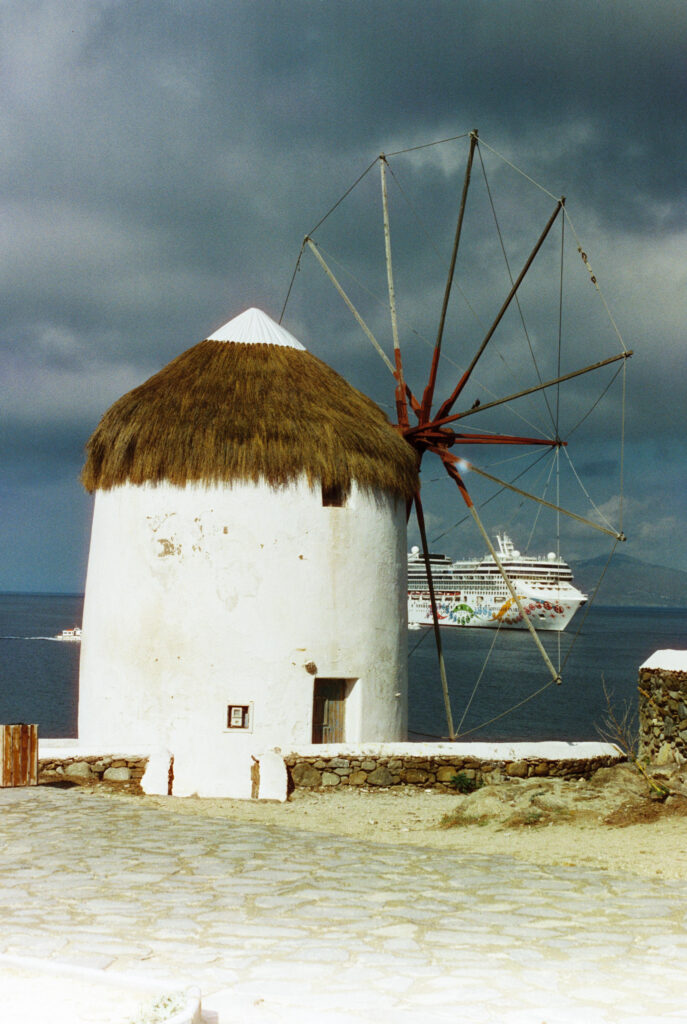
An old windmill in Mykonos with a cruise ship moored in the bay behind it
Frame 1 – 11:18, the windmill

The first picture of the day, taken just after stepping off the ship. One of the old Mykonos windmills, with a cruise ship moored in the background. Not my ship – mine was berthed on the other side of the port, and there were several cruise ships out at sea that day. I didn’t compose the ship into the frame deliberately, it was simply there. But once I saw the negative I liked it: a three-hundred-year-old wind machine and a floating hotel in the same frame, photographed by a camera built roughly halfway between the two. Burnt out at the base, stormy sky above. The sun was out, but the clouds were running without pause. This is what came out: a little crooked, no filters.

A small whitewashed church with red domes and an empty taverna with stacked chairs
Frame 2 – 14:03, the red dome

A small church in the upper town: red domes, white walls, a bougainvillea, a deserted taverna with chairs stacked, waiting for the evening shift. October light is softer than August, but still hard, and the white of the walls is a touch blown out. The Candido, however, pulled the terracotta of the dome through with an unexpected warmth, and the cobblestones on the ground held their detail.
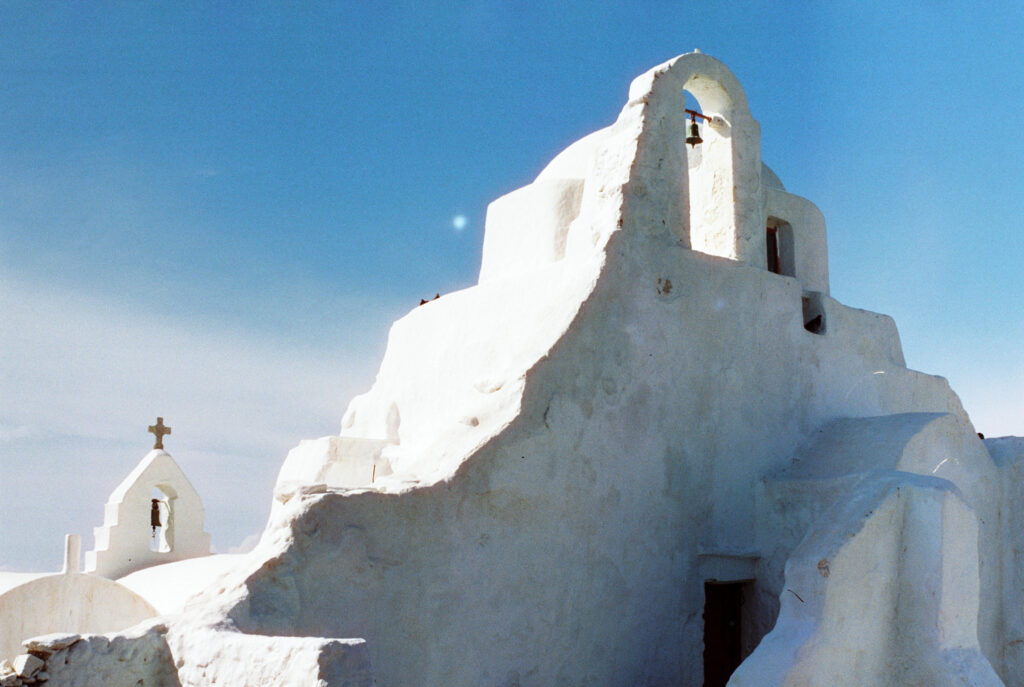
Sculpted white forms of the Panagia Paraportiani church against a blue sky
Frame 3 – 14:08, Panagia Paraportiani

Probably the most photographed church on the island. Sculpted white shapes against a sky the Elmar managed to render dense rather than washed out, and that’s more than I’d hoped for from such an old lens in that kind of glare. The spot landed in the upper-left part of the sky. The sun burns, and the wall – white as it is – is “burnt” too. Too much light. But with walls like those, it’s almost inevitable. And realistic.
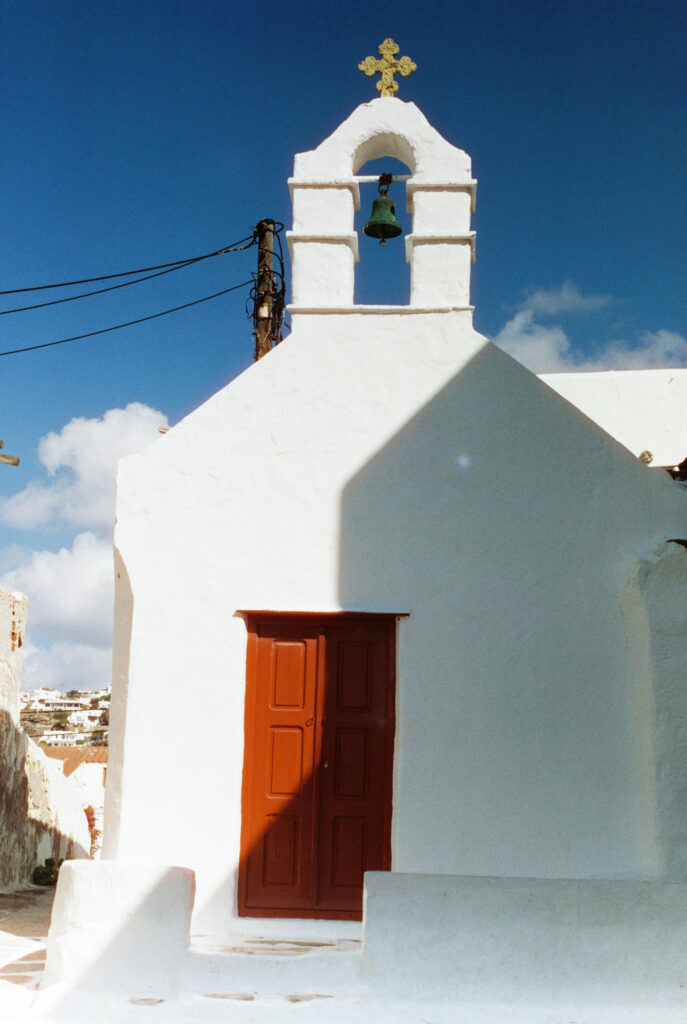
A small whitewashed chapel with an orange wooden door in a Mykonos alley
Frame 4 – 14:21, the orange door

A small chapel tucked into an alley, early afternoon. I was afraid the lime-washed wall would blow out to nothing, but the Candido kept it clean and pulled out an orange from the door I hadn’t seen with my own eyes. A small spot sits on the wall to the right of the door.
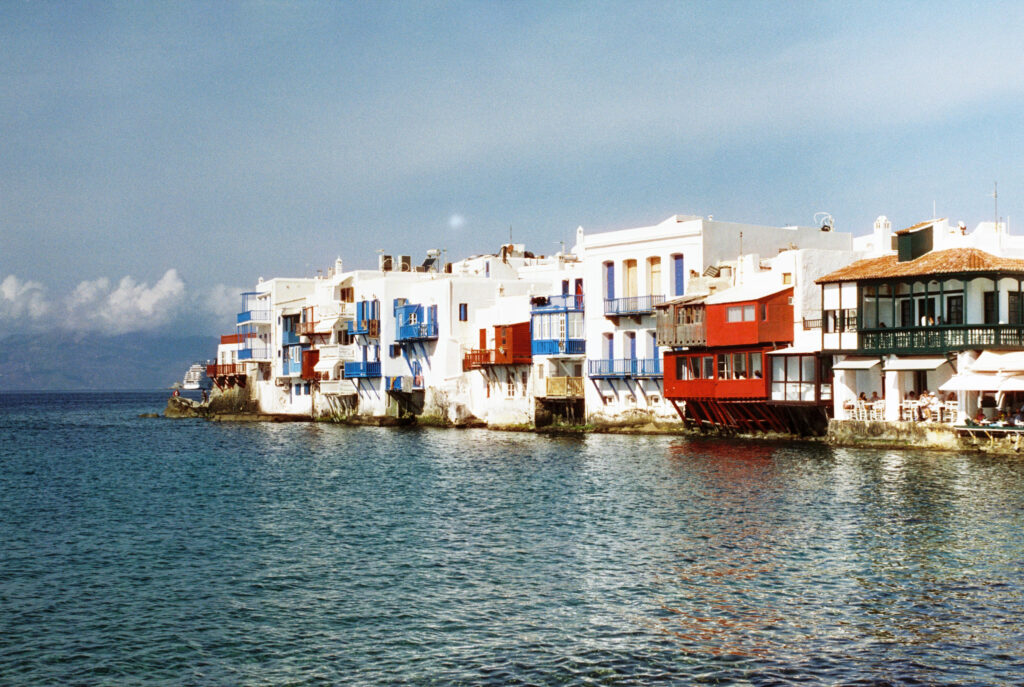
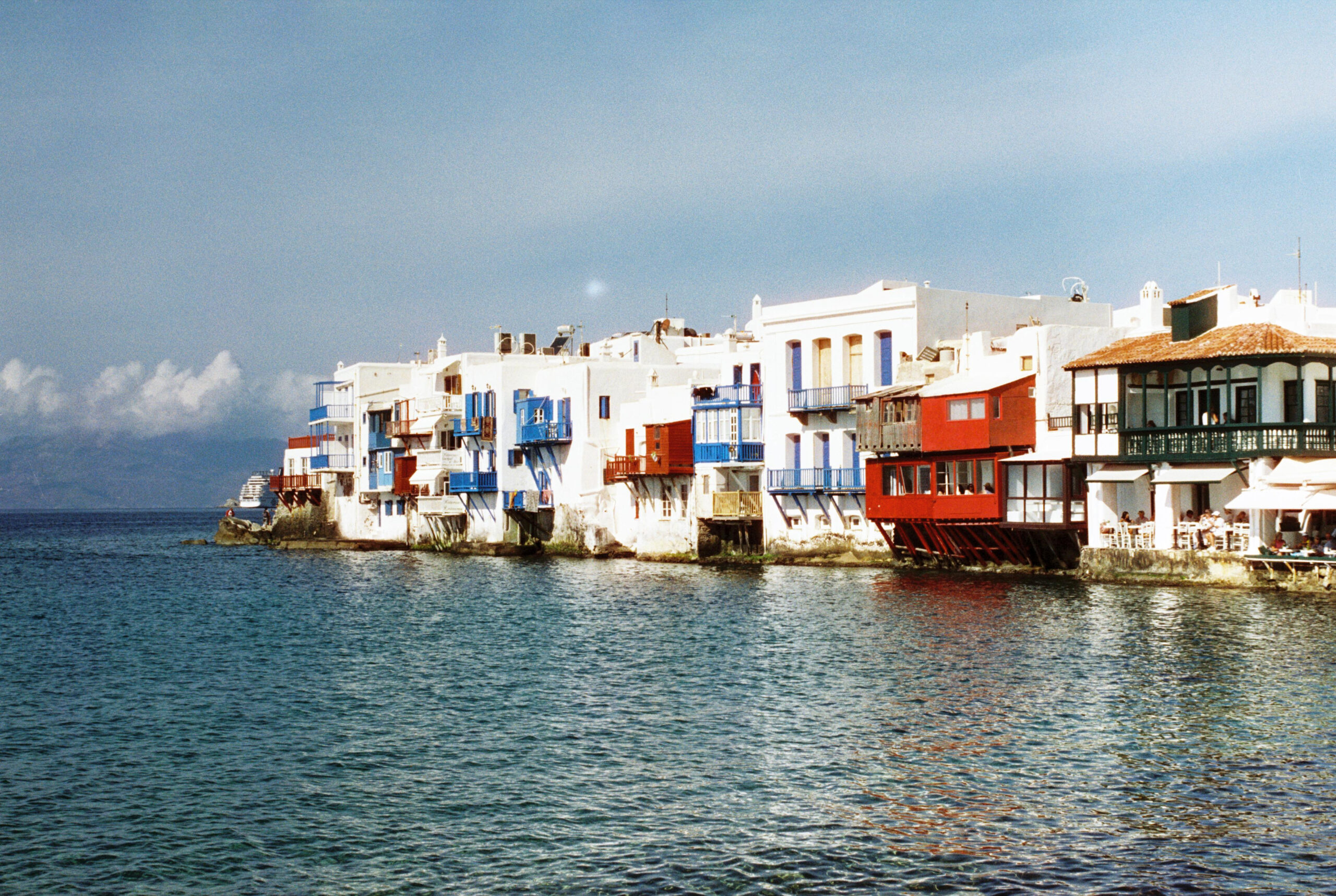
Painted houses of Little Venice in Mykonos seen from the water, late afternoon light
Frame 5 – 14:25, Little Venice

The last frame of the afternoon. Late light starting to slant, water with the reflections of the painted houses. A cruise ship is just visible on the left, behind the buildings – probably mine, but there were many that day. The red of the houses is intense, deeper than coral. The sea almost green. I feel a certain nostalgia every time I look at this picture.

After the roll

I sent the film to Ghisa Film Lab – C-41 development, Fujifilm Frontier SP-3000 scans. When I picked up the negatives, I sat with them for a long time. Looking back at them, part of me is sorry to see how imperfect they are. Then I realise that everything today seems perfect because it’s unreal, while these pictures are real – sent to me from 1935 to remind me that my own world is imperfect, limited and fallible, but no less beautiful for it, and no less worth living.

More of my photography is on NewGrain (@mocce). An older digital landscape of mine, taken at the Salar de Atacama, was featured by USRA EPOD in 2014 and is listed on Wikipedia. On Instagram I’m @inquieto — but that’s a world of digital pictures, a different story.


Share this post:

About The Author

By Francesco Mocellin
I'm a film photographer based in northern Italy. After many years shooting digital I returned to film, developing and printing at home, mostly in black and white. I shoot everything from 35mm rangefinders to large format.
Read More Articles From Francesco Mocellin

Find more similar content on 35mmc

Use the tags below to search for more posts on related topics:

Donate to the upkeep, or contribute to 35mmc for an ad-free experience.

There are two ways to contribute to 35mmc and experience it without the adverts:

Paid Subscription – £3.99 per month and you’ll never see an advert again! (Free 3-day trial).

Subscribe here.

Content contributor – become a part of the world’s biggest film and alternative photography community blog. All our Contributors have an ad-free experience for life.

Sign up here.

Make a donation – If you would simply like to support Hamish Gill and 35mmc financially, you can also do so via ko-fi

Donate to 35mmc here.

Comments

Ibraar Hussain on 5 Frames With a 1935 Leica II and Candido 400 in Mykonos

Comment posted: 23/06/2026

The photos have a look and character to them which is timeless - these could’ve been taken in the 70ies

Modern digital pictures are clinical and too real with the same soulless empty look regardless of how they’re manipulated
Reply

Leave a Reply

Your email address will not be published. Required fields are marked *

Francesco Mocellin replied:

Comment posted: 23/06/2026

Thank you, I couldn't agree more. This is actually one of the very reasons I chose to go back to film and now use digital only marginally - that timeless, real character is something digital never quite gives me, however polished it is.

Reply

Leave a Reply

Your email address will not be published. Required fields are marked *

ARTHUR Gottschalk replied:

Comment posted: 23/06/2026

Yes, pinholes. Repair shutter. And I had a similar experience with my IIIF in Morocco last year. A guy stopped me to say he had a similar camera back in the day. Then he showed me his new Canon digital.

Reply

Leave a Reply

Your email address will not be published. Required fields are marked *

Francesco Mocellin replied:

Comment posted: 23/06/2026

Thanks all - pinholes were my first thought too, but my own testing across several rolls pointed to flare instead: the spots only show in strong backlight, never in soft light, which fits the uncoated, hood-less Elmar rather than curtain holes. A hood should be the real fix.

Reply

Leave a Reply

Your email address will not be published. Required fields are marked *

Geoff Chaplin replied:

Comment posted: 23/06/2026

My vote is with Arthur - but I stand to be corrected. I had a iiif which had pinholes; they showed in strong light but were hard to see in soft light. Try the hood first in strong light - then get the shutter blinds replaced! A well written and illustrated story. With 400asa and that light it would have been hard to find a setting that didn't overexpose, not that the overexposure did any harm anyway. The opening image shows how good the Elmar is for normal photography.

Reply

Leave a Reply

Your email address will not be published. Required fields are marked *

Walter Reumkens replied:

Comment posted: 23/06/2026

A camera of this age should always be serviced. I’m very much in agreement with Arthur and Geoff on this. And then there’s the 400 film. Of course, the Hedeco Lime Two’s light-metering system also contributes to the overexposure. It really doesn’t suit such a great Combi at all. But that’s just my opinion.

Reply

Leave a Reply

Your email address will not be published. Required fields are marked *

Francesco Mocellin replied:

Comment posted: 23/06/2026

Geoff, fair point - pinholes can also be light-dependent, you're right. I'll try a hood first and see what happens, then move to a CLA if the spots persist.

Reply

Leave a Reply

Your email address will not be published. Required fields are marked *

Chuck Young on 5 Frames With a 1935 Leica II and Candido 400 in Mykonos

Comment posted: 23/06/2026

Francesco: Thanks for sharing your story. I learned to use completely manual cameras an do my own processing at home about 70 years ago. Set up the darkroom after others are in bed. Expose by "sunny 16" rule. Your photos are beautiful. My manual cameras work just fine for me.
Lucky you to find that ancient Leica II.
Chuck
Reply

Leave a Reply

Your email address will not be published. Required fields are marked *

Michael Flory on 5 Frames With a 1935 Leica II and Candido 400 in Mykonos

Comment posted: 23/06/2026

These are beautiful, with deep, rich colors I wouldn't have expected from an uncoated lens. What wonderful orange-reds and deep blues! The white spots on each frame (to the right of center on the portrait-oriented shot of the windmill) do indicate a pinhole leak in the shutter curtain, probably from someone leaving the camera facing the sun without a lens cap. A spot of paint should solve the problem.
Reply

Leave a Reply

Your email address will not be published. Required fields are marked *

Russ Rosener on 5 Frames With a 1935 Leica II and Candido 400 in Mykonos

Comment posted: 23/06/2026

Lovely shots and color!
Those bright spots are likely a hole in one of the shutter curtains. Might be patchable with liquid electric tape or some similar solution.
Reply

Leave a Reply

Your email address will not be published. Required fields are marked *

Neal Wellons on 5 Frames With a 1935 Leica II and Candido 400 in Mykonos

Comment posted: 23/06/2026

I love the pictures and your story. And I love the Leica II. I shoot mine often.
Since the bright spots seem to be in the same location in each picture, I suspect they are pinholes. To some folks, they would be major defects and to others, part of the charm of that camera. Clone them out or leave them in like you did. Unless you are trying to replicate perfect digital images, I recommend embracing the imperfections. (But I also shoot Holgas so I may be biased.)
Thanks for a very nice article.
Reply

Leave a Reply

Your email address will not be published. Required fields are marked *

Gary Smith on 5 Frames With a 1935 Leica II and Candido 400 in Mykonos

Comment posted: 23/06/2026

Like you, I keep hoping that somebody like TTArtisan or 7Artisan will craft a modern Barnack. I suppose the market just isn't large enough? A great series of shots!
Reply

Leave a Reply

Your email address will not be published. Required fields are marked *

Markus Larjomaa replied:

Comment posted: 23/06/2026

Light Lens Lab has one in the works, but I think their ”Barnack” project is on hold while they’re focusing on developing completely new film stocks for the market. Their prototype was a Leica Standard clone though, so no rangefinder.

Reply

Leave a Reply

Your email address will not be published. Required fields are marked *

Simon Atkins on 5 Frames With a 1935 Leica II and Candido 400 in Mykonos

Comment posted: 23/06/2026

I am tempted to own a Leica Barnack camera from the 1930s, there is something about a camera that's nearly a century old that appeals to me. These results are great, especially considering the Elmar lens wasn't designed for colour film.
Reply

Leave a Reply

Your email address will not be published. Required fields are marked *

Francesco Mocellin replied:

Comment posted: 23/06/2026

Indeed, flare and spots aside, the rendering is incredible - a shot from Morocco hangs in my studio, and it holds its own against anything I've shot digitally.

Reply

Leave a Reply

Your email address will not be published. Required fields are marked *

Russ Rosener replied:

Comment posted: 23/06/2026

The Leitz Elmar, like most 20th century lenses was indeed designed for color. Panchromatic color- but it's still full spectrum light. By the early 1930s Panchromatic black and white film was becoming available to amateurs. So Leitz and others like Zeiss fully corrected their lenses for color. They also knew color pack film was just a few years down the road as well.

Reply

Leave a Reply

Your email address will not be published. Required fields are marked *

Nick Rogers on 5 Frames With a 1935 Leica II and Candido 400 in Mykonos

Comment posted: 23/06/2026

Great photos with great character. You echo what I love about my 1937 iiia. I have other old and older cameras I enjoy using, but this is the only one I feel I use without compromise. As an aside, some of my most treasured photos I’ve taken with it are of my father, who was born the year it was made!
Reply

Leave a Reply

Your email address will not be published. Required fields are marked *

Francesco Mocellin replied:

Comment posted: 23/06/2026

Nick, that's a beautiful coincidence - a camera and your father born the same year. There's something special about photographing someone with a tool from their own era. Thanks for sharing that.

Reply

Leave a Reply

Your email address will not be published. Required fields are marked *

Markus Larjomaa on 5 Frames With a 1935 Leica II and Candido 400 in Mykonos

Comment posted: 24/06/2026

The humble, back to basics and basics only Leica II is one of my favourite cameras, too. While it is handy to have a camera without slow shutter speeds (which seem to be more or less unreliable even after service, at least that’s the case wirh my III and IIIf), one should note that while the III and all(?) the later Barnack Leicas sport a 1.5 X magnified rangefinder, Leica II’s rangefinder is 1 X. That, combined with the short rangefinder baselength all the Barnacks have in common, makes the II absolutely incapable to properly focus longer and/or faster lenses. Not a problem with its ”native” 50/3.5 Elmar at all, of course, but something to keep in mind when pairing the II with other lenses. I use mine with a pair of Voigtländers: a 40/2.8 and a 15/4.5, the latter doesn’t even have rangefinder coupling nor does it need it, the depth of field is so deep it’s quite difficult NOT to have everything in focus. The II with the 40 is my daily carry. When it’s time to mount a Nikkor 50/2, a 90/4 Elmar or the occasional Canon 135/3.5, they’ll go on the III or the IIIf
Reply

Leave a Reply

Your email address will not be published. Required fields are marked *

Alasdair Mackintosh on 5 Frames With a 1935 Leica II and Candido 400 in Mykonos

Comment posted: 24/06/2026

Yet another comment saying it must be pinholes in the shutter, and also saying how well these have come out. The colours are wonderful, and really capture the essence of the Mediterranean ;-) If you hadn't told us what lens you used, I'd never have guessed.

Have it serviced and it should be good for another 90 years ;-)
Reply

Leave a Reply

Your email address will not be published. Required fields are marked *

Gerard on 5 Frames With a 1935 Leica II and Candido 400 in Mykonos

Comment posted: 27/06/2026

Thank you for sharing these dreamy photographs, reminding me of those taken with my 1939 Leica llla.
"Quality never goes out of style"
Reply

Leave a Reply

Your email address will not be published. Required fields are marked *

Francesco Mocellin replied:

Comment posted: 27/06/2026

Thank you - that means a lot, coming from a fellow Barnack user. The 1939 IIIa must be a wonderful camera to live with.

Reply

Leave a Reply

Your email address will not be published. Required fields are marked *

Leave a Comment

Leave a Reply

Your email address will not be published. Required fields are marked *