The Pier at Teignmouth

The Pier at Teignmouth, Devon

By Ed

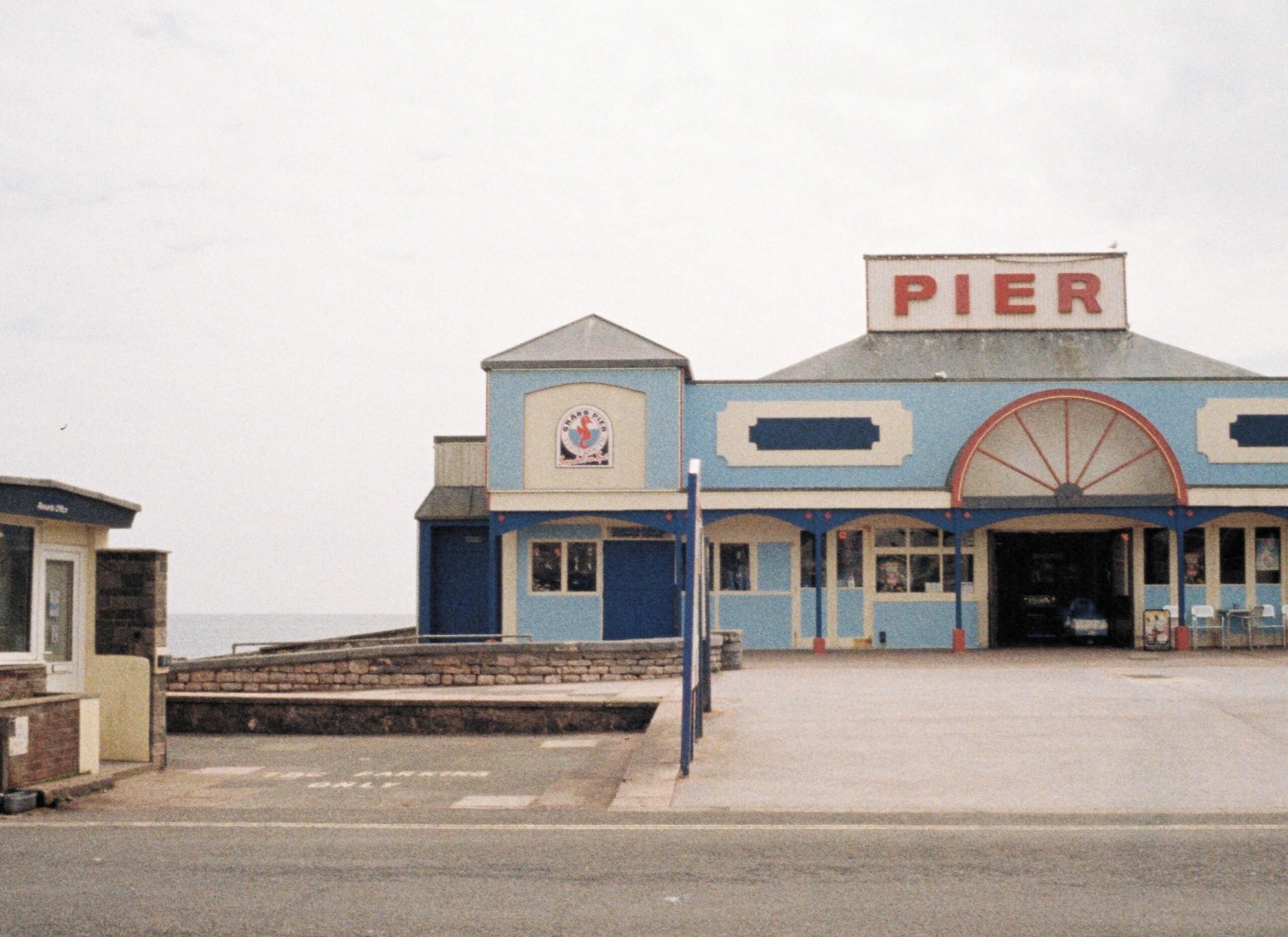
The featured image shows the entrance to the amusement arcade on the pier in Teignmouth, Devon. Although the arcade survived the winter storms, the pier did not. Half the structure was swept away in January 2026 by high seas raised by Storm Ingrid. Teignmouth neighbours Dawlish, whose seafront features in the next One Shot Story (later today). Both are classic seaside towns, although Teignmouth is somewhat larger and grander.

The pier was built in 1865 and must have survived many storms over the last 160 years, but storms seem more destructive now and England’s nineteenth century infrastructure is no match for natural forces in our time. The future of the pier is uncertain. It requires extensive repairs costing upwards of £1000000 and was uninsured.
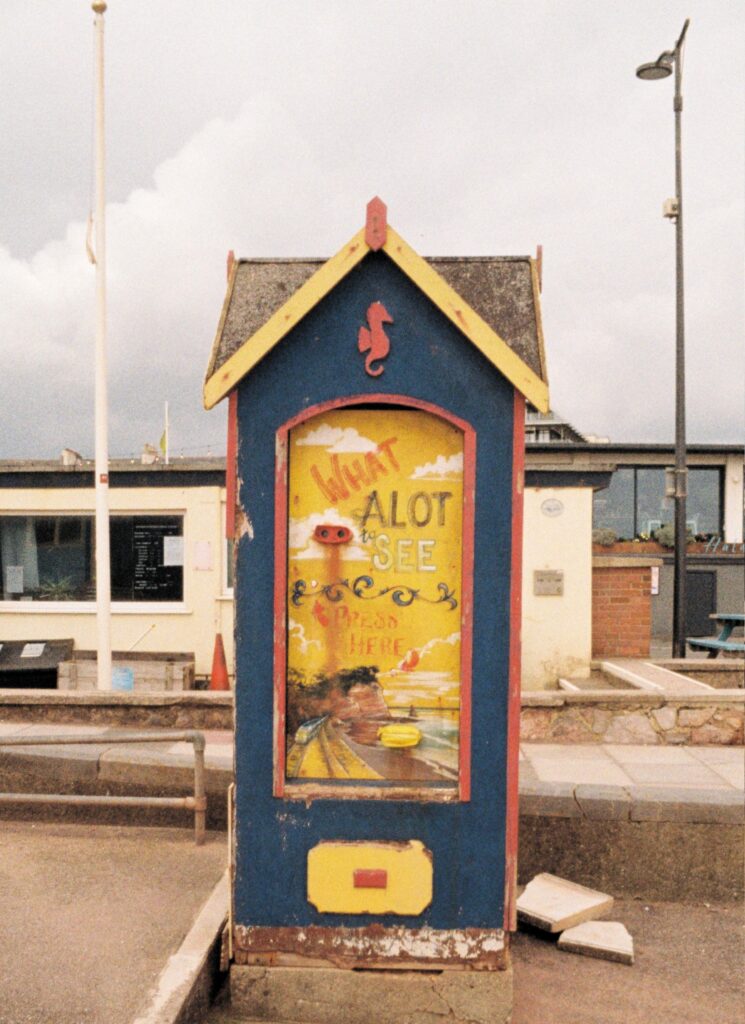
What a lot to see!
A faded peep show sentry box on Teignmouth seafront near the Pier

The seafront near the pier has a couple of traditional amusements – this faded peep show sentry box has seen better days, although it seems it was renovated as recently as 2022. The peep show is decorated with an image of the seaside railway line built by I K Brunel in the nineteenth century. The line was considered a marvel of Victorian ingenuity and engineering, bringing the winding railway through a complex series of tunnels along the shoreline. The views are breathtaking. However, the line is now a fragile piece of infrastructure, subject to regular disruption due to winter storm damage and inundation.

The peep show would have been a popular form of Victorian and early Edwardian seaside entertainment. The sentry box now holds about half a dozen images of historical interest and the images can be glimpsed through the binocular viewing lenses. The broken paving stones at the foot of the peep show might be debris from the storm. The sea takes its toll.

Even in its weather worn state, the peep show box is a perfect example of the colourful seaside aesthetic, precisely observed by Philip Larkin (1922-1985) in the first lines of his poem To the Sea:

To step over the low wall that divides

Road from concrete walk above the shore

Brings sharply back something known long before –

The miniature gaiety of seasides.

To the Sea is the first poem in Larkin’s 1974 collection High Windows. This was Larkin’s last formal collection of poems. He was not a prolific poet but explored the English identity with an unflinching, iconoclastic eye for detail.

The images were recorded using a Pentax Auto 110 Super with wide angle lens using Lomography Tiger cartridge film rated at 100 ISO. Minor jpg editing in Shotwell open source image editing software.


Share this post:

About The Author

By Ed
Ed has recently retired and is re-connecting with a long-term, but fitful, interest in photography.
Read More Articles From Ed

Find more similar content on 35mmc

Use the tags below to search for more posts on related topics:

Donate to the upkeep, or contribute to 35mmc for an ad-free experience.

There are two ways to contribute to 35mmc and experience it without the adverts:

Paid Subscription – £3.99 per month and you’ll never see an advert again! (Free 3-day trial).

Subscribe here.

Content contributor – become a part of the world’s biggest film and alternative photography community blog. All our Contributors have an ad-free experience for life.

Sign up here.

Make a donation – If you would simply like to support Hamish Gill and 35mmc financially, you can also do so via ko-fi

Donate to 35mmc here.

Comments

Chuck on The Pier at Teignmouth, Devon

Comment posted: 26/07/2026

Ed: Thanks for sharing your photos of Teignmouth. I live in a former copper mining town in the US. Lots of industrial stuff to photograph, draw or paint.
Reply

Leave a Reply

Your email address will not be published. Required fields are marked *

Ed replied:

Comment posted: 26/07/2026

Thanks Chuck - good to hear from you. I always find the post-industrial scene interesting. Even in Exeter where I live, which was never an industrial town as such, one can see relics of this past on a small scale. I'm glad you enjoyed the story.

Reply

Leave a Reply

Your email address will not be published. Required fields are marked *

davesurrey on The Pier at Teignmouth, Devon

Comment posted: 26/07/2026

Ed it’s good to see someone showing some love for this often maligned format.

I’ve written before that it was the Pentax Auto 110 that allowed me to take a camera to places where it would have been problematic otherwise with a larger format system. As a result I have so many photographic memories that I wouldn’t have had were if not for the 110 format.

As well as a Pentax Auto 110 (several actually including a Safari version and a Super with a broken winder) plus a full set of lenses I have a Minolta 110 Zoom SLR (Mk2) plus several “chocolate bar” ones including a Canon 110ED and a Kodak Ektramax.

But with the cost of film and a need to declutter many of them will have to go. Sad.
Reply

Leave a Reply

Your email address will not be published. Required fields are marked *

Ed replied:

Comment posted: 26/07/2026

Hi Dave - the format has always intrigued me, but passed me by when I was younger. At that age I wanted a 'serious' camera. The Safari Auto 110 is an interesting variation on the standard black issue - I quite like the look but they seem to command a rather high premium over the mainstream product. The challenge with these cameras is their age, and being so small I think they are quite fragile internally. I had to go through a number of Auto 110s before I got to this one. I tried to repair one of the cameras and ended up trashing it. The mechanism that the Pentax engineers crammed into the 110's tiny body is an absolute marvel. The limited availability of fresh film stock, the cost and limited commercial options for developing, do make the format extremely expensive. I hadn't originally intended to pick up 35mm again, but this is a much cheaper option, especially for black and white, but I will continue to use the 110 cameras, just perhaps a bit less than I intended. Thanks for your interest and kind feedback.

Reply

Leave a Reply

Your email address will not be published. Required fields are marked *

Ed replied:

Comment posted: 26/07/2026

Hi again - your comment on the size advantage of the Pentax Auto 110 (and weight!) is spot on. The camera is so discrete it can be used where even a small 35mm outfit would be obvious. Thanks for this insight.

Reply

Leave a Reply

Your email address will not be published. Required fields are marked *

davesurrey replied:

Comment posted: 26/07/2026

Hi Ed, And as well as being discrete it's portability. How many other system cameras can one carry in ones pocket along with 2 other lenses!

Reply

Leave a Reply

Your email address will not be published. Required fields are marked *

Ed replied:

Comment posted: 26/07/2026

Of course, it is remarkable that pretty much a full kit of lenses (18mm, 24mm, 50mm) and the camera can be held in the palm of one's hand. The whole system is quite miraculous, and the fact that it all works so well is astonishing. Not too mention what is probably the world's tiniest zoom lens (20-40mm) for an SLR system.

Reply

Leave a Reply

Your email address will not be published. Required fields are marked *

Tony Warren replied:

Comment posted: 26/07/2026

A sad tale Ed. So much is held im museums to remind us of the past but piers unfortunately don't lend themselves. I believe they started out as a way to berth pleasure cruises, from London to Southend for instance, independent of tides. As to the greqat little Pentax 110, I have just said goodby to mine after it has terminally succumbed to the brittle plastic. The lenses wll live on, however, with the adapter I have ordered for my Sony APS-c digital.

Reply

Leave a Reply

Your email address will not be published. Required fields are marked *

Ed replied:

Comment posted: 26/07/2026

Thanks Tony. I'm sorry to hear about your Pentax. Most of these little cameras are probably on borrowed time being so finely engineered but fragile. The lenses are jewels with few moving parts so it's good to hear the legacy will endure on your digital camera. This seems to be quite a popular option for the glass. A brief history of the English pier can be found at: https://www.historyhit.com/the-rise-and-demise-of-britains-victorian-pleasure-piers/

Reply

Leave a Reply

Your email address will not be published. Required fields are marked *

Sneakerzoom on The Pier at Teignmouth, Devon

Comment posted: 26/07/2026

It would be really sad to see yet another piece of history go to waste. I can't speak much of piers here, as Lake Ontario has had many and just as many are now gone, but derelict and often simply destroyed rail lines and attached infrastructure are a very common and unfortunate sight here in Canada, especially knowing rail is what literally built the country as we know it now. On the bright side, it's very nice to see your Pentax Auto 110 spewing out some very respectable imagery. I really should give mine a whirl...
Reply

Leave a Reply

Your email address will not be published. Required fields are marked *

Ed replied:

Comment posted: 26/07/2026

Thanks for your comment and I'm glad you enjoyed the images. The piers over here are slowly diminishing in number. Most of them are from the nineteenth century and the sea is a harsh environment for any human structure. I'm surprised that as many of them have lasted this long, which is a testament to the engineers of that time. I don't know exactly how many are left in the UK, but it can't be more than a handful. It is sad but there doesn't seem to be the money or will to upkeep them.

Reply

Leave a Reply

Your email address will not be published. Required fields are marked *

Walter Reumkens on The Pier at Teignmouth, Devon

Comment posted: 27/07/2026

As I’ve already said, I like this style. Even in colour!
Reply

Leave a Reply

Your email address will not be published. Required fields are marked *

Ed replied:

Comment posted: 27/07/2026

Once again Walter, I very much appreciate your feedback. One of the joys of these tiny cameras is that the exposure, at least with a reasonable amount of light, seems to take care of itself, so the process of making the image is very much about composition and getting the focus right. The latter is surprisingly easy as the tiny camera has a split image screen. I've found this very easy to use. Best wishes to you. Ed

Reply

Leave a Reply

Your email address will not be published. Required fields are marked *

Alan Simpson on The Pier at Teignmouth, Devon

Comment posted: 27/07/2026

An interesting subject and photos - thank you. There are still around 60 seaside pleasure piers remaining in the UK (according to Google ...).

Alan
Reply

Leave a Reply

Your email address will not be published. Required fields are marked *

Ed replied:

Comment posted: 27/07/2026

Thanks Alan - that is helpful to know. I'm surprised that it is so many. I think many of the ones on the southwest peninsula have gone. The piers seem subject to all sorts of harm, from the weather to fire to neglect. It's good to know that a number of them are still about.

Reply

Leave a Reply

Your email address will not be published. Required fields are marked *

Leave a Comment

Leave a Reply

Your email address will not be published. Required fields are marked *